On this page5 sections, 13 min read
- Which chess academy franchises operate in India?
- How much does a chess academy franchise cost in India, and how do you apply?
- Which costs change the investment you must recover?
- What six questions should you ask a franchisor before you sign?
- What if you want to franchise your own academy instead?
- Frequently asked questions
Bottom line
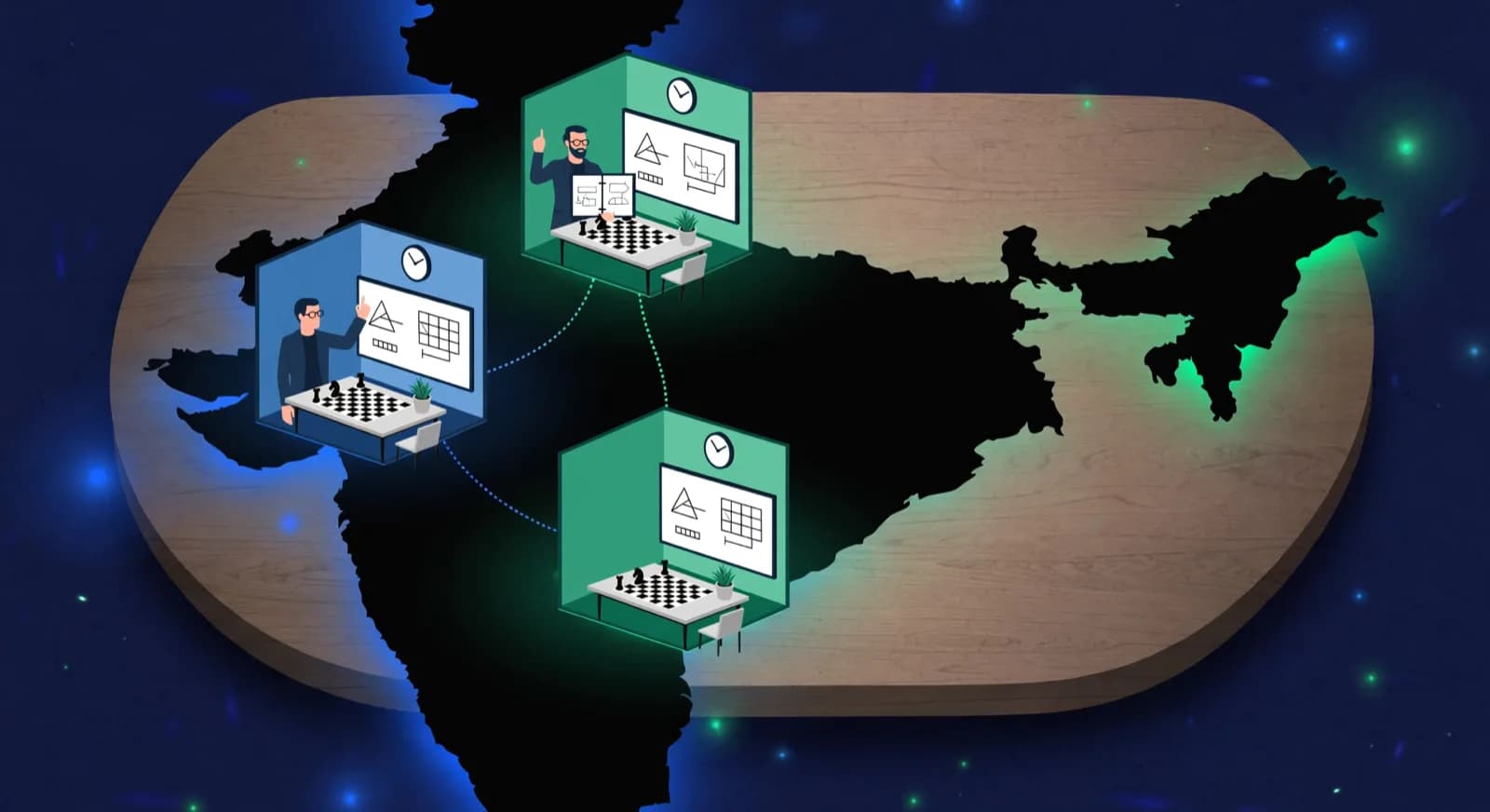
CHESS KLUB (Single Location from INR 18,00,000) and Kingdom of Chess (models from INR 3.80 lakh; its FAQ says from INR 3.5 lakh) sell chess academy franchises in India, with curriculum, training, setup and marketing support [5][6]. A chess academy franchise in India lets a local operator run a centre under a brand’s teaching and operating system.
TL;DR
- CHESS KLUB and Kingdom of Chess publish franchise offers in India; compare the named model and written cost sheet, not an assumed industry-wide investment [5][6].
- Separate the upfront capital you must recover from monthly operating break-even, and treat a missing royalty or exclusion as unknown, never zero.
- Put six questions to every franchisor: fees and exclusions, royalties, territory, staffing, a current franchisee and exit and data terms.
- To franchise your own academy, test readiness first: one centre profitable without you and a written curriculum and operating method.
- Franchising in India is a legal and tax decision with real contract weight, so structure it with a lawyer and a chartered accountant before signing anyone.
Key facts
- A franchise is the licensing of a proven, repeatable business system, including brand, curriculum, and operating method, to an independent operator who runs a unit under that system.
- The core readiness question is transferability: a business that depends on the founder personally has no system to license, only a job that cannot be cloned.
- Company-owned expansion keeps all profit and control with the founder but consumes the founder's capital and management capacity for every new center.
- Franchising shifts the capital and local execution to the franchisee in exchange for fees and royalties, which trades per-unit margin and control for faster geographic reach.
- Across centres the founder does not personally run, consistency depends on a written operations manual and training rather than on the founder's presence.
Which chess academy franchises operate in India?
CHESS KLUB and Kingdom of Chess advertise franchise offers in India, with teaching systems and support for local operators [5][6]. They are starting points for enquiries, not a complete directory or a promise that your preferred territory is available. Verify location eligibility directly.
Buying a franchise: read the first two sections. Franchising your own academy: start at readiness.
| Franchise offer | Model and space | Included support | Published investment in India |
|---|---|---|---|
| CHESS KLUB [5] | Single Location: physical or hybrid centre | Curriculum, Atlas operations system, training and launch support | INR 18,00,000 onwards |
| Kingdom of Chess [6] | Smart Point: 300 sq ft, online teacher; Prime Centre and Flagship Academy: 600 sq ft, on-site coach | Curriculum, coach training, setup and marketing support | Model cards: INR 3.80 / 6.30 / 8.30 lakh respectively; FAQ says from INR 3.5 lakh |
| CHESS KLUB master franchise [5] | Master Franchisees: 15 to 20 locations, exclusive territory | Right to recruit franchisees, up to 50% share of franchise fees and royalty | INR 30,00,000 to INR 50,00,000 (listed 16 October 2026) |
As of 16 October 2026, Kingdom of Chess’s model cards and its own FAQ disagree on the starting investment: the Smart Point card says from INR 3.80 lakh, while the FAQ says the investment starts from INR 3.5 lakh [6]. Request a dated, itemised quote rather than choosing the lower figure. Neither a marketing page nor this table establishes what your lease, staffing, local permissions and working capital will cost.
Use the support column as an interview agenda. Ask to see the curriculum, a sample coach-training session and the actual reporting system. Then separate what the franchisor supplies from what the local operator funds and executes. A recognisable name is useful only if the operating support fits the centre you intend to run.
How much does a chess academy franchise cost in India, and how do you apply?
CHESS KLUB publishes Single Location investment from INR 18,00,000 [5]; Kingdom of Chess gives model-specific figures that conflict with its FAQ [6]. Treat these as advertised starting points. Apply through the brand’s enquiry process and compare written commercial terms before committing funds.
CHESS KLUB describes enquiry and discovery, financial review, territory selection, agreement and onboarding, then launch [5]. Use those stages as checkpoints: you should understand the proposed territory and financial assumptions before signing, and the training responsibilities before scheduling an opening.
- Describe your city, available space, operating experience and budget in the enquiry.
- Request the current model-specific cost sheet, territory map and support schedule.
- Ask which setup costs, deposits, equipment, taxes and working capital are outside the advertised investment.
- Review royalty, marketing charges, renewal, transfer and exit terms with your advisers.
- Confirm who recruits and pays coaches, who owns student records and what support continues after launch.
For comparison, build a cash plan with separate lines for the initial payment, premises, fit-out, staffing and ongoing brand charges. Use quoted amounts and your actual local costs. Do not turn a seller’s revenue illustration into a forecast for your centre, and do not assume a modest franchise fee implies a modest total opening budget.
Which costs change the investment you must recover?
Before you weigh any offer, separate two different numbers: the operating break-even, which is the point where monthly income covers monthly costs, and the recovery of the upfront capital you put in to open. A centre can be running at a monthly surplus and still be years from returning the money you spent to launch it. Our academy break-even calculator helps you test monthly operating break-even, but recovering the launch capital is a separate sum. Treat the recovery question as a worksheet you fill with quoted figures, not a payback month a brand hands you.
- Initial payment to the franchisor, and whether any deposit is refundable.
- Premises: deposit, fit-out, furniture, boards and signage.
- Staffing before the first fee arrives: a coach and any admin help during ramp-up.
- Marketing to fill the first batches, which the brand may part-fund or leave to you.
- Working capital to cover months when enrolment is still building.
- Ongoing royalty and marketing charges, which reduce the monthly surplus you recover from.
If the royalty rate or the list of exclusions is not in writing, your worksheet is incomplete and the payback period cannot be calculated yet. That is the signal to ask the brand for the exact figure rather than to assume a royalty of zero or copy a seller's projection. CHESS KLUB publishes a franchisee profitability calculator at a separate address [7]; a seller's own calculator shows a modelled result, not an observed outcome for your centre, so use it to understand which inputs the brand thinks matter, then rebuild the sums with your own quoted numbers.
What six questions should you ask a franchisor before you sign?
A written quote and a conversation with the franchisor settle more than any brochure. Put the same six questions to every brand you compare, and keep the answers side by side. Anything the seller will not put in writing stays unknown, and unknown is a reason to pause, not a reason to assume the best.
- Fees and exclusions: what is the total written quote for my model, what does it include, and which costs such as premises, deposit, staff, marketing and working capital sit outside it?
- Royalties: what percentage of collections or fixed fee do I pay, from which month, and are marketing or technology charges separate?
- Territory: which area is exclusive to me, for how long, and what happens if the brand opens or sells a centre nearby?
- Staffing: who trains my coaches, how long does training take, and who pays for it?
- Current franchisees: can I speak to a centre that has run for at least a year, chosen by me and not by the franchisor?
- Exit and data: what are the renewal, transfer and termination terms, and who keeps the student records and parent contacts if I leave?
If a seller quotes only a starting investment, ask for the full cost sheet for your model before you compare it with another brand. Then run the recovery worksheet above with those numbers. Where the royalty or exclusions are missing, the payback cannot be calculated yet, and the honest answer is to ask again.
What if you want to franchise your own academy instead?
Franchising means licensing a repeatable system to an independent operator who pays to run a unit under your brand and method. What the operator buys is repeatability: a curriculum that works in someone else's hands, an operating method that runs without you in the room, and a name parents already recognise. A successful academy that runs on the founder's own coaching and relationships has a job to sell, not a system, and a job cannot be cloned.
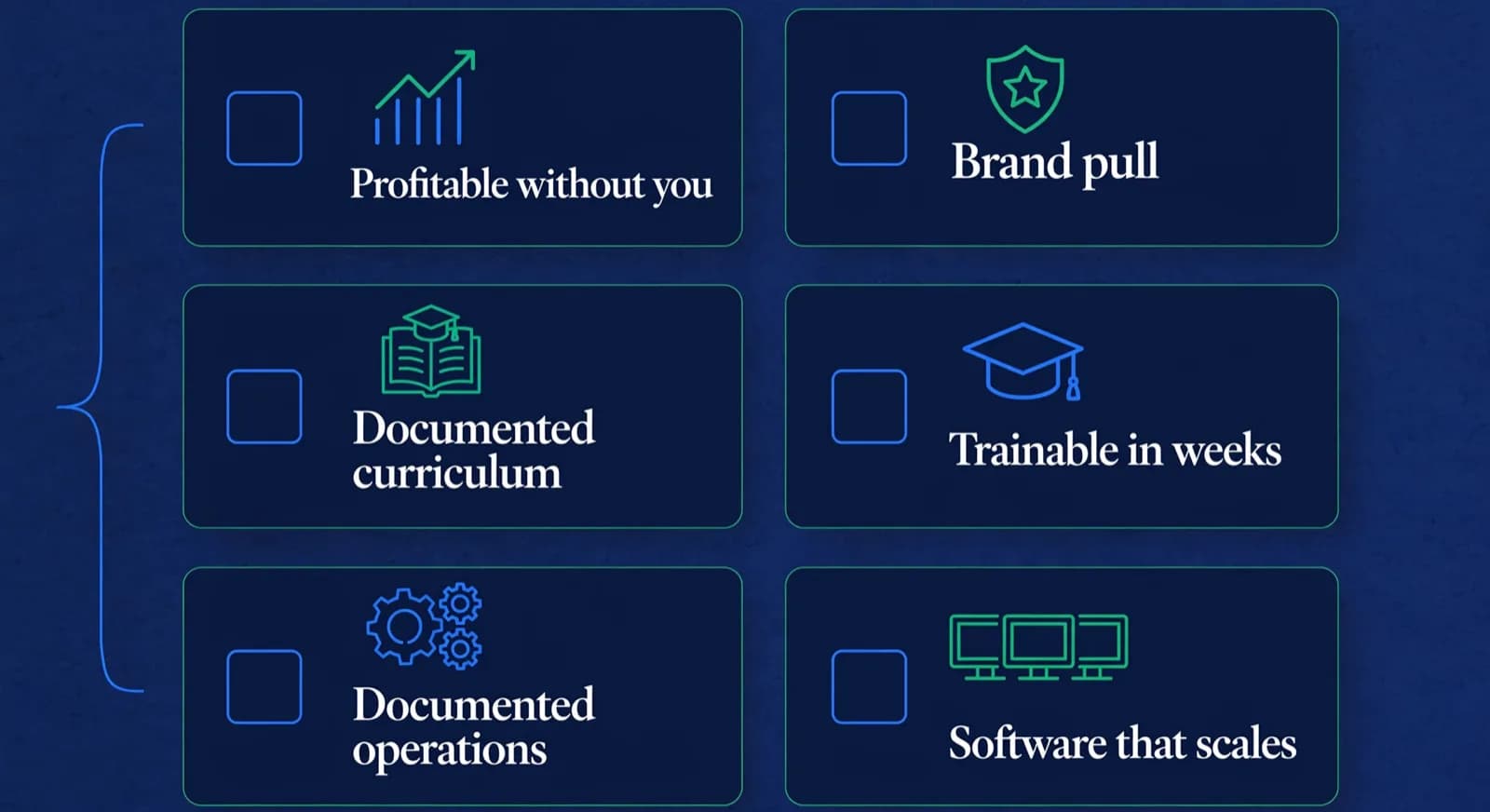
- Profitable without you: at least one centre runs at a healthy profit while you are away from it for weeks.
- Documented curriculum: your teaching method, level progression and assessment exist as materials a new coach can follow.
- Documented operations: enrolment, scheduling, attendance, fees, parent communication and reporting are written as repeatable procedures.
- Brand pull: parents choose you partly for the name and reputation, not only for your personal coaching.
- Trainable in weeks: you can take a competent operator from zero to running a centre within a defined onboarding period.
- Unit economics you can show: you know the real cost, revenue and break-even of a single centre.
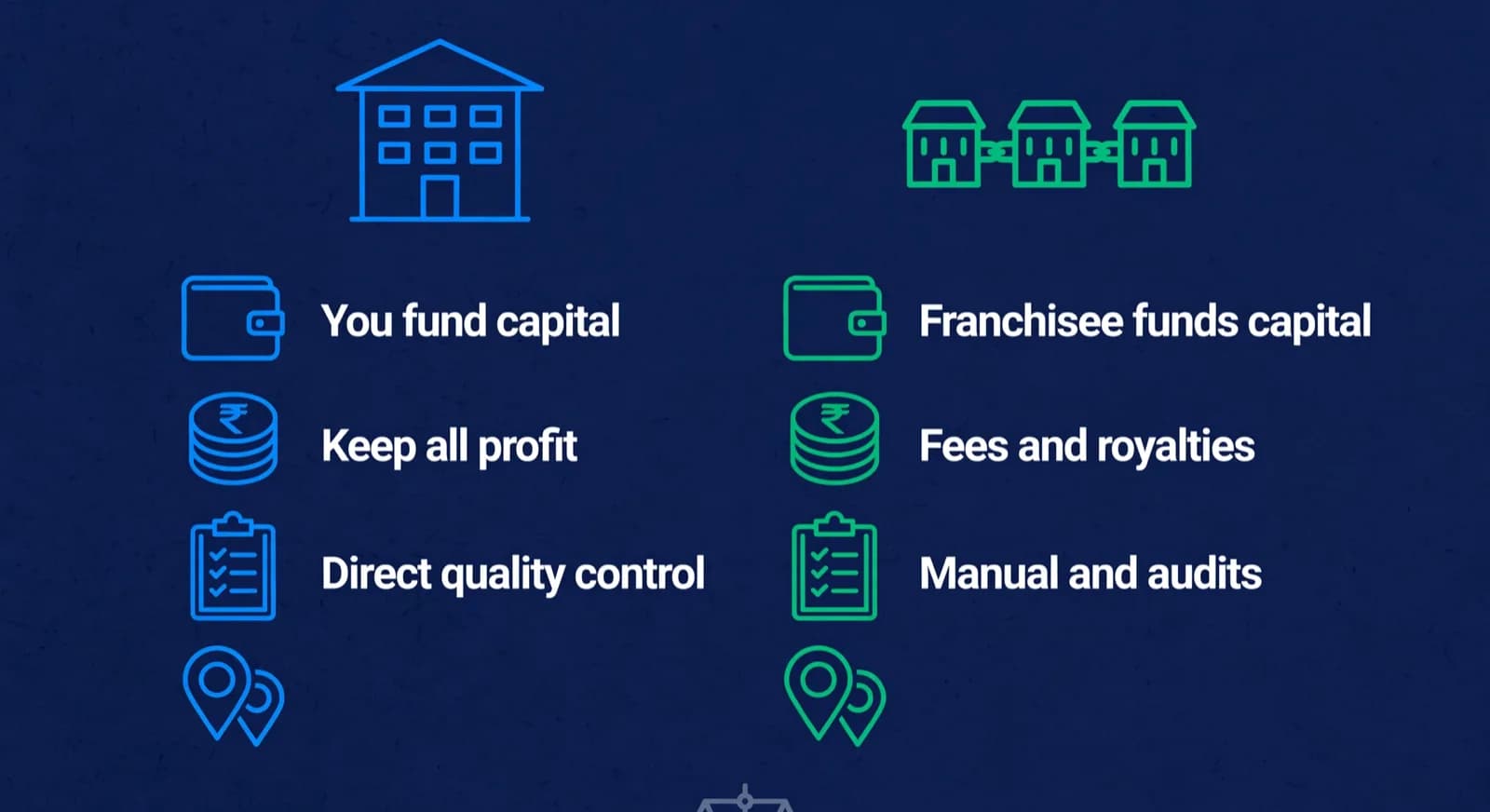
| Dimension | Company-owned | Franchise |
|---|---|---|
| Capital per center | You fund every center | The franchisee funds the center |
| Profit per center | You keep all of it | You keep fees and royalties only |
| Quality control | Direct and complete | Indirect, via manual, software, and audits |
| Speed of reach | Bounded by your capital and attention | Faster, limited mainly by good franchisees |
| Brand risk | Contained; you run every center | A weak franchisee can damage the brand in a city |
| What you must build | Strong operations and hiring | All of that, plus a sellable system and support |
Franchising does not remove the work of company-owned growth; it adds to it. You still need excellent operations, plus a sellable system, a training programme and a way to check quality at a distance. A sane middle path is to run two or three company-owned centres first, which forces you to document everything and shows the model travels beyond one location. Expansion through school partnerships is a third path; our guide to running a school chess program in India covers how that differs. For the staffing backbone both paths need, see our guide to how to run a chess academy.
On tooling, the practical question is whether head office can see each centre's batches and attendance, labelled by centre, without a separate login per location. That is a monitoring need, not an accounting one. How fees, royalties and any revenue share are invoiced and split between you and a franchisee is a contract and bookkeeping matter for your chartered accountant. In India, parents expect to be reached on WhatsApp [1], so the operations manual should also set how often centres message families and in what tone.
Franchising is a contractual and tax relationship before it is a growth strategy. The offers above quote published starting investments, not a complete cost of opening, and royalty percentages and legal thresholds need separate checking for your model. These are the points to settle with professionals before you sign anyone.
- The franchise agreement: territory, term, renewal, exit, and what happens if a franchisee underperforms or breaches your standards.
- Brand protection: registering and licensing your trademark so franchisees use the name only as agreed and you can stop misuse.
- Fee and royalty structure: what the franchisee pays up front and ongoing, and how that is invoiced and taxed.
- Tax treatment: how franchise fees and royalties are taxed, including whether and when GST applies, which depends on your turnover and structure.
- Quality and termination terms: the standards a franchisee must meet and the documented process for acting when they do not.

Fees · October · all batches
136 of 148 paidCollected · this term
92%Lucas M. · October · $180
Card AutoPay · receipt sent to Müller family
Mia G. · October · $180
Payment link opened in WhatsApp
Batch B2 · 12 of 14 paid
No bank-transfer screenshots needed
AutoPay mandates · 41 active
Renew monthly without reminders
Keep business registration, tax registration and franchise rights as separate questions. The official Udyam portal describes free, self-declared MSME registration [2]; ask your adviser how it applies to your enterprise rather than treating it as incorporation or permission to use a franchise brand. Ask your chartered accountant to verify GST treatment on the official portal [3] before pricing or invoicing fees and royalties. Also decide how each centre will collect and reconcile parent payments. Razorpay’s subscription documentation is a starting point for assessing recurring collection [4], but your operating manual must still define receipts, failed payments, refunds and reconciliation. Use the same reporting definitions across centres so collections can be compared without confusing invoices raised with cash received.

A franchise transfers your system, but it never transfers students, coaching quality or parent trust, which every franchisee must build locally. Your name lowers the cost of earning that trust; it does not replace it. If the honest answer is not yet, our guide to starting a chess academy in India and the wider India chess academy guides hub will serve you better than a franchise contract while you build the system that makes franchising worth doing.
Week of 12 October · all batches
0 conflictsMake-up credit · Mia G. · Sat 4:30 PM
Absent Thursday with notice · booked by Noor
Class reminders sent to 148 families
Timing changes update everyone at once
Frequently asked questions
When is a chess academy ready to franchise in India?
When the model works without the founder. Concretely, at least one center should run profitably while you are away from it, your curriculum and operations should be documented well enough for an ordinary competent operator to follow, your brand should pull students on its own rather than only your personal coaching, and you should be able to train a new operator in a defined onboarding period. The cleanest test is to run one center entirely off your documented system without teaching it yourself; if it produces your results, you have something franchisable, and if it only works when you step in, the system is not ready yet.
What does a franchisee actually buy from a chess academy?
A repeatable system, not a name alone. The transferable asset is a documented curriculum that produces results in someone else's hands, an operating method for enrolment, scheduling, attendance, fees, communication, and reporting, a brand that already means something to parents, and software that enforces consistency and gives the franchisor visibility. What a franchise never transfers is students, coaching quality, or parent trust; the franchisee must build those locally just as the founder did. The brand lowers the cost of earning that trust, but it does not replace the work of earning it.
Do I need to be a chess coach to buy a franchise?
Not for every offer. Kingdom of Chess says applicants need not be professional players or coaches because it provides curriculum, coach training and systems [6]. That does not remove the local operator’s responsibility for running the centre. Ask each brand separately about eligibility and who supplies the teaching staff.
Is there a royalty on a chess academy franchise?
Kingdom of Chess says it charges a percentage of collections after the initial three months, but leaves the complete terms to the franchise discussion [6]. Request the percentage, calculation basis, payment dates and treatment of refunds in writing. Do not treat an unpublished rate as zero or assume another brand uses the same terms.
What space or investment models are offered?
Kingdom of Chess lists Smart Point, Prime Centre and Flagship Academy; CHESS KLUB lists physical or hybrid Single Location options [6][5]. The comparison table records the published space and investment details. Ask for approval of your actual premises and clarification of exclusions before choosing a model.
Do I need legal help to franchise my chess academy?
Yes, and not just at signing. A franchise agreement covers territory, term, renewal, exit, and underperformance; trademark licensing protects your brand; and the tax treatment of franchise fees and royalties, including whether GST applies, depends on your structure and turnover. These bind you for years and are costly to unwind, so structure them with a lawyer and a chartered accountant who understand franchising in India, and verify any registration or tax question with the relevant authority. Treat franchising as a legal and tax decision first and a growth strategy second.
Sources
- [1]WhatsApp (Wikipedia): India is WhatsApp's largest market · accessed 2026-07-15
- [2]Udyam: official MSME registration · accessed 2026-10-02
- [3]Goods and Services Tax portal, Government of India · accessed 2026-07-15
- [4]Razorpay Subscriptions documentation · accessed 2026-10-02
- [5]CHESS KLUB: India franchise investment and process · accessed 2026-10-16
- [6]Kingdom of Chess: models, support and franchise FAQ · accessed 2026-10-16
- [7]CHESS KLUB Franchisee Profitability Calculator · accessed 2026-10-16
Written by Abhishek Tiwari
ChessCore
Drafted with AI, fact-checked and approved by a human before publishing, the same guardrail our product applies to every report it sends. Read our editorial standards.
Run your own centres from one place
ChessCore keeps batches, attendance, fees and parent updates in one place, with centre labels so you can tell locations apart. It does not calculate royalties or split revenue.
- Roster import from the spreadsheets you already keep
- Lichess and Chess.com connections, batches, and fee plans
- First reports in week one, after your approval
- Free plan, no credit card required