
On this page10 sections, 20 min read
- What does a chess academy fee structure actually have to decide?
- How do online vs physical class fees differ?
- What do chess academy fees in India look like?
- Which fee model should an academy use?
- How do you work out a pricing floor without market data?
- What should a written fee schedule say?
- How should fees get collected, and how do you know they were?
- What do you do when a family pays late?
- How do you raise fees without losing students?
- What belongs on the receipt?
- Frequently asked questions
Bottom line
A chess academy fee structure is a set of written decisions, not a single number: pick a billing period, say what one payment buys, and set the due date, discounts and missed-class rule before you quote an amount. Monthly in advance is a common default. Put it all on one page so a parent reads one schedule instead of asking five questions.
TL;DR
- A fee structure is a written schedule: amount, billing period, included sessions, discounts, due date, missed-class rule, academy cancellations and refunds.
- Monthly fees in advance on one fixed date are a common default; term fees and per-class pricing are trade-offs to weigh against your own batches.
- Price from costs upward: total a batch's monthly cost, add the surplus you need, and divide by a conservative number of paying students.
- Collection is three separate events with three records: the family authorises payment, the debit succeeds, and a receipt is issued.
- Late payment needs a written escalation ladder and a fee increase needs a dated script, because improvising either one strains the relationship.
Key facts
- In Razorpay Subscriptions the customer first makes an authentication payment, scheduled charges follow, and an invoice moves to paid with an email to the customer when a charge succeeds.[1]
- For UPI subscriptions Razorpay's documentation says a failed charge moves the subscription to pending and is retried the next day and then twice more, after which the subscription halts.[2]
- Stripe Billing manages subscriptions and invoicing and lists smart retries for recurring payments, which gives academies charging outside India the same shape.[3]
- Worked example with placeholder figures: a batch that costs 9,000 a month, a 6,000 surplus target and eight paying students give a pricing floor of 1,875 per student per month.
- In the demo academy, a made-up academy, the standard fee is $120 a month on the 1st, and 136 of 148 families had paid for October.
- As of October 2026, published Indian group chess fees run about Rs.2,500 to Rs.4,000 a month across academy pages such as Indian Chess School and ChessGurukul, with advanced online batches and one-to-one coaching costing several times more.[6]
What does a chess academy fee structure actually have to decide?
A chess academy fee structure settles five things before it quotes a price: the billing model, the price itself, how the money gets collected, what happens when a family pays late or misses a class, and how you change fees later. Treat the headline amount as the last decision, not the first, because a number without a billing unit, a due date and a missed-class rule starts arguments you could have prevented. If you run an academy in India and want the market side, published rupee fees, GST and UPI AutoPay collection, the India section below covers it, so the rest of this page can stay on how an operator writes the policy wherever they teach.
The order matters because each decision constrains the next. The billing model decides your cash-flow shape and how often you talk to a family about money. The price has to cover your real delivery cost, not a competitor's advertised figure whose costs you cannot see. Collection mechanics decide whether you spend the first week of a month chasing payments. The late-payment and missed-class rules decide whether a problem becomes a quiet renewal or a loud dispute. The output of all five is a one-page fee schedule, set out in a later section.
How do online vs physical class fees differ?
Online and physical classes are different products, so price each from its own costs rather than discounting one against the other. A physical batch carries rent, travel for the coach and the cost of a room; an online batch carries a platform or software cost and almost no premises overhead. Neither is automatically cheaper to deliver, and your fee should follow your costs, not an assumption about which format families expect to pay less for.
When a family asks you to compare the two, give them matched quotes for the same student level, group size, lesson duration and teaching frequency. Add any platform charge to the online quote and the family's travel cost to the physical option, and keep those household costs separate from your tuition so a parent can see which part actually changes with the format. That keeps the conversation about teaching value rather than a single headline figure.
A useful decision is whether the format makes the lesson usable. Ask how the coach checks understanding, gives individual feedback and handles a missed lesson. An online lesson with attentive feedback can suit a student who studies independently; a physical class may suit a child who needs help staying engaged. Treat that as a family-specific choice, not a universal price or quality ranking.
What do chess academy fees in India look like?
Published group chess fees in India run roughly Rs.2,500 to Rs.4,000 a month as of October 2026, with advanced online batches and one-to-one coaching costing several times more. There is no national average worth quoting, because the fee depends on coach credentials, batch size, city, format and what the price includes. The reliable method is three local quotes compared on what each one buys, which is the same cost-first logic the rest of this page uses, now read from the parent's side of the table.
Several Indian academies publish monthly fees in rupees, and the dated examples below show the spread. Indian Chess School lists group training at Rs.2,950 per month incl. taxes [6]. Platinum Chess Academy lists an online group cohort at Rs.2,500 per month, capped at 8 students, with one-to-one at Rs.1,200 a session by evaluation [7]. ChessGurukul's India GST table lists online groups from Rs.2,500 to Rs.4,000 per month inclusive of GST, with its Advance 1 and Advance 2 batches at Rs.6,500 and Rs.10,500, plus a one-time Rs.1,000 registration fee that sits outside the monthly tuition [8]. Kings Chess Academy prices by class count, Rs.4,000 for 8 physical classes a month or Rs.5,500 for 12 [9], and Ekagra lists Rs.600 to Rs.750 per class inclusive of 18 percent GST plus a Rs.2,800 yearly platform charge [10]. These are dated examples for specific formats and cities, not a benchmark to copy.
| Academy | Format quoted | Batch cap published | Published fee (October 2026) |
|---|---|---|---|
| Indian Chess School | Group training, all levels | Not published | Rs.2,950 per month incl. taxes [6] |
| Indian Chess School | One-on-one online | 1 student | Rs.1,200 per session incl. taxes [6] |
| Platinum Chess Academy | Group cohort, online | Max 8 students | Rs.2,500 per month [7] |
| ChessGurukul | Online India groups | Not published | Rs.2,500 to Rs.4,000 per month inc GST [8] |
| ChessGurukul | Advance 1 and Advance 2 online | Not published | Rs.6,500 and Rs.10,500 per month inc GST [8] |
| Kings Chess Academy | Physical classes at the academy | Not published | Rs.4,000 (8 classes) or Rs.5,500 (12 classes) [9] |
| Ekagra Chess Academy | Online group, beginner | Not published | Rs.600 to Rs.750 per class incl. 18 percent GST [10] |
Read the billing unit before the amount, because a monthly tuition, a per-class rate and a yearly platform charge are different purchases. Where a page states the class count you can reduce it to a cost per class: Kings Chess Academy's Rs.4,000 for 8 classes is Rs.500 a class, while Rs.5,500 for 12 is about Rs.458 a class [9], so the dearer monthly plan is slightly cheaper per class. Where a page gives only a weekly cadence, ask for the monthly count before dividing rather than assuming four weeks, and treat any registration or yearly platform charge as a separate line.
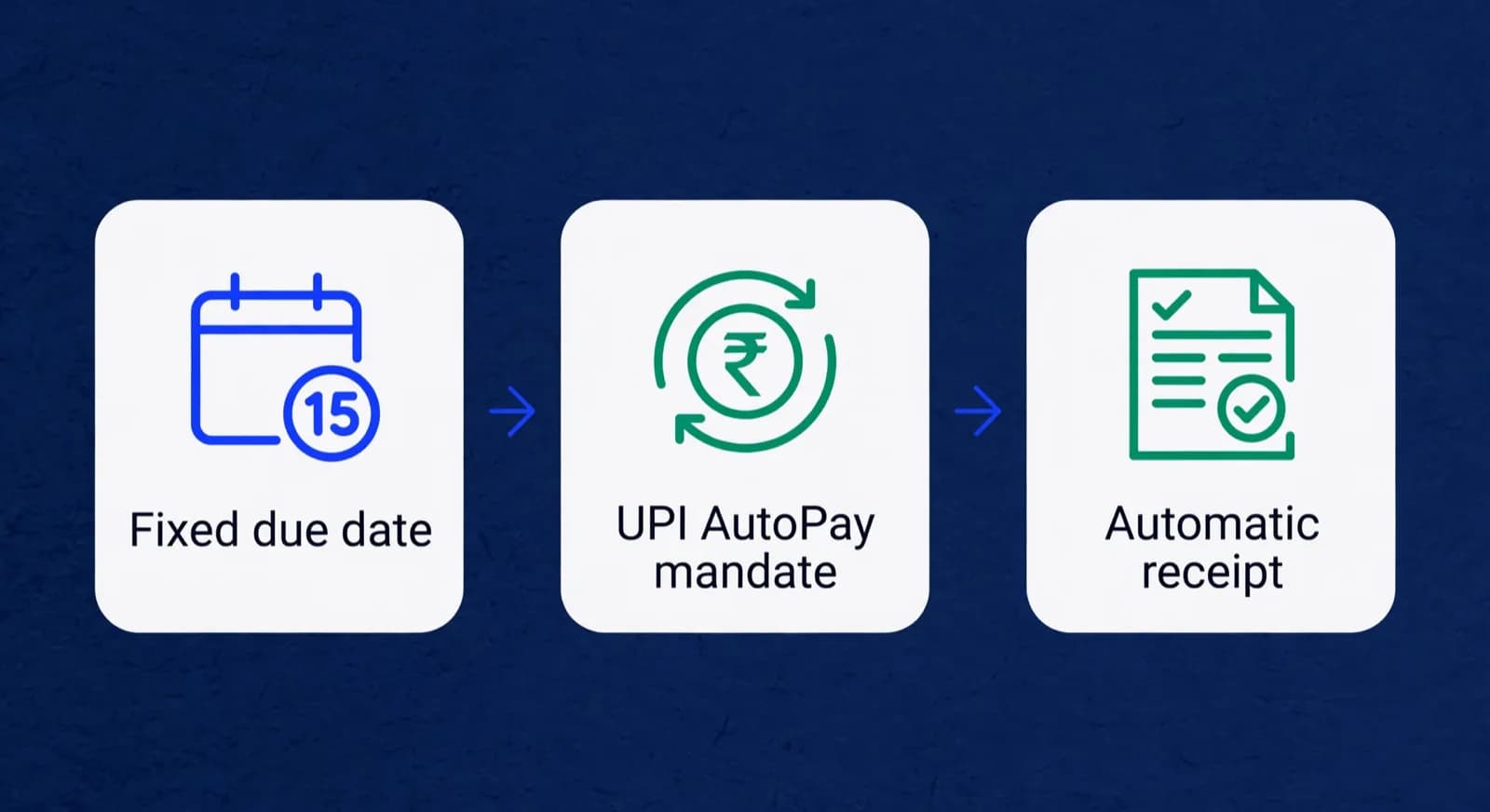
Two India-specific money details belong in the quote. First, GST: coaching fees may attract Goods and Services Tax when the academy is registered under the GST system [4], so ask whether the quoted fee is inclusive and confirm what the receipt shows. Several academies above price inclusive of tax and say so, such as Indian Chess School [6] and Ekagra at 18 percent GST [10]. Second, collection: many Indian academies debit monthly fees through UPI AutoPay, the NPCI product that lets a parent authorise a recurring debit once instead of transferring manually each month [5], and send reminders and receipts over WhatsApp. That one-time approval is the fee mandate described earlier, and from the operator's side it runs on the same three-event sequence, authorise, debit, receipt, in rupees rather than dollars.
 Collected through Razorpay · UPI AutoPay and payment links
For a parent comparing two academies, make both quotes answer the same three questions before you weigh the numbers: what is the maximum batch size, what exactly does the fee include item by item, and who actually teaches the batch. A titled coach on the banner sometimes teaches only the advanced group while juniors sit with assistants, and a batch advertised at six that grows to twelve halves a child's share of attention without changing the fee. Until all three are answered for both academies, the monthly figures are not yet comparable, because you do not know what each one buys.
Which fee model should an academy use?
Start with a monthly fee collected in advance unless you have a specific reason not to. The three workable models are monthly, term (quarterly or semester) and per-class, and they differ less in revenue than in cash-flow shape, admin load and how often a family re-decides. With per-class pricing the decision comes up at every lesson, with a monthly fee once a month, and with a term fee once a term. Whether that changes attendance in your academy is something to watch in your own batches, not to assume.
| Model | Cash flow | Admin load | Best for | Main risk |
|---|---|---|---|---|
| Monthly, in advance | Smooth, predictable, small ticket | One collection cycle per month | Kids' batches, most academies | Twelve collection events a year, so the mechanics must be reliable |
| Term (3 to 6 months) | Lumpy but front-loaded | Few cycles, bigger conversations | Competitive programmes, school-year batches | Refund questions when a student leaves mid-term |
| Per-class or class packs | Irregular, follows attendance | Constant tracking and balances | Hobby adults, drop-in formats | Families re-decide every lesson, so attendance may swing more |
Hybrids are fine once the base works: a monthly default with an optional term plan at a small discount serves families who budget monthly and families who prefer to pay once. What gets hard to run is offering all three models to everyone, because every exception becomes a ledger you maintain by hand. Pick one default, one alternative, and write down who qualifies for the alternative. If a family asks about missed classes, that is a make-up policy question rather than a fee model question, and our guide to make-up classes covers the credit ledger.
How do you work out a pricing floor without market data?
Price from your costs upward. The pricing floor is the lowest fee per student that covers what one batch costs to run and the surplus you need from it. You do not need market benchmarks to find it. You need four numbers and one evening.

- Total one batch's monthly cost: the coach's pay for those sessions, the batch's share of rent and utilities, and a slice of overheads such as software, materials and your own admin time.
- Add the surplus you need that batch to produce, stated as money rather than a percentage, so the number stays honest.
- Divide by a conservative enrolment, such as 70 to 80 percent of capacity, because pricing at full capacity means every empty seat eats your margin.
- Round to a clean number, then compare it with the two or three academies and tuition centres your families would actually weigh you against.
Here is the method with placeholder figures. It illustrates the arithmetic and is not market data. Suppose a twice-a-week batch costs 9,000 per month to run all-in, you want a 6,000 surplus from it, and the batch holds ten students but you plan on eight paying. That is 15,000 divided by eight, so 1,875, rounded to a fee of 1,900 or 2,000 per month. Every input is something you control or observe, and changing any one of them moves the fee. Use the academy fee calculator to calculate a batch pricing floor with your own rent, coach pay and batch size. Costs beyond one batch, such as setup, marketing and the cash you need to carry between months, belong in the business plan, where you can separate costs and cash flow properly.
Compare the floor with local alternatives using the matched-quote method above. If it lands far above them, name the reason a parent can see, such as smaller batches or structured homework. If it lands far below, check that your cost list is complete before you accept a thin margin. The new-academy version of this question, pricing your first batches before you have any history, is covered in our guide to starting a chess academy.
Discounts are part of the price, so write the rules once. Two common ones are a sibling discount and a prepayment discount, and each is a trade-off to test rather than a proven win. A sibling discount lowers revenue per child in exchange for keeping a household in the academy. A prepayment discount trades margin for earlier cash and fewer collection events. Decide whether discounts combine, cap the total, give each an expiry date, and put them in the fee schedule so no one negotiates a new one in conversation.
What should a written fee schedule say?
A written fee schedule is one page a parent can read in two minutes. It names each choice and gives the reason, so a question at the door has an answer you already wrote. The brackets below are placeholders for your own numbers. Set them with the pricing floor above and your local market, and do not copy any figure from this page.
| Field | What to write | Choices to weigh |
|---|---|---|
| Amount and period | [Amount] per [month or term], for [number] sessions of [minutes] | Name the unit one payment buys. A month with five Thursdays needs a stated rule: a flat fee for the calendar month, or a fee per four-week block. |
| Included sessions | [Sessions] per period, plus [homework review or tournament preparation, if any] | State what is included beyond the lesson so extras do not appear later as surprise charges. |
| Registration charge (optional) | [One-time amount], or none | A one-time charge can cover setup; some academies skip it. If you charge one, say when it is due and whether it is refundable. |
| Discounts and stacking | [Discount], who qualifies, when it expires, and whether it combines with others | Allowing one discount per student gives the simplest ledger. If you allow stacking, cap the total. |
| Due date and grace period | Due on [date] of each period, with [number] days before the first reminder | One fixed date for everyone is easier to run than dates tied to each joining day. A joining-day schedule is fairer to a student who starts mid-month. Choose one and say why. |
| Class missed by the student | [No credit, a credit with notice, or a credit by reason], with a notice period and an expiry | This is the make-up policy. Write it once and refer to it from the fee schedule. |
| Class cancelled by the academy | The class is rescheduled, made up or credited within [number] days | A cancellation you cause is yours to fix, so decide the remedy before it happens. |
| Withdrawal and refunds | [Notice needed], what happens to the current period, and whether any unused part is refunded | Choose this yourself. Whether a refund rule can be enforced depends on where you operate, your contract and your payment provider, so check local rules instead of copying another academy's terms. |
Two choices deserve a reason inside the schedule itself. The first is break weeks: say whether the fee is flat across the year or reduced in a holiday week, because families will ask. Either approach works if it is written down before the first payment. The second is the missed-class rule, where the policy is longer than a table cell can hold. Use the make-up guide to write the missed-class policy, then paste its short form into the schedule.
How should fees get collected, and how do you know they were?
Treat collection as three separate events, each with its own record: the family authorises the payment method, the debit succeeds, and a receipt is issued. Mixing them up is how an academy ends up treating an active mandate as paid fees. Razorpay's subscription documentation shows the sequence: the customer completes an authentication payment, scheduled charges follow, and when a charge succeeds the invoice moves to paid and the customer receives an email [1].

Fees · October · all batches
136 of 148 paidCollected · this term
92%Lucas M. · October · $180
Card AutoPay · receipt sent to Müller family
Mia G. · October · $180
Payment link opened in WhatsApp
Batch B2 · 12 of 14 paid
No bank-transfer screenshots needed
AutoPay mandates · 41 active
Renew monthly without reminders

Plan for the debit that fails. For UPI, Razorpay's documentation says a failed charge moves the subscription to pending, the charge is retried the next day and twice more, and the subscription halts if every retry fails [2]. Stripe Billing lists smart retries among its features for recurring payments [3]. Retry rules differ by provider and payment method, so read yours and decide what the academy does at each step: who is told, whether the class continues and when the late-payment ladder starts.
A payment link is the fallback for a family that declines a mandate or whose debit failed. A mandate removes a monthly action for the parent, while a link keeps the parent in control each time. Which one collects more reliably is a question to measure in your own academy, so keep a simple count of paid-on-time by payment route before you choose a default. If you teach families in other countries, the merchant setup and currency questions are covered in our guide to starting an online chess academy.
Sequence the cycle the same way every month: a reminder a few days before the due date, the debit or the link on the date, a receipt on payment, and anything unpaid after the grace period enters the late-payment ladder below. Run it on a calendar, not on memory. ChessCore, which we build, lets an academy collect and track tuition fees through Razorpay, including UPI AutoPay, and through Stripe, and fee reminders can go out automatically on a schedule the academy turns on. Choose and test your own tools against the three-event sequence above. The day-by-day version of the cycle is laid out in our pillar guide to running a chess academy.
What do you do when a family pays late?
Follow a written escalation ladder that starts gentle and gets firmer on a schedule, so the awkwardness lives in the policy instead of in you. Most late payments are forgetfulness, not refusal, and the goal of the ladder is to collect the fee while keeping the family, in that order. Every step is dated relative to the due date, and every step assumes good faith until the family tells you otherwise. Treat the days below as a template to adapt, not a standard.
| Day | Step | What it sounds like |
|---|---|---|
| Due date + 3 | Gentle reminder with the payment link | Hi, a quick reminder that this month's fee is pending. Here is the link, and do tell us if anything is wrong on our side. |
| Due date + 7 | Direct follow-up, same thread | Following up on the fee for this month. If the timing is difficult, tell us and we will work something out. |
| Due date + 14 | Personal call from the founder or admin | A two-minute call to ask if everything is okay, not a demand. |
| Due date + 21 | Pause notice in writing | We will pause classes from next week until the fee is settled. The seat is held for the month, and we would much rather see them back. |
Two rules keep the ladder humane. First, never raise a pending fee in front of the child or other parents; every step happens in the family's private thread or on a call. Second, if your ladder includes a pause, make it real but reversible: classes stop, the seat is held for a stated time, and payment restores everything without further comment. Whether to pause at all is your policy choice, so write it in the fee schedule before the first due date. If a family is in genuine difficulty, a payment plan agreed once, in writing, with dates, keeps the flexibility from becoming open-ended.
How do you raise fees without losing students?
Change fees on a fixed date, give written notice well in advance, and state the reason plainly. A dated, regular revision is easier to explain than a surprise, so script the announcement and send it to every family on the same day rather than letting it leak batch by batch.
A script to adapt: "From 1 August, the monthly fee for Batch B2 moves from X to Y. This is our first revision since last August and it reflects higher coach and venue costs. Nothing else changes: same coach, same schedule, same reporting. Current students stay at X until that date, and the annual-payment option locks the current fee for the year. Reply here or call me if you would like to talk it through." Every sentence does a job: the date gives notice, the history shows how rarely fees change, the reason is concrete, the freeze rewards loyalty and offers the prepayment option, and the invitation keeps the channel open.
Send the notice with something concrete in the same week, such as a progress note on the child, so the message arrives alongside evidence of the teaching. The communication habit behind that, covered in our guide to WhatsApp for chess academies, matters more than the wording of any one announcement. Answer questions with the same calm as the late-payment ladder: the policy is the policy, the tone is warm, and exceptions are not negotiated in a group chat.
What belongs on the receipt?
A receipt should let a parent reconstruct what they paid for without asking you: the academy's name and contact, the student's name and batch, the period the payment covers, the amount with any discount shown, the payment method and date, and a receipt number. Issue it as soon as payment lands, in the thread where the family already talks to you, because a receipt that has to be requested is a dispute waiting for a date.
- Academy name, contact, and registration details where applicable
- Student name and batch, so multi-child families can file it correctly
- Billing period stated as dates, not just a month name
- Amount paid, with any sibling or prepayment discount itemised
- Payment method, transaction reference, and date received
- A sequential receipt number, which turns a dispute into a lookup
Parent updates · this week
14 of 14 sentWeekly recap · Lucas M.
Lucas attended Thursday's class and won 2 arena games. His September report is in your portal.
Receipt · October fee
$180 received via card AutoPay. Receipt saved.
9:42 AMRecap approved by Coach Elena
Open the guardian portal
Own login · nothing to install
The receipt is the third of the three collection events, and the record that closes the loop. A family that can see exactly what each payment covered has fewer questions at renewal, and your own ledger shows which fees are authorised, which are collected and which are still open.
Frequently asked questions
What is the best fee structure for a chess academy?
There is no single best structure. A common default is a monthly fee collected in advance on one fixed date, with an optional term plan at a small discount. It matches how many families budget and gives you one due date to automate. Choose differently for drop-in formats or tournament-preparation terms, and write the choice, with its reason, into a one-page fee schedule.
Should chess academy fees be per class or monthly?
Monthly suits most children's batches, and per class suits drop-in formats such as adult groups. With a monthly fee the family decides once a month; with per-class pricing the decision comes up at each lesson. A small class pack beside a monthly default is one option for adults who cannot commit to a fixed night. Compare attendance in your own batches before you generalise.
How should a chess academy collect fees each month?
Decide how you will record three separate events: the family authorises payment, the debit succeeds, and a receipt is issued. In India, UPI AutoPay mandates and payment links are common routes, and Stripe Billing covers recurring payments outside India. Add a reminder before the due date, read your provider's retry rules, and write a late-payment ladder for fees still unpaid after the grace period.
What is a fair late fee policy for academy fees?
One option is a dated escalation ladder: a gentle reminder a few days after the due date, a direct follow-up at a week, a personal call at two weeks and a written pause notice at three weeks. A monetary late fee is another option. Whichever you pick, write it in the fee schedule before the first due date, apply it the same way to every family, and check whether local rules limit late charges where you operate.
How much notice should an academy give before a fee increase?
At least one full billing cycle, and ideally four to six weeks, in writing, to every family on the same day. That range is our suggestion, not a rule. State the new amount, the effective date, the time since the last revision and one concrete reason. Offering to lock the current fee for families who prepay a term or year is one way to soften the change.
What should a chess academy fee schedule include?
Eight fields: the amount and billing period, the sessions included, any registration charge, discounts and whether they combine, the due date and grace period, the rule for classes the student misses, the remedy for classes the academy cancels, and the withdrawal and refund terms. Give the reason for each choice in a sentence, and keep it to one page.
Sources
- [1]How Subscriptions Work, Razorpay documentation · accessed 2026-10-16
- [2]Payment Retries, Razorpay Subscriptions documentation · accessed 2026-10-16
- [3]Stripe Billing documentation · accessed 2026-10-16
- [4]Goods and Services Tax, Government of India portal · accessed 2026-06-10
- [5]UPI Autopay for Recurring Payments | NPCI · accessed 2026-10-16
- [6]Fee structure for Indian students, Indian Chess School · accessed 2026-10-02
- [7]Online programs and fees, Platinum Chess Academy · accessed 2026-10-02
- [8]Payments for Indian students, ChessGurukul · accessed 2026-10-16
- [9]Kings Chess Academy: published India fees · accessed 2026-10-16
- [10]Ekagra Chess Academy: online class fees · accessed 2026-10-16
Written by Abhishek Tiwari
ChessCore
Drafted with AI, fact-checked and approved by a human before publishing, the same guardrail our product applies to every report it sends. Read our editorial standards.
Put fee collection on rails
ChessCore tracks mandates, payment links and what is overdue for each family, so you chase only the exceptions. Fee reminders can go out automatically on a schedule you turn on.
- Roster import from the spreadsheets you already keep
- Lichess and Chess.com connections, batches, and fee plans
- First reports in week one, after your approval
- Free plan, no credit card required