On this page6 sections, 18 min read
- Why does a chess academy plan start with one batch?
- What does a chess academy business plan need to cover?
- How do you work out what one batch earns?
- How do you set the fee, find families and plan your cash?
- What should you check before you launch and take fees?
- Which risks should the plan test in the first ninety days?
- Frequently asked questions
Bottom line
A chess academy business plan is a worksheet you fill with your own numbers: who you teach, what one batch earns and costs, how families find you, when cash arrives and what to check before you take fees. Test those inputs on one batch before you commit to a venue or a hire.
TL;DR
- A useful chess academy business plan is short and starts with one batch: prove that one batch covers its costs before you plan ten of them, because a plan that scales a loss only loses faster.
- Keep three layers apart in the batch table: cash costs you pay out, overhead you allocate, and your own unpaid time. Mixing them hides whether the batch works.
- Cash timing is a separate sum from profit. Fill in three months of opening cash, fee dates, deposits and payments, and read off the lowest closing balance.
- Check registrations, permissions and child-safety rules while you test demand, and settle the ones that apply before you take the first fee. Udyam registration does not replace the others.
Key facts
- Coach pay and space are booked per batch rather than per child, so the plan tests one batch before it multiplies batches.
- Cash costs, allocated overhead and unpaid founder time are three separate layers; the batch table in this guide lists them separately so a batch that only works because the founder is unpaid is visible.
- Contribution margin subtracts only variable costs. Nearly every cost of a batch is fixed for the batch, so this guide calls the result surplus after listed costs.
- The Udyam portal states that MSME registration is free, paperless and based on self-declaration, and that PAN and GSTIN as applicable under the GST law are required.[4]
- ChessCore plans are flat capacity tiers priced in US dollars, not per student: Core covers up to 100 students at $69 a month billed annually or $89 a month billed monthly.
Why does a chess academy plan start with one batch?
A chess academy plan starts with one batch because almost every cost you carry is booked per batch, not per child. A coach is paid for the hour whether four students or eight sit in front of them, and a room is rented for the slot however full it is. Prove that one batch, taught for a month at your real fee, covers what it costs, and the rest of the plan is arithmetic: how many batches you can fill and staff.
Plans that open with a vision and a growth chart to hundreds of students skip that proof. A chart built on an unproven batch scales whatever the batch actually is. If it only works because the founder is unpaid, or because every seat is always sold, adding batches adds the same problem. The sections below build outward from one batch, and the tables give you the lines to fill in with your own figures.
What does a chess academy business plan need to cover?
A chess academy plan needs seven answers, each tied to a decision you make before spending money. Copy the worksheet below into a spreadsheet or a notebook and fill the right-hand column with your own entries. Leave a cell empty if you do not know yet: an empty cell is a task, not a failure.
| Section | Question to answer | What to enter yourself |
|---|---|---|
| 1. Who you teach | Which age and level will you teach first, and where do they live or log in from? | One sentence in the form: we teach X to Y who want Z. Add the catchment or the online niche. |
| 2. What you offer | What does a family get each month that a free app does not give them? | Sessions per week, batch size, homework and how parents hear about progress. |
| 3. Fee unit | What does one seat cost, and for what period? | The fee per month or per term in your currency, and the due date. |
| 4. Costs | What does one batch cost in cash, in allocated overhead and in your own time? | Coach pay, space, equipment, software share and the hours you work. |
| 5. Acquisition test | Which two channels will you try, and what will count as working? | Channel, weeks tested, hours spent, enquiries and paid enrolments. |
| 6. Cash timing | When does money come in and go out in the first three months? | Opening cash, fee dates, deposits, payment dates and the lowest closing balance. |
| 7. Risks and obligations | What could stop the launch or break a batch, and what must you check before taking fees? | Each risk with its early signal and your decision, plus each registration or permission with an owner and a date. |
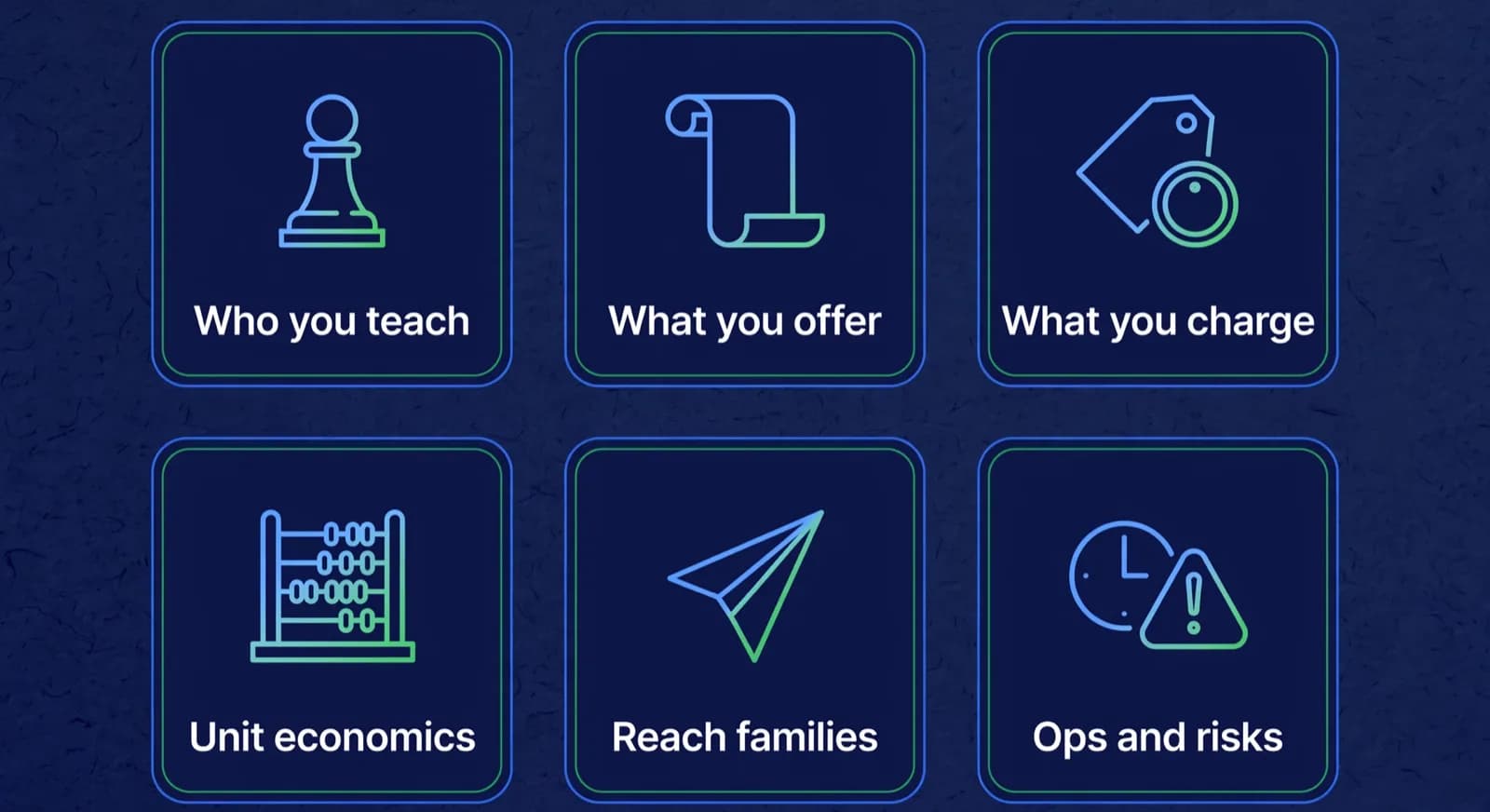
Four of the seven rows are about money, timing and obligations rather than teaching. That is deliberate: a half-full batch still pays a full coach, and fees do not arrive on the due date just because the plan says so. Read how to set a chess academy fee structure for the pricing decision, and the pillar guide to running a chess academy for the operating week. This plan only ties them together.
How do you work out what one batch earns?
Work out one batch for one month in three layers: cash costs you pay out, overhead you allocate to the batch, and your own time at a rate you would accept. Keep them apart, because they answer different questions. Cash costs tell you whether the bank balance survives. Allocated overhead tells you whether the batch carries its share. Your own time tells you whether you built a business or an underpaid job. The table works an ordinary example, six seats at $120 a month taught twice a week. Every figure is illustrative, so replace each one with your own.

| Line item | Illustrative figure, per batch per month | Layer and note |
|---|---|---|
| Revenue: 6 seats at $120 | $720 | Assumes a full batch and fees paid on time |
| Coach pay: 8 sessions at $40 | $320 | Cash cost. Paid whether six students or three attend |
| Space for the slot | $100 | Cash cost. A half-empty batch still carries it |
| Surplus after cash costs | $300 | $720 less $420 of cash costs |
| Software share | $45 | Allocated overhead. Your own plan cost divided across batches, in your currency |
| Surplus after allocated overhead | $255 | $300 less $45 |
| Founder admin time: 5 hours at $15 | $75 | Imputed cost. Unpaid work you would otherwise pay someone to do |
| Surplus after your own time | $180 | $30 per seat across six seats |
| Break-even seats | 5 seats | $540 of listed costs divided by the $120 fee is 4.5, rounded up |
Call the last surplus figure surplus after listed costs, not contribution margin. Contribution margin subtracts only variable costs, the ones that rise with each extra student. Almost every line here is fixed for the batch, so the useful comparison is the batch's total listed cost against the fee. Break-even is that total divided by one seat's fee: $540 over $120 is 4.5 seats, so 5. An 8-seat batch that fills to 70 percent averages 5.6 paying seats. That clears break-even by a little over one seat, and two dropouts would take it below. The thin gap, not the headline surplus, is the number the plan should show.
Rerun the batch with your own city's fees and costs: the academy fee calculator lets you calculate one batch with your own costs, and the academy break-even calculator lets you check combined batches and launch recovery once more than one batch is running.
ChessCore, which we build, prices software as a flat tier by capacity, not per student. Core covers up to 100 students at $69 a month billed annually ($828 a year) or $89 a month billed monthly, in US dollars. Convert at your own rate when you fill in the software line, and see the pricing page for the other tiers.

Fees · October · all batches
136 of 148 paidCollected · this term
92%Lucas M. · October · $180
Card AutoPay · receipt sent to Müller family
Mia G. · October · $180
Payment link opened in WhatsApp
Batch B2 · 12 of 14 paid
No bank-transfer screenshots needed
AutoPay mandates · 41 active
Renew monthly without reminders
How do you set the fee, find families and plan your cash?
Set the fee floor from the batch table: the lowest fee at which the batch covers its listed costs at the seat count you expect to fill, with your own time included. Underpricing to win early students traps you as the unpaid coach, because a fee that cannot pay a coach cannot survive hiring one. Check your floor against what nearby academies charge for similar contact hours, and say what the fee includes: lesson time, group size, homework and progress updates.

 Collected through Stripe · saved cards and payment links
Acquisition cost is the number to measure, not guess. Pick two channels, run them for a fixed number of weeks, and count the hours you spent, the enquiries you received and the paid enrolments that followed. Divide your hours and money by paid enrolments and you have what one student costs you to win. Referrals from families and a small local catchment usually cost less in cash than paid advertising, so test them first; our guide on how to get more chess academy students covers the channels in detail. Much of that conversation happens on WhatsApp, so meeting families there costs an academy almost nothing in tools. If acquisition cost is high and the surplus per seat is thin, the plan should say the academy is hard to grow.
- Working capital: enough cash to pay coaches, space and software through the weeks before batches fill, because revenue lags the costs that start on day one.
- A real fee floor: the lowest fee that still clears your per-batch costs with a paid coach, held to rather than discounted away to win early sign-ups.
- A low-cost acquisition test: two channels, a fixed number of weeks, and a written definition of what counts as working before you spend on more.
- A collection plan: how fees are invoiced, chased and recorded, because a batch with a surplus that cannot collect on time still runs short of cash.
Cash timing is a separate sum from surplus. Costs start on day one and repeat on fixed dates, while fees arrive when families pay. A batch can show a surplus on paper and still leave the account empty in week three. Fill the table below for the first three months. Opening cash is what you hold before the first class. Add fees only on the dates you expect them, add deposits and equipment when you pay them, subtract coach and space payments when they fall due, and read off the closing balance. The number that matters is the lowest closing balance, because that is the cash you must hold before launch. If it goes below zero, your options are more opening cash, a smaller cost base, or fees collected earlier, for example a term in advance. Leave growth out of it: enter only what you have booked or been promised.
| Line | Month 1 | Month 2 | Month 3 |
|---|---|---|---|
| Opening cash | ____ | ____ | ____ |
| Fees received (date and amount) | ____ | ____ | ____ |
| Deposits and equipment paid | ____ | ____ | ____ |
| Coach and space payments | ____ | ____ | ____ |
| Other costs: software, insurance, travel | ____ | ____ | ____ |
| Closing cash | ____ | ____ | ____ |
Late fees are normal enough to plan for. Decide in advance how many days after the due date you chase a family, who does it and what you say, so a late fee does not sour a relationship you want to keep for years. Software that records who has paid, who is pending and who is overdue makes that routine; whichever tool you choose, its job in the plan is narrow: stop a month of fees slipping through the cracks.
The collection plan works best once it stops depending on someone remembering to raise an invoice. Academies in India can build recurring collection on Razorpay's subscriptions tooling [1], layered on UPI AutoPay [2], the mandate system that lets a parent authorize a fixed monthly debit once and have it recur automatically until they cancel it. Academies billing families outside India can build the same standing authorization on Stripe's subscription billing [3] instead. Either route turns the plan's revenue line from a hope into a debit that clears or fails on a fixed date, which is the only version of fees arriving on time that is actually worth planning around.
What should you check before you launch and take fees?
Before you take the first fee, list every registration, permission and tax rule that applies to your academy, and note who issues it and when you will check it. Do this while you test demand, not after, so a missing document does not hold up a venue booking or a school contract. In India the list usually starts with the business structure and a bank account, then registrations such as Udyam and GST, then permissions tied to the premises or the host school. Rules differ by state and by how you teach, so confirm each item with the body that issues it, and use our guide to starting a chess academy in India to check India-specific setup.
A chess academy in India usually starts as a sole proprietorship, a partnership or a limited liability partnership. The choice is mostly about how many owners there are and how much you want personal and business money kept apart. A sole proprietorship is the simplest and cheapest and fits one founder teaching a few batches. A partnership suits two or three people sharing the work. An LLP adds protection for the partners' personal assets and a little more paperwork, which starts to earn its keep once you rent a space, hold deposits or sign a school contract. Pick the lightest structure that fits who owns the academy, and change it when the numbers justify the formality.
Udyam registration is the government's registration for micro, small and medium enterprises. The portal states that it is free, paperless and based on self-declaration, that an Aadhaar number is enough to start, and that PAN and GSTIN, as applicable under the GST law, are required [4]. It registers the enterprise as an MSME. It is not a substitute for GST, for any local registration your state asks of a coaching business, for permission from a school or hall, or for the safeguarding rules that apply to adults teaching children.
GST registration depends on your turnover, your state and the kind of service you supply. The GST portal is where registration is filed [5], and our guide to GST for chess coaching in India works through whether and when it applies to you.
| Check | What to confirm | Who issues it | Your status |
|---|---|---|---|
| Business structure and bank account | Who owns the academy, and whether fees land in an account in its name | You, with a professional if needed | ____ |
| Udyam registration | Whether you want MSME registration now, and that PAN and any GSTIN are ready | Ministry of MSME portal | ____ |
| GST | Whether your turnover and state require registration, and from when | GST portal | ____ |
| Local permissions | Any shop and establishment or trade registration your state or city asks for | State or municipal authority | ____ |
| Venue or school terms | Written permission, who supervises the children, and any invoice or insurance requirement | Landlord, school or hall | ____ |
| Child safety | Screening or safeguarding rules for adults who teach minors | Venue, school or regulator | ____ |
- Business registration: a sole proprietorship, partnership or LLP, plus a current account in the academy's name. Illustrative budget line to fill in with your own professional's quote.
- Udyam registration: free and online, so budget your time.
- GST registration: free on the portal; budget for a professional's fee only if you ask someone to file it for you. Illustrative line to fill in.
- Equipment: boards, pieces, clocks and a demonstration board. Illustrative line to fill in with real quotes from your city.
- Space: a deposit and first month if you rent, or nothing if you teach online or from a borrowed room. Illustrative line to fill in locally.
- Software and payments: a management and billing tool billed as a flat capacity tier, not per student. Illustrative line to fill in from your chosen plan.
If you are starting in the United States rather than India, the shape of the checklist is different. ZenBusiness's guide to starting a chess academy names an LLC as the common structure because it separates personal finances from business risk, and lists a general business license, a Certificate of Occupancy for a commercial space, instructor background checks for working with minors, a sales-tax permit if you sell sets or merchandise, and youth camp licensing in some states for full-day summer camps [6]. Treat it as the shape of the checklist and confirm the exact licences with your own state and county.
| If you are in the US: startup cost item | Estimated range | Source |
|---|---|---|
| Business registration and entity formation | $50 to $500 | ZenBusiness chess academy startup cost table [6] |
| Chess sets and boards, clocks and a demonstration board | $530 to $2,400 | Sum of three lines in the ZenBusiness startup cost table [6] |
| Website, booking software and marketing | $450 to $2,000 | Sum of two lines in the ZenBusiness startup cost table [6] |
| Insurance (general and professional liability) | $400 to $1,200 | ZenBusiness chess academy startup cost table [6] |
| Facility rental deposit and first month | $0 to $4,000 | ZenBusiness chess academy startup cost table [6] |
| Volunteer club versus a leased, staffed academy | Under $1,500 versus $20,000 to $60,000 | Avvale chess club business plan guide, Avvale's own estimate [7] |
Which risks should the plan test in the first ninety days?
Write risks as things to test, not predictions. For each one, note the early signal and the decision you have already made, so you are not improvising while your savings drain. The table lists four that follow directly from the numbers above; add your own.
| Risk to test | Early signal | Decision to settle in advance |
|---|---|---|
| The batch fills slower than planned | Paid seats below your break-even count at the end of week 4 | Review the offer, the slot or the fee, or pause before committing to a longer venue term |
| Students leave after the first month | Paid seats fall between month 1 and month 2 | Ask each family what changed and record the reason |
| Fees arrive late | Fees still unpaid a set number of days after the due date | Who chases, when, and what you say; whether to collect a term in advance |
| Your own hours exceed the plan | Admin and preparation hours above the line in the batch table | What you drop, hand over or price in |
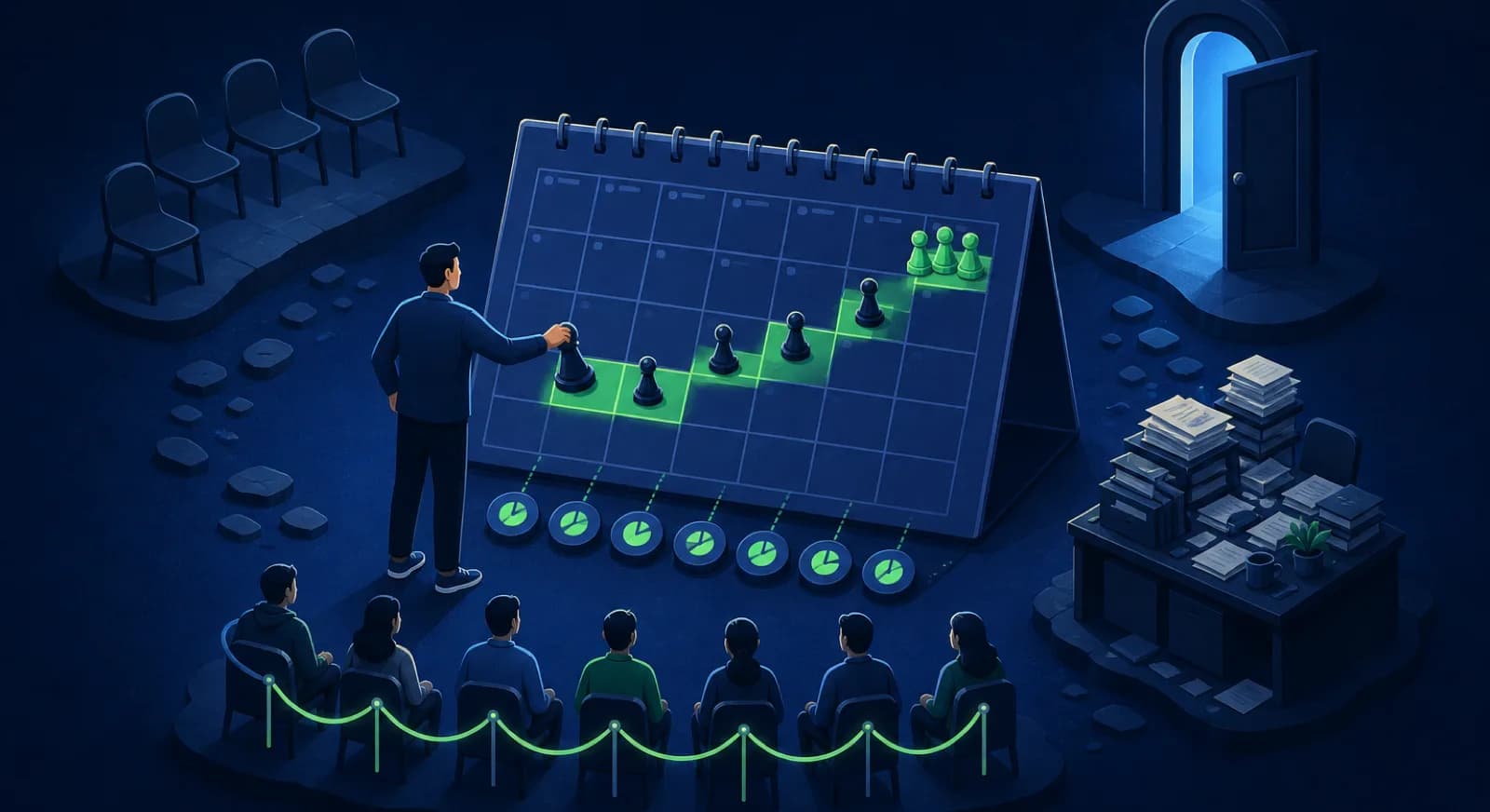
Retention belongs in a business plan because a student who leaves is a seat you must refill just to stand still. A simple test is average months a student stays multiplied by the monthly fee. At $120 a month and an average stay of 6 months, one student brings $720 in fees (illustrative). The surplus they leave after costs is lower than that, and it is the ceiling on what winning one student can sensibly cost. Track it with your own roster rather than an assumed rate: why students quit chess academies covers the causes, and the glossary entry on retention rate shows how to calculate it.
End the plan with the first ninety days: how you reach your first paying students, how you run and convert trial classes, and what you measure each week. Start with your own network and the families nearby, which cost least to reach. Use the launch guide to sequence launch tasks week by week, and treat the plan as a working model you check against real numbers and correct as they arrive.
Week of 12 October · all batches
0 conflictsMake-up credit · Mia G. · Sat 4:30 PM
Absent Thursday with notice · booked by Noor
Class reminders sent to 148 families
Timing changes update everyone at once
Frequently asked questions
How long should a chess academy business plan be?
Short enough that you keep updating it. Two or three pages that cover who you teach, what you charge, the economics of one batch, your acquisition test, cash timing and your first ninety days are worth more than a long document full of optimistic projections. The part that needs care is the numbers: cost your own time, enter real fee dates, and leave out growth you have not seen. Write the plan to make decisions, not to impress anyone.
What is the most important number in the plan?
The surplus of one batch after all listed costs, with your own time counted, together with its break-even seat count. Because almost every cost in an academy is booked per batch, the business is one batch repeated. If a full batch does not cover its coach, its space, its overhead share and your hours, the unit does not work, and adding batches does not fix it. Once one batch shows a surplus that survives a couple of dropouts, the rest is arithmetic.
What cash and retention risks should a chess academy plan test?
Test how long the batch takes to fill, whether paid seats hold between the first and second month, how late fees arrive, and whether your own hours match the plan. Costs such as coach pay and space are regular and immediate, while fees arrive on the dates families pay, so the account can run short even when the batch shows a surplus. The cash table in this guide finds the lowest closing balance. Each risk needs a signal you can watch and a decision made in advance.
Should I include the cost of my own time in the plan?
Yes, as a separate line. If you do not cost your own teaching and admin hours, the plan can look profitable only because you are unpaid. That hidden subsidy disappears the moment you hire someone to replace yourself. Put your time in at a rate you would accept, show the surplus before and after it, and you will see whether the batch earns its keep or whether you have built a job that pays less than the work is worth.
How much money do I need to start a chess academy?
Enough to cover the lowest closing balance in your three-month cash table, plus a buffer for a slow month. Costs begin on day one while revenue follows the dates families pay, so list opening cash, booked fees, deposits and payments, and read off the lowest point. An online academy run from home needs far less than a rented centre, but both need that sum done before launch rather than full batches assumed from month one.
Is there a chess academy business plan template I can use?
Yes. The tables on this page work as one: copy the seven-row worksheet, the batch table and the three-month cash table into a spreadsheet and fill them with your own entries. They hold prompts and blank fields rather than a forecast, so nothing in them is a price or a market figure for your city. Outside templates exist, but offers and prices change and some sit behind accounts, so check the current terms on the provider's own site.
Sources
- [1]Razorpay Subscriptions documentation · accessed 2026-07-15
- [2]UPI Autopay for Recurring Payments | NPCI · accessed 2026-10-16
- [3]Stripe Billing documentation · accessed 2026-07-15
- [4]Udyam Registration (Ministry of MSME) · accessed 2026-10-16
- [5]Goods and Services Tax portal · accessed 2026-10-16
- [6]How to Start a Chess Academy in 8 Steps (ZenBusiness) · accessed 2026-10-16
- [7]Chess Club Business Plan Template page (Avvale), startup cost estimates · accessed 2026-10-16
Written by Abhishek Tiwari
ChessCore
Drafted with AI, fact-checked and approved by a human before publishing, the same guardrail our product applies to every report it sends. Read our editorial standards.
Turn your academy plan into real numbers
ChessCore shows you fees collected, batch occupancy, and schedules in one place, so the assumptions in your business plan become numbers you can watch and act on.
- Roster import from the spreadsheets you already keep
- Lichess and Chess.com connections, batches, and fee plans
- First reports in week one, after your approval
- Free plan, no credit card required