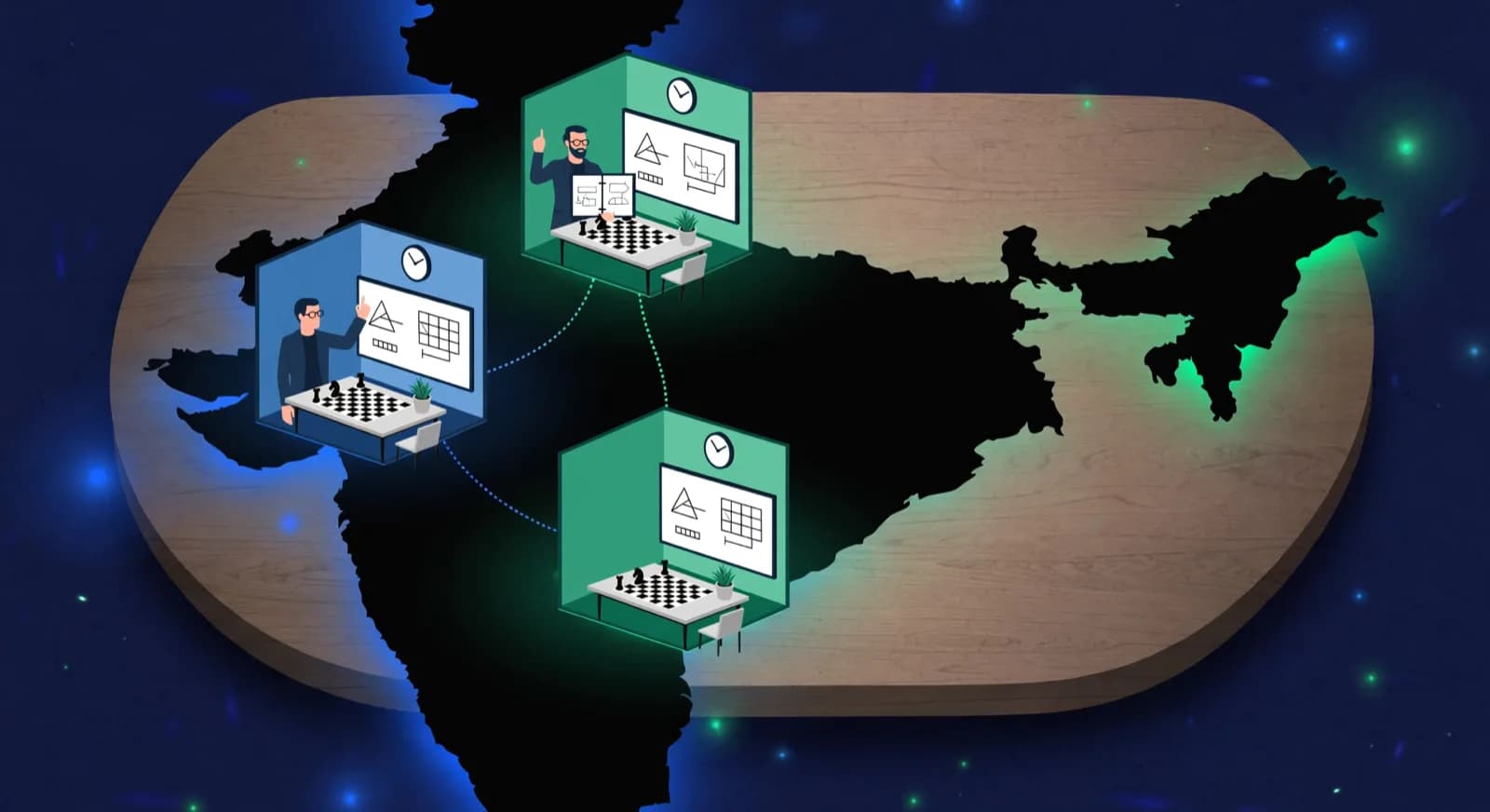
On this page9 sections, 18 min read
- What does starting a chess academy in India involve beyond the universal steps?
- How do you register a chess coaching business in India?
- How should you plan safeguarding when teaching children in India?
- When does GST apply to chess coaching fees?
- How do you affiliate with AICF and your state association?
- What cash must you have before the first batch?
- How should you set and collect fees in India?
- How do Indian academies handle parent communication?
- Should you start physical, online, or hybrid?
- Frequently asked questions
Bottom line
To start a chess academy in India, choose a business structure with a chartered accountant (a proprietorship or an LLP are both common), consider free Udyam MSME registration, and open a current account in the academy's name. Register for GST only once turnover nears 20 lakh rupees, 10 lakh in four states [9]. Set fees from your costs, collect over UPI AutoPay, and write a safeguarding policy before enrolling minors.
TL;DR
- The universal steps of starting an academy (curriculum, batches, first students) do not change in India; what changes is registration, tax, the federation pipeline, and how money and messages move.
- Decide the business structure with a local adviser rather than assuming one form; Udyam offers free MSME registration, while GST obligations need a separate check against your turnover and circumstances.
- Ask your state association about academy affiliation, player registration, and event approval separately; a student's FIDE rating comes from rated play.
- Set fees from your real costs and batch capacity, collect them as monthly UPI AutoPay mandates, and treat WhatsApp as the default channel parents actually read.
Key facts
- Udyam registration is the Government of India's online MSME registration; it is free, paperless, based on self-declaration, needs only an Aadhaar number, and classifies a micro enterprise at investment up to 2.5 crore rupees and turnover up to 10 crore rupees.[1]
- GST registration for a services business becomes mandatory above ₹20 lakh of aggregate turnover, or ₹10 lakh in Manipur, Mizoram, Nagaland and Tripura, per the GST Council registration flyer.[9]
- The All India Chess Federation is the national body for chess in India, and rated tournament play is organized through it and its affiliated state associations.[3]
- FIDE is the international chess federation; students earn FIDE ratings by playing FIDE-rated events, which in India sit under the AICF umbrella.[4]
- UPI AutoPay lets a parent approve a recurring mandate once, after which monthly fees debit automatically under NPCI's mandate framework.[5]
- WhatsApp Business is Meta's product line for businesses communicating with customers on WhatsApp, the channel most Indian parents already use daily.[6]
What does starting a chess academy in India involve beyond the universal steps?
Beyond the universal steps, starting a chess academy in India means handling four India-specific layers: business registration and tax, the federation pipeline through your state association and AICF, fee setting and collection in rupees over UPI, and parent communication that defaults to WhatsApp. Everything else, choosing a curriculum, structuring batches, finding your first ten students, pricing your own time, is the same everywhere, and we cover it in our guide to starting a chess academy. This page deliberately does not repeat that material.
Think of it as two checklists. The global checklist answers what any founder anywhere must do. The India checklist answers what a founder in Pune, Chennai, or Guwahati must additionally get right: which legal form to register, when the tax department starts caring about your turnover, how your strongest students get into rated tournaments, and why a collection method parents find awkward tends to leak fees month after month. The rest of this post walks the India checklist in the order you will actually face it.
How do you register a chess coaching business in India?
Choose the business structure with a chartered accountant who understands your proposed setup. A sole proprietorship is simple to run and common for a solo coach; an LLP or a private limited company suits co-founders, hired staff, or outside investment, at the cost of more filing. Discuss which registrations and banking documents you need before accepting fees in the academy's name, and how to keep personal and business records separate. Make this decision before signing a venue agreement, because the structure should fit the responsibilities you are taking on rather than being an administrative choice you revisit only after a problem.
Whatever the form, consider Udyam registration early. Udyam is the Government of India's online MSME registration: free, paperless, and based on self-declaration on the official portal at udyamregistration.gov.in, where an Aadhaar number is enough and no documents are uploaded [1]. A coaching academy comfortably fits the micro enterprise definition at the start, since the portal sets the micro ceiling at investment up to 2.5 crore rupees and turnover up to 10 crore rupees [1]. The certificate is a government record that your academy is a registered enterprise, which some banks and payment providers ask to see. Udyam does not replace a current account, a GST registration, or any local trade licence, so treat it as one registration among several rather than a single key that opens everything.
- Discuss the legal form with a chartered accountant, including ownership, liability, staffing, and record-keeping.
- Open a current account in the academy's trade name so fees never mix with personal money.
- Complete Udyam (MSME) registration on the official portal if it suits you; it is free, paperless, and self-declared, with an Aadhaar number enough and no documents uploaded [1].
- Check whether your state or municipality requires a local trade licence or Shops and Establishments registration for a physical centre.
- Keep a simple ledger of income and expenses from day one; your CA and your future GST filings will both depend on it.
One honest note on scope: none of this is legal or tax advice. Registration norms vary by state, and the right structure depends on your situation. Use this checklist to walk into a CA's office with good questions, not to skip the visit.
How should you plan safeguarding when teaching children in India?
Prepare a written child-safeguarding policy before enrolling minors. Ask a qualified local adviser about your legal duties and each partner school about its requirements for visiting coaches. Your policy should explain supervision, collection arrangements, communication boundaries, and how families can raise concerns. Give every coach the same procedure so a parent receives a clear answer regardless of who is teaching that day.
Build the policy around decisions staff will actually face, and name the person responsible for each. Who stays with a child whose parent is late, and where does that child wait? Who may collect a child, and what happens when a different adult arrives claiming to be the pickup: the standard answer is that the coach does not release the child until the registered guardian confirms the change in writing or by a call. Who hears a concern about a staff member, and who is the named safeguarding lead when that person is the subject of the concern? Agree those answers before the first class, name an alternate contact for when the usual lead is unavailable, review the arrangements with any school or venue that hosts your sessions, then share the relevant details with parents.
- Write a one-page policy: who may be alone with a child, how you handle toilets and pick-up, and how a parent reports a concern.
- Name one safeguarding lead and one alternate, and set the escalation route for a concern, including what to do when the concern is about the lead.
- Set a pick-up rule in writing: release a child only to a registered guardian, and require written or verbal confirmation from that guardian before handing the child to anyone else.
- Ask each partner school what background-check or volunteer clearance they require this year, and keep a copy of what you supplied.
- Ask a qualified local adviser to explain the reporting and child-protection duties that apply to your academy, and document the agreed response procedure.
- Prepare the policy before approaching a school, then ask what additional documentation its staff need.
When does GST apply to chess coaching fees?
GST applies to chess coaching once your aggregate turnover crosses the services threshold: ₹20 lakh a year, or ₹10 lakh if the business is in Manipur, Mizoram, Nagaland or Tripura, and the GST Council's registration flyer says service suppliers under that limit are exempt from registration even when they supply services outside their state [9]. Ask a chartered accountant how aggregate turnover is calculated for your business, because it counts all your taxable supplies across India, not only coaching fees. The CBEC flyer on education services from 2017 taxes commercial coaching at 18 percent (9 percent central tax plus 9 percent state tax) and states that private coaching centres, even if they call themselves educational institutions, are not treated as an educational institution for the exemption [8]. Confirm that the rate still applies on the day you register.
Below the threshold, you can run unregistered and keep things simple. Approaching it, you face a real pricing decision: GST charged on top of fees makes your sticker price higher than unregistered competitors, while absorbing it compresses your margin. If the 18 percent rate in the 2017 flyer still applies the day you register, model both 'add 18 percent on the card' and 'absorb 18 percent in the fee' before that day arrives [8]. Founders who think about this only after crossing the threshold end up raising fees mid-year, which is the worst time to do it.
Put the threshold in student terms, assuming coaching fees are your only taxable supply. At an illustrative 2,000 rupees a month per student, one student brings in 24,000 rupees a year, so 83 students all year is 19,92,000 rupees, just under the 20 lakh line, and 84 students is 20,16,000 rupees, just over it [9]. An academy with 48 students at that fee turns over 11,52,000 rupees a year and sits well below the line; one growing past about 70 students should be modelling GST pricing a term before it gets there. These are illustrative figures: ask a chartered accountant how aggregate turnover is calculated for your business, because it counts all taxable supplies across India, not only coaching fees.
How do you affiliate with AICF and your state association?
Contact your state association early to discuss player registration, academy affiliation, and event approval as separate questions. Tell the association whether you plan to teach classes, enter students in existing tournaments, or organise your own rated event. AICF is the national chess body in India [3]; its state-association network is the starting point for those conversations. Keep the answers with your operating documents so staff can give families accurate entry instructions.

Before promising rated tournament access, confirm what each student and event organiser must do. Ask the state association about current player registration, event approval, reporting deadlines, and any requirements specific to your proposed event. If you hope to host a rated open in a later year, discuss the process while planning your first season. Meanwhile, describe internal academy games clearly to parents: practice results and academy membership do not themselves confer a FIDE rating [4].
The rating pipeline itself runs one more level up. FIDE, the international federation, awards ratings based on results in FIDE-rated events [4], and in India those events sit under the AICF umbrella. A student's path is therefore: AICF player registration, then state and national rated events, then a published FIDE rating once they have qualifying results. No academy membership confers a rating, and any academy that implies otherwise is overselling. We walk the student-side journey, costs, and timelines in our guide to getting a FIDE rating in India.
- Locate your state association via aicf.in and ask about academy and player registration [3]
- Register tournament-ready students as players so they can enter rated events
- Track event calendars at state level; rated opens fill up early in strong districts
- Treat FIDE ratings as the outcome of rated play, never as something an academy grants [4]
What cash must you have before the first batch?
Before the first batch, hold enough cash to cover one-off purchases, any refundable deposit, and a few months of fixed costs while fees are still ramping. Keep those three in separate lines so you do not confuse a deposit you may get back with money you will spend. The worksheet below uses the same illustrative 60,000 rupees a month of fixed costs modelled in the fee section, which here includes your own target salary. If you do not pay yourself in the first months, strike that line and the run rate drops accordingly.
| Line | Illustrative figure | Working |
|---|---|---|
| One-off purchases | Your quotes | Boards, clocks, furniture, a computer for online teaching; a one-time spend, not a monthly cost |
| Refundable venue deposit | Your quote | Held by the landlord; recorded separately because it is not an expense |
| Monthly fixed cost | ₹60,000 | Same assumption as the fee section, including your target salary |
| Three months of fixed cost | ₹1,80,000 | ₹60,000 x 3, before any one-off purchases or deposit |
| Home or online variant | ₹1,35,000 | Rent of ₹15,000 removed leaves ₹45,000 a month; ₹45,000 x 3 |
Read the table as a floor, not a budget. Three months of the physical model is 1,80,000 rupees of fixed cost on its own; add your one-off purchases and the deposit on top, and subtract whatever fees you realistically expect to collect in those months. A home or online start removes the rent line and brings the three-month fixed cost to about 1,35,000 rupees, which is why many founders test demand that way first. Do not count the three-month cushion and the same monthly costs twice: the cushion is simply three repetitions of the monthly line, held as cash.
How should you set and collect fees in India?
Set fees from your costs, not from a number a competitor put on a poster. The arithmetic is short: add up your monthly fixed costs (rent if any, your own target salary, software, electricity, marketing), add per-student variable costs, decide a realistic batch size and how many batches you can actually teach well, and divide. The fee that covers all of that with margin is your floor. A fee copied from the academy across town tells you about their costs and their desperation, not about yours. Use local quotes for rent and equipment, and allow for partly filled batches while you build demand. Our guide to chess academy fees in India covers what goes into typical fee cards, and the fee structure guide covers admission fees, quarterly versus monthly billing, and sibling discounts.
| Line | Illustrative monthly figure | Working |
|---|---|---|
| Rent for a small room | ₹15,000 | Local quote; ₹0 if you teach online or in a school |
| Your own target salary | ₹40,000 | What you need to earn to keep doing this |
| Software, electricity, internet | ₹3,000 | Assumed |
| Marketing and trial classes | ₹2,000 | Assumed |
| Total fixed cost | ₹60,000 | Sum of the lines above |
| Seats you can teach well | 48 | 6 batches of 8 |
| Fee floor at full batches | ₹1,250 per student | ₹60,000 / 48 |
| Fee floor at 75 percent full | About ₹1,670 per student | ₹60,000 / 36 students |
Price from the 75 percent row, not the full row, because a new academy spends its first two terms with gaps in most batches. In this example a fee under about ₹1,670 means you are paying to teach until the batches fill. Swap in your own rent quote and salary, and the same three-line division gives your floor.
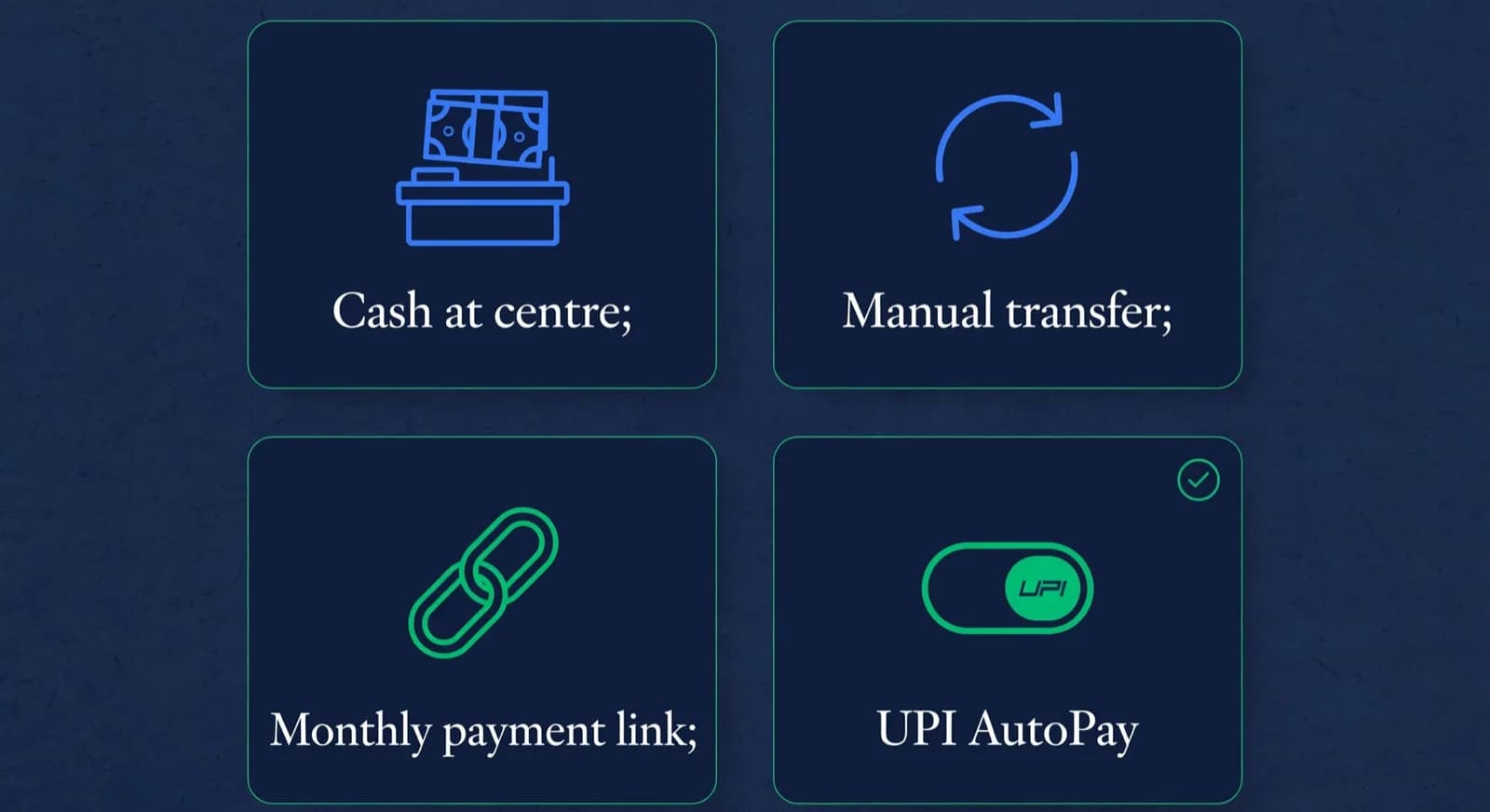

Collection is where India differs most from the Western playbook, and where friction costs a young academy real money. Cash adds reconciliation work and awkward reminder conversations, and one-off bank transfers depend on a parent remembering you on the 1st of every month, which some will not do reliably. The common Indian answer is UPI, and specifically UPI AutoPay: NPCI's mandate framework lets a parent approve a recurring debit once, on their own phone, after which the monthly fee is debited automatically on schedule until they revoke it [5]. A mandate reduces the chasing, but it is not a guarantee: a debit can still fail for insufficient balance or a bank issue, and a parent can pause or cancel the mandate, so you still watch for failed and lapsed debits each month.
In practice you will not integrate with NPCI directly. Payment providers such as Razorpay expose UPI AutoPay through their subscriptions product, where you define a monthly plan and the parent authorises the mandate against it [7]. Razorpay's subscriptions also run automatic retry logic on a failed charge and generate an invoice each cycle, so a single missed debit is retried rather than lost [7]. Whatever provider you choose, insist on three things: UPI AutoPay support, not just one-time UPI; automatic receipts to the parent on every successful debit; and a dashboard that shows who has paid, who has failed, and whose mandate has lapsed, so you can reconcile the failures by hand. Collection rate is one of the most underrated operational metrics in a young academy, because a sound academy with leaky collection looks worse on its bank statement than it really is.
| Collection method | Parent effort each month | Failure mode |
|---|---|---|
| Cash at the centre | Remember, withdraw, hand over | Missed classes mean missed payments; reconciliation by hand |
| Manual bank transfer | Remember and initiate | Forgotten transfers; chasing screenshots in chat |
| UPI payment link sent monthly | One tap, but every month | Links ignored in a busy inbox; you chase repeatedly |
| UPI AutoPay mandate | Approve once, then nothing | Occasional failed debits to follow up |

Fees · October · all batches
136 of 148 paidCollected · this term
92%Lucas M. · October · $180
Card AutoPay · receipt sent to Müller family
Mia G. · October · $180
Payment link opened in WhatsApp
Batch B2 · 12 of 14 paid
No bank-transfer screenshots needed
AutoPay mandates · 41 active
Renew monthly without reminders
Two policies to write down before your first admission: a due date with a defined grace period, and what happens after it (a polite pause on classes is standard and removes the personal awkwardness), and an annual fee revision month so increases are expected rather than negotiated family by family. Both are easier to enforce when the fee itself collects automatically and every payment generates a receipt the parent can see.
How do Indian academies handle parent communication?
On WhatsApp, because that is where Indian parents already are. In our experience, academy emails get read late or not at all, SMS reads to parents like OTP traffic, and a custom app is one more icon to install, while WhatsApp messages are usually read the same day. That is an operator observation, not a measured rate. WhatsApp Business is Meta's product line for exactly this: a business presence on the channel, with profiles, quick replies, and messaging tools designed for customer conversations [6].
The mistake is not choosing WhatsApp; it is running everything through one chaotic group. Class reminders, fee receipts, progress notes, and tournament logistics all have different audiences and different stakes. A workable starting split: one announcement group with replies restricted to admins for schedule changes and event news, individual chats for anything about a specific child (progress, fees, behaviour), and a strict rule that money conversations never happen in a group. Our guide to WhatsApp for chess academies covers templates, boundaries, and how to keep coach time from leaking into all-evening chat duty.
Should you start physical, online, or hybrid?
Start with the model your teaching approach and budget can support. For physical classes, check rent, travel distance, safe collection arrangements, and whether the room suits younger children. For online lessons, test the student's equipment, attention, and ability to use the board before committing to a regular batch. Hybrid teaching adds a second set of logistics, so give each format a purpose, such as classroom practice followed by online game review. Pilot the proposed timetable with a small group before expanding it.
| Model | Cost structure | Best first fit |
|---|---|---|
| Physical centre | Rent and fit-out dominate; local catchment | Founders with a strong local network and access to affordable space |
| Online only | Near-zero fixed cost; competition is national | Strong coaches with a niche, a rating, or content reach beyond their city |
| Hybrid | Modest space cost plus tooling | Established local batches adding online theory, game review, or holiday camps |
If you lean online, the operating playbook changes enough that we wrote it up separately in our guide to starting an online chess academy. And whichever model you pick, scheduling becomes the daily operational grind: batches, coach availability, make-up classes, and the inevitable exam-season pauses. How you run that grind week to week is the subject of our pillar on running a chess academy.
Week of 12 October · all batches
0 conflictsMake-up credit · Mia G. · Sat 4:30 PM
Absent Thursday with notice · booked by Noor
Class reminders sent to 148 families
Timing changes update everyone at once
Frequently asked questions
Is a chess academy franchise in India worth it?
Sometimes, but evaluate it like any business purchase rather than a shortcut. We do not name or endorse specific franchises. Judge any offer on stated criteria: what exactly the fee buys (curriculum, brand, leads, software, training), whether existing franchisees in comparable cities will speak to you, what the contract says about territory and exit, and whether the same money spent on your own curriculum and local marketing would buy more. A franchise transfers a playbook; it does not transfer students, coaching quality, or parent trust, which you must build locally either way.
Do I need AICF affiliation before I can start coaching?
Ask your state association which requirements apply to coaching, academy affiliation, player registration, and hosting rated events. These are different activities, so a player's registration should not be treated as an academy licence. Before advertising a rated event, confirm the event approval and reporting process with the association. For students entering an existing event, follow the organiser's published eligibility and registration instructions.
Can I run a chess academy from home in India?
A home setup may suit a small academy, but confirm the local rules before inviting students or accepting fees. Ask about housing-society restrictions, municipal requirements, safe access, supervision, and any documents needed for the business. Include internet, equipment, utilities, and your own teaching time in the budget even when there is no separate room rent. We suggest setting a clear capacity and reviewing it as demand grows; a full batch is not a reason to overcrowd the teaching space.
How much does it cost to start a chess academy in India?
Startup cost depends on your venue, equipment, staffing, and the cash you need before fees arrive. Build an estimate from actual quotes: deposit and rent, boards and clocks, furniture, software, insurance, and marketing. For online teaching, include a suitable computer, internet connection, and teaching setup. For a physical centre, add fit-out and recurring venue costs. Separate one-off purchases from monthly expenses, and allow for a period with partly filled batches. A borrowed room may reduce rent, but confirm access, storage, and supervision arrangements before relying on it. Set fees from this budget and the number of students you can teach well.
How do students at a new academy get FIDE ratings?
By playing FIDE-rated tournaments, which in India are organized under AICF and its state associations. The sequence is: register the player through the AICF system, enter rated events at state or national level, and the rating is published by FIDE once the player has the qualifying results. No academy can grant or fast-track a rating; an academy's role is preparing students and keeping them on the rated-event calendar.
Sources
- [1]Udyam Registration portal, Government of India MSME registration · accessed 2026-06-10
- [2]Goods and Services Tax portal, Government of India · accessed 2026-06-10
- [3]All India Chess Federation · accessed 2026-06-10
- [4]FIDE, International Chess Federation · accessed 2026-06-10
- [5]UPI Autopay for Recurring Payments | NPCI · accessed 2026-10-16
- [6]WhatsApp Business · accessed 2026-06-10
- [7]Razorpay Subscriptions documentation · accessed 2026-06-10
- [8]CBEC flyer on Education Services under GST, 2017 (18 percent; private coaching not an educational institution) · accessed 2026-10-16
- [9]GST Council flyer: Registration under GST Law (services threshold ₹20 lakh, ₹10 lakh in four states) · accessed 2026-10-16
Written by Abhishek Tiwari
ChessCore
Drafted with AI, fact-checked and approved by a human before publishing, the same guardrail our product applies to every report it sends. Read our editorial standards.
Run the India playbook without the spreadsheets
ChessCore handles UPI AutoPay fee collection, batch scheduling, and WhatsApp parent updates in one place, so a new academy runs like an established one from month one.
- Roster import from the spreadsheets you already keep
- Lichess and Chess.com connections, batches, and fee plans
- First reports in week one, after your approval
- Free plan, no credit card required