On this page6 sections, 13 min read
- Does GST apply to chess coaching in India?
- What GST rate applies to private chess coaching?
- When does GST registration become mandatory?
- What about online students in other states or abroad?
- Should you add GST on top of chess coaching fees?
- How do you stay GST-compliant once registered?
- Frequently asked questions
Bottom line
A for-profit chess academy in India usually has no GST exemption for coaching: the sports-coaching entry covers only charitable entities registered under section 12AA or 12AB [10]. The residual rate is 18 percent in total [11], and registration starts once financial-year turnover passes Rs 20 lakh (Rs 10 lakh in special category states) [12]. Confirm your case with a CA.
TL;DR
- A private academy that is not a charitable entity registered under section 12AA or 12AB has no sports-coaching exemption to rely on, so its coaching fees are generally taxable [10].
- Registration turns on aggregate turnover counted over a financial year, 1 April to 31 March, not over the last twelve months [12].
- At 18 percent, a Rs 4,500 fee is Rs 5,310 if you add GST on top, or Rs 3,813.56 plus Rs 686.44 of GST if the Rs 4,500 already includes it. These are arithmetic illustrations, not advice.
- Composition, inter-state relief and export of services each have conditions that decide whether they fit your academy, so bring the facts to an adviser before you copy a rule.
- This is general background only; confirm current thresholds, rates and your own case with a chartered accountant and the official GST portal.
Key facts
- Entry 80 of Notification 12/2017-Central Tax (Rate), as substituted by Notification 04/2022 from 18 July 2022, exempts training or coaching in sports only when it is provided by charitable entities registered under section 12AA or 12AB of the Income Tax Act.[10]
- The consolidated rate notification taxes recreational, cultural and sporting services outside its named exceptions at 9 percent central tax, which is 18 percent once state tax is added.[11]
- Section 22 of the CGST Act makes a supplier liable to register when aggregate turnover in a financial year exceeds Rs 20 lakh, or Rs 10 lakh for suppliers in special category states.[12]
- The CBIC rate-notification index lists the composition scheme for suppliers of services as 6 percent for a supplier whose turnover in the preceding year was up to Rs 50 lakh.[9]
- Registration under section 12AB alone does not exempt every service; the exemption entries name the specific activities they cover.[6]
- Udyam registration, the Ministry of MSME's process for recognising a small enterprise, is separate from GST registration and runs on its own portal.[2]
Does GST apply to chess coaching in India?
Usually yes, for a for-profit academy. The exemption that names sports coaching is entry 80 of Notification 12/2017-Central Tax (Rate). Since Notification 04/2022 replaced it from 18 July 2022, it covers training or coaching in sports only when a charitable entity registered under section 12AA or 12AB of the Income Tax Act provides it [10]. The arts-or-culture limb of the same entry is the one that mentions individuals, and it does not mention sports [10]. An academy that is not such a charitable entity therefore has no sports-coaching exemption to rely on. Whether chess coaching counts as sports coaching for that entry is a classification question for your chartered accountant. This guide assumes it does, as the 2017 ChessBase India reading did [7].
The rate follows from that. The consolidated rate notification taxes recreational, cultural and sporting services that are not one of its named exceptions at 9 percent central tax, which is 18 percent once the matching state or integrated tax is added [11]. That consolidated text on the GST Council site is dated 1 April 2019, so check later amendments on the portal before you rely on it [1]. Education services under heading 9992 also sit at 18 percent, and the GST Council education flyer puts private coaching institutes outside the educational-institution exemption because their training does not lead to a recognised qualification [6]. Either route lands on the same rate, so the practical question is exemption and registration rather than which heading to quote.
Do not stretch a charity registration into a blanket exemption. Registration under section 12AB does not exempt every service an entity sells: the sports entry covers coaching in sports, and the separate charitable-activities entry covers only the activities the notification defines [6] [10]. Notification 07/2021-Central Tax (Rate) added the words "or 12AB" to serial number 1 of Notification 12/2017, which carried the older section 12AA wording forward to the newer registration [9]. A school's exemption does not carry over to a nearby academy either. The flyer defines an educational institution by pre-school to higher secondary education, a recognised qualification or an approved vocational course [6]. Ask your chartered accountant to test the lessons you actually sell against these entries and keep that advice with your registration papers.
Registration is a separate step from the rate, and the figures come from the Act. Section 22 of the CGST Act makes a supplier liable to register when aggregate turnover in a financial year exceeds Rs 20 lakh, or Rs 10 lakh in the special category states [12]. Section 2(6) defines aggregate turnover as the all-India total of taxable supplies, exempt supplies, exports and inter-state supplies for one PAN, leaving out the taxes themselves [12]. The CBIC GST FAQ repeats the Rs 20 lakh and Rs 10 lakh limits, and also says a person engaged in inter-state supplies is liable to register [8]. For service suppliers, Notification 10/2017-Integrated Tax gives relief to inter-state suppliers who stay under the same limits, so read the FAQ answer together with that notification and confirm its current text. There is also a composition scheme for service suppliers at 6 percent, 3 percent central plus 3 percent state, where turnover in the preceding financial year was up to Rs 50 lakh [9].
| GST point for a service supplier | What to check as of 16 October 2026 | Official source |
|---|---|---|
| Sports-coaching exemption | Entry 80 covers sports coaching only by charitable entities registered under section 12AA or 12AB | Notification 04/2022-Central Tax (Rate) [10] |
| Rate when no exemption applies | 9 percent central tax plus the matching state or integrated tax, 18 percent in total, for the residual recreational and sporting heading | Consolidated Notification 11/2017, version dated 1 April 2019 [11] |
| Registration threshold (most states) | Rs 20 lakh aggregate turnover in a financial year | CGST Act, section 22 [12] |
| Registration threshold (special category states) | Rs 10 lakh aggregate turnover in a financial year | CGST Act, section 22 [12] |
| Inter-state service supplier below the threshold | Relief from the inter-state registration trigger under Notification 10/2017-Integrated Tax; confirm the current text | CBIC GST FAQ [8] |
| Composition option for services | 6 percent for a supplier with turnover up to Rs 50 lakh in the preceding financial year; check the notification's conditions first | CBIC rate-notification index [9] |
What GST rate applies to private chess coaching?
Where no exemption applies, the rate is 18 percent: 9 percent central tax plus 9 percent state tax inside one state, or 18 percent integrated tax on an inter-state supply. The consolidated rate notification sets 9 percent central tax for the residual recreational, cultural and sporting services item [11], and the GST Council flyer gives the same 18 percent for education services outside the exemption, citing serial no. 30 of Notification 11/2017 dated 28 June 2017 [6]. Treat both as the rate for the common case, not a guarantee for yours.
A 30 June 2017 ChessBase India article read the sports-coaching position the same way: charitable entities registered under section 12AA or 12AB were treated as exempt, while other entities above the then threshold were described as liable at 18 percent [7]. That article predates the 2022 substitution of entry 80, so treat it as a 2017 interpretation, not a current official circular. The Wikipedia overview of GST in India is a reasonable map of the system, but it is not a source for a rate [5].
When does GST registration become mandatory?
Registration becomes mandatory when your aggregate turnover for a financial year passes the limit, Rs 20 lakh in most states and Rs 10 lakh in special category states [12]. The financial year runs from 1 April to 31 March, so the number to watch is your running total since 1 April, not your last twelve months. Because aggregate turnover also counts exempt supplies and exports, it can be larger than the fees you invoice at 18 percent [12]. An academy that adds up income every month sees the line coming. One that reconciles once a year meets it by accident.

- Keep a clean monthly record of fee income from day one, and total it from each 1 April.
- Confirm the current limit for your state and the definition of aggregate turnover with a CA and on gst.gov.in [1] [12].
- Watch the trend as well as the total, so the limit is visible a quarter or two ahead.
- Decide your pricing response before the month registration becomes due.
Turnover is the usual trigger for a single-location academy, but not the only one. Inter-state supplies, a second state and a shared PAN across several businesses can each change the answer, so confirm your own obligation instead of assuming the limit is the whole story [8] [12]. Plan your registrations as a set: GST, Udyam and, for players, AICF and FIDE registration are separate processes with separate owners. Udyam is the Ministry of MSME's enterprise registration [2], and completing it does not complete GST registration. Our guide to getting a FIDE rating in India covers the player side, and our guide to starting an academy in India helps you plan academy registrations in order.
What about online students in other states or abroad?
Online lessons make the question harder, not easier. For services delivered online, section 13 of the IGST Act sets the place of supply, and the default is the location of the recipient, while lessons that need the student's physical presence follow where they are performed [13]. Whether a lesson to a student abroad counts as an export of service depends on several conditions in section 2(6) of the IGST Act, including where the recipient is located and how the payment arrives, and zero-rating then runs through a Letter of Undertaking or a refund claim [13]. That source is the 2017 Bill text on the CBIC site and the Act has been amended since, so use it to learn the questions, not to decide the answer. Do not assume a lesson is zero-rated because the payer lives abroad.
- Who is the recipient: the child, or the parent who pays, and where is each located.
- How the lesson is delivered: live video with a coach, or recorded material.
- What currency the money arrives in, and the bank or gateway entry that shows it.
- Which state each domestic student is in, for inter-state supply.
- Whether your turnover already puts you near the registration limit.
Take that list, your invoices and a few sample payment entries to your adviser. The answer is theirs to give, from the current text of the Act and notifications.
Should you add GST on top of chess coaching fees?
Once you must charge GST, you either add it on top of the fee or you treat the fee as already including it. The two give different amounts in your bank account. Take a Rs 4,500 monthly fee, the October fee of Demo Chess Academy, a made-up academy, and assume 18 percent only for the arithmetic. If you add GST on top, the family pays 4,500 x 1.18 = Rs 5,310, of which Rs 810 goes to the tax. If the Rs 4,500 must include GST, the taxable fee is 4,500 / 1.18 = Rs 3,813.56 and the GST is Rs 686.44, so you keep Rs 686.44 less per fee. Figures are rounded to the paisa, and they are illustrations, not a customer invoice or a margin forecast.
| Approach when GST applies | Family pays per month | Taxable fee | GST at 18 percent | Academy keeps before costs |
|---|---|---|---|---|
| Add GST on top of Rs 4,500 | Rs 5,310.00 | Rs 4,500.00 | Rs 810.00 | Rs 4,500.00 |
| Keep the Rs 4,500 fee and include GST in it | Rs 4,500.00 | Rs 3,813.56 | Rs 686.44 | Rs 3,813.56 |
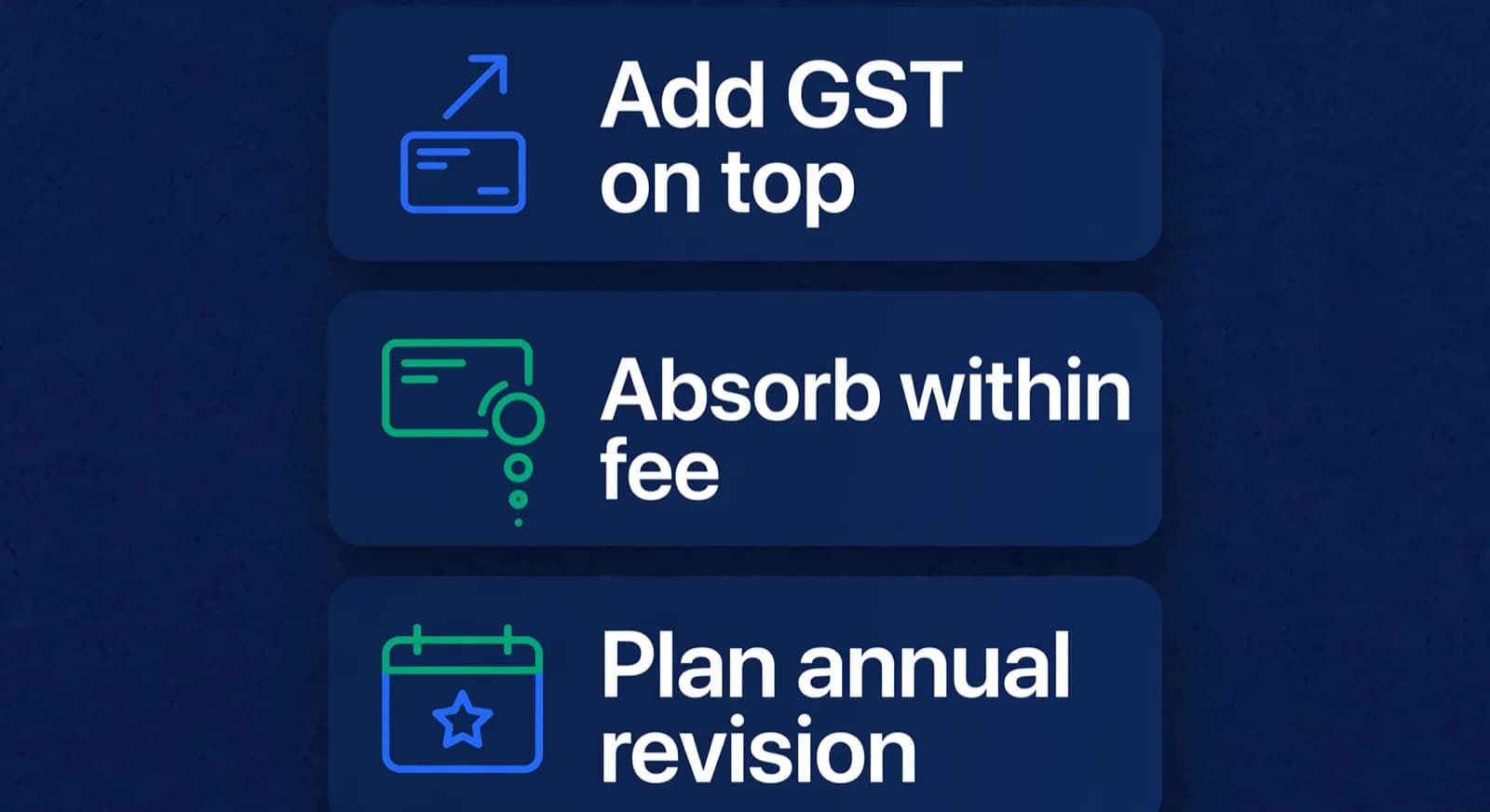
The first row raises the sticker price above an unregistered rival's by Rs 810. The second leaves the price at the door but cuts what you keep by about 15 percent (686.44 / 4,500). Neither is a rule. Founders who decide only after crossing the limit end up raising fees mid-year, which parents experience as a sudden increase. Choose while you are still below the line, and set an annual revision month so any change is expected. Our fee-structure guide helps you decide how tax changes your fee card, and our guide to chess academy fees in India helps you compare coaching fee quotes.
Composition is not simply another way to add a tax rate. Before you model it, check the preceding-year turnover test, whether you may make inter-state supplies, whether you may collect tax from families separately and whether you can claim input tax credit, because the notification attaches conditions to each [9]. A registered business on the normal scheme can offset GST paid on eligible purchases against the GST it collects, but which purchases qualify depends on what you buy and how it is invoiced. Ask your CA to model the credit and the registration decision together.

Fees · October · all batches
136 of 148 paidCollected · this term
92%Lucas M. · October · $180
Card AutoPay · receipt sent to Müller family
Mia G. · October · $180
Payment link opened in WhatsApp
Batch B2 · 12 of 14 paid
No bank-transfer screenshots needed
AutoPay mandates · 41 active
Renew monthly without reminders
How do you stay GST-compliant once registered?
After registration, GST is a rhythm of correct invoicing and periodic filing. Academies that find it painless are the ones whose fee records were already clean. If every fee a parent pays produces a dated receipt and income is recorded as it arrives, a filing period is a matter of compiling what you already have. If fees arrive as cash and scattered transfers reconciled from memory, each period becomes a scramble.
A recurring UPI AutoPay mandate is one example of income landing as dated transactions. NPCI describes UPI AutoPay as recurring payments that debit on a schedule once a payer approves the mandate [4]. Approval does not guarantee collection: Razorpay's subscription documentation says a scheduled debit can fail, for example on insufficient balance or a cancelled mandate, and a subscription that exhausts its retries moves to a halted state where invoices must be charged manually [3]. A mandate also does not decide whether you owe tax. For the threshold, the rate and your filings, verify on gst.gov.in and consult a CA [1].
Frequently asked questions
Is chess coaching exempt from GST in India?
Generally not for a for-profit academy. Entry 80 of Notification 12/2017 exempts sports coaching only when a charitable entity registered under section 12AA or 12AB provides it, and its arts-or-culture limb for individuals does not mention sports [10]. The GST Council flyer also places private coaching institutes outside the educational-institution exemption [6]. Whether chess counts as sports coaching for entry 80, and whether a charity registration covers your lessons, are questions for a chartered accountant with your papers in hand.
When does a chess academy need to register for GST?
When aggregate turnover for a financial year exceeds Rs 20 lakh, or Rs 10 lakh in special category states [12]. The year runs from 1 April to 31 March, and aggregate turnover counts exempt supplies and exports as well as taxable fees. Inter-state supplies and several businesses under one PAN can change the answer, and Notification 10/2017-Integrated Tax gives some relief to small inter-state service suppliers [8]. Track income monthly and ask your CA to confirm the limit for your state.
Should I add GST on top of fees or absorb it?
It is a business choice, not a rule. On a Rs 4,500 fee at 18 percent, adding GST gives Rs 5,310 for the family and leaves you Rs 4,500. Keeping Rs 4,500 as the total price leaves you Rs 3,813.56, because Rs 686.44 is tax. Decide before you cross the limit, plan an annual revision month, and ask your CA to include input tax credit on eligible purchases and any composition eligibility.
Do I need a chartered accountant for GST?
For anything specific, yes. Exemption entries, composition conditions, inter-state and overseas students, invoicing rules and input tax credit all depend on facts about your academy that a guide cannot see. Use this page for background and the questions to ask, then spend a paid hour with a chartered accountant before you approach the limit, and check current rates on the official GST portal.
Does GST work differently for an online chess academy teaching students in other states or abroad?
It can. Place of supply for online lessons defaults to the recipient's location, and a lesson to a student abroad is an export of service only if all the Act's conditions are met, including where the recipient is located and how payment arrives [13]. Do not assume zero rating because the payer lives abroad. Bring student locations, invoices and payment entries to your adviser, and see our guide to starting an online chess academy for the teaching side.
Is Udyam registration the same as GST registration?
No. GST registration concerns tax obligations once turnover passes the limit, while Udyam is the Ministry of MSME's process for recognising a small enterprise. They run on separate portals with separate criteria, and completing one does not complete the other [2].
Sources
- [1]Goods and Services Tax portal, Government of India · accessed 2026-07-15
- [2]Udyam Registration portal, Ministry of MSME, Government of India · accessed 2026-07-15
- [3]Razorpay Subscriptions documentation · accessed 2026-07-15
- [4]UPI Autopay for Recurring Payments | NPCI · accessed 2026-10-16
- [5]Goods and Services Tax (India), Wikipedia · accessed 2026-07-15
- [6]GST on Education Services, GST Council flyer · accessed 2026-10-02
- [7]Impact of GST on Indian Chess, ChessBase India, 30 June 2017 · accessed 2026-10-02
- [8]Frequently Asked Questions on registration, CBIC GST (Government of India) · accessed 2026-10-16
- [9]Central Tax (Rate) Notifications, CBIC GST (Government of India) · accessed 2026-10-16
- [10]Notification No. 04/2022-Central Tax (Rate), GST Council · accessed 2026-10-16
- [11]Consolidated Notification No. 11/2017-Central Tax (Rate), version dated 1 April 2019, GST Council · accessed 2026-10-16
- [12]Central Goods and Services Tax Act, 2017 (updated to 1 August 2021), CBIC GST · accessed 2026-10-16
- [13]Integrated Goods and Services Tax Bill, 2017 (as introduced), CBIC GST · accessed 2026-10-16
Written by Abhishek Tiwari
ChessCore
Drafted with AI, fact-checked and approved by a human before publishing, the same guardrail our product applies to every report it sends. Read our editorial standards.
Keep fee records GST-ready from day one
ChessCore collects recurring fees with an automatic receipt on every payment, so clean records make any future GST filing routine rather than a scramble.
- Roster import from the spreadsheets you already keep
- Lichess and Chess.com connections, batches, and fee plans
- First reports in week one, after your approval
- Free plan, no credit card required