Chess Student Dropout: The Early-Warning Signals

Chess student dropout signals: a weekly table and playbook to spot the four early signs, run the right save play, and act before the quit notice.
By the ChessCore team · Published June 24, 2026 · Updated August 13, 2026 · 10 min read
Bottom line
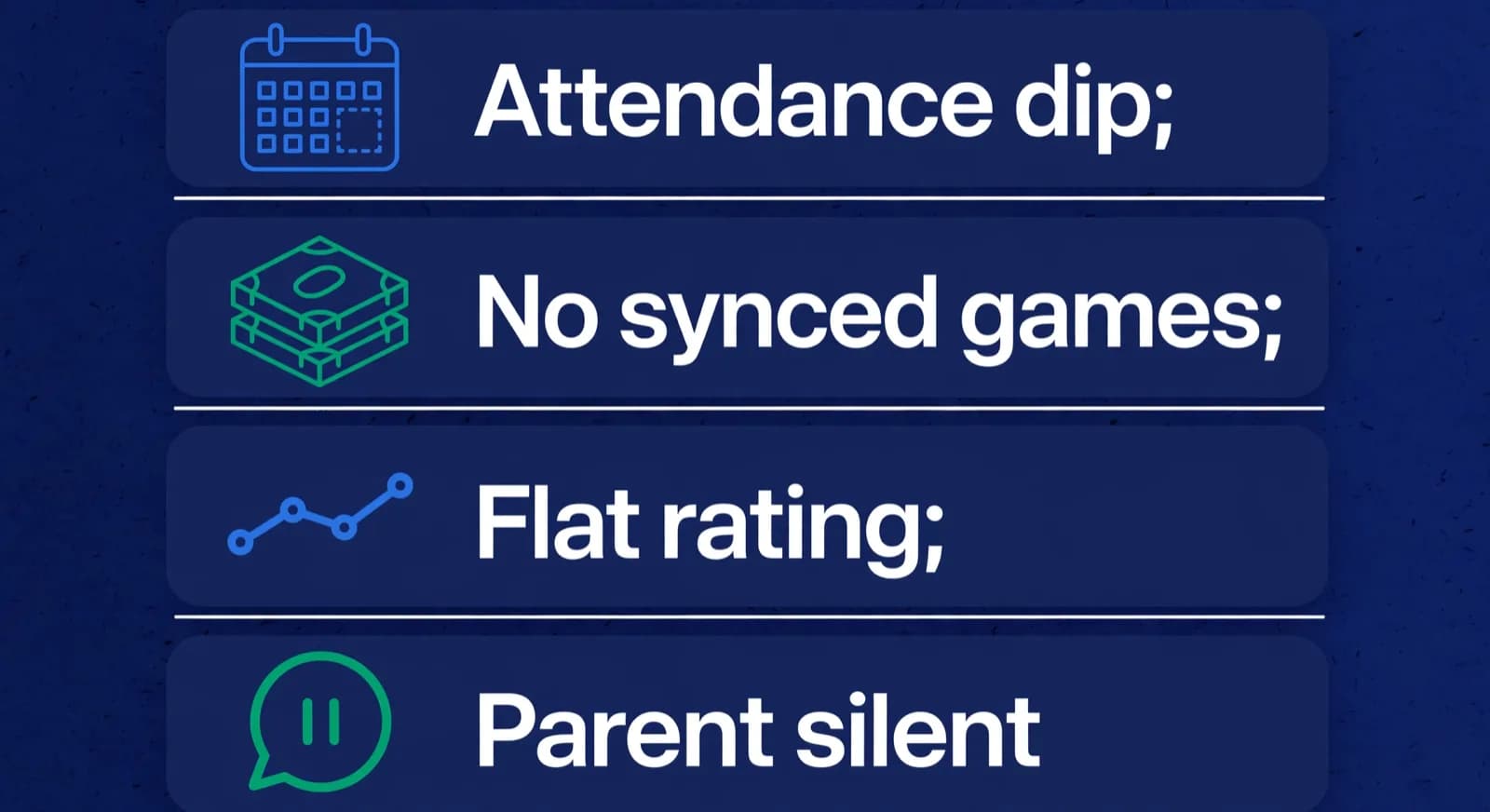
Chess students rarely drop out on the day they say they will. Dropout is a multi-week drift you can read in records you already keep: attendance thins, games stop appearing online, the rating goes flat with no review, and the parent goes quiet. Academies that watch four signals weekly and run a specific intervention for each one keep most drifting families, and let the rest leave gracefully so they still refer you.
TL;DR
- Dropout is a four-to-eight-week drift, not a single decision, so there is a real window to intervene before the family formally leaves.
- Four early signals predict a quit: an attendance dip, no synced games for two weeks, a flat rating with no review loop, and a parent who stops replying.
- Each signal maps to one specific save play, so spotting drift is only useful if it is paired with a scripted intervention you actually run.
- Some dropouts are correct; a graceful exit with a progress summary keeps the family recommending you instead of warning other parents away.
Key facts
- The dropout pattern operators see runs in order: interest fades, attendance dips, homework stops, the parent goes quiet, then the quit notice, usually across four to eight weeks. (operator observation)
- Elo-style ratings only climb when results beat expectation, so an improving student can sit at a flat number for weeks while their actual skill consolidates. (elo)
- The Lichess API exposes a player's recent games, so an academy can see whether a student has played at all in a given week without asking the family. (lichess-api)
- An intervention that opens with specific evidence of the child's progress invites a more honest reply than one that opens with a complaint about missed classes. (operator practice)
- A graceful exit, with a short progress summary and a route back, turns a departing family into a referral source rather than a critic. (operator practice)
What actually causes chess students to drop out?
Dropout messages almost always cite school workload, but workload is rarely the real cause; it is the socially easy reason to give. Underneath it, most departures trace to one of a small set of drivers, and naming them honestly is the first step to preventing the avoidable ones. A student leaves because the value stopped being visible, because a plateau went unexplained, because logistics got too hard, because money felt uncertain, or because they had no friend in the room.
The trap is treating all five as equally fixable. They are not. Invisible progress is almost entirely within your control: the improvement is real and already in the student's games, and the only missing step is showing a parent the evidence. Social disconnect is the least fixable, because you can place a child with peers and run team events but you cannot manufacture a friendship. Spending your retention effort proportionally, most of it on making progress visible, very little on the things you cannot change, is what separates academies that hold their rosters from those that quietly bleed students every term. Our pillar guide to running a chess academy frames the wider operating system this fits inside.
Dropout is a communication failure more often than a coaching failure
In the common case the child is genuinely improving, but nobody showed the parent. The parent sees an unchanged rating and a recurring fee, the child stops talking about chess at home, and the family concludes the money is wasted. Nothing about the coaching was wrong; the evidence simply never travelled from the board to the parent.
Which dropout signals should you track every week?
Four signals, scanned once a week across the whole roster, catch most drifting students while there is still time to act. Each one is a proxy for a stage of the drift, and the value of the table below is that it pairs every signal with the single intervention that fits it, so detection always has a matching action rather than a vague worry.
| Early signal | What it usually means | The matching save play |
|---|---|---|
| Attendance dip: two misses in three weeks | Logistics or fading interest starting to bite | A warm logistics check-in, not a warning; offer a make-up slot |
| No synced games for two weeks | Student has stopped playing between classes | Set a short game-based homework task and a review date |
| Flat rating, no recent review | Plateau frustration building with no counter-narrative | Run a game review, then send the parent a plateau explainer |
| Parent stops replying to updates | Family quietly disengaging before deciding to leave | Send one evidence-led message and offer a five-minute call |
The weekly scan only works if the underlying records exist, which is why attendance discipline and game syncing are retention infrastructure rather than admin chores. The Lichess API makes the games signal visible automatically: an academy can see whether a child has played at all in a week without asking anyone. The habit itself takes about fifteen minutes: read the roster, flag every student showing two or more signals, and book exactly one conversation per flagged family that week. Our attendance tracking guide covers the register side, and our guide to building homework from games covers turning the games signal into a task students actually do.
Aarav R.
Batch B2 · Tue/Thu · joined Aug 2025
1395
Rapid · synced from Lichess
Won vs. 1410 · French Defense
Best gameMissed fork on move 23
Homework setWhat does the intervention playbook look like in practice?
An intervention has a fixed shape regardless of which signal triggered it: lead with specific evidence of the child's chess, ask one open question that lets the family name the real problem, and offer one low-effort next step. The order matters. A message that opens with attendance reads as a demand and invites a defensive reply; a message that opens with something true and specific about the student reopens a conversation the family had been quietly closing.

- 1Open with proof you are paying attention: one concrete observation from the student's recent play, named precisely, not a generic compliment.
- 2Name the signal plainly but warmly: that you have missed them on Thursdays, or that you have not seen new games this fortnight.
- 3Ask one open question that surfaces the cause: is the slot still working, has something changed at home, is the workload heavy right now.
- 4Offer one easy next step matched to the likely cause: a make-up slot, a review session, or a five-minute call if that is simpler for the parent.
- 5Log the outcome on the student record so the next weekly scan knows whether this family is recovering or still drifting.
The drift intervention, word for word
Hi, wanted to share something from review: in her game last Tuesday, Meera found a knight manoeuvre to a strong outpost that we only worked on last month, and she set it up unprompted. That carry-over is exactly what we coach for. Separately, we have missed her the last two Saturdays. Is the slot still working for you, or should we look at moving her? Happy to call for five minutes if that is easier.
Send it where the family already lives, which for most academies is WhatsApp, not email, because that is where a reply costs the parent ten seconds rather than ten minutes. Then route by the answer. If the reply names schedule trouble, offer the make-up class. If it names money, show progress before discussing price, since a discount offered to a family that doubts the value simply confirms the doubt. If it names genuinely fading interest after a fair run, you have reached the honest case the next section covers. Our guide to running parent communication over WhatsApp covers the channel discipline that keeps these messages from drowning in a chaotic group.
When should you let a student go, and how?
Some dropouts are correct, and fighting them costs you more than the lost fee. A student who has genuinely lost interest after a real run, or one drowning in exam-year workload, is not a retention failure; they are a person whose priorities changed. Retention plays aimed at these families read as sales pressure, and sales pressure is the thing former customers remember and repeat when another parent asks them about your academy.

The graceful exit has three parts. First, accept quickly and warmly with zero guilt, and thank the family for the seasons they gave you. Second, send a short summary of what the student actually achieved: the rating arc, the skills built, one memorable game, so the chapter closes with proof it was worth it. Third, leave a specific route back, such as a holiday camp or a casual club night, because lapsed students who return are the cheapest enrolments you will ever get. A family that leaves well tells other parents the academy was excellent but their child moved on; a family that leaves through friction tells other parents about the friction.
March progress report · Aarav R.
1 of 14 drafts for Batch B2
Aarav attended 11 of 12 classes this month and played 18 rated games, moving from 1348 to 1395.
His endgame conversion improved clearly. Next month the focus is back-rank defense, based on the mistakes tagged in his last three games.
Highlighted numbers come from your attendance and rating records. The AI cannot change them.
Goes to the Sharma family after approval
How does showing progress prevent dropout at the source?
Making progress visible attacks the most common and most fixable dropout driver directly. It converts the parent's experience from paying for an invisible service into watching a documented climb. The fee stops being a monthly question the moment the parent can see what it bought, and a plateau stops being scary the moment it sits on a chart next to the climbs that came before it. This is prevention rather than rescue: it works before any signal fires, which is why it belongs in your default operating rhythm and not only in your intervention toolkit.

Ratings alone are not enough, because ratings lag skill by design. The evidence that lands with parents is layered: the rating trend for the long arc, an annotated position from a real game for the proof of skill, and a one-line coach observation for the human signal. Sent on a fixed monthly cadence, this beats a brilliant report sent once and never again, because retention is won by predictability more than by polish. Our guide to showing parents rating progress and our full guide to chess progress reports cover the formats; the discipline that matters here is simply that the evidence goes out every month, on time, for every student. The student progress tracking feature keeps all of it on one timeline so the monthly note writes itself from real data.
Where AI fits, and where it must not
ChessCore can draft the monthly parent update and the drift intervention from the student's real attendance, synced games, and rating trend, so a coach is editing rather than writing from scratch. But every message waits in an approval queue, and a human coach approves each send. AI accelerates the cadence that prevents dropout; it never speaks to a family unreviewed.
Frequently asked questions
What is the most common reason chess students drop out?
In practice it is invisible progress: the child is genuinely improving, but nobody showed the parent the evidence. The parent sees an unchanged rating number and a recurring fee, the child stops mentioning chess at home, and the family concludes the money is wasted. The improvement was real and already sitting in the student's games; the only failure was that the evidence never travelled from the board to the parent. That is why making progress visible on a fixed cadence prevents more dropouts than any other single habit.
How early can you predict that a chess student will drop out?
Usually four to eight weeks before the family formally leaves. Dropout is a drift, not a decision: interest fades, attendance thins, online games stop appearing, the rating goes flat with no review, and the parent stops replying. Each of those stages is visible in records you already keep, so a weekly scan of attendance, synced games, and rating movement flags a drifting student while there is still time to intervene rather than after the quit notice arrives.
Should you offer a discount to keep a student from dropping out?
Rarely. If the real driver is invisible progress or an unexplained plateau, a discount confirms the family's suspicion that the service was overpriced and only delays the exit. Show evidence of progress first, and fix schedule friction with a make-up slot if that is what the family names. Reserve fee flexibility for genuine hardship, where it builds loyalty, rather than using it as a general retention lever, where it quietly erodes your pricing and trains families to expect it.
Is a rating plateau a real cause of chess dropout?
It is one of the most common triggers, but the underlying cause is almost always that nobody explained the plateau. Elo-style ratings only rise when results beat expectation, so improving players routinely sit at a flat number while their skill consolidates. Families who have seen that explained, with their own child's games as evidence, generally ride the plateau out. Families who watch a flat number in silence read it as wasted money and start drafting the quit message in their heads.
When is dropping out the right call for a chess student?
When interest is genuinely gone after a fair run, or when school workload makes the commitment unhealthy, leaving is correct and should be made easy. Accept warmly, send a short summary of what the student achieved, and leave a specific route back such as a holiday camp. A graceful exit keeps the family recommending the academy at the school gate; a pressured one creates a critic who tells other parents about the friction rather than the chess.
Sources
- [1]Elo rating system · accessed 2026-06-24
- [2]Lichess.org API documentation · accessed 2026-06-24
Written by the ChessCore team
Drafted with AI, fact-checked and approved by a human before publishing, the same guardrail our product applies to every report it sends. Last updated August 13, 2026. Read our editorial standards.
Catch dropout signals before the quit notice
ChessCore puts attendance, synced games, and rating trends on one student record, flags drifting students weekly, and drafts the parent interventions a coach approves before they send.
Get started