On this page8 sections, 17 min read
- Do you have a lead problem or a leak problem?
- How do you turn current families into a referral engine?
- Which growth channels are worth your time?
- How do you compare marketing channels with your own numbers?
- How do I partner with local schools?
- How do you track an enquiry from first message to paying student?
- How do you know which chess academy marketing is working?
- Where does AI help with getting students?
- Frequently asked questions
Bottom line
To get more chess academy students, record each enquiry from first message to first payment and look at the stage where families stop. Then ask current families for referrals, complete a free Google Business Profile, and approach nearby schools early enough to fit their calendars. Change one thing at a time and compare before you spend on promotion.
TL;DR
- Record each enquiry from first message to first payment and find the stage where families stop before you buy more advertising.
- Ask current families for referrals when they can name a specific benefit, and make the ask easy to forward.
- Rank channels with your own numbers: time, spend, enquiries, attended trials and paid students per channel, counted after pending decisions finish.
- Count a family as enrolled when the first payment arrives. An accepted offer or an authorised mandate comes earlier and is not money received.
- Keep Google reviews separate from referral incentives: Google's policy prohibits incentivised reviews and selectively asking only happy customers.
Key facts
- Google describes a Business Profile as free, shown on Search and Maps, and able to carry photos and customer reviews.[6]
- Google's contributed content policy prohibits offering payment, discounts or free services in exchange for reviews, and prohibits selectively soliciting positive reviews; it allows asking for genuine reviews without incentives.[7]
- Synthetic arithmetic, not a finding: at 55, 30, 21, 7 and 6 of every 100 enquiries surviving each stage, doubling enquiries to 200 gives about 12 first payments, because stage rates multiply.
- Parents of young children often weigh travel time heavily, so a centre's effective market is often a small radius rather than a whole city.
- Counting a family as enrolled at first payment is a measurement convention we recommend, not a universal definition; an accepted offer and an authorised mandate both come earlier.
Do you have a lead problem or a leak problem?
To get more students, first track how enquiries become trials and paid enrolments, then look at the stage where families stop. Review the last three months before you increase the marketing budget, because your own record is the only honest read on where families stop. How many families received a clear reply? How many booked a trial, attended it, and paid for a first month? Record the next action and its owner for each open enquiry. If parents are waiting for a timetable or a price, answer them before paying to attract more families.
A funnel for a chess academy has five stages [1], and a family can fall out of any of them. Someone hears about you. They make first contact by WhatsApp message, form or phone call. They book a trial. They attend the trial. They enrol and pay the first month. Academy operators usually call this the enrolment funnel (see the enrolment funnel glossary entry), and the discipline is to measure the drop at each step rather than assume the problem is at the top. Count a family as enrolled when the first payment is received. That is our measurement convention, and you can choose a different milestone if you write it down. The table lists a leak to check at each stage.
| Funnel stage | A leak to check for | A fix to try |
|---|---|---|
| First contact | Reply takes hours or days and the parent has moved on | Reply the same day, and set a target time you can keep |
| Booking a trial | No clear slot offered; the parent has to chase | Offer two specific times, not 'let me know when suits' |
| Attending the trial | No reminder; the trial is forgotten | A reminder the evening before with the address and time |
| After the trial | Polite thank-you, no next step or price | An explicit enrolment offer with the fee stated |
| First payment | Friction at payment; the parent stalls | A payment link or recurring mandate ready to send |
To see why the order of stages matters, follow 100 enquiries through the same five stages as plain multiplication. The numbers below are synthetic, chosen to show the arithmetic. They are not findings from any academy and they say nothing about which rate you can change. Because each stage keeps a fraction of the one before, the rates multiply instead of adding. The three columns compare lower rates at every stage, higher rates at every stage, and higher rates at the reply stage only.
| Funnel stage | Lower rates at every stage (of 100) | Higher rates at every stage (of 100) | Higher rate at the reply stage only (of 100) |
|---|---|---|---|
| Enquiries received | 100 | 100 | 100 |
| Reply reaches the parent | 55 | 85 | 85 |
| Trial booked | 30 | 68 | 46 |
| Trial attended | 21 | 61 | 32 |
| Enrolled after the trial | 7 | 37 | 11 |
| First payment collected | 6 | 36 | 9 |
Read the table as arithmetic only. With the lower rates, 100 enquiries give 6 first payments. With higher rates at every stage they give 36, and raising only the reply stage lifts 6 to 9. Doubling enquiries to 200 at the lower rates gives about 12, so extra traffic multiplies whatever rates you already have, good or bad. What the table cannot tell you is whether a faster reply would change your reply-stage rate, or by how much. To learn that in your own academy, change one thing for a stretch of weeks, keep the channel mix and season comparable, and compare the same stage rate before and after. Give the comparison a decision window of at least a couple of months, because a small academy's counts are small and a few families either way can swing a rate.
How do you turn current families into a referral engine?
Ask satisfied parents for referrals at a moment when they can describe a specific benefit of the academy. Word of mouth passes a recommendation through personal relationships [4]; for a chess class, that might be one parent telling another how their child gained confidence in a tournament. Make the invitation easy to share: give the parent a short description of the beginner batch, its meeting time, and the trial booking link, because an ask a parent can forward in one tap is easier to act on than a vague tell your friends. Ask how each new family heard about you, then track whether referrals attend and enrol rather than assuming recommendations always convert.

A good moment is a visible success: a student wins a local tournament, crosses a rating milestone, or a parent sends an unprompted thank-you. The family feels good about the academy then, and a referral ask can land as a natural next step rather than a sales request. A billing reminder or a difficult conversation is a poor moment for the same ask.
- Make the ask specific: 'Do you know one other family whose child might enjoy this?' is easier to act on than 'tell your friends'.
- Time it to a success: a tournament result, a milestone, or an unprompted compliment, not a billing message.
- Make sharing one-tap: a short message a parent can forward, with your trial-booking link, removes effort.
- Close the loop: thank the referring parent personally when their referral enrols.
- Offer a small incentive only if it fits your culture, such as a free week or a fee credit for both families. Keep it separate from reviews, as the Google policy below explains.

Parent updates · this week
14 of 14 sentWeekly recap · Lucas M.
Lucas attended Thursday's class and won 2 arena games. His September report is in your portal.
Receipt · October fee
$180 received via card AutoPay. Receipt saved.
9:42 AMRecap approved by Coach Elena
Open the guardian portal
Own login · nothing to install
A second, quieter source is the family that leaves well. A student who finishes their time with you with a warm goodbye and a summary of what they achieved may speak well of the academy at the school gate. We cover the mechanics of that exit in our guide to why students quit chess academies.
Which growth channels are worth your time?
Several channels can bring students to a chess academy, and a long tail of others mostly costs founder hours. Which ones pay depends on your catchment, your capacity and how well your funnel converts, so this page does not rank them in advance. The next section gives you a worksheet to rank them with your own numbers. Paid advertising is not a starting move for an academy with a leaky funnel, because ads multiply whatever conversion you already have.
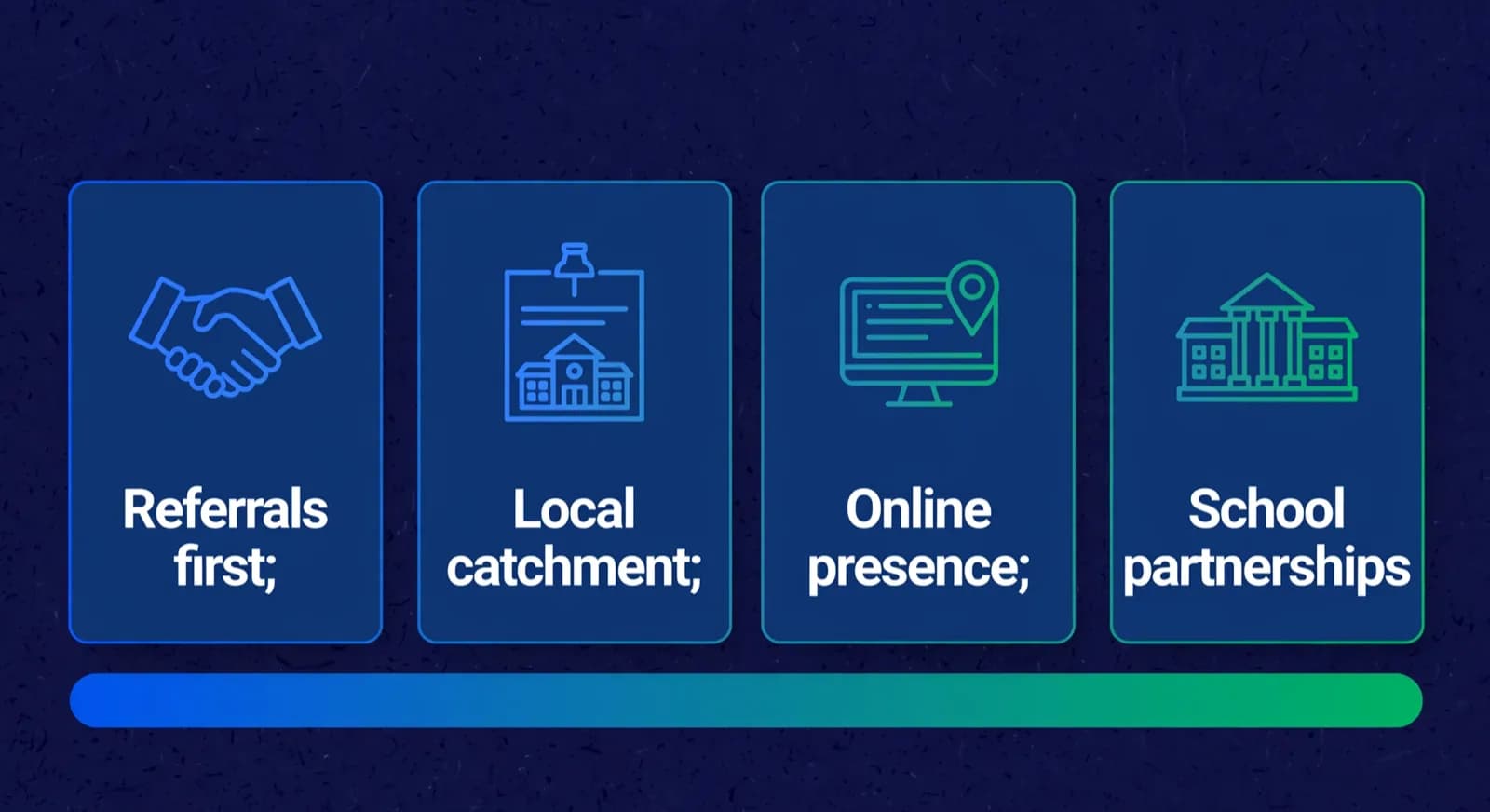
- Referrals: current families recommending the academy, covered above.
- Local catchment: flyers at nearby schools, a presence at local events and a clearly findable location. Parents of young children often weigh travel time heavily, so a nearby presence may matter more than a city-wide campaign.
- Online presence: a simple findable page, an active local listing and a few real moments from classes, so a searching parent can check that you exist and are active.
- School and community partnerships: an after-school chess offering or a club tie-up can put you in front of interested families. It takes groundwork, so treat it as a project, not a post.
- Paid advertising: worth testing once your funnel converts and a referral habit runs, because ads amplify whatever conversion rate you already have, including a poor one.
Whatever channels you choose, growth creates work: more enquiries to answer, more trials to schedule, more first payments to collect, more parents to keep informed. An academy that wins more students and then drowns in admin has traded one problem for another. The systems you run decide whether growth is sustainable, which is the subject of our pillar guide to running a chess academy and our wider hub of guides on running a chess academy, and why chess academy management software starts to matter once your funnel works.
How do you compare marketing channels with your own numbers?
Compare channels on what each one cost you and how many paying students it returned, over the same period, and calculate nothing until families who attended a trial have decided. Parents of young children often weigh travel time heavily, so an academy is a local business even when it teaches some classes online, and reach in a city you cannot serve adds enquiries you cannot convert. Fill in one row per channel from your own enquiry records. The brackets are for your numbers.
| Channel | Hours and spend | Enquiries | Attended trials | Paid students | Effort and cost per paid student |
|---|---|---|---|---|---|
| Referral habit | [hours, dollars] | [count] | [count] | [count] | [calculate] |
| Google Business Profile | [hours, dollars] | [count] | [count] | [count] | [calculate] |
| Website | [hours, dollars] | [count] | [count] | [count] | [calculate] |
| Local social presence | [hours, dollars] | [count] | [count] | [count] | [calculate] |
| School and community partnerships | [hours, dollars] | [count] | [count] | [count] | [calculate] |
| Paid local advertising | [hours, dollars] | [count] | [count] | [count] | [calculate] |
The last column is hours and dollars divided by paid students. Illustration with made-up numbers: a channel took 6 hours and $60 in a month and produced 2 paid students after every pending decision finished. That is $30 and 3 hours per paid student. Decide what an hour of your time is worth before you compare channels, because hours and dollars do not add up on their own. Leave out families who attended a trial and are still deciding, and count them in the next window. A channel with a low count in the first month is not yet a verdict.
A simple website and a few real moments on local social media do a different job from a lead source. They let a parent who is already considering you check that the academy exists and is active. Count them as supporting evidence, then see in the worksheet whether they bring enquiries of their own.
A Google Business Profile is free to create. Google describes it as a profile that appears on Search and Maps and carries photos and customer reviews, and it lets you share up-to-date information such as hours and contact details [6]. Fill it in completely and add real photos of classes. Record how many enquiries name Search or Maps as the source before you decide how much time it deserves.
Reviews follow Google's rules, not the referral playbook. Google's policy says merchants may not offer incentives such as payment, discounts or free services in exchange for a review, and may not selectively solicit positive reviews or discourage negative ones. It allows asking for genuine reviews without incentives, and it warns against pressuring people to review on the premises [7]. So keep review requests separate from referral incentives: ask every family the same way at a routine point, such as the end of a term, and keep any free week or fee credit for referrals only.
How do I partner with local schools?
Partner with local schools by walking in, leaving a flyer, or offering one free lunchtime demo, and target a small set of nearby primary and middle schools rather than emailing the whole city. A face at the front desk is harder to ignore than a cold email, and a lunchtime demo lets the children show what the class is like. For a concrete scale, a 2026 start-an-academy playbook from lynk.coach puts the ask at five minutes, a newsletter flyer, or a free 30-minute lunch demo, aimed at 5 to 10 local schools [5]; that is a sensible starting range, not a rule.
- Pick 5 to 10 nearby primary and middle schools in walking or short-drive range, not a city-wide list, because the groundwork only pays off where you can turn up in person.
- Ask each school about its term dates, who handles activities, and its rules for visiting coaches before you propose a date. Calendars and procedures differ between schools and boards, so do not assume one timetable.
- Offer a flyer drop or one free 30-minute lunch demo, and do not pitch a paid term on the first visit, because the demo is the door and the paid term is the second conversation.
- If one school says yes, run the demo as a door, then convert interested families with the same trial-to-enrolment steps as any other enquiry.
- Write down who you met and when you will follow up, so the partnership does not die in a busy inbox.
Bring a written safeguarding policy to any school conversation, because a school cannot say yes to a visiting coach without one. Put it in a short information pack with the coach's details, the proposed activity, and a named contact for parents. Track school approaches, demos, trials, and paid first months separately. A school that welcomes a demo has given you a chance to meet families; only your own enrollment records will show whether that chance becomes a useful source of students.
How do you track an enquiry from first message to paying student?
Keep one line per enquiry from first message to first payment, and fill it in as the enquiry arrives, not from memory at month end. The table shows the fields with made-up rows to show the shape. They are not findings from any academy. The follow-up message after a trial, the diagnostic questions and the scripts live in our guide to the follow-up after a demo class, so this section stays on tracking.
| Week | Channel and who referred | Child age and level | First reply time | Trial booked (y/n) | Outcome |
|---|---|---|---|---|---|
| Week 1 | Referral from a current parent | 7, beginner | 18 min | y | Enrolled |
| Week 1 | Google Business Profile, found in search | 9, knows the rules | 3 hr | y | Trial attended, deciding |
| Week 2 | School walk-in demo | 8, beginner | next day | n | No reply after two touches |
| Week 3 | Social media direct message | 11, plays online | 2 days | n | No trial booked |
Keep three events apart in the last two columns: the family accepts your offer, the family authorises a mandate if you use one, and the money arrives. Only the third is a first payment. For an India-based academy a UPI AutoPay mandate [2] is one route to recurring fees, and Stripe billing [3] covers families paying from outside India. Count the family as enrolled when the first payment is received, as the funnel section above explains.
Fees · October · all batches
136 of 148 paidCollected · this term
92%Lucas M. · October · $180
Card AutoPay · receipt sent to Müller family
Mia G. · October · $180
Payment link opened in WhatsApp
Batch B2 · 12 of 14 paid
No bank-transfer screenshots needed
AutoPay mandates · 41 active
Renew monthly without reminders
Read the log after a decision window, with the cohort in mind. A reply time beside an outcome shows an association, not a cause: fast replies may simply have gone to warmer enquiries. Compare like with like, meaning the same channel over comparable weeks, before you conclude that reply speed or any single habit moved the result. Two or three months of rows will also show whether a channel that feels busy brings paying families. Our guide to chess academy fee structure covers how to set the number you state at the end of the trial.
How do you know which chess academy marketing is working?
Ask every new enquiry where they heard about the academy, record the answer against the enquiry, and review the record after a decision window of at least a couple of months. A pattern may appear: one or two channels produce most of the enrolled students and the rest produce activity. Treat the pattern as a prompt to test, not a verdict. A small academy's numbers are small, and a few families either way can change the order.
- Record the source on the enquiry itself, not in a separate sheet, so the trial and the first payment stay linked to where the family came from.
- Count paid students per channel, not enquiries, because a channel that brings enquiries you then lose points at the funnel, not at the marketing.
- Before dropping a channel, check the funnel table above: a slow reply or a trial with no stated price can make every channel look weak.
- Review on a fixed date each quarter and move hours from the weakest channel to the strongest only when the counts have had time to settle.
Operations count as marketing too. A batch that meets on a fixed timetable and a fee that is collected without chasing messages put a family in a good frame of mind, which is when a referral ask can land naturally. A founder who tracks channel sources but ignores how the academy runs is measuring only half of what decides growth.
Where does AI help with getting students?
AI does not get you students. Trust does, and coaching and communication build it. What software can do is remove friction that slows follow-up. ChessCore, which we build, can suggest a follow-up for a lead from the enquiry's source, stage and age. Staff add the checked personal details, and the suggestion does not send a message to a family by itself.
Whatever tool you use, the human part is the point, because a family can tell a message written about their child from one sent to a list. Our overview of how the ChessCore AI copilot works covers what it drafts and what needs approval.
Frequently asked questions
How do I get my first ten chess students?
Start with people who already know you: friends, your own children's classmates, a school you have a connection to, and your immediate neighbourhood. Run a few well-structured trial classes, end each one with a clear offer and price, and follow up two days later. For many academies the first students come from that existing network plus a tight trial-to-enrolment process. Our guide to starting a chess academy covers the setup decisions behind those first ten.
Are paid ads worth it for a chess academy?
Test them after the funnel works, not before. Ads multiply whatever conversion rate your funnel already has, so spending on traffic while follow-up is slow or trials do not convert pays to lose people faster. Count enquiries, attended trials and paid students per channel, and compare the cost per paid student with your referral and listing channels before you commit more budget.
What is the best marketing channel for a chess academy?
The best channel depends on your catchment and capacity, so rank yours with your own numbers. Two low-cost ones to set up early are a referral habit and a complete Google Business Profile, which Google describes as free. Keep reviews and referral incentives separate: Google's policy prohibits incentives for reviews and selectively asking only happy customers.
How do I find where my chess academy funnel leaks?
Count enquiries, replies, trials booked, trials attended, enrolments and first payments for a month, then compare the percentage drop between each pair of stages. The biggest drop is where to look first. It may be reply time, trial booking, attendance or payment friction, and only your own counts tell you which. Re-count after changing one thing, over a comparable window.
Why do I get enquiries but few enrolments?
The gap usually sits between enquiry and first payment rather than in the enquiries themselves. Common places to check are a slow first reply, a trial that is hard to book, no reminder before the trial, and no specific follow-up after it. Track your numbers at each funnel stage for a month, find the biggest percentage drop, and change that one step first.
When should a chess academy move enquiries from a notebook into a CRM?
When you can no longer say, for every open enquiry, who owns it and what the next dated step is, or where each family came from. A student count is not the trigger. Fix the enquiry-to-paid leaks first, because a CRM records the process you have and does not repair it. Our page on a chess academy CRM shows what a record of enquiries and follow-up can look like.
Sources
- [1]Conversion funnel (Wikipedia) · accessed 2026-07-15
- [2]UPI Autopay for Recurring Payments | NPCI · accessed 2026-10-16
- [3]Stripe Billing documentation · accessed 2026-10-16
- [4]Word-of-mouth marketing (Wikipedia) · accessed 2026-07-15
- [5]How to Start a Chess Academy: A 2026 Playbook (LYNK) · accessed 2026-10-02
- [6]Google Business Profile · accessed 2026-10-16
- [7]Prohibited and restricted content (Google Maps User Generated Content Policy) · accessed 2026-10-16
Written by Abhishek Tiwari
ChessCore
Drafted with AI, fact-checked and approved by a human before publishing, the same guardrail our product applies to every report it sends. Read our editorial standards.
Stop losing the students you already attract
ChessCore keeps each enquiry, its owner and its next step in one place, and can suggest a trial follow-up for staff to check before anything goes to a family.
- Roster import from the spreadsheets you already keep
- Lichess and Chess.com connections, batches, and fee plans
- First reports in week one, after your approval
- Free plan, no credit card required