
On this page6 sections, 14 min read
- What actually changes when you add a second coach?
- What should software for a multi-coach chess academy do?
- What belongs in a shared student record?
- Who should own each academy responsibility?
- How do you hand a student from one coach to another?
- How do you keep one teaching standard across coaches?
- Frequently asked questions
Bottom line
Running a multi-coach chess academy works when one curriculum and one shared student record replace the founder's head as the source of truth. Give every student one accountable coach, write a handoff note for every cover class or coach change, and decide on the next hire from workload, not a headcount rule.
TL;DR
- Before adding a second coach, write down your curriculum, student progress and parent-update routine so both coaches can use the same standard.
- A shared student record, not the founder's memory, must become the source of truth, so any coach can pick up any student and know exactly where they are.
- A who-owns-what table removes the silent gaps where curriculum, parent communication, and tournament prep fall between coaches and nobody is accountable.
- Handoffs (cover classes, batch reassignments, a coach leaving) are where multi-coach academies break; a written handoff template makes them routine instead of risky.
Key facts
- A single-coach academy stores its standard in the founder's head; a multi-coach academy must externalise that standard into a shared curriculum and shared records or quality drifts coach by coach.
- Give parent communication and tournament preparation a named owner and a covering person for absences, so the team can check who is responsible.
- A cover coach who cannot see what was last taught may repeat material, which a parent can read as disorganisation. A written handoff note is the cheapest way to prevent it.
- Lichess publishes a public API, so an academy can sync a linked account's recent games instead of asking a parent for a game link. ChessCore's Lichess and Chess.com auto-sync starts on the Pro plan.[1]
What actually changes when you add a second coach?
Adding a second coach means another person needs access to your teaching plans, student progress and parent context. If you have kept those details in your head, start writing them down before the first handover. A new coach may use a different level sequence or explain progress differently; agree the shared standard so a batch change does not confuse a child or their family. Parents should know who is teaching the next lesson and how that coach will continue the work already underway.
So the real problem of a multi-coach academy is not management headcount; it is making the academy's standard exist outside any one person. That means three things have to move from a founder's memory into shared, visible systems: the curriculum (what gets taught and in what order), the student record (where each child actually is), and the communication standard (what a parent receives and how often). Get those three externalised and a second, third, or fifth coach extends your academy. Skip it and each new coach quietly forks it into a slightly different one. This guide focuses on that transition. When to hire the next coach is a workload question, covered in our guide on when coach load says hire, and the fee, enquiry and scheduling groundwork sits in our chess academy operations hub.
What should software for a multi-coach chess academy do?
Software for a multi-coach academy should put every coach under one academy account, limit what each role can see and approve, and keep one shared record per student that an authorised covering coach can open before a cover class. Those properties matter more than any feature list, because they are what let the framework in this guide run without the founder in the room.
- One academy account with coach logins underneath it, not separate coach accounts stitched together by a spreadsheet
- Roles: a coach works from their own batches and students, and an owner or admin sees fees and approves money actions
- A shared student record with level, attendance, recent games and the open coaching focus
- A timetable that shows coach assignments and cover slots together
Ask any vendor to show you these with your own coach and student numbers, and check which students a covering coach can open and how. The choice of product has its own guide in our shortlist of chess academy software, so this page stays on the operating framework.
What belongs in a shared student record?
Everything else in a multi-coach academy rests on one thing: a single place where each student's state is recorded, that every coach reads and writes. Without it, coaches keep private notes in private notebooks, and the academy becomes a set of silos that happen to share a name. The first time a regular coach is sick and a substitute opens nothing but a class register, the parent watches their child redo last month's material, and concludes the academy is disorganised, which it is.
A usable shared record holds, per student: current level and the curriculum stage they are on, attendance history, recent games and what was reviewed, the open coaching focus for the next few sessions, any tournament they are preparing for, and the parent-communication context (what was last shared, any sensitivities). ChessCore, the academy management software we build, can sync a linked Lichess account's recent games on the Pro plan and up, since Lichess publishes a public API for exactly this kind of sync [1], so no coach has to chase a parent for a game link before reviewing it. The point is not bureaucracy. The point is that a coach who has never met the student can open the record, read for ninety seconds, and continue the work rather than restart it. That ninety-second continuity is the entire difference between an academy and a roster of independent tutors.
- Current level and curriculum stage, so no coach repeats or skips material
- Attendance and recent games, so a substitute sees the same picture the regular coach does
- The open coaching focus, a line or two on what to work on next
- Tournament context, so prep does not stall when the usual coach is away
- Parent-communication notes, so the family hears one consistent voice

Lucas M.
Batch B2 · Thursdays · joined Aug 2025
1342
Academy rating · Lichess games synced
Won vs. 1410 · French Defense
Best gameMissed fork on move 23
Homework setWho should own each academy responsibility?
Give each recurring responsibility one named owner, including parent updates, tournament entries and follow-up for a struggling student. Write the allocation down before you add another coach. Two people can contribute to a task, but one should check that it is complete and arrange cover when needed. The table below offers a starting allocation for a small academy with a founder and two or three coaches. Adapt it to your team and record who takes over during absences, rather than leaving the duty to whoever happens to notice.
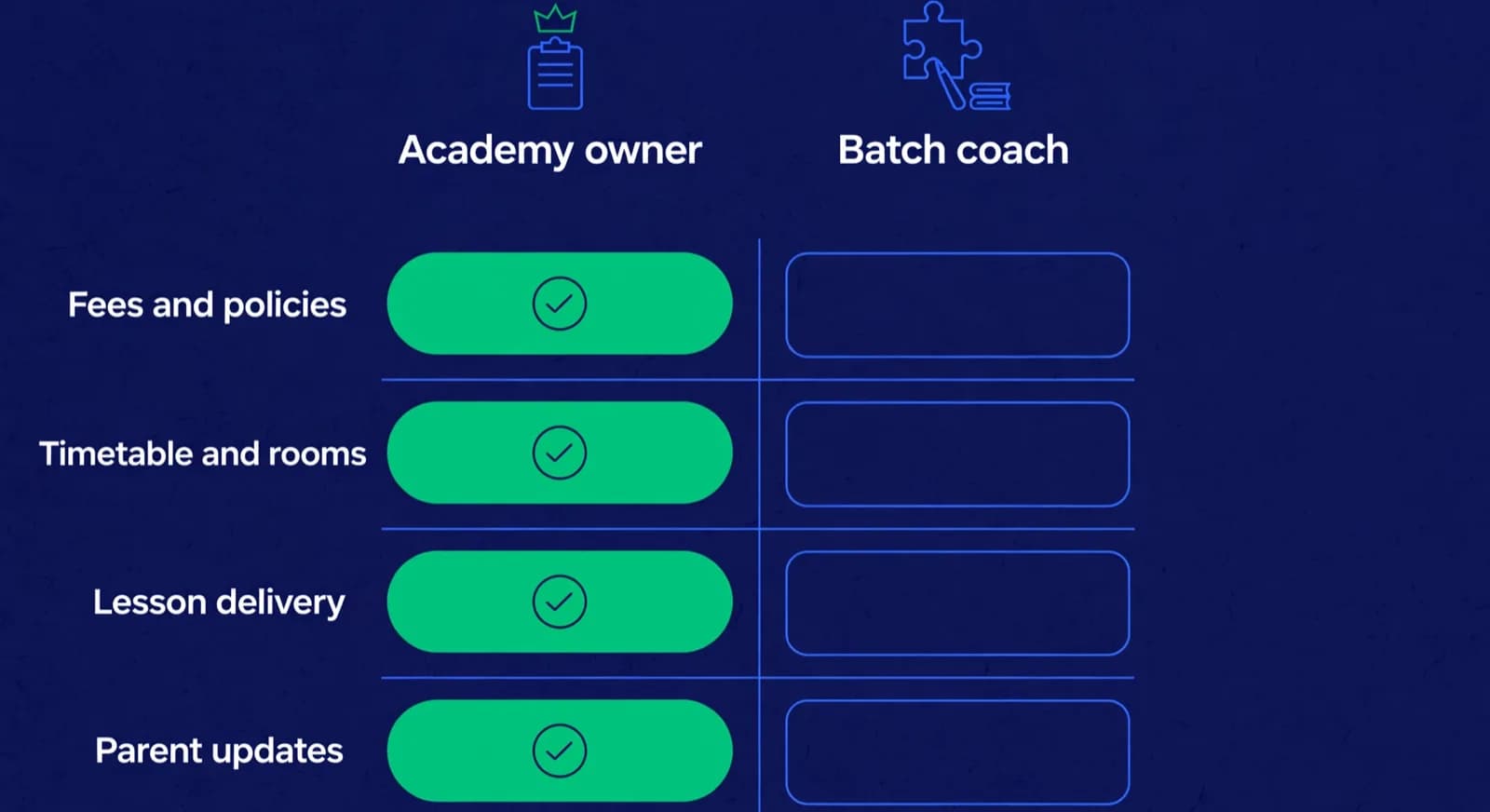
| Responsibility | Owner | Why it sits there |
|---|---|---|
| Curriculum and teaching standard | Founder or head coach | One person must own what 'good' looks like, or it drifts per coach |
| A student's weekly progress | That student's assigned coach | Continuity needs one coach accountable for each child's arc |
| Parent communication for a student | That student's assigned coach | Families want one voice, not messages from a rotating cast |
| Batch scheduling and cover | Founder or an ops lead | Cover and clashes need a single coordinator with the whole timetable |
| Tournament entries and prep | Head coach, with the assigned coach | Deadlines slip when entry duty belongs to no one in particular |
| Fees and enrolment | Founder or ops lead | Money and admissions should never be split across coaches ad hoc |
The principle behind the table is that every student has one accountable coach for their progress and their parent, while shared infrastructure, the timetable, fees, the curriculum standard, has a single owner above the coaching line. This avoids the two failure modes that wreck multi-coach academies: the diffuse-responsibility gap, where shared duties evaporate, and the fragmented-family problem, where a parent gets contradictory messages from three coaches about one child. Pin each student to a primary coach, and the parent always knows whose name to expect.
Review the ownership table alongside each coach's workload once a month. Count preparation and parent conversations as well as classes; a coach supporting several students through difficulties may need more time than the roster suggests. Ask what is overdue and arrange cover before assigning new work. Tournament preparation needs its own checklist: confirm the event's entry deadline, who submits the entry and who checks the confirmation. Consult the organiser and relevant federation, such as the All India Chess Federation [2], for the event requirements, and use FIDE's rating information [4] when discussing rated play with parents. Keep those entry tasks separate from teaching preparation so the team can see both. Our guide to structuring batch scheduling and coach cover explains how to fit these responsibilities into the timetable.
How do you hand a student from one coach to another?
Before another coach takes over a student, share the current curriculum stage, last-session note, next teaching focus and relevant parent context. Use the same handoff routine for a sick-day substitute, a batch change or a coach departure. The receiving coach should know what to continue and what to ask about before meeting the student. A short written template gives both coaches something to check, even when they cannot speak before class; leave time afterwards for the covering coach to record what happened.
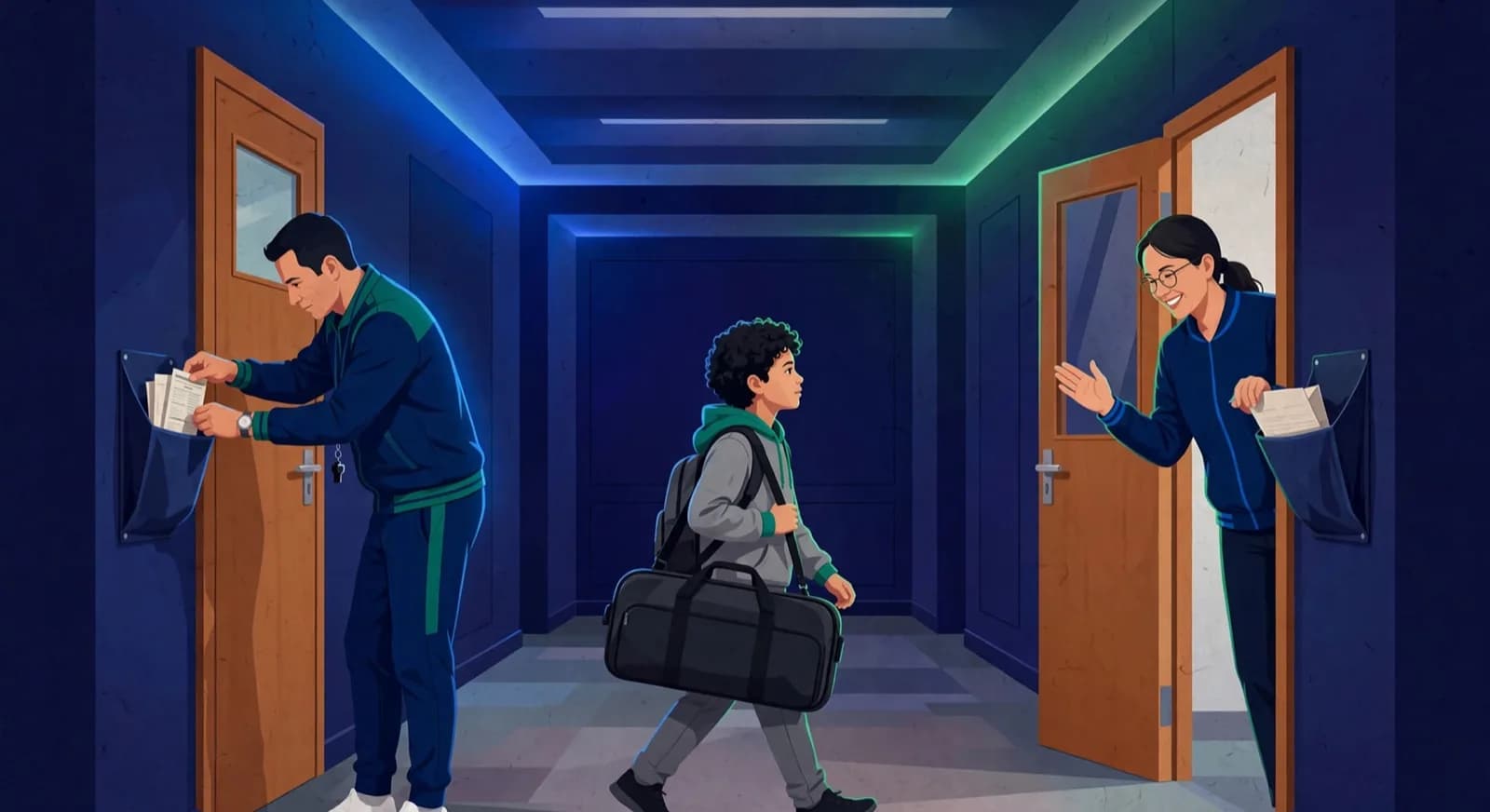
A good handoff answers, for each student, the questions the receiving coach will hit in the first five minutes of class. Where is this child in the curriculum? What were we working on last session? What should I not do, the line that already failed, the topic that frustrates them, the parent sensitivity? And what does the parent expect to hear after this class? When those four answers travel with the student, a cover class feels to the parent like the regular coach was simply having an off-day; when they do not, it feels like starting over with a stranger.
- Read the record first: a covering coach opens the student record before class, not the register, so they continue the open coaching focus.
- Carry the last-session note: a single line on what was covered last time prevents the substitute from repeating it.
- Flag the don'ts: note any topic, approach, or parent sensitivity the receiving coach should avoid, because surprises here cost trust fastest.
- Match the parent voice: keep the communication tone and cadence the family already knows, so a cover class does not change the relationship.
- Write back after class: the covering coach updates the record so the regular coach returns to continuity, not a gap they have to reconstruct.
| Handoff field | What the outgoing coach writes | Placeholder to copy |
|---|---|---|
| Student and batch | Name, batch, day and time of the class being covered | [Student], [Batch], [Day and time] |
| Curriculum point | The unit or level the student is on | [Unit or level] |
| Last task | What was set or taught last session and how it went | [Task] and [How it went] |
| Difficulty | The part the student found hard, or a topic to avoid | [Difficulty or topic to avoid] |
| Next task | What the receiving coach should do next | [Next task] |
| Parent agreement | Anything agreed with the family that the new coach must honour | [Agreement, for example the update day] |
| Acknowledgement | The receiving coach confirms they have read the note and will write back after class | [Receiving coach] and [Date] |
Keep parent updates in the channel the family already uses with your academy. If that is WhatsApp [5], introduce the covering coach in the existing thread and explain who will send the next update. Agree which coach answers questions and who can see the conversation, so a parent does not need to repeat a concern to several people. A change of teacher is easier to understand when the timetable and contact arrangements are clear; tell families what is changing before the cover class where possible.
Week of 12 October · all batches
0 conflictsMake-up credit · Mia G. · Sat 4:30 PM
Absent Thursday with notice · booked by Noor
Class reminders sent to 148 families
Timing changes update everyone at once
The permanent version of the handoff is a coach leaving. If a departing coach's students live only in that coach's notebook and chat history, the exit takes part of the academy with them. If they live in the shared record, rehoming them is a sequence of four steps, and the time each takes depends on your academy.
- Assign a replacement: name the new primary coach for every student the departing coach taught.
- Transfer the authorised records: give the new coach the records for the students they will teach, and only those.
- Introduce the new coach: send one warm note in the channel each family already uses, saying who is taking over and when.
- Check continuity after the first class: read the new coach's note, and ask the family whether the lesson picked up where the last one ended.
Our pillar guide on running a chess academy covers the weekly scheduling that makes routine cover smooth.
How do you keep one teaching standard across coaches?
A shared record solves continuity; it does not by itself guarantee that every coach teaches to the same standard. That requires a written curriculum, a light review rhythm, and a head coach who owns 'what good looks like'. The written curriculum does not need to be a textbook; it needs to be a clear sequence of what students learn at each level and the milestones that mark moving up, so two coaches teaching the same level are genuinely teaching the same thing. Without it, level names mean different things to different coaches and a parent moving batches finds their child mysteriously re-graded.
The review rhythm is how you catch drift early. A short monthly check, the head coach reading a sample of progress notes across coaches, watching a class occasionally, comparing how two coaches assessed similar students, surfaces inconsistency while it is still small. This is not surveillance; it is the same quality discipline any multi-person service needs. Pair it with a monthly look at which coaches have sent parent updates, so a coach who has gone quiet with their families is noticed before it becomes a retention problem.
Finally, decide deliberately where AI fits, because a growing academy is exactly where the temptation to automate communication is strongest and most dangerous. Two rules keep it safe across every coach. First, whatever engine sits behind analysis should evaluate every position identically regardless of who is coaching, the way an open-source engine like Stockfish [3] does, so two coaches reviewing the same game work from one objective assessment rather than two opinions. Second, a human coach sends every AI draft to a family: an AI draft can save a busy coach the blank-page tax and keep the academy's voice consistent, but the assigned coach still reads it and presses send, so the parent gets a real message about their real child rather than a templated blast. That is how you scale communication without scaling the spam that erodes trust, and our guide to how the AI approval queue keeps every draft accountable to a named coach covers exactly what that review step looks like.
Frequently asked questions
How many students before I should hire a second coach?
Hire a second coach when sustained demand exceeds the time you can give teaching, preparation and parent communication within your agreed week. Check waitlists and overdue work together rather than choosing a student-count threshold. Before the new coach starts, document the curriculum and student records, agree which batches they will take over, and leave time for supported handovers. Our guide on when coach load says hire explains how to assess that capacity.
Should every student have one assigned coach in a multi-coach academy?
Yes, even when several coaches teach a child across the week. Name one coach as primary: the person accountable for that student's arc and the single voice to the parent. Shared teaching is fine and often good, but shared accountability fails, because a duty split among several coaches reliably falls to none. A primary coach gives the family one name to expect and gives you one person to hold accountable for each child's progress and retention.
How do I handle a coach calling in sick at a multi-coach academy?
Give the covering coach access to each student's shared record before class. They should read the current teaching focus and last-session note, continue the planned work, and write a brief update afterwards. Tell parents who is covering and who will answer questions. Rehearse this handover during onboarding, so a sick-day absence does not leave the substitute searching through private notebooks or asking families to explain the curriculum.
What happens to students when a coach leaves the academy?
If their students live only in the departing coach's private notes and chats, the exit takes part of the academy with them and rehoming is painful. If those students live in a shared record, rehoming is routine: reassign each student a new primary coach, hand over the records, and send one warm note to each parent explaining the change and reassuring them their child's progress is fully documented. The cost of a coach leaving is set long before they leave, by whether your academy kept its knowledge in shared systems or in their head.
How do you keep teaching consistent across different coaches?
Write the curriculum down as a clear level-by-level sequence with milestones, so every coach teaches the same thing at each level, then run a light monthly review where a head coach reads sample progress notes and occasionally observes classes to catch drift early. Pair that with a shared student record so no coach repeats or skips material. Consistency is a system, not a hope: it comes from an externalised standard plus a regular look at whether coaches are meeting it, not from assuming everyone teaches the same way.
When should a chess academy hire a third coach?
Decide from workload, not from a fixed hours threshold. Count teaching, preparation, review and parent time for each existing coach, and look at waitlists and overdue work together. When the load stays high for a sustained period and no batch can move, start recruiting. Our guide on when coach load says hire sets out how to do that. Before a third coach starts, check that the shared record and the ownership table already work with two coaches, because a new coach multiplies any gap.
Sources
- [1]Lichess.org API documentation · accessed 2026-07-15
- [2]All India Chess Federation · accessed 2026-07-15
- [3]Stockfish: open-source chess engine · accessed 2026-07-15
- [4]FIDE international rating system · accessed 2026-07-15
- [5]WhatsApp · accessed 2026-07-15
Written by Abhishek Tiwari
ChessCore
Drafted with AI, fact-checked and approved by a human before publishing, the same guardrail our product applies to every report it sends. Read our editorial standards.
Run a multi-coach academy as one academy
ChessCore keeps student levels, games and progress in a shared record, so a covering coach can prepare for class and continue the work the regular coach began.
- Roster import from the spreadsheets you already keep
- Lichess and Chess.com connections, batches, and fee plans
- First reports in week one, after your approval
- Free plan, no credit card required