
On this page5 sections, 15 min read
Bottom line
Hire another chess coach when waitlists form or notes and parent replies slip while a coach sits in your stretched band for several weeks. The 15, 18 and 24 hour bands in this guide are adjustable starting points, not industry standards. The right limit depends on lesson length, class size and the paid hours you agreed.
TL;DR
- Hire on coach load and utilisation, not raw student count: the real ceiling is how many quality teaching hours a coach can sustain each week, not a magic student number.
- Use a coach-load decision table to read your zone, healthy, stretched, or overloaded, from teaching hours and class sizes rather than from how busy you feel.
- The clearest hire-now signals are forming waitlists, skipped progress notes, slipping reply times, and a coach's own teaching quality starting to drop under volume.
- Hire a few weeks early, because a new coach needs onboarding and ramp time, and hiring after the ceiling means a stretched coach trains a new one while already overloaded.
Key facts
- Coach capacity is bounded by sustainable teaching hours per week, not by student headcount, because a coach with many small group classes carries a very different load than one with a few large ones.
- Note timeliness and parent reply times are worth checking alongside teaching hours, because a coach can still deliver classes while falling behind on work outside them.
- A new coach needs onboarding and ramp time before carrying a full load, so hiring at the moment of overload means the existing coach trains a replacement while already past their ceiling.
- Group class size trades teaching hours for per-student attention, so raising a batch from small to large buys capacity at the cost of the individual attention parents are paying for.
Why is student count the wrong trigger for hiring?
Student count alone cannot tell you when to hire: you also need teaching hours, class sizes and the work outside lessons. Consider two illustrative schedules. One coach teaches six one-hour groups of four students, giving 24 students six weekly contact hours. Another teaches ten one-hour sessions, including individual lessons, and may have fewer students but more contact time. Add preparation, game review and parent conversations to both schedules before comparing capacity. Neither headcount nor an empty calendar slot tells you how much attention the coach can give another student.
Measure coach load in four parts, all against the paid hours you agreed with the coach. Teaching is the contact time on the weekly timetable. Preparation is the time to plan each session. Review is game review and progress notes. Parent work is replies and conversations. Lichess provides game access through its API [2], and Stockfish supplies engine analysis [1]; coaches still need time to decide what a student should work on. If your academy uses WhatsApp for parent communication [3], count that time too. Ask coaches to record all four parts for a representative week, including any work they take home, then compare the total with their agreed availability.
| Part of the week | What it covers | Example against 30 agreed paid hours |
|---|---|---|
| Teaching | Contact hours on the timetable | 18 hours |
| Preparation | Planning each session | 4 hours |
| Review | Game review and progress notes | 4 hours |
| Parent work | Replies, calls and update messages | 2 hours |
| Slack | What is left for cover, a sick colleague or a longer conversation | 2 hours |
The example is illustrative: 18 + 4 + 4 + 2 = 28 of 30 hours, which leaves two hours of slack. Change the numbers to your coach's real agreement. A coach with 18 contact hours and only 24 agreed hours has no slack at all, even though the timetable still shows open slots.
How should you use a coach-load decision table?
Use the table to compare each coach's agreed capacity with the work they can complete within it. Read it in four zones, based on weekly contact hours and whether preparation, notes and parent replies remain current. The hour bands are editorial starting points for a coach who also does their own reviews and parent replies, not industry limits, and you should move them. They assume roughly half an hour of surrounding work per contact hour, so 24 contact hours is already about a 36-hour week. Set your own weekly ceiling after accounting for lesson length, class size, student needs and paid preparation time. A coach with a full contact timetable still needs room for the work around those lessons; a coach with fewer classes may already spend that room on individual reviews.

| Zone | Weekly teaching load (example bands, adjust them) | What you observe | Action |
|---|---|---|---|
| Healthy | Under 15 contact hours | Notes on time, parents answered same day, coach has slack | Hold; use spare capacity to grow this coach's batches |
| Approaching | 15 to 18 contact hours | Still good, but the slack is gone and a busy week strains | Write the role and line up candidates |
| Stretched | 18 to 24 contact hours | Progress notes occasionally late; replies slower | Recruit now; have the new coach teaching before anyone passes 24 |
| Overloaded | Over 24 contact hours | Notes skipped, parents waiting, teaching quality dipping | Hire urgently and move one batch while you onboard |
Why those example numbers: at 15 contact hours and half an hour of surrounding work per hour, a coach is at about 22 hours, which leaves room for a busy tournament week. At 18 the total is 27, the point where a single extra batch or a sick colleague's cover pushes notes late. At 24 the total is 36, and the review and reply tail is the part most likely to be cut first, which is why the hire has to land before that line rather than after it. A coach who teaches mostly one-to-one lessons can sit higher, because the review load per hour is lower; a coach with many beginner groups should use lower bands.
The pattern across the rows is the point: the right time to hire is the 'Approaching' or 'Stretched' row, not the 'Overloaded' one. By the time a coach is overloaded, the academy is already paying for it in skipped notes and slow replies, which are the exact things that drive the quiet churn we describe in our guide to why students quit chess academies. Hiring is a few-week project, recruit, trial, onboard, ramp, so the trigger has to fire while the existing coach still has the bandwidth to help the new one. Waiting for overload means asking your most stretched coach to also train their relief, which is how good coaches burn out and leave.
When should you hire another chess coach?
Start recruiting when sustained demand exceeds the time your coaches can give it without delaying preparation, progress notes or parent replies. Watch the four signals below over several weeks. A single late note may have a simple explanation; repeated delays across several tasks deserve a workload conversation. Ask the coach which work is slipping, check whether a timetable change would help, and identify the hours a new hire would take on before you advertise.

- Forming waitlists: you are turning away or queuing students for the batches a coach already runs, which is demand you are leaving on the table for want of capacity.
- Skipped or late progress notes: the surrounding work is the first thing to slip under load, so a coach whose notes are drifting late is signalling overload before their timetable does.
- Slowing parent replies: response times to families creeping from same-day to several days is a capacity signal, and also a direct retention risk.
- Coach teaching quality dipping: less preparation, more generic classes, a tired coach cutting corners, which is the most expensive signal because it degrades the actual product.
Three of the four signals concern work outside the lesson. Include that work when you assess an apparently open timetable: a coach with two free Saturday slots may already use those hours for reviews and parent conversations. Try a simple calculation with illustrative figures. Eight one-hour classes plus eight half-hour preparation slots use 12 hours. Add 24 ten-minute student reviews, which is 4 hours, and the total reaches 16 hours, before parent messages or meetings. Compare that total with the coach's agreed weekly hours and leave room for cover and longer conversations. Use measured times from your own academy when making the offer; the example shows the method, not a recommended workload. A class register alone will not give you those times.

Parent updates · this week
14 of 14 sentWeekly recap · Lucas M.
Lucas attended Thursday's class and won 2 arena games. His September report is in your portal.
Receipt · October fee
$180 received via card AutoPay. Receipt saved.
9:42 AMRecap approved by Coach Elena
Open the guardian portal
Own login · nothing to install
How do you time and structure the next hire?
Once the signals point to a hire, two decisions follow: when, and what kind. On timing, work backwards from when the new coach must be carrying real load and subtract the ramp. Recruiting, a trial class or two, reference checks, and onboarding into your curriculum and systems realistically take several weeks before a coach is independent, so the start of recruiting should sit a clear margin ahead of the ceiling. The cheapest growth mistake in an academy is hiring too late and spending a term in the overloaded zone; the recoverable one is hiring slightly early and using the new coach's initial slack to grow batches.
Decide whether the gap needs a full-time coach or someone for specific weekly batches. A part-time hire can fit overflow if those classes cover the cost and you can offer a dependable timetable. Write down the sessions, preparation time and parent responsibilities before discussing pay, so both sides understand the role. Whether the coach is an employee or a contractor changes your obligations, so check them with your state labour authority or an adviser before you write the offer. This guide covers the hiring decision; for handoffs once the second coach starts, including assigning students and keeping one teaching standard, use our guide to running a multi-coach chess academy.
Run the coach-pay break-even before you write the offer. The figures that follow are illustrative inputs, not market rates, and they cover coach pay only. A part-time coach paid $30 per class hour, with preparation included, teaching a batch that meets twice a week for an hour costs about $260 a month (2 classes x 4.33 weeks x $30 = $259.80). At a $100 monthly fee per student, that batch covers its coach pay at three students ($300) and leaves $340 above coach pay at six. A guaranteed 12 hours a week across six batches costs about $1,559 a month in coach pay (12 x 4.33 x $30), which the batches cover once they hold 16 students between them, about three per batch. That is not the break-even of the hire. Venue, student acquisition, software, your own time, taxes and any employer obligations come on top, and each extra $100 of monthly cost needs one more student at that fee. Below your full break-even the hire is a bet on growth; above it the hire is funded.
| Line (coach pay only) | Illustrative figure | Working |
|---|---|---|
| Coach pay per batch | About $260 a month | 2 classes x 4.33 weeks x $30 = $259.80 |
| Students to cover one batch's coach pay | 3 | $259.80 / $100 per student = 2.60, rounded up |
| Coach pay for 12 hours a week | About $1,559 a month | 12 x 4.33 x $30 = $1,558.80 |
| Students to cover that coach pay | 16 across six batches | $1,558.80 / $100 = 15.59, rounded up |
| Each extra $100 of monthly cost | One more student | $100 / $100 per student |
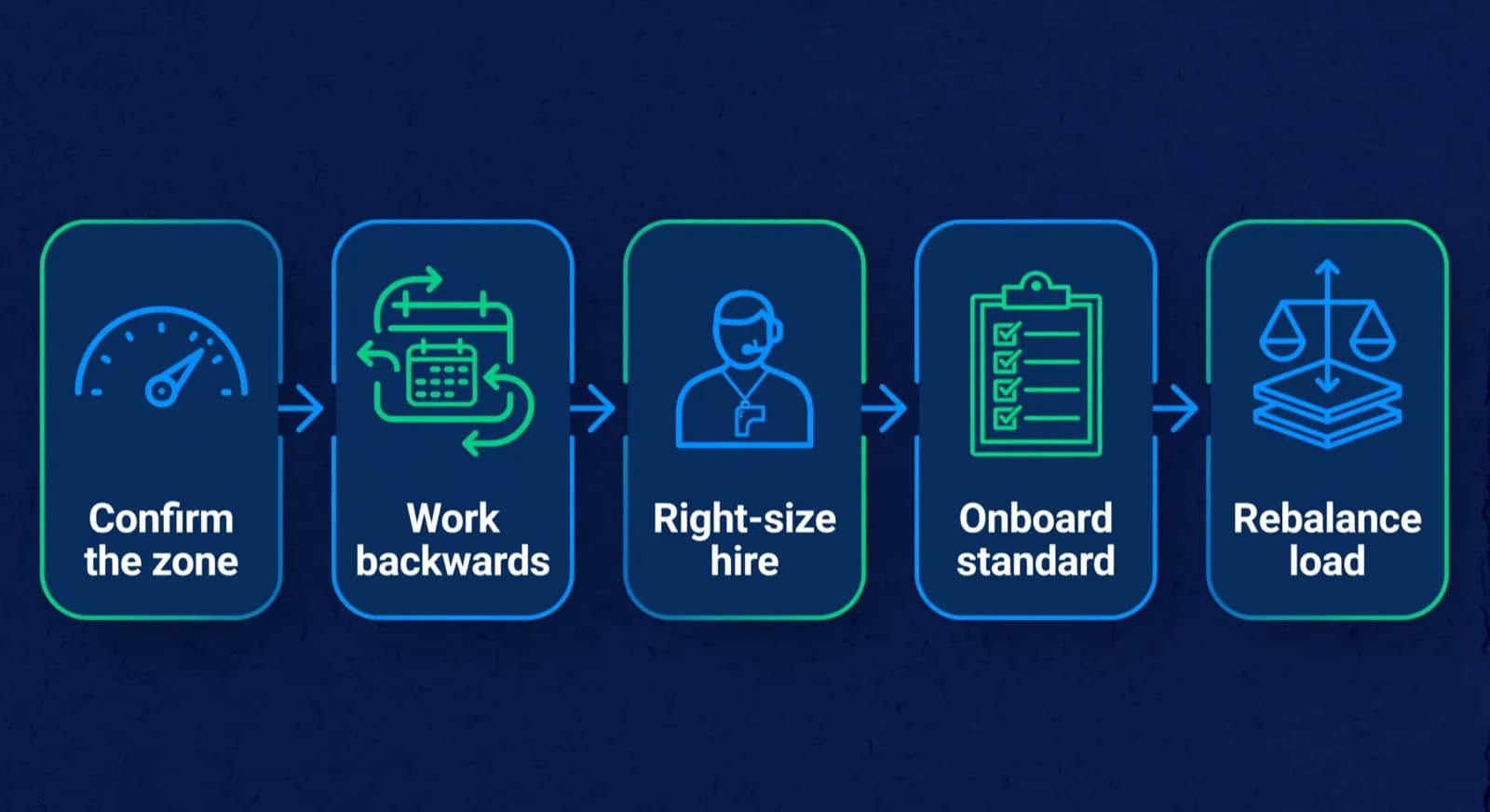
- Confirm the zone: use the load table and the four signals together, not a single bad week, to verify you genuinely need capacity.
- Work backwards from ramp: start recruiting several weeks before the ceiling, because a new coach is not productive on day one.
- Right-size the hire: a part-time coach for the overflow often fits the real gap better than a full hire made on optimism.
- Onboard into the standard: bring the new coach into your shared curriculum and records so they extend the academy, not fork it.
- Rebalance deliberately: move specific batches and students to the new coach so your existing coaches drop back into the healthy zone.
- Check the credential you are paying for: FIDE's Trainers Commission awards titles from Developmental Instructor up to FIDE Trainer on a 1,000-point seminar score (200 for Developmental Instructor, 400 National Instructor, 600 FIDE Instructor, 800 FIDE Trainer) [5], so ask which title a candidate holds and whether it came from a seminar you can verify.
One last principle keeps hiring honest: before you add a coach, make sure you are not hiring around a fixable inefficiency. A coach buried under hours of game review [4] and progress-note writing may need better tooling more than a colleague. ChessCore, which we build, can draft a progress report narrative from attendance and rating records, and a coach edits and approves AI-written report text before it reaches a parent. Automatic monthly reports carry attendance and rating data only. That can shrink part of the attention tail without removing the human judgement parents pay for. Sometimes the right next hire is a tool that gives your current coaches their time back; often, once volume keeps climbing, it is still a coach, but rule out the cheaper fix first.
A rating trend can inform a progress conversation, but it cannot establish spare coaching capacity: it reflects playing results, not preparation time or workload. Even if results hold steady, overdue notes or work outside paid hours deserve attention. Before adding another batch for a coach, check the hours that coach spends teaching, reviewing games and writing updates, and ask whether the new lessons fit inside the agreed week. Plan the hire around those hours rather than treating student improvement as permission to add another class.
What mistakes make the hire backfire?
The first mistake is hiring on revenue alone. A founder sees fees climbing and hires to match, without checking whether the existing coaches are actually at their ceiling, and ends up with an under-utilised coach eating margin. Revenue tells you the academy is growing; coach load tells you whether that growth has filled your teaching capacity. They are different questions, and hiring is an answer only to the second.

The second mistake is solving overload by quietly enlarging group sizes instead of hiring. Pushing a batch from a handful of students to a crowd does buy teaching capacity, but it spends the individual attention that is the entire premise of paying for an academy over a free app. Parents notice when their child becomes one of twelve, and the churn that follows can cost more than the coach you avoided hiring. Enlarging groups is a deliberate model choice, not a stealth capacity fix; if your promise is small-group attention, protect it, and hire instead. Our pillar on running a chess academy covers how scheduling, capacity, and quality fit together as you grow past the founder-coach stage.
Frequently asked questions
How many students can one chess coach handle?
There is no single right number, because load depends on teaching hours and class sizes, not headcount. Class size and weekly load are two different limits. Class size is how many students one lesson can serve with real feedback; our guide to batch sizes and banding gives example ranges that shrink as the level rises. Weekly load is the sum of teaching, preparation, review and parent work against the coach's paid hours. A coach can run small classes and still be overloaded by the number of classes. When the total reaches the agreed week and the surrounding work starts being skipped, the coach is at capacity regardless of the headcount.
What are the signs I need to hire another chess coach?
Consider hiring when waitlists persist and coaches cannot complete preparation, progress notes or parent replies within their agreed hours. Review these signals together over several weeks, then talk to the coach about what is causing the delays. One missed note needs follow-up; it does not decide a hire by itself. Define which batches and responsibilities a new coach would take over, and check whether those hours require a part-time role or a larger commitment.
Should I hire before or after my coaches are overloaded?
Before. A new coach needs weeks of recruiting, trial, and onboarding before carrying a full load, so if you only start hiring once coaches are overloaded, you spend that ramp period in the overloaded zone, losing quality and leaning on an exhausted coach to train their relief. Hire one zone early, at 'approaching' or 'stretched', so the new coach absorbs overflow while your existing coaches drop back into a healthy load. Hiring slightly early costs a little margin; hiring late costs quality and risks the churn that follows skipped notes and slow replies.
Is it cheaper to enlarge group classes than to hire a coach?
On paper, yes, but it can cost more in churn. Enlarging a group buys teaching capacity by spending the per-student attention that is the reason parents pay for an academy instead of a free app. If your promise is small-group or individual attention, quietly turning batches into crowds breaks that promise and parents notice. Treat group size as a deliberate model decision, not a stealth capacity fix. If small-group attention is your value, protect it and hire; only grow group sizes where it genuinely fits your model and price.
Could better tools delay the need to hire a chess coach?
Sometimes. If a coach's overload is dominated by game review and progress-note writing rather than teaching hours, tooling that drafts report text from your records, with a coach editing and approving the AI-written wording, can shrink the attention tail and return some capacity without a new hire. That works up to a point; once teaching hours themselves are full, no tool substitutes for another coach. Rule out the cheaper fix first, but do not use tooling to mask a genuine teaching-capacity ceiling, which only delays a hire you already need.
Sources
- [1]Stockfish: open source chess engine · accessed 2026-07-15
- [2]Lichess.org API documentation · accessed 2026-07-15
- [3]WhatsApp Help Center · accessed 2026-07-15
- [4]Lichess Studies · accessed 2026-07-15
- [5]Organising and participating in a FIDE trainer seminar, FIDE Trainers Commission · accessed 2026-10-16
Written by Abhishek Tiwari
ChessCore
Drafted with AI, fact-checked and approved by a human before publishing, the same guardrail our product applies to every report it sends. Read our editorial standards.
Know your real coach load before you hire
ChessCore keeps batches, attendance and progress reports in one place, so the hours you measure start from one set of records. Book a demo to see how they fit together.
- Roster import from the spreadsheets you already keep
- Lichess and Chess.com connections, batches, and fee plans
- First reports in week one, after your approval
- Free plan, no credit card required