
On this page7 sections, 14 min read
- What should an attendance register record?
- How do you test an attendance method before you trust it?
- Who marks attendance and when?
- Should parents see attendance?
- What do absence patterns tell you?
- How does attendance connect to make-up credits?
- What does a monthly attendance review look like?
- Frequently asked questions
Bottom line
Chess academy attendance tracking is a register that records, for every session, who was expected, whether each student was present, late or absent, why, who marked it and what happens next. Mark within the first five minutes, keep an unmarked class as unknown rather than absent, and follow up on a second unexplained absence.
TL;DR
- A register is useful when every mark can lead to a decision: a parent message, a make-up under your policy, or a follow-up with a name on it.
- The teaching coach marks attendance within the first five minutes and corrects late arrivals during class, while the room is still in front of them.
- A class nobody marked is unknown, not absent. Keep it out of both the attended and the absent counts, and list it beside the monthly figure.
- Test any method with four awkward cases: a missing mark, a corrected late arrival, a dropped connection and a make-up taken in another batch.
- Our working rule is a personal message after the second unexplained absence in a month. It is an editorial trigger, not a proven predictor, and it never delays a safety check.
Key facts
- A register that only records present or absent cannot separate a late arrival, an unexplained absence and a class nobody marked, so each needs its own entry.
- In ChessCore, attendance statuses settle make-up credits according to the academy's own policy, and a class a coach did not mark stays unrecorded instead of counting as an absence.
- Worked example with made-up numbers: of 8 sessions, 5 present, 1 late, 1 absent and 1 not recorded give 6 of 7 recorded sessions (86 percent), or 75 percent if the unrecorded session is wrongly counted as absent.
- Two unexplained absences within a month is our planning threshold for a personal follow-up, not an industry standard; contact the parent sooner if an absence raises an immediate concern.
What should an attendance register record?
Record six things for each student and session: whether the student was expected, the status, the reason for any absence, who marked it and when, any correction, and the follow-up decision. A present-or-absent tick tells you who came. The other fields answer the questions that come next: does this absence qualify for a make-up lesson under your policy, has someone contacted the family, and is the same difficulty recurring? The register can live on paper or on a screen. What matters is that every session ends with a mark or an honest entry that says not recorded.
- Expected: who was on the roster for that session. Without it you cannot tell an absence from a student who was never in the batch.
- Status: present, absent or late. Keep late as its own status, because a creeping lateness pattern means something different from an absence.
- Reason: notice given, no notice, or not yet known. An absence nobody has explained is the one to follow up.
- Marked by and marked when: a register filled in three days later by an admin is a reconstruction, and the timestamp shows which kind you have.
- Correction: who changed a mark, when and why, so a disputed mark can be traced instead of argued from memory.
- Follow-up: a make-up decision under your written policy, a message to the family, or nothing. Write the decision beside the mark.
How do you test an attendance method before you trust it?
Run four awkward cases through whatever you use, whether that is a paper register, a spreadsheet or software, and write down what each one produces. The cases are a missing mark, a late arrival corrected in class, a dropped connection and a make-up taken in another batch. These are test questions for your own process, not features any tool promises. A method that handles them without a phone call to the coach is ready for a term.
| Test case | What to record | Who owns the correction | Policy question to settle |
|---|---|---|---|
| A class nobody marked | Leave the session as not recorded. Do not tick present or absent for anyone. | The coach who taught it, on the same day if possible | How long can a mark be added late, and who signs it off? |
| A student marked absent who then walks in late | Change the mark to late and note the arrival time. Keep the original mark visible in the history. | The teaching coach, during class | Does late count as attended in your monthly figure? |
| A student's connection drops mid-class (online) | Present if the student took part in the opening segment. Add a note that the connection dropped. | The coach who ran the session | Does a technical fault earn a make-up, and who decides? |
| A make-up taken in a different batch | Mark the make-up in the batch where the student attended it, and link it to the original absence. | The original coach confirms the reason; the make-up coach marks attendance | Which batch's figure does the make-up count toward? |
Ask the same four questions when you trial software, and use real classes rather than a demo. Check that attendance on scheduled classes stays tied to the session it belongs to, so a make-up in another batch cannot overwrite the original mark. Recording a join from a video call is a convenient start, but a join log shows that a device connected, not that the child took part. Decide who corrects the mark, and where that correction is written, before the first term depends on it.
Who marks attendance and when?
The coach teaching the session marks it, within the first five minutes of class. Not the front desk, not the owner reconciling at night, not the coach from memory the next morning. The person looking at the room is the only one who knows who is in it, and that knowledge fades fast: by evening, was Hana there has become a guess. Five minutes is our working rule, not a standard. The point is that the mark is made while the room is still in front of the coach.
The routine takes about a minute: open the batch roster, mark the absentees, add a one-word reason where you know it, and start teaching. Anything longer gets skipped on busy days, and a register with gaps teaches you to distrust it everywhere. A student who walks in late is changed from absent to late on the spot, which keeps the lateness pattern visible.
Substitute coaches are the routine's weak point. A substitute who does not mark attendance leaves a hole exactly where scrutiny is highest, because parents notice cover classes. Make marking part of the handover: the substitute receives the batch roster with the cover request, and the session is not closed until the register is.
Should parents see attendance?
Yes, on two rhythms: the same day for an absence, and monthly for the full picture. A same-day message when a child was expected and did not arrive is partly safety and partly a signal that the academy noticed. Silence teaches families that attendance does not matter here. The monthly summary, attendance beside rating movement, shows what the fee covers.

Parent updates · this week
14 of 14 sentWeekly recap · Lucas M.
Lucas attended Thursday's class and won 2 arena games. His September report is in your portal.
Receipt · October fee
$180 received via card AutoPay. Receipt saved.
9:42 AMRecap approved by Coach Elena
Open the guardian portal
Own login · nothing to install
Use the channel parents already open. A notice board, or a portal the parent must remember to visit, loses to the app already on their home screen. Whether a dedicated guardian portal beats a group chat for the monthly view is a real trade-off, and our guide to using WhatsApp at a chess academy covers the channel itself.
Do not send a raw feed of every mark as it happens. A notification for each tap trains families to ignore the channel, and one mistaken absent mark broadcast at once damages trust. Send the absence message after the coach has confirmed the room, and keep everything else for the monthly summary.
What do absence patterns tell you?
Repeated absences can prompt a useful conversation before a family decides whether to continue. Review attendance alongside homework completion and parent messages, then ask about a change rather than assuming its cause, because the register shows the dates but not the reason. A child may miss lessons because of exams, transport, another activity or a difficult tournament. The register gives you dates to discuss; the parent and student can explain what changed and what help would make returning easier.
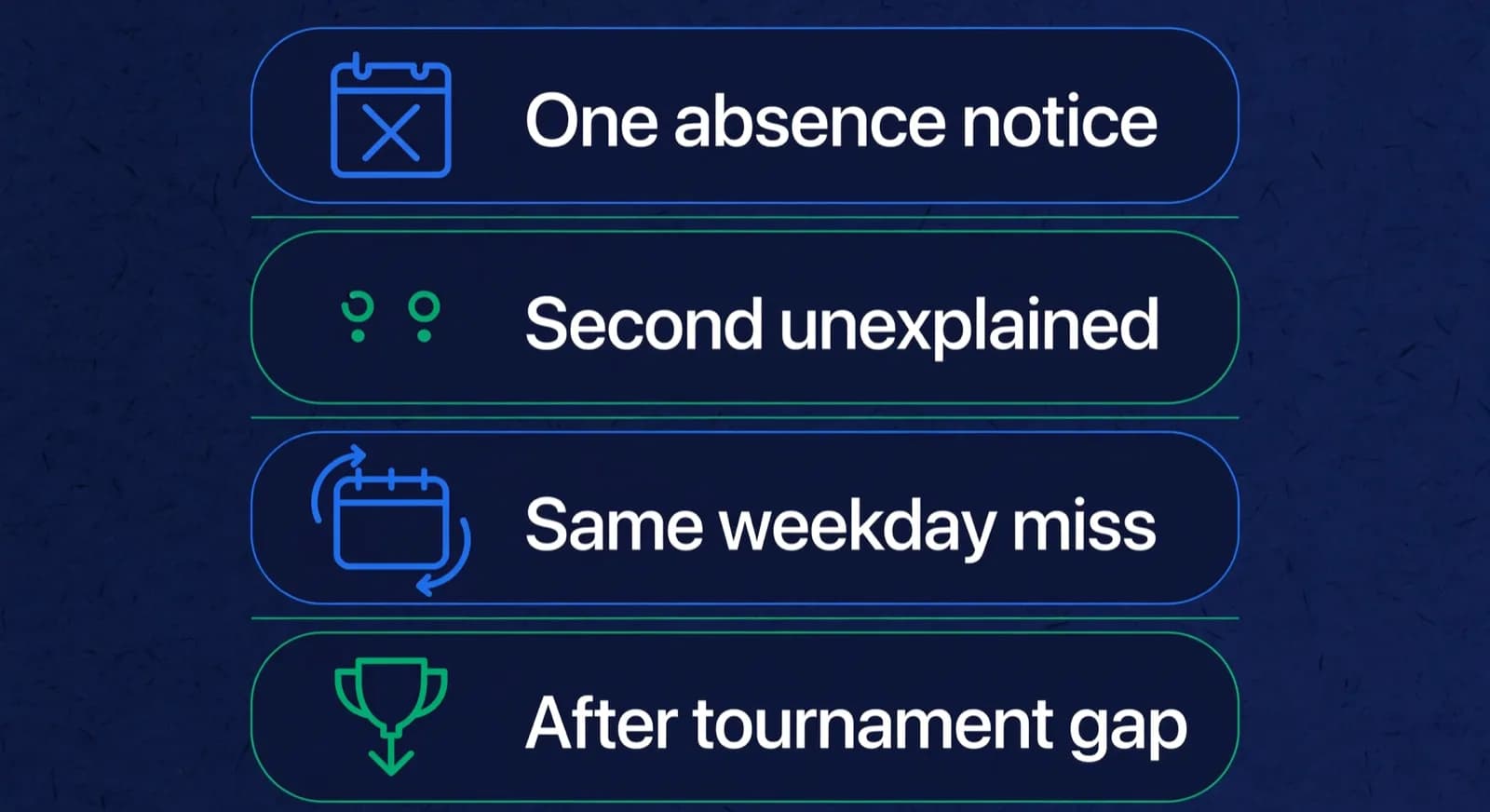
Our working rule is a personal message from the assigned coach after the second unexplained absence within a month, sent that day while the missed lessons are still recent. It is an editorial trigger from running batches, not a validated predictor of who will leave, and it never replaces an immediate check: if a child was expected and nobody knows where they are, contact the family at once. Example: "We missed Hana on Thursday. Is everything alright? The batch worked on rook endgames; let us know if the timing has become difficult." Keep the question open. A schedule clash, a loss of confidence or a fee concern each calls for a different response. Record the parent's answer and agree one next step, such as a slot change or a catch-up task, so the next coach knows what the family needs.
| Pattern | Possible explanation to ask about | The move |
|---|---|---|
| One absence, with notice | Illness, travel or another explained commitment | Record the reason and apply your make-up policy |
| Second unexplained absence in a month | A schedule clash, lost confidence or a fee concern | Personal coach message the same day, asking, not chasing |
| Same weekday missed repeatedly | A recurring clash with school tuition or another activity | Offer a batch or slot change before the family concludes chess lost |
| Lateness creeping upward | Drop-off difficulties or a change in enthusiasm | A friendly logistics chat with the parent at pickup |
| Absent right after a tournament | Disappointment after a loss or a need for recovery time | Coach reaches the student directly with the game, not the score |
| Whole batch dips together | Exams, a festival or a timetable problem affecting the group | Fix the timetable, not the families |
| Long planned gap (exams, travel) | A planned break with an agreed return date | Agree the return date now and decide in writing how the seat and any credits are handled |
Two patterns in that table are timetable problems wearing an attendance costume: the repeated-weekday miss and the whole-batch dip. Treat those as scheduling work, covered in our guide to batch scheduling and the weekly grid, not as seven separate parent conversations. The rest are retention work. Our guide to why students quit chess academies lists the questions to ask when attendance changes.
How does attendance connect to make-up credits?
Let your written policy decide which absences earn a make-up class, and record the decision against the missed session. If a parent asks at the counter or by message, enter the decision before promising a replacement class. A coach reading the register later should see the reason and the outcome without asking the family to explain again. Expiry windows, credit caps and what counts as notice belong in the policy itself, covered in full in our guide to make-up class policy and the credit ledger.
Linking the decision to the session keeps the policy fair in both directions. A family that gives notice gets a clear answer without having to ask twice, and an unexplained absence gets a follow-up conversation instead of an automatic replacement. ChessCore, which we build, works like this: the coach marks attendance from the class, attendance statuses settle make-up credits according to the academy's own policy, and a class nobody marked stays unrecorded, so the monthly report does not count it as an absence.
Lucas M.
Batch B2 · Thursdays · joined Aug 2025
1342
Academy rating · Lichess games synced
Won vs. 1410 · French Defense
Best gameMissed fork on move 23
Homework setWhat does a monthly attendance review look like?
Hold a 30-minute monthly review with the owner and coaches, and bring a register that is complete enough to count. Leave with named follow-up actions, each with an owner and a date. Spend the time on changes that need a decision, such as a recurring clash or an unused credit, rather than reading each mark aloud.

- Read each batch's attendance figure for the month and compare it with the previous two months, looking at direction more than the absolute number.
- List every student below the level you agreed in advance, or with two or more unexplained absences, and confirm each one already got the follow-up message; assign any that slipped.
- Compare make-up credits issued with credits used. If several are unused, ask whether the available slots fit those families before adding more sessions.
- Pick one action per flagged batch: a slot change, a parent call, or a coach conversation, with a name and a date on it.
Start from the same blank register for every batch so the review compares like with like. This is a worksheet to copy, not a sample of real data; each bracket is a field to fill in.
| Session and student | Status | Reason | Marked by | Correction | Action |
|---|---|---|---|---|---|
| [Date, batch, expected student] | [Present, late, absent or not recorded] | [Notice given, no notice or not known] | [Coach and time] | [Who changed it, when, why, or none] | [Follow-up, make-up decision or none] |
| [ ] | [ ] | [ ] | [ ] | [ ] | [ ] |
| [ ] | [ ] | [ ] | [ ] | [ ] | [ ] |
Define the figure before you calculate it. Count a student as attended when marked present or late, and report late arrivals as their own line so lateness stays visible. Divide attended sessions by sessions that have a recorded mark. A session nobody marked is unknown: list it beside the figure and leave it out of both the top and the bottom of the fraction. Illustration with made-up numbers: a student has 8 scheduled sessions in a month, with 5 marked present, 1 late, 1 absent and 1 not recorded. Attended is 6 and recorded is 7, so the figure is 6 of 7, or 86 percent, with one session unknown. Counting the unrecorded session as an absence would give 6 of 8, or 75 percent, which tells a different story from a gap in the record.
For online students, platform activity is not attendance. A student can play games between classes and still miss the live session, and the reverse. Keep the register for the live class and review practice separately, then include the agreed next step in the monthly parent summary. Our guide to showing parents rating progress covers how to explain the progress part of the same summary.
Frequently asked questions
What should a chess class attendance register include?
Per student per session: whether they were expected, the status (present, absent or late), the reason where known, who marked it and when, any correction, and the follow-up decision. The reason field matters most, because an absence nobody has explained is the one to act on, and a register that cannot separate excused from unexplained cannot warn you.
Do I need an attendance app for coaching, or is paper enough?
Paper is enough if the coach marks it during class and someone reviews absences and follows up. Consider software when the monthly review needs repeated tallying or make-up decisions sit in a separate ledger. Test how quickly you can mark a class, correct an error and find the students who need a conversation before paying for extra features.
Should parents be notified of every absence?
Notify the same day when a child was expected and did not arrive, after the coach confirms the room. Everything else belongs in a monthly summary alongside progress. A message for every single mark trains parents to ignore the channel, and a mistaken absent mark sent at once damages trust more than a short delay ever would.
When does an absence become a churn risk, and how does tracking it reduce drop-offs?
There is no proven threshold. Our working rule is a personal message after a second unexplained absence within a month, and an immediate call if an absence raises a safety concern. Ask whether the family needs a different slot, help catching up or a planned pause. Tracking helps you notice a change and act on it; an absence alone does not show that a student intends to leave.
How is attendance different for online chess classes?
Presence is easier to capture, since a student either connected or did not, but taking part is harder to see. A join shows that a device connected, not that the child stayed or played. Record a dropped connection as a note rather than an absence, let the coach correct the mark, and keep platform practice separate from the live-class register.
How do I count late arrivals, unrecorded classes and make-ups in attendance?
Decide the rules first and write them down. A workable set: late counts as attended and is reported on its own line; the figure divides attended sessions by sessions with a recorded mark; an unrecorded class is listed as unknown, not absent; a make-up is counted once, on a separate line, and does not erase the original absence from the register.
Written by Abhishek Tiwari
ChessCore
Drafted with AI, fact-checked and approved by a human before publishing, the same guardrail our product applies to every report it sends. Read our editorial standards.
Make the register work for you
In ChessCore, coaches mark attendance from the class, make-up credits settle by your academy's policy, and a class nobody marked stays unrecorded instead of counting as an absence.
- Roster import from the spreadsheets you already keep
- Lichess and Chess.com connections, batches, and fee plans
- First reports in week one, after your approval
- Free plan, no credit card required