On this page9 sections, 19 min read
- Which missed classes deserve a make-up?
- How much notice is required for a make-up?
- How do make-up credits work?
- Where do make-up classes fit in the timetable?
- How do you handle exam season and other edge cases?
- What happens when the academy cancels a class?
- How do you stop the policy being gamed?
- What should the written policy say to parents?
- What happens to unused credits?
- Frequently asked questions
Bottom line
Chess academy make-up classes run on four decisions: which absences earn a credit, how much notice a family gives, how many credits a term allows and when each credit expires. Published policies differ on all four, so choose values your coaches can staff and write them as one rule.
TL;DR
- Treat make-up classes as a ledger of credits issued under a written policy, not as favours negotiated chat by chat.
- Decide four values once, the eligible absences, the notice window, the credit cap and the expiry, and use the same values in the policy, the reply templates and the ledger.
- Redeem credits in a make-up class chosen by level and free seats, and do not owe a private lesson for a missed group class.
- Keep an academy cancellation separate from a student absence: the academy owes a replacement or an adjustment, and a student absence earns a credit only if the policy says so.
- Write down the awkward cases, exam blocks, repeated absence and a missed make-up, before they happen so no rule is invented in a chat thread.
Key facts
- A make-up credit ledger records when each credit was earned, why it was earned, and when it expires, the same way a fee ledger records payments and dues.
- A capped make-up slot lets families redeem credits without pushing a regular batch past its planned size; the alternative is a free seat in a batch of the same level.
- WhatsApp Business tools let an academy keep the policy, absence notices, and rebooking confirmations in one searchable thread per family.[1]
- A shared Lichess study can host an online make-up session when no physical slot fits the family's week.[3]
- Fraser Valley Chess asks for 24-48 hours of written notice by email or SMS, allows a make-up only within the same calendar month, and forfeits the make-up when it is told less than 24 hours ahead; emergencies are reviewed case by case. Page read 16 October 2026.[4]
- Chess Comic Academy encourages 24 hours of notice when possible, allows up to three make-ups per enrollment period, and does not carry unused make-ups over or exchange them for cash, refunds or credits. Page read 16 October 2026.[5]
- Make Your Move requires notice 5 hours before a group class and 12 hours before a private lesson, and allows a maximum of three group make-ups per registration cycle, used within that cycle. The page is dated August 2025 and was read 16 October 2026.[6]
Which missed classes deserve a make-up?
Start with the absence types and decide, for each, whether the academy issues a credit. Three published policies, read on 16 October 2026, show how much the choices vary. Fraser Valley Chess asks for 24-48 hours' written notice by email or SMS and offers make-ups within the same calendar month [4]. Chess Comic Academy encourages 24 hours' notice when possible and allows up to three make-ups per enrollment period [5]. Make Your Move requires notice 5 hours before a group class and caps group make-ups at three per registration cycle [6]. Treat them as examples of structure, not numbers to copy: your coaches, seats and term length decide yours.
Notice matters because it changes what the academy can do with the seat. A message the evening before lets a coach adjust pairings, offer the spot for another student's make-up, or plan a smaller group exercise. A no-show wastes preparation and blocks anyone else from using the seat. Rewarding notice with a credit and withholding it from silence is not punitive; it prices two behaviours differently, which is what a policy is for. The table below covers student absences. Classes the academy cancels have their own section further down.
| Student absence type | Credit (set your own values in brackets) | Why |
|---|---|---|
| Illness with notice before class | One credit | Notice lets the coach replan the session and reoffer the seat |
| Illness or emergency without notice | Case by case: [the first N per term] earn a credit, goodwill after that | Genuine emergencies happen, but silence cannot stay free forever |
| No-show with no message | No credit | The class ran, the seat was held, and the fee covered both |
| Planned family travel with advance notice | One credit if notice is at least [your planned-absence notice] | Enough time to fill or repurpose the seat |
| Public holiday on the published calendar | No credit, if the fee was priced around that calendar | The term fee already assumes the calendar |
The table only works if absences are recorded the day they happen, which is an attendance discipline rather than a policy question. Our guide to attendance tracking covers the register habits that feed this ledger; without them, every credit becomes a memory test between a parent and a coach.
How much notice is required for a make-up?
There is no standard notice window, and the published ones differ. Fraser Valley Chess asks for 24-48 hours in writing [4], Chess Comic Academy encourages 24 hours [5], and Make Your Move requires 5 hours before a group class starts [6]. Choose a deadline that gives your coach enough time to adjust pairings or offer the vacant seat to another student, then tell families how to send notice.
| Academy policy page | Notice they publish | Cap and window |
|---|---|---|
| Fraser Valley Chess [4] | 24-48 hours, by email or SMS rather than a phone call; under 24 hours forfeits the make-up | Same calendar month; a miss in the last week can be made up the next month; a missed make-up cannot be rescheduled |
| Chess Comic Academy [5] | Encouraged 24 hours when possible; they say they will try to accommodate emergencies | Three per enrollment period, same period only; unused make-ups do not carry over and cannot become cash, refunds or credits |
| Make Your Move [6] | 5 hours before a group class; 12 hours before a private lesson | Three group make-ups per registration cycle, same cycle only; no make-up for private no-shows |
Use those pages as examples, not as your default numbers. A 5-hour clock is easy for a parent and hard for a coach who needs to re-pair a group. A 48-hour clock protects the timetable and will feel strict on a Monday morning fever. Pick one clock, name the channel (a written message, not a lobby chat), and say what happens when notice is late. Fraser Valley forfeits the make-up if it is not told at least 24 hours ahead, with emergencies reviewed case by case [4]. Make Your Move says it cannot guarantee eligibility without prior notice [6].
Make Your Move requires 12 hours for private lessons and 5 hours for group classes [6], and private no-shows get no reschedule [6]. If you teach both formats, publish both clocks so a parent cannot quote the group rule against a private slot. Then record the notice timestamp on the credit itself and measure it against your one stated deadline, which settles the 4:55-for-5:00 argument: a message after the deadline is a no-show, not notice.
How do make-up credits work?
A make-up credit is a recorded entry, not a verbal promise. The ledger holds four facts per credit: which student earned it, which missed class produced it, the date it was earned and the date it expires. When the family books a make-up, the redemption is written against that specific credit. The glossary explains what a make-up credit records in one place; the point here is that without the entry, a coach is trying to remember in November whether a family's missed class was in August or September, and whether it was one class or two.
Expiry is the part academies most often skip. A credit with no expiry is a stored claim on future coach time, and stored claims pile up. A short expiry protects the timetable but penalises a family with a busy fortnight. A long one is kinder, but it can leave a pile of redemptions at the end of the term that needs seats you do not have. Set the window from the seats you can staff: estimate how many replacement seats you can offer per week and how many credits are likely to be outstanding, then choose an expiry that keeps the two roughly level. Chess Comic Academy and Make Your Move both tie make-ups to the enrollment period or registration cycle in which the class was missed [5][6]. If you use a number of weeks as well as the term end, say which of the two comes first.
Treat the ledger as money, because to the family it is money. A parent who paid for eight classes and attended six experiences the gap as fees spent on nothing. A visible credit with a clear expiry tells them the academy noticed, recorded it and reserved a way to deliver what was paid for. A credit preserves the value of a class while a refund reprices it, which our guide to designing a fee structure covers in more detail.
Caps complete the system. A cap per student per term covers genuine life without underwriting chronic absence, and the two published caps above are both three [5][6]. Past the cap, absences are acknowledged with sympathy and homework, not with claims on the timetable. State the cap in the written policy, because a cap announced at the moment it is hit reads as a refusal rather than a rule.
- Issue: record the student, the missed class, the reason, when notice arrived and the expiry date.
- Booking: record the replacement class and seat against that specific credit.
- Redemption: mark the credit used when the coach marks attendance at the replacement class.
- Cancellation: decide whether a family that cancels a booking in time gets the credit back with its original expiry, and write the answer into the policy.
- Expiry: remind the family before the date, then log the lapse or the conversion on the date.
A tool can hold some of these steps and not others, so check which transitions yours records and which stay manual before you promise families anything. ChessCore, which we build, settles make-up credits from the attendance marks a coach records, following the policy the academy sets; a parent's leave request on its own does not record attendance. See the feature page on attendance marks and make-up credits for what the product covers. The notice, cap and expiry values in this guide are editorial suggestions that the software does not decide for you.

Lucas M.
Batch B2 · Thursdays · joined Aug 2025
1342
Academy rating · Lichess games synced
Won vs. 1410 · French Defense
Best gameMissed fork on move 23
Homework setWhere do make-up classes fit in the timetable?
Decide where make-ups happen by level and capacity, under the written policy. A regular batch can host a make-up when three things are true: it is the same level, it has a free seat below its planned size, and the topic works for a visitor. When any of the three fails, use a pooled slot or an online session. The common failure is a generous-sounding policy that lets credits book into any class: a batch planned for eight runs at eleven, the lesson plan breaks, and the families who never missed a class get a worse session. To reserve replacement-class capacity before you promise it, work from the batch scheduling guide.
| Where the make-up happens | Works when | Watch for |
|---|---|---|
| Pooled make-up slot, weekly, with a seat cap | Several levels need replacement classes and regular batches have no free seats | Mixed levels, so the coach runs tactics or game review rather than replaying the missed lesson |
| A free seat in a regular batch of the same level | The batch is below its planned size and the topic suits a visitor | Class size above plan; a lesson that depends on last week |
| Online session or coached review of the student's own games | The family cannot reach any physical slot before the credit expires | Offering it by default, which empties the physical slots |
Mixed levels are fine for a one-off session: the coach runs tactics, endgame drills or game review rather than the batch syllabus, so a make-up delivers coaching value without pretending to be the missed lesson replayed.
The academy chooses the make-up format, not the family. A missed group class is made good with a seat in a make-up class, an online session or a coached review of the student's own recent games. It is not owed back as private one-to-one time, which would upgrade the service every time a child is absent. Chess Comic Academy writes a similar limit into its policy: make-ups are subject to availability and must be taken in a class that suits the student's level and has space [5]. Put that condition in your own wording on day one, because a parent who first hears it when no seat is free hears a broken promise.
Week of 12 October · all batches
0 conflictsMake-up credit · Mia G. · Sat 4:30 PM
Absent Thursday with notice · booked by Noor
Class reminders sent to 148 families
Timing changes update everyone at once
If a family genuinely cannot reach any physical slot before expiry, an online session is an honest substitute: a coach and student walking through prepared positions in a shared Lichess study delivers focused work in thirty minutes [3]. Offer it as the fallback, not the default.
How do you handle exam season and other edge cases?
Exam blocks, repeated absence, a session the whole batch misses and a make-up the student then skips all need answers written before they happen. These are the cases a coach otherwise decides under pressure in a chat thread, and two families in the same situation end up with different outcomes.
| Edge case | Default to write down | Trade-off |
|---|---|---|
| Exam season takes out three or four weeks | A pause or a fee adjustment for the block, agreed before the exams start | Several credits cannot be redeemed in a full exam month, and a held seat has a staffing cost |
| A student misses most weeks | A conversation about timing or fit, not a stream of credits | The cap already limits credits; repeated absence is an enrolment question |
| The student misses the booked make-up | The credit is spent unless the policy allows one reschedule | Fraser Valley Chess states that a missed make-up cannot be rescheduled [4] |
| Siblings on a family discount | The same policy, applied per child | A discount changes the price, never the rules |
Exam season is where academies lose families quietly. A child who misses a month for board exams and then watches credits expire may conclude that the academy does not bend for real life, which is one of the schedule frictions behind students drifting away. A pause agreed before the exams keeps the family and removes the pile of credits, but it has a cost: the seat is held for a month, and the coach's hours may go unfilled. Decide which cost you prefer, a pause with a held seat, a fee adjustment for the exam block, or a normal exit with priority re-entry, and mark the exam weeks on the term calendar so the option is known before the first request.
What happens when the academy cancels a class?
When the academy cancels, the family did not miss anything, so it is not a student absence and should not use up the student's cap. The academy owes a replacement session or a fee adjustment, and the choice belongs in the written policy. Fraser Valley Chess says it prorates monthly billing and credits fees for cancellations from its side [4].
| Cause | What the academy owes | Ledger treatment |
|---|---|---|
| Coach unwell or venue unavailable for one batch | A replacement session at the same level, or a fee adjustment if none can be offered before the term ends | Record a separate academy credit that does not count against the cap |
| Whole-batch cancellation, such as weather or a school closure | One replacement session for the batch where possible | One shared session instead of scattering the missed class across many make-up slots |
| Class on the published holiday calendar | Nothing, if the fee was priced around that calendar | No entry |
Do not let unused academy-side credits expire silently. Before the term ends, decide whether they become a fee adjustment or a refund, and say which in the policy. That is the opposite of a parent no-show, which holds the seat and earns no credit.
How do you stop the policy being gamed?
Every make-up policy attracts the same small set of abuse patterns, and each one has a structural fix that works better than confrontation. The goal is not to catch anyone; it is to make the gaming move pointless so the conversation never has to happen.
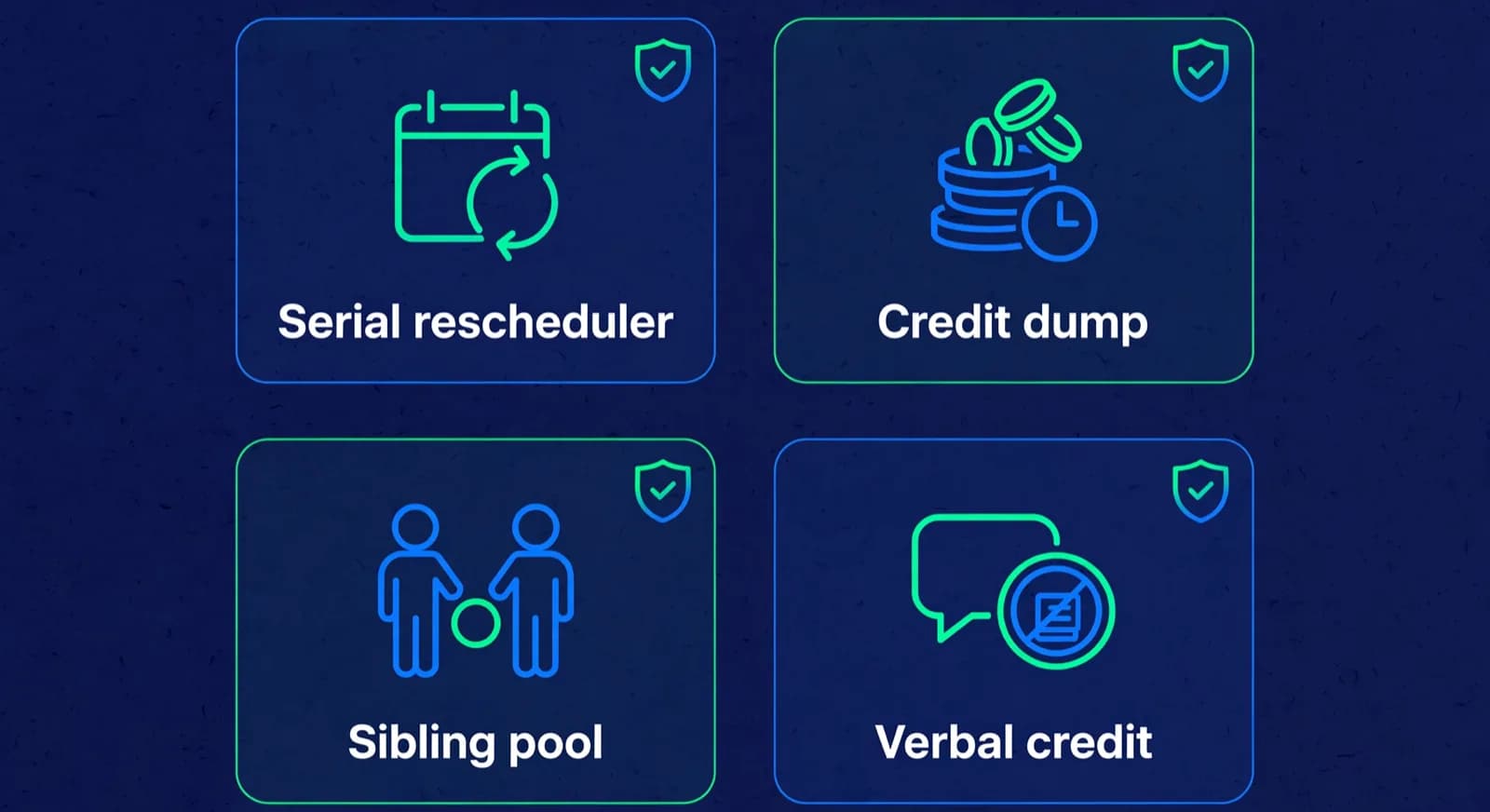
- The serial rescheduler treats the regular batch as optional and rebooks weekly. Fix: the per-term credit cap, plus credits earned only for the defined absence types in the table, not for preference shifts.
- The end-of-term credit dump hoards credits and demands several sessions in the final fortnight. Fix: an expiry tied to the term or a rolling window, which limits how many credits can be outstanding at once.
- The 4:55 cancellation for a 5:00 class claims notice was given. Fix: define one notice clock in writing, measured from the class start, so a message after that deadline is a no-show, not notice.
- The sibling pool tries to spend one child's credit on another child's session. Fix: credits are per student and non-transferable, stated in the policy.
- The verbal credit cites a promise a coach supposedly made months ago. Fix: a credit exists only if it is in the ledger, and the ledger entry is shared with the parent when the credit is issued.
Notice that every fix is a rule, not a judgement call. Rules scale across coaches and survive staff changes; judgement calls turn each absence into a negotiation that lands on whoever is friendliest. The pattern matters beyond make-ups too: families who feel a policy is applied unevenly drift, and our piece on why students quit chess academies traces how small fairness frictions compound into churn.
What should the written policy say to parents?
The written policy should be short enough to read in a minute and concrete enough to settle a dispute without a phone call. State both protections explicitly: what the family is owed when life intervenes, and what the academy needs to keep classes good for everyone who showed up. Avoid legal tone; parents read a warm, plain policy as confidence and a defensive one as a warning.
Deliver it where parents already are. Send the policy in each family's WhatsApp thread at enrolment using the academy's business account, so it sits in the same searchable history as fee receipts and class updates [1]. WhatsApp's own help centre documents how business profiles and message tools work for routine customer communication [2]. When a family invokes the policy, reply with the relevant line quoted back, the credit confirmation and the next available slot, all in one message. Calm, fast and consistent is the whole brand.
If software drafts your parent replies, hold it to the same written policy. A drafted reply about a make-up should quote only what the policy allows, never offer a private slot or an extra credit, and wait for a coach to approve it before it sends. Automation should make a consistent policy faster to communicate, not negotiate new terms on the academy's behalf.
What happens to unused credits?
Unused credits expire, and they should expire loudly rather than silently. A week before a credit lapses, send the family a short reminder with the remaining options. If they still cannot attend, you may offer one conversion before expiry, such as a thirty-minute online session in a shared Lichess study or a prepared homework set with the coach's notes [3], if your policy allows it. Either delivers value at low timetable cost, and the family ends the term feeling the credit was honoured rather than confiscated.
What unused credits should not become, by default, is cash. A refund-by-default policy turns your timetable into a metered service and invites end-of-term reconciliation on every invoice. The class was scheduled, the coach was paid, and the fee priced the term as a whole; the credit system exists so that fairness is delivered in coaching time. Reserve refunds and fee adjustments for the cases where the academy failed to deliver, such as a cancelled class that was never rebooked.
Run an end-of-term sweep as a routine: list every expiring credit, send the reminder batch, log each conversion or lapse in the ledger, and start the new term at zero. Ten minutes of admin closes the loop on the whole policy and gives you a clean number for how many classes were actually missed and recovered, which is worth knowing when you plan next term's calendar. The pillar guide to running a chess academy puts this sweep alongside the other end-of-term routines.
Frequently asked questions
Should chess academy make-up classes be free?
Yes, when the absence type earns a credit under your policy, because the family already paid for the class in their term fee. A make-up credit is not a free extra; it is delivery of something purchased. Charging again for a credited make-up reads as double billing. The protection for the academy comes from the credit cap, the expiry and the seats you offer, not from charging twice.
How long should make-up credits last before they expire?
There is no standard, so choose from the seats you can staff. Chess Comic Academy and Make Your Move both require make-ups to be used in the enrollment period or registration cycle in which the class was missed [5][6], and Fraser Valley Chess requires the same calendar month [4]. State the expiry on the credit itself, and if you use both a number of weeks and the term end, say which comes first.
Should a missed group class be made up as a private lesson?
No, unless the academy offers it as a goodwill gesture. The academy chooses the make-up format, and a missed group class is fairly made good with a seat in a make-up class, an online session in a shared study, or a coached review of the student's own games. Say so in the written policy at enrolment. Owing private one-to-one time for every missed group class upgrades the service each time a child is absent.
What if a parent demands a refund instead of a make-up class?
Quote the policy line, confirm the credit, and offer the next available options plus the online fallback, all in one calm message. Reserve refunds for cases where the academy failed to deliver, such as a class you cancelled and never rebooked within the term. If you refund routine absences, you have repriced your term fee as a per-class meter, and every future invoice becomes a reconciliation exercise.
How many make-up credits per term is reasonable?
Choose a cap you can staff and announce it at enrolment. Chess Comic Academy and Make Your Move each cap make-ups at three per enrollment period or cycle [5][6]. Past the cap, acknowledge further absences with sympathy and a homework set rather than timetable claims. A cap revealed only when a family hits it reads as a refusal invented on the spot.
What happens if the academy cancels the class?
The academy owes a replacement session or a fee adjustment, not a debate, and it should not count against the student's cap. Fraser Valley Chess says it prorates monthly billing and credits fees for cancellations from its side [4]. Write your own rule into the policy, and decide before the term ends whether unused academy-side credits become a fee adjustment or a refund.
Sources
- [1]WhatsApp Business · accessed 2026-06-10
- [2]WhatsApp Help Center · accessed 2026-06-10
- [3]Lichess Study: shared analysis boards · accessed 2026-06-10
- [4]Fraser Valley Chess lessons and makeup policy · accessed 2026-10-16
- [5]Chess Comic Academy makeup class policy · accessed 2026-10-16
- [6]Make Your Move make-up class policy · accessed 2026-10-16
Written by Abhishek Tiwari
ChessCore
Drafted with AI, fact-checked and approved by a human before publishing, the same guardrail our product applies to every report it sends. Read our editorial standards.
Keep attendance and make-up credits together
ChessCore keeps the register and make-up credits in one place and settles credits from the attendance marks a coach records, following the policy you set. You still choose the notice, the cap and the expiry.
- Roster import from the spreadsheets you already keep
- Lichess and Chess.com connections, batches, and fee plans
- First reports in week one, after your approval
- Free plan, no credit card required