On this page8 sections, 18 min read
- What is a typical chess coach salary?
- Can chess coaching actually be a career?
- How is a chess coach's income built?
- What does the income math look like?
- What raises a chess coach's income over time?
- Part-time side income or full-time coaching?
- What about chess coach income in India specifically?
- How do coaches grow their income from here?
- Frequently asked questions
Bottom line
Salary.com estimates its After School Chess Instructor role in the United States averages 61,187 US dollars a year (29 US dollars an hour) as of 1 October 2026, with a 25th to 75th percentile range of 53,530 to 69,784 US dollars [9]. For India, Salary.com shows an estimated 4,19,981 rupees a year for a Chess Coach role [10], but hourly offers differ by employer and private coaches set their own rates.
TL;DR
- Salary.com's United States estimate for the After School Chess Instructor job title is 61,187 US dollars a year on average, with a 25th to 75th percentile range of 53,530 to 69,784 US dollars a year as of 1 October 2026 [9].
- As of 16 October 2026, JD Chess lists private lessons at 40 US dollars an hour, with a 10-lesson pack at 350 US dollars (35 US dollars per lesson) [7], and IM Adarsh's pricing page lists 60, 55, and 50 US dollars an hour by package [8].
- The levers that raise income over time are rating and title credibility, student retention, group formats that break the one-to-one time ceiling, and running the practice on software instead of by hand.
- Part-time coaching is a low-risk side income built around a day job, while full-time coaching only works once retention and referrals keep the calendar full without constant selling.
- In India, titled-coach credibility through FIDE and AICF and the shift to group or online formats matter more to total income than any single headline per-hour rate.
Key facts
- FIDE awards international titles such as FIDE Master and International Master, and titled credibility is one of the strongest signals a coach can use to justify a higher rate.[1]
- The All India Chess Federation administers ratings and events in India, so AICF and FIDE registration underpins the competitive credibility that raises a coach's income.[2]
- Player strength is expressed through Elo-derived rating systems, which give a coach a public, verifiable credential that supports charging above a beginner-teacher rate.[3]
- A group class lets one coach-hour serve several students at once, which is why batch size changes the income arithmetic far more than the hourly rate does.
- In ChessCore, recurring fees can collect through Razorpay UPI AutoPay on the Grow plan and up, so a coach's billed income arrives on a schedule instead of being chased by hand each month.[5]
What is a typical chess coach salary?
A typical chess coach salary benchmark is Salary.com's US estimate for the After School Chess Instructor job title: 61,187 US dollars a year on average as of 1 October 2026 [9]. Its 25th to 75th percentile range is 53,530 to 69,784 US dollars a year, and its hourly equivalent is 29 US dollars. These figures describe that employed job title in the United States, not every chess coaching role and not a private coach's lesson revenue.
Private coaches set their own lesson prices. As of 16 October 2026, JD Chess lists private lessons at 40 US dollars an hour and a 10-lesson pack at 350 US dollars, which is 35 US dollars per lesson [7]. IM Adarsh's pricing page lists 60 US dollars pay-as-you-go, 275 US dollars for five hours (55 US dollars an hour), and 500 US dollars for ten hours (50 US dollars an hour) [8]. Those are those coaches' listed USD rates, not a US or India market salary and not an annual wage.
| Seller page as of 16 October 2026 | Listed offer | Listed USD price |
|---|---|---|
| JD Chess private lessons | 1 hour | 40 per hour [7] |
| JD Chess 10-lesson pack | 10 lessons | 350 total (35 per lesson) [7] |
| IM Adarsh pay-as-you-go | 1 x 60 minutes | 60 per lesson [8] |
| IM Adarsh 5-hour plan | 5 x 60 minutes | 275 total (55 per hour) [8] |
| IM Adarsh 10-hour plan | 10 x 60 minutes | 500 total (50 per hour) [8] |
Those hourly figures still sit inside the income model this page already uses: students times rate times hours actually taught, plus group classes, courses, and academy margin. A listed 40 or 60 US dollar private hour is a rate input, not take-home pay. No-shows, unpaid make-ups, and empty seats shrink it. Format still moves the total more than the sticker rate, which is why the illustrative batch math later in this guide stays useful after you substitute a real listed price.
Can chess coaching actually be a career?
Yes, chess coaching can be a full-time career, but it works as a portfolio of income streams rather than a single salaried job. The coaches who make a living from it combine private lessons, group classes, and often their own small academy, and they treat their weekly teaching capacity as the asset to grow. A listed hourly rate from one seller is a starting input, not the annual figure searchers mean by chess coach salary.
This matters because the honest answer to how much chess coaches make is a range of assembled totals, not one wage. A titled coach in a metro who runs full batches earns nothing like a weekend hobby tutor with three students, and both are called chess coaches. Alongside the US After School Chess Instructor benchmark, it is useful to understand the private-coaching income model that produces your own total, so you can see which decisions move it. That is what this guide covers after the listed-rate table, and it is why we keep the per-lesson pricing question in a separate piece: this post owns total income and career viability, while our guide to what to charge for chess lessons owns the rate itself.
How is a chess coach's income built?
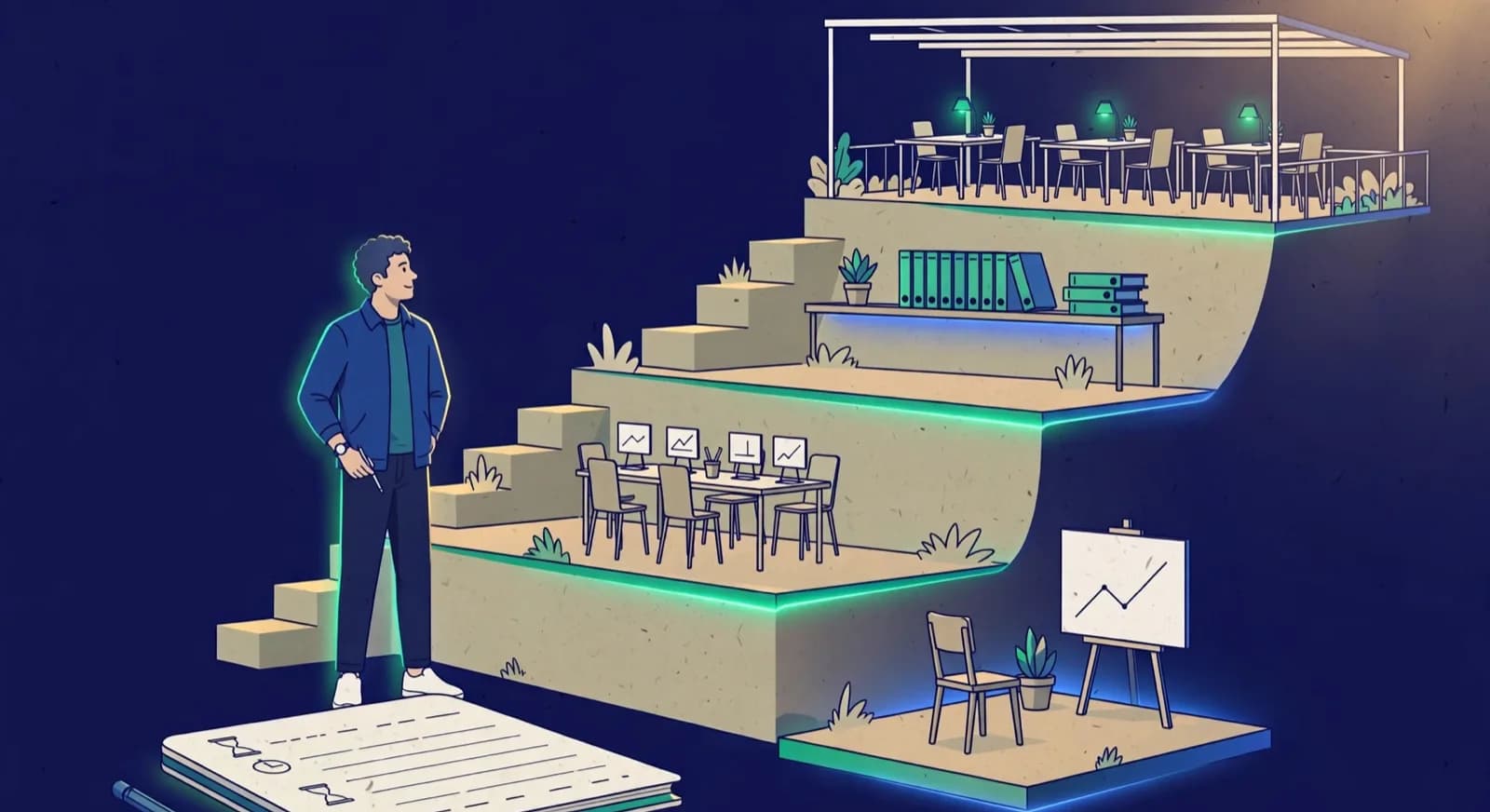
A chess coach's income is built from four stackable streams: one-to-one private lessons, group classes, packaged courses or content, and running an academy. Each stream trades differently between rate, volume, and effort, and a durable coaching income almost always blends at least two of them rather than relying on private lessons alone.
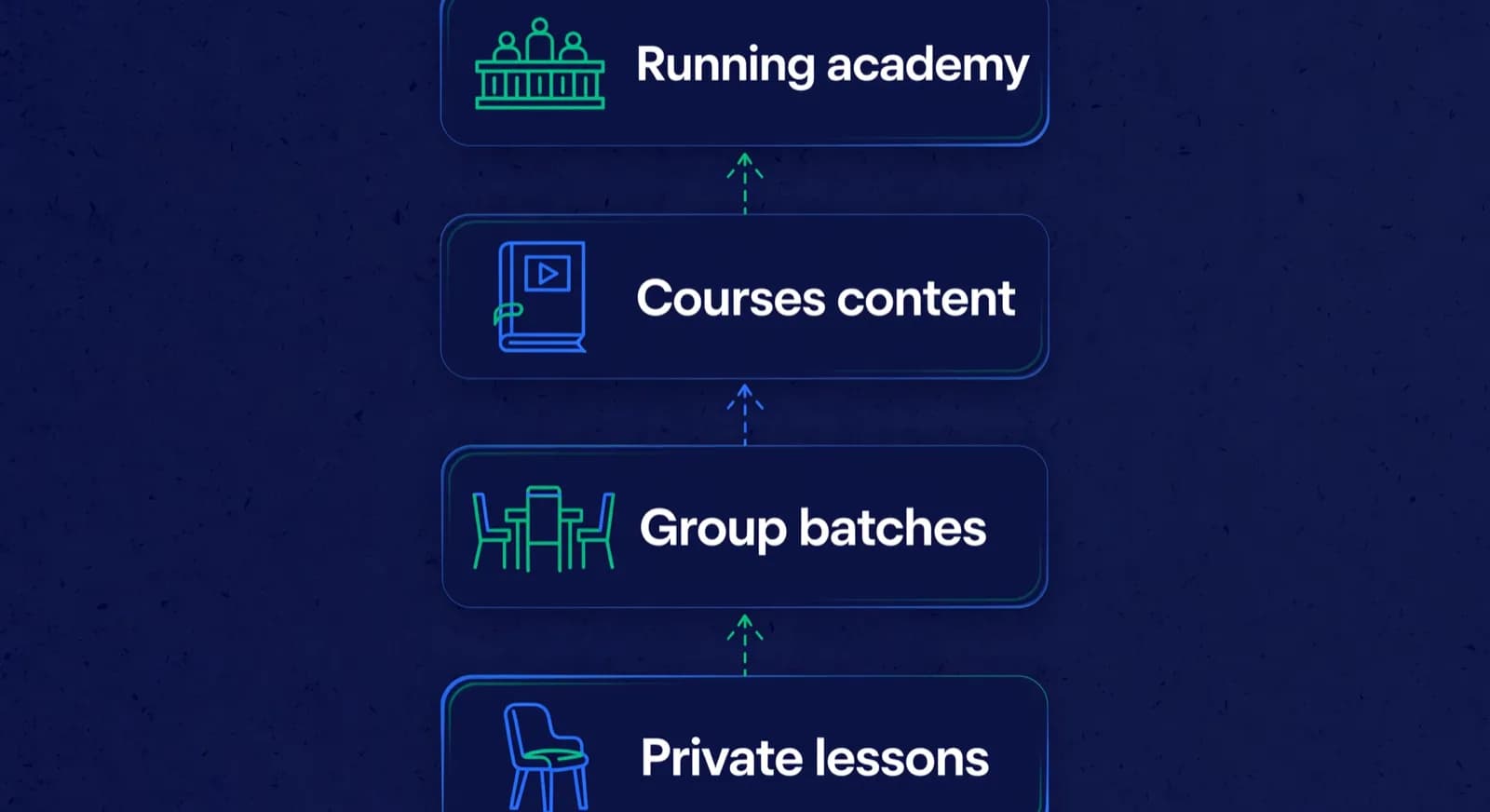
- Private lessons: the highest rate per student and the easiest to start, but capped hard by the hours in your week, so they set a low ceiling if used alone.
- Group classes and batches: a lower fee per student but far more paid seats per teaching hour, which is the single biggest lever on total income.
- Courses, recorded content, and homework packs: work you produce once and sell many times, so revenue stops being tied to hours you are physically present.
- Running an academy: you coach some batches yourself and take a margin on batches taught by other coaches, which is how income scales past your own calendar.
- Adjacent income: tournament arbiting, writing, and school programs that use the same credibility but diversify the streams.
The reason the blend matters is that private lessons have a mathematical ceiling. There are only so many productive teaching hours in a week, and once they are full, the only way to earn more from private lessons is to raise the rate, which credibility limits. Every other stream on that list exists to break the one-to-one time ceiling: a group serves more students per hour, a course serves students while you sleep, and an academy earns from hours you did not personally teach. Coaches who plateau are usually the ones still selling only private hours in year three.
What does the income math look like?
The income math starts as students times rate times hours, so the same coach can bill very different totals depending on which lever they pull. The table below uses clearly labeled placeholder figures to show the method, not market data; substitute your own city's rates and your own realistic student count. Every figure here is gross revenue before costs and before personal tax, not take-home pay. What it demonstrates is that format, not rate alone, is what moves the coach's gross revenue per teaching hour.

| Format (illustrative US dollar figures, not market data) | Paid seats per hour | Fee per seat per hour | Gross revenue per teaching hour |
|---|---|---|---|
| One-to-one private lesson | 1 | $40 | $40 |
| Small group of four | 4 | $20 | $80 |
| Batch of eight | 8 | $15 | $120 |
| Recorded course (sold monthly) | many | small | scales past your hours |
Read the last column as gross billing, not earnings. In these illustrative figures the batch charges each family the least per hour, yet brings in three times the gross a private lesson does for the same sixty minutes, because the seats stack. Now turn one month into take-home with a single worked example, with figures that are illustrative, not a survey. Say you teach 8 students at $100 a month each: that is $800 billed. If one family's fee is unpaid that month you collect $700, not $800, and an unpaid fee is not a cancellation, the seat was still taught. Subtract $200 of stated monthly costs (platform, internet, a share of rent) and you have $500 of surplus before your personal tax. If that month took 10 teaching hours plus 6 hours of preparation and admin, that is 16 total working hours, so the surplus works out to about $31 per total working hour.
| Measure (one illustrative month) | Amount | What it means |
|---|---|---|
| Gross billed | $800 | 8 students x $100, before anything is deducted |
| Cash collected | $700 | One fee unpaid; the class was still taught |
| Surplus before personal tax | $500 | Cash collected less $200 of costs |
| Per total working hour | about $31 | $500 over 16 teaching plus prep and admin hours |
That surplus is not the same thing as an employee's gross salary, which already bundles in paid leave and any benefits, so compare like with like: a private coach's business surplus before personal tax against an employed role's gross pay. These are example numbers to illustrate the mechanism, not a promise. Your real inputs are your rate, your fill rate, your actual costs, and how many hours you can teach and prepare without burning out, and an unpaid fee stays unpaid until it is collected rather than disappearing from the record.

Fees · October · all batches
136 of 148 paidCollected · this term
92%Lucas M. · October · $180
Card AutoPay · receipt sent to Müller family
Mia G. · October · $180
Payment link opened in WhatsApp
Batch B2 · 12 of 14 paid
No bank-transfer screenshots needed
AutoPay mandates · 41 active
Renew monthly without reminders
What raises a chess coach's income over time?
Five levers raise a coach's income over time: credibility, retention, format, systems, and scale. They compound in roughly that order, and none of them is a higher hourly rate on its own, because a rate you cannot justify or cannot fill is just a smaller practice with bigger numbers on the price list.
Credibility comes first because it sets the rate you can charge without emptying your calendar. A verifiable playing strength, expressed through the Elo-derived rating that every serious player understands [3], and ideally a FIDE title such as FIDE Master or International Master [1], lets parents and adult students place you instantly. A public FIDE rating profile that anyone can look up [4] does more for your pricing power than any amount of marketing copy, because it is a claim the buyer can verify in ten seconds. This is why competitive coaches invest in their own rating even while teaching: it is a business asset, not vanity, and it is the one credential that keeps working while you sleep.
Retention is the least glamorous lever and the most powerful. Income from a student who stays two years dwarfs income from a student who leaves in two months, and it costs you nothing to acquire twice. A coach with strong retention spends their energy teaching a full, stable roster; a coach with weak retention spends it endlessly refilling a leaky one, which is unpaid sales work that caps how much teaching they can actually do. Retention is built in the first month through visible progress and steady parent communication, which is why the coaches who send a short update after every few classes keep families the longest. In the demo academy, showing a parent that Mateo R. climbed to 1342, up 118 since June is what makes the next term's fee an easy yes.
Format and systems then multiply what credibility and retention give you. Format means shifting suitable students from private lessons into group batches and online cohorts, where free tools like a shared Lichess study let you run structured group teaching without extra cost [6], breaking the one-to-one time ceiling described earlier. Systems mean running the practice on software instead of by hand: when scheduling, attendance, fee collection, and parent updates are automated, you can carry more students per week without the admin load that usually forces a coach to cap their roster. The final lever, scale, is turning the practice into an academy, coaching some batches yourself and earning a margin on batches other coaches teach. Each lever is a separate decision, and you do not need all five at once; you need to know which one your income is currently missing.
Lucas M.
Batch B2 · Thursdays · joined Aug 2025
1342
Academy rating · Lichess games synced
Won vs. 1410 · French Defense
Best gameMissed fork on move 23
Homework setPart-time side income or full-time coaching?
Part-time coaching is a low-risk side income built around a day job, while full-time coaching is a business that only works once retention and referrals keep the calendar full without constant selling. Most sustainable full-time coaches started part-time and only made the jump when their evening and weekend roster was already turning people away.
Part-time is the honest starting point for almost everyone. A handful of private students or one weekend batch is real income with none of the risk: your rent is covered by the day job, so you can afford to build credibility and a reputation slowly. The trap is staying accidentally part-time forever, teaching a few random hours without ever building the retention and systems that would let it grow. Treat the side income as a deliberate first stage with a target, not a permanent ceiling.
Going full-time is a capacity-and-stability decision, not a passion one. The test is simple: is your part-time roster consistently full, retaining students across terms, and generating referrals faster than you lose students? If yes, the constraint holding your income down is the hours your day job takes, and going full-time removes that constraint. If no, going full-time just means more empty hours to fill under financial pressure, which is the worst condition for the patient relationship-building that coaching income actually rests on. The move from side income to livelihood is covered in more depth in our guide to starting a chess coaching business.
What about chess coach income in India specifically?
In India, a chess coach's income is shaped less by a headline per-hour rate and more by two things: credibility through the federation system, and the shift to group and online formats that serve many students affordably. AICF and FIDE registration is what lets a coach position for competitive, rated students [2], and that credibility is the clearest lever on what families will pay. As a single rough benchmark, Salary.com's India page estimated an average Chess Coach salary of about 4,19,981 rupees a year as of 16 October 2026 [10], but that is one estimator's figure for an employed role, not a survey of private coaches, so treat it as a reference point rather than a target.
Indian employers mostly pay by the hour or by the session rather than by salary, and the pay basis is rarely the same from one offer to the next. We did not find a pay rate on a named academy's own careers page that we could quote, so this page gives no hourly range for India. Before you compare any offer with a salary or with your own batch, read the posting for the pay basis, the paid hours and what happens when a class is cancelled.
| Pay basis in an offer | What to ask before comparing | Why it changes the comparison |
|---|---|---|
| Per paid class hour | Are preparation, travel and parent updates paid? | An hour of teaching usually needs more than an hour of work, so the effective rate is lower than the posted one. |
| Per session or per student | How many students must attend for the session to be paid? | A session rate that depends on attendance behaves like variable income, not a fixed wage. |
| Monthly stipend | How many hours a week does the stipend cover? | Divide the stipend by weekly hours times four to compare it with an hourly rate. |
| Salary with benefits | Which benefits, leave and notice period apply? | Gross salary and cash from private lessons are different measures, so compare after costs and tax. |
Here is the conversion in one line. A stipend of 20,000 rupees a month for 10 class hours a week and 4 weeks is 20,000 divided by 40 hours, or 500 rupees per class hour, and about 333 rupees per working hour if each class needs 0.5 hour of preparation and messages. The numbers are an illustration, not an offer anyone has advertised. The same working-hour test applies to your own batch, so use the income example above for private practice.
The federation path is concrete and worth understanding as an income decision, not just a sporting one. A coach whose students play AICF and FIDE rated events, and who holds a public FIDE rating themselves [4], can charge and retain differently from one teaching only casual beginners, because rated results are visible proof of coaching that parents of ambitious children actively seek out. How ratings work in the Indian context, and how a student moves from unrated to a first FIDE rating, is laid out in our guide to FIDE rating in India, and what families across Indian cities actually pay is covered in our guide to chess academy fees in India.
The format shift matters even more to total income here. Group batches and online cohorts let one coach serve far more students at fees each family finds reasonable, which fits the Indian market better than a small number of high-priced private hours. The practical constraint then becomes collection at volume: with many families, chasing monthly fees by hand takes time. ChessCore, which we build, can collect recurring fees through Razorpay UPI AutoPay on the Grow plan and up, with receipts [5]. A mandate that a parent has approved still depends on the parent's bank, so failed debits need follow-up. Collection speed affects cash flow; it does not change what families are willing to pay.
How do coaches grow their income from here?
Coaches grow their income by moving up the leverage ladder deliberately: set a defensible rate, fill it, add group formats, systematize the admin, and then scale into an academy. Each step assumes the one before it is solid, and skipping steps is how coaches end up busy and underpaid at the same time.
Start with the rate, because it is the input every other calculation multiplies. Setting it well is its own decision with its own trade-offs, and we keep it in a dedicated guide so this post can stay focused on total income: our guide to what to charge for chess lessons owns per-lesson pricing, while this page owns the career-level picture that a rate feeds into. Once the rate is set and your private hours are filling, the next dollar of income is easier to earn from a group slot than from a rate rise, and the dollar after that from a course or a second coach.
The through-line of everything above is that income growth is a capacity problem disguised as a pricing one. You raise credibility so you can charge more, you raise retention so you refill less, you shift format and systematize admin so you can teach more students per hour, and eventually you scale so you earn beyond your own hours. If you are ready to turn a coaching practice into an actual business with these levers built in, our guide to starting a chess coaching business is the next step, and the software that removes the admin ceiling is worth seeing on the features tour before you commit to any tool.
Frequently asked questions
What is a typical chess coach salary?
For a typical chess coach salary benchmark, Salary.com estimates the After School Chess Instructor job title in the United States averages 61,187 US dollars a year as of 1 October 2026 [9]. Its 25th to 75th percentile range is 53,530 to 69,784 US dollars a year. This is a US estimate for that job title. For private coaching, JD Chess lists 40 US dollars an hour [7] and IM Adarsh lists 60 US dollars pay-as-you-go [8]. Those lesson prices feed your own income model of rate, fill rate, and paid hours.
How much do chess coaches make per hour?
Salary.com's United States estimate for the After School Chess Instructor job title gives an hourly rate of 29 US dollars as of 1 October 2026 [9]. Listed private-lesson rates include 40 US dollars an hour at JD Chess [7] and 60, 55, or 50 US dollars an hour at IM Adarsh depending on the package [8]. Those are listed USD lesson prices, not hourly wages. Across formats, a group at a lower per-seat fee can still earn the coach more per teaching hour than a one-to-one lesson, because the seats stack.
Can chess coaching be a full-time career?
Yes, but it works as a portfolio of income streams rather than a salaried job. Full-time coaches combine private lessons, group batches, courses, and often their own academy, and they make the jump from part-time only once their roster is consistently full, retaining students across terms, and generating referrals. If those conditions are not met, going full-time usually means more empty hours to fill under financial pressure rather than more income.
Is chess coaching a good career choice?
It can be, if you treat it as a business with levers rather than a hobby you charge for. The coaches who do well invest in verifiable credibility, retain students through visible progress and steady communication, use group and online formats to break the one-to-one time ceiling, and run the admin on software so they can carry a larger roster. Coaching that stays stuck on private lessons alone tends to plateau, because there are only so many hours in a week.
What is a chess coach's income in India?
In India, income depends less on a single per-hour rate and more on federation credibility and format. AICF and FIDE registration lets a coach position for competitive rated students, which supports both higher fees and stronger retention. Group batches and online cohorts then serve many students at reasonable fees, and recurring collection through UPI AutoPay can reduce the time spent chasing monthly fees, although failed debits still need follow-up.
What is a chess coach salary in the US?
A US chess coach salary benchmark is Salary.com's estimate for the After School Chess Instructor job title: an average of 61,187 US dollars a year as of 1 October 2026 [9]. The US 25th to 75th percentile range is 53,530 to 69,784 US dollars a year, with an hourly equivalent of 29 US dollars. This estimate covers that job title rather than every chess coach. Private-lesson prices, such as JD Chess's 40 US dollars an hour [7], are separate inputs for calculating a private coach's revenue.
Sources
- [1]FIDE: International Chess Federation · accessed 2026-07-08
- [2]All India Chess Federation · accessed 2026-07-08
- [3]Elo rating system · accessed 2026-07-08
- [4]FIDE Ratings · accessed 2026-07-08
- [5]Razorpay Subscriptions documentation · accessed 2026-07-08
- [6]Lichess Study: free shared analysis boards · accessed 2026-07-08
- [7]JD Chess: online private lessons pricing · accessed 2026-10-16
- [8]IM Adarsh Tripathi: online chess coaching pricing · accessed 2026-10-16
- [9]Salary.com: After School Chess Instructor salary in the United States (1 October 2026) · accessed 2026-10-16
- [10]Salary.com: Chess Coach salary in India · accessed 2026-10-16
Written by Abhishek Tiwari
ChessCore
Drafted with AI, fact-checked and approved by a human before publishing, the same guardrail our product applies to every report it sends. Read our editorial standards.
See the admin ceiling disappear from your practice
Bring one batch's roster to a walkthrough and watch scheduling, attendance, fee collection, and parent updates run themselves, so you can teach more students without more admin.
- Roster import from the spreadsheets you already keep
- Lichess and Chess.com connections, batches, and fee plans
- First reports in week one, after your approval
- Free plan, no credit card required