
On this page7 sections, 17 min read
- How much do chess coaches charge?
- How do you set your own rate from your costs upward?
- How should rates differ by format?
- How do your rating and results change what you can charge?
- Should you sell per-hour lessons or packages?
- How and when do you raise your rates?
- How is a coach's rate different from an academy's fee?
- Frequently asked questions
Bottom line
Set your rate from your costs upward: divide the pay and costs you need each month by the hours you can really bill, and treat that as your floor. As orientation only, two Indian academy pages list online one-to-one at Rs 1,200 a session (Indian Chess School, taxes included [10]; Platinum Chess Academy, tax treatment not stated [11]), and two coaches list $40 to $60 an hour in USD [8] [9].
TL;DR
- A chess coach's rate depends on format, student level, geography, credentials, group size and how many hours you can really bill, not on one universal hourly figure.
- Your floor is (target pre-tax pay + fixed monthly costs + per-session costs) divided by billable hours, where billable hours are working hours minus unpaid preparation and admin hours.
- A group can beat a private hour or fall below it, depending on how many seats actually pay. In the worked example below, four paid seats are the break-even point.
- A rating gain is a recorded change in a student's results, not proof that your coaching caused it, so keep credentials, records and causes separate when you explain a rate.
- Raise rates for new students first and for existing students at a boundary your written terms allow, with notice and a real reason. A solo coach's rate is a different question from an academy's fee.
Key facts
- Online platforms rate players with Elo-derived systems, so a coach can point to a visible strength number for a student, though a number shows what changed and not why.[1]
- FIDE administers official international ratings and trainer titles, which a coach can cite as a credential.[2]
- A UPI AutoPay mandate lets a payer approve recurring debits once, but approval does not guarantee collection: Razorpay's subscription documentation lists insufficient balance and a cancelled mandate among reasons a debit fails.[15]
- Indian Chess School lists online one-on-one at Rs 1,200 per session including taxes, and Platinum Chess Academy lists Elite 1-on-1 at Rs 1,200 per session with no tax statement on the page, both read on 16 October 2026.[10]
- In the demo academy, a made-up academy, student Mateo R. is at an academy rating of 1342, up 118 since June. That is an illustrative record of change, not evidence of what caused it.
How much do chess coaches charge?
For India, two academy pages read on 16 October 2026 give the nearest dated orientation. Indian Chess School lists online group training at Rs 2,950 a month including taxes and online one-on-one at Rs 1,200 a session including taxes [10]. Platinum Chess Academy lists a group cohort at Rs 2,500 a month for a batch of up to eight and Elite one-on-one at Rs 1,200 a session, by evaluation only, with no tax statement on the page [11]. These are academy programme fees, not what a solo coach earns, and neither page states the length of its one-to-one session. For online private lessons in USD, JD Chess lists $40 an hour with a 10-lesson pack at $350 [8], and chesscoaching.org lists $60 pay-as-you-go with 5-hour and 10-hour plans at $275 and $500 [9].
| Seller | Seller type and format | Listed price, read 16 October 2026 | Currency, tax and unit |
|---|---|---|---|
| Indian Chess School, online one-on-one [10] | Academy; private, online | Rs 1,200 per session | INR, taxes included; session length not stated |
| Indian Chess School, online group [10] | Academy; group, online | Rs 2,950 per month | INR, taxes included; 16 to 48 sessions depending on the course |
| Platinum Chess Academy, Elite 1-on-1 [11] | Academy; private, online, by evaluation | Rs 1,200 per session | INR, tax treatment not stated; pay per session, no monthly package |
| Platinum Chess Academy, group cohort [11] | Academy; group of up to 8, one-hour slots | Rs 2,500 per month | INR, tax treatment not stated |
| JD Chess, private lessons [8] | Individual coach; private, online | $40 per hour | USD, tax not stated |
| JD Chess, 10-lesson pack [8] | Individual coach; private, online | $350 for 10 lessons | USD; works out to $35 a lesson. The first lesson is $40 for 90 minutes including 30 free minutes |
| chesscoaching.org, pay as you go [9] | Individual coach; private, 60 minutes, online | $60 per lesson | USD, tax not stated |
| chesscoaching.org, 5-hour plan [9] | Individual coach; private, 60 minutes, online | $275 for 5 lessons | USD; works out to $55 an hour |
| chesscoaching.org, 10-hour plan [9] | Individual coach; private, 60 minutes, online | $500 for 10 lessons | USD; works out to $50 an hour |
Read the table by unit before you compare anything. The Indian figures are INR per session or per month and the others are USD per hour, so no row converts into another without a stated exchange rate and a stated lesson length. The pattern worth copying from the two coaches is packaging: both lower the hourly figure inside a larger plan. Beyond these points, rates vary with five drivers rather than one market number: the lesson format, the student's level, your geography, your credentials and results, and how many students share the hour.
| Driver | Pushes your rate down | Pushes your rate up |
|---|---|---|
| Lesson format | Large group class | Private one-to-one |
| Student level | Absolute beginner or hobby | Competitive, tournament-bound |
| Geography | Small town, low-cost region | Metro city, high-cost region |
| Coach credentials | No rating or title to cite | FIDE rating or trainer title [2] |
| Group size | Many students share your hour | One student has your full attention |
The same coach can honestly charge very different amounts for different work: a beginner group for young children, a teenager preparing for rated events and an adult improver are three products. Averaging them into one hourly rate throws away the information you need. If you want a wider sample of what individual coaches ask, the Lichess coach directory shows an hourly rate for some of its titled coaches, in whatever currency each chose [12]. It is a sample of asking prices, not a market average. Our guide to chess academy fees in India covers Indian price levels for academies, and if you are earlier in the journey, our guide on how to become a chess coach covers getting to your first paying student.
How do you set your own rate from your costs upward?
Set your rate from your costs upward: decide what the month must pay, count the hours you can really bill, and divide. Do not start from a competitor's number. Start from the pay you need, the fixed and per-session costs the work creates, and the unpaid hours that sit around every paid one.
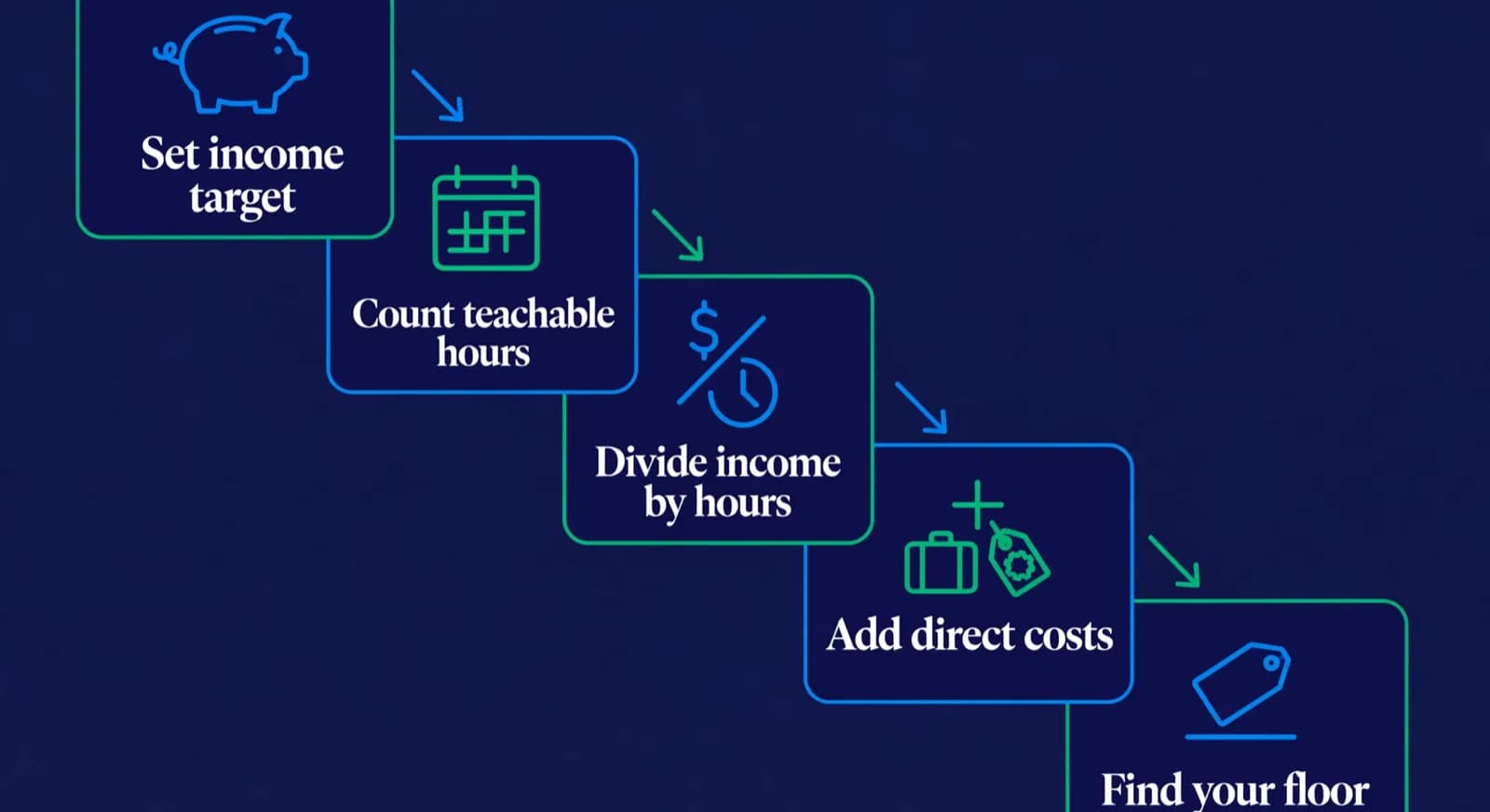
Define three quantities and keep them apart. W is your total working hours for the month. A is the unpaid part of W: preparation, game review, messages to parents, scheduling and payment follow-up. H, the billable hours, is W minus A. Your floor per billable hour is then (target pre-tax owner pay + fixed monthly costs + per-session costs) divided by H. If your payment provider takes a percentage p of each fee, divide the result by (1 - p) so the fee does not eat into your pay. Round only at the end, and count the unpaid time once: either subtract A from W, or scale hours by a ratio, but never both.
- Set the pre-tax pay the coaching must produce this month, separate from any salaried job.
- Set W, the working hours you will really give, not the theoretical maximum.
- Estimate A, the unpaid hours the work creates, and compute H = W - A.
- Add fixed monthly costs (software, board, subscriptions) and per-session costs (travel, venue).
- Divide the total by H, then divide by (1 - p) if you pay a percentage fee. Round at the end.
Compare that floor with the table above and the lesson is honest rather than flattering. A floor of $74.11 sits above the $40 to $60 an hour that the two online coaches in the table list, so a solo coach with these inputs cannot match those listed rates by teaching 22.86 paid hours. The levers are your pay target, your unpaid time, your fixed costs and the hours you can fill, and each one changes the floor in a way you can compute. Whether you charge GST also changes what a family pays and what you keep; our guide to GST questions for chess coaching in India covers when that applies without giving tax advice here. You can run your own inputs in the academy fee calculator.
How should rates differ by format?
Rates differ by format because both the value to each student and your cost to deliver it differ. A private lesson maximises your earnings per student seat, a group spreads one hour across several payers, and online lessons remove travel, which you can share with the family or keep as margin. There is no universal ratio between a private rate and a group seat. What decides it is how many seats actually pay.
Compare formats by collected revenue at real attendance, minus the costs that belong to that format, divided by the working time it consumes. Take illustrative inputs. A private hour is priced at $76 and carries 45 minutes of unpaid work, so it uses 1.75 working hours. A group hour has up to six seats at $32 a seat, $8 of group-specific cost per session (for example a share of a classroom tool) and 75 minutes of unpaid work, so it uses 2.25 working hours.
| Scenario | Paid seats | Collected revenue | Revenue minus $8 group cost | Working hours | Per working hour |
|---|---|---|---|---|---|
| Private lesson, $76 | 1 | $76 | $76 (no group cost) | 1.75 | $43.43 |
| Group, full | 6 | $192 | $184 | 2.25 | $81.78 |
| Group, partly filled | 4 | $128 | $120 | 2.25 | $53.33 |
| Group, four enrolled and one cancels unpaid | 3 | $96 | $88 | 2.25 | $39.11 |
In this example the group beats the private hour at four paid seats ($53.33 against $43.43 per working hour) and falls below it at three ($39.11). The break-even is 3.3 paid seats, so the fourth seat is where it turns. The last row depends on your cancellation terms: a written policy that charges for a late cancellation would keep that seat paid. All figures are illustrative, so replace them with your own prices, costs and unpaid time before you act on the pattern.
Online changes the cost base rather than the format. A remote lesson needs a video call and a shared analysis board, and the free Lichess study tools provide the board at no cost [6], so you save the travel time a home visit demands. You can price online slightly below in person to reflect that saving or hold the rate and use the recovered time as teaching capacity. Either is defensible, as long as you are open with families about what you charge for what. When you run several formats at once, a clear timetable stops slots from colliding and shows which formats actually fill.

Week of 12 October · all batches
0 conflictsMake-up credit · Mia G. · Sat 4:30 PM
Absent Thursday with notice · booked by Noor
Class reminders sent to 148 families
Timing changes update everyone at once
How do your rating and results change what you can charge?
Keep three things apart when a parent asks why your rate is what it is: your credential, a student's recorded change and evidence that your coaching caused it. Only the first is about you. The second describes a student, and the third is hard to establish. A rating moves for many reasons, including the student's own play between lessons, the events they enter and ordinary variation.
Your credential is the first lever. A FIDE rating, a national rating or a trainer title is something a parent of a competitive student can check, and FIDE administers the international ratings and trainer titles behind it [2]. It belongs in how you describe yourself and can sit in your rate. It tells a parent about your playing strength or training, not about how well you teach.
A student's recorded change is the second lever. Online platforms rate players with Elo-derived systems, so a student who plays rated games accumulates a visible number [1]. In the demo academy, a made-up academy, student Mateo R. is at 1342, up 118 since June. That is an example of what a record can show. It is not a testimonial or a promise, and it does not show what produced the gain. Use records to describe what happened with a family, such as attendance, topics covered and the games reviewed, and let the family judge.
Causal evidence is the third, and a solo coach rarely has it. You would need to rule out the other reasons a rating moves, which a handful of students cannot do. So do not tell a parent that your lessons produced a gain. Say what you taught and what the record shows. That honest framing still supports a rate rise, because it rests on credentials, preparation load and demand, not on a claim you cannot prove. If you are weighing certification as a lever, our guide to chess coach certification covers the credential routes, and our chess coach salary and income guide covers the wider picture of what coaches earn.
Lucas M.
Batch B2 · Thursdays · joined Aug 2025
1342
Academy rating · Lichess games synced
Won vs. 1410 · French Defense
Best gameMissed fork on move 23
Homework setShould you sell per-hour lessons or packages?
Packages usually suit a coach past the first few students, because a monthly or term package turns an unpredictable diary into more predictable revenue, and one up-front payment replaces a decision to pay every week. A per-hour model is easy to start with and hard to plan around: you are paid only when a lesson happens, so a holiday or a forgotten session is lost income unless your terms say otherwise.

What a package really changes is the agreement, not the physics of missed weeks. Write down what happens to a missed lesson, a late cancellation and a student who leaves mid-term, and agree it before the family pays. A package with no stated terms produces the same arguments as per-hour pricing. A small discount inside a package for a firm commitment can be fair to both sides, as long as the terms are clear about refunds and make-ups.
Collection is the other half of a package. If you priced a floor and then spend the last week of every month sending reminders and reconciling who has paid, your real rate is lower than the number on the invoice. A recurring collection method reduces that work. A UPI AutoPay mandate in India or card billing internationally can charge the package fee on a set date once the payer has approved it [4] [5]. Approval is not collection, though. Razorpay's subscription documentation says a scheduled debit can fail, for example on insufficient balance or a cancelled mandate, that it retries on a schedule, and that a subscription whose retries run out moves to a halted state where invoices must be charged manually [15]. Keep a way to follow up, and send the receipt on the channel the family already uses, which for many is WhatsApp [7].

Fees · October · all batches
136 of 148 paidCollected · this term
92%Lucas M. · October · $180
Card AutoPay · receipt sent to Müller family
Mia G. · October · $180
Payment link opened in WhatsApp
Batch B2 · 12 of 14 paid
No bank-transfer screenshots needed
AutoPay mandates · 41 active
Renew monthly without reminders
How and when do you raise your rates?
Raise your rates for new students first, and for existing students at a boundary your written terms allow, such as the start of a new term, with notice and a specific reason. A new enquiry only ever knew the new price, while a surprise jump in the middle of a package is the hardest to explain to a loyal family.
Move the new-student rate when demand tells you to: if slots fill faster than you can open them, your price is probably under what your market will pay, and each enrolment at the old rate is money left on the table. For existing students, set a standing policy rather than an ambush. Tell families at the outset that rates are reviewed once a year or each term. When the time comes, give the notice your agreement requires, name the new rate plainly and tie it to something real: a heavier preparation load, a change in the format or the annual review you flagged in advance.
Two failure modes are worth avoiding. The first is never raising rates, which quietly turns a well-paid coach into an underpaid one as costs rise. The second is apologising for the increase, which invites negotiation. State the new rate as a fact, offer to answer questions and hold it. Some families will leave over price, and you can decide in advance whether the rate you would have to keep for them is above your floor. Your thinking on what the work is worth, covered in our chess coach salary and income guide, should update as your costs and demand do.
How is a coach's rate different from an academy's fee?
A coach's rate and an academy's fee answer different questions. A coach's rate is what one person charges for their own teaching time. An academy's fee is the price of a program, and it has to cover several coaches, a room or platform, software, administration, and a margin, so it is structured and collected very differently even when the classroom hour looks the same.
This distinction matters the moment you compare numbers, because an academy fee and a coach rate are not comparable per hour. When an academy charges a monthly program fee, a share of that money never reaches the coach in the room: it pays for the coordinator who scheduled the batch, the venue, the payment system, and the owner's margin. A solo coach charging their own rate keeps the whole fee but also carries all the unpaid admin the academy would otherwise absorb. Neither is simply cheaper; they are different businesses. If you are pricing yourself against a local academy, you are comparing your take-home rate to their gross program fee, which will always look like they charge more, because they are paying more people out of it.
Because the two are separate topics, this guide deliberately stays on the individual coach's rate and leaves the academy side to its own pages. What an academy actually charges families, benchmarked for the Indian market, is covered in our guide to chess academy fees in India, and how an academy structures and collects those fees (models, discounts, late-payment policy, and fee increases across many batches) is the subject of our guide to designing a chess academy fee structure, and you can model a batch's monthly fee and costs in the academy fee calculator. If you are a solo coach who is starting to think in programs rather than sessions, that is the boundary at which you move from this page to those: the day your pricing has to cover other people's time as well as your own, you are pricing an academy, and our guide to starting a chess coaching business covers the transition.
Frequently asked questions
How much do chess coaches charge per hour?
There is no single rate. On 16 October 2026, Indian Chess School listed online one-on-one at Rs 1,200 per session including taxes and Platinum Chess Academy listed Elite 1-on-1 at Rs 1,200 per session, both academy programme prices in INR. Two coaches listed online private lessons in USD: JD Chess at $40 an hour and chesscoaching.org at $60 pay-as-you-go. Units and lesson lengths differ, so set your own rate from your floor.
What should I charge for chess coaching as a beginner coach?
Start with your floor: the pay you need plus fixed and per-session costs, divided by the hours you can really bill. A new coach without a rating or track record may price near that floor, but should not go below it, because a rate that ignores unpaid work leaves you underpaid. The seller listings in this guide are established academies and coaches, not beginner rates, so use them only to see how packaging lowers an hourly figure.
Should I charge more for private chess lessons than group classes?
Per student, yes: a private lesson gives one student your full attention. Per working hour, it depends on how many seats pay. In the worked example above, four paid seats at $32 each beat a $76 private hour, while three do not. Price the formats as different products and test them with your own prices, costs and unpaid time.
How do I raise my chess coaching rates without losing students?
Raise the rate for new students when demand supports it, and for existing students at a boundary your written terms allow, such as a new term. Give the notice your agreement requires, tie the change to a real reason like preparation load, and state the new rate plainly. Some families may still leave, so decide beforehand whether the rate you would keep for them is above your floor.
Is a chess coach's rate the same as an academy's fee?
No. A coach's rate is what one person charges for their own teaching time, while an academy's fee is the price of a programme that must also cover other coaches, a venue or platform, software and administration. Comparing them per hour is misleading, because part of every academy fee pays for people and overhead that a solo coach either goes without or absorbs unpaid.
Sources
- [1]Elo rating system · accessed 2026-07-08
- [2]FIDE: International Chess Federation · accessed 2026-07-08
- [3]Razorpay Subscriptions documentation · accessed 2026-07-08
- [4]UPI Autopay for Recurring Payments | NPCI · accessed 2026-10-16
- [5]Stripe Billing documentation · accessed 2026-07-08
- [6]Lichess Study: free shared analysis boards · accessed 2026-07-08
- [7]WhatsApp Business · accessed 2026-07-08
- [8]Online chess lessons, JD Chess · accessed 2026-10-16
- [9]Online chess coaching pricing, chesscoaching.org · accessed 2026-10-16
- [10]Fee Structure, Indian Chess School · accessed 2026-10-16
- [11]Online Training Programs and fees, Platinum Chess Academy · accessed 2026-10-16
- [12]Lichess coaches directory · accessed 2026-10-16
- [13]Razorpay pricing · accessed 2026-10-16
- [14]Stripe pricing for India · accessed 2026-10-16
- [15]Razorpay Subscriptions: payment retries · accessed 2026-10-16
Written by Abhishek Tiwari
ChessCore
Drafted with AI, fact-checked and approved by a human before publishing, the same guardrail our product applies to every report it sends. Read our editorial standards.
Price your lessons, then collect without chasing
See how ChessCore holds your timetable, tracks each student's rating history, and collects package fees on schedule through UPI AutoPay or card billing, with a receipt every time.
- Roster import from the spreadsheets you already keep
- Lichess and Chess.com connections, batches, and fee plans
- First reports in week one, after your approval
- Free plan, no credit card required