On this page9 sections, 24 min read
- Who can become a chess coach?
- What do you actually need to start coaching chess?
- Do you need a certification or FIDE title to coach chess?
- How do you get your first students?
- Should you coach online, in person, or both?
- What should you charge for chess lessons?
- Can chess coaching be a full-time career?
- How do I get listed as a coach on Chess.com?
- How do you grow from a solo coach into a business or academy?
- Frequently asked questions
Bottom line
To become a chess coach, teach a level below your own strength, pick who you teach, prepare a lesson structure, get first students from people who already know you, and set a price. A title is optional for beginners. Chess.com listing and FIDE trainer titles each have their own published rules.
TL;DR
- Teaching ability, reliability, and a strength edge over your students matter far more than a title or a specific rating for most coaching work.
- You can start coaching with almost no fixed cost: a lesson plan, a free analysis board, a communication channel, and a way to take payment.
- Certifications and FIDE trainer titles help only when you position for competitive, rated players, not for beginner and improver lessons.
- Your first students come from your existing network, free trial lessons, and the platforms where players already gather, not from paid advertising.
- Becoming a coach is about you as a teacher; founding a multi-batch academy is a separate business decision covered in its own guide.
Key facts
- FIDE administers official ratings and its own trainer titles (from Developmental Instructor up to FIDE Senior Trainer), which are relevant mainly for coaching competitive, rated players.[1]
- The All India Chess Federation is the national federation in India and the route through which players enter the rated and titled pipeline that competitive coaching feeds.[2]
- Online platforms rate players with Elo-derived systems, so a coach can show a beginner student a visible strength number that moves within their first weeks of play.[3]
- Lichess studies are free shared analysis boards, so a new coach can run structured lessons, save them, and set homework positions at zero software cost.[4]
- To be listed in the Chess.com Coach Directory, a coach must verify their account, hold an established rating from FIDE or a nationally recognised federation, and be at least 18 years old.[7]
- FIDE awards four trainer titles through seminars (Developmental Instructor up to 1200, National Instructor 1201 to 1700, FIDE Instructor 1701 to 2200, FIDE Trainer over 2200) plus a fifth, FIDE Senior Trainer, for lifelong contribution outside the seminar ladder.[11]
- A FIDE trainer title is awarded for life, while a trainer license certifies current proficiency; only a licensed trainer may use the title as an official certification, with a two-year initial license and four-year renewals.[11]
- AICF's 2026 FIDE Trainer Seminar notice set a fee of Rs 8,500 stated to include the FIDE fee, accepted only candidates recommended by their state association, and left travel and stay to the participant.[12]
Who can become a chess coach?
Almost anyone with solid teaching ability and a playing strength comfortably above their students can become a chess coach. A high rating helps with credibility, but the skill parents and adult learners actually pay for is the ability to explain clearly, structure progress, and keep a student engaged, not your own tournament results. The gap that matters is between you and your student, not between you and a grandmaster.
This is the single most useful thing to understand before you start, because the rating question stops most people who would be excellent coaches. Teaching a beginner the value of the pieces, the ideas behind development, and how not to hang material every move is a job for a strong club player, not a titled professional. Teaching an 1800-rated junior how to convert winning endgames is a different job that needs a stronger coach. So the honest first question is not what is your rating, it is who can you teach well. The practical test is whether you can look at a student's game one level below you and explain each mistake clearly enough that the student can avoid it next time; where that stops being true is where you have reached the ceiling of who you can teach, and that ceiling differs by coach rather than sitting at a fixed number of rating points.
Ratings themselves are worth understanding because you will use them daily as evidence. Online platforms rate players with Elo-derived systems, so every student you take on acquires a visible number that moves as they improve [3]. That number is your friend: it turns coaching, which parents find hard to evaluate, into something concrete they can watch. Competitive coaching sits on top of the same idea, formalized through official federations. FIDE, the international chess federation, administers the official rating and title system that competitive players are climbing toward [1], and in India the path into that system runs through the All India Chess Federation [2]. You do not need any of that to teach beginners well, but you should know the ladder your ambitious students are on.
Before you take a paying student, rehearse one trial lesson with a friend or relative who plays at the level you want to teach. This is an editorial exercise, not a validated coaching assessment, and it does not predict results. It simply shows you whether your explanations hold together under a clock. Thirty minutes is enough for one full pass.
- Minutes 0 to 5: look at one of their recent games and pick the single mistake that cost the most. Say it back to them in one sentence.
- Minutes 5 to 15: teach one theme that would have prevented it, for example how to check whether a piece is defended before moving a neighbour.
- Minutes 15 to 25: give them three positions on that theme to solve, with you silent until they ask for a hint.
- Minutes 25 to 30: ask them to explain the idea back in their own words, then agree one thing to practise before the next lesson.
If the student can explain the idea and use it on a fresh position by the end, your teaching is ready for that level. If they cannot, the usual fix is a narrower theme or a clearer example, not a higher rating.
What do you actually need to start coaching chess?
To start coaching, you need five things and none of them is expensive: a clear picture of who you teach, a simple repeatable lesson structure, a way to review students' games, a channel to talk to students and parents, and a way to get paid. You can assemble all five in a weekend, and the whole toolkit can be free at the start.
- A defined student: beginners, improvers, or competitive players. Pick one to start so your lessons, pricing, and marketing point the same direction.
- A lesson structure: a warm-up, one teaching theme, guided practice, and a takeaway the student can show at home. Reuse the shape every week so you are not reinventing each session.
- A way to analyze games: a free Lichess study gives you a shared board, saved lessons, and homework positions with no software cost [4].
- A communication channel: the free WhatsApp Business app gives you a profile, quick replies, and labels so student and parent messages do not get lost in your personal chat [6].
- A way to collect payment: a fixed fee, a fixed due date, and a receipt for every payment. Decide this on day one, because the habit you start with is the habit you keep.
Notice what is not on that list: a website, a logo, a company, or a certification. Those can come later, and for most coaches they come after the first few paying students, not before. The one thing worth investing time in early is your evidence trail. Keep a simple record for each student showing attendance, what you covered, and their rating over time, because that record is what turns a happy student into a referral and a prospective parent into a paying one. In the demo academy, that is exactly what the student record page holds: attendance, session notes, and a rating history a coach can show a new family in ten seconds.

Lucas M.
Batch B2 · Thursdays · joined Aug 2025
1342
Academy rating · Lichess games synced
Won vs. 1410 · French Defense
Best gameMissed fork on move 23
Homework setDo you need a certification or FIDE title to coach chess?
You do not need a certification or a FIDE title to start teaching beginners and improvers privately; what a credential settles is a narrower question than many new coaches assume. It is worth keeping four things apart: your own playing strength, your evidence that students improve, any requirement a specific employer or school sets, and the eligibility rules of a listing directory. Certifications and titles matter most when you position yourself for serious competitive players and their parents, who reasonably want proof of coaching credibility before they commit, or when an employer or directory asks for one. Check the rules of the particular role or platform you are aiming at rather than assuming none exist.
There are two different things people mean by credential, and it is worth keeping them apart. The first is a playing title (Candidate Master, FIDE Master, International Master, Grandmaster), which is earned through rated tournament results and administered under FIDE's system [1]. A playing title signals strength, not teaching skill, but it is powerful marketing to parents of competitive juniors because it is instantly legible. The second is a trainer title, which FIDE awards specifically for coaching (running from Developmental Instructor up through FIDE Senior Trainer) [1]. Trainer titles are the closest thing chess has to a formal coaching qualification, and they matter most if you intend to work with rated players or coach at national events, a pipeline that in India begins with All India Chess Federation registration [2].
For the coach teaching kids their first hundred games or helping club players stop blundering, neither is necessary, and pursuing one before you have students is a way to delay the work that actually builds a practice. The practical sequence is: coach first, build a track record of students who improved, and add a certification later if and when your target students start needing that reassurance. The rest of this section covers which trainer titles exist, how the seminar and licensing work, and the routes in FIDE, the United States and India.
If you do pursue a trainer title, it helps to know the ladder. FIDE's trainer-title regulations list five titles. Four are awarded through seminars: Developmental Instructor (typically players up to 1200), National Instructor (1201 to 1700), FIDE Instructor (1701 to 2200), and FIDE Trainer (typically over 2200), scored against a 1,000-point assessment. The fifth, FIDE Senior Trainer, sits outside that seminar ladder and recognizes a lifelong contribution or extraordinary achievement as a trainer [11]. One distinction catches new coaches out: a title is awarded for life, while a trainer license certifies current proficiency, and only trainers holding a valid license may use the title as an official certification. A new seminar title includes a two-year license, and later renewals are reviewed in four-year periods [11].
The seminar itself is a real commitment, not a form. A FIDE trainer seminar runs for at least three days and no longer than two weeks, with about 10 hours of lectures and 6 hours of panel discussion, and the Trainers Commission currently prefers to hold it online over Zoom; anyone who plays chess may attend, but you may sit the license exam only with a FIDE ID from your federation and if you are at least 18 [8]. Routes differ by country. In the United States, US Chess runs a Certified Chess Coach Program that, as of its 26 August 2025 notice, is marked under construction and not taking new applications until the rebuilt program launches, with existing certifications extended through 31 December 2026 [9]. In India the path runs through the All India Chess Federation and its state associations [2]; its 2026 FIDE Trainer Seminar notice set a fee of Rs 8,500 stated to include the FIDE fee, accepted only candidates recommended by their state association, and left travel and stay to the participant, so check the current AICF listing for the next dates [12].
How do you get your first students?
Your first students come from three places, and none of them is paid advertising: your existing network, free or token-priced trial lessons, and the online platforms where players already gather. In the first few months the constraint is trust, not reach, and trust is built through personal contact and a good first lesson, not a bigger audience.
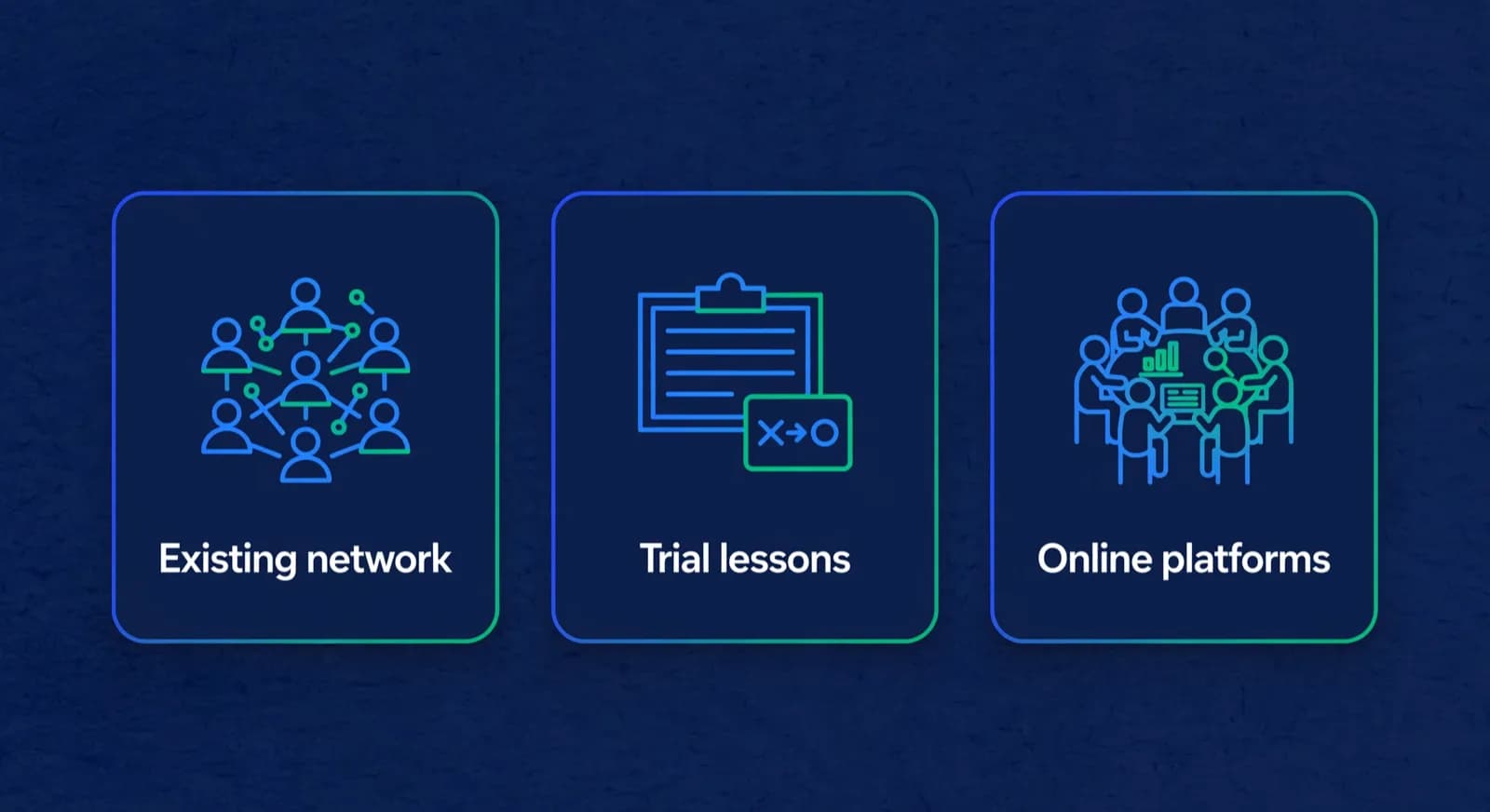
Start by telling people who know your chess that you are taking on students: friends at the club, parents, schoolteachers, and players in your online circles. Explain which students you help and what a lesson includes. We suggest asking for introductions before paying for advertising, so a prospective family can hear about you from someone they trust. Offer an interested student a free or modestly priced trial lesson. Teach a self-contained idea the student can practise that day, then explain what they understand and what a coaching plan would cover. For a beginner, choose a tactic they can demonstrate to a parent that evening and leave one short practice task.
The online platforms are both a recruiting ground and a retention tool. Players congregate on Lichess and Chess.com, so a coach who is visibly active there, analyzing games, writing clear annotations, and being helpful in the right places, becomes discoverable to exactly the right people [5]. Being active is open to anyone, but the formal coach directories are not: Lichess invites applications only from coaches with an NM or FIDE title, which it verifies before listing, so an untitled coach recruits through activity and referral rather than that directory [10]. Once someone becomes a student, those same platforms give you their game history and a live rating you can point to, which is why syncing a student's account is the first thing to set up. After the first lesson, follow up once within a day or two on WhatsApp, because that is where students and parents actually reply, and the free WhatsApp Business tools keep those conversations organized as your student count grows [6]. Ask every happy student, or their parent, for one introduction, because referral is the channel that compounds while advertising just costs money.
Should you coach online, in person, or both?
Coach online if you want the widest reach and the lowest cost, in person if your students are young children or you value the room and the ritual, and hybrid only once one of the two is already working. Online coaching removes travel and rent and lets you teach students in any city; in-person coaching gives young kids the supervision and focus a screen struggles to hold. Online is a common starting point because the economics are simplest, with in-person work added if local demand appears, but the right choice depends on who your students are.
| Factor | Online | In person | Hybrid |
|---|---|---|---|
| Main cost | Almost none to start | Travel or venue hire | Both, added in stages |
| Best student | Improvers, teens, adults, anyone remote | Young children, local beginners | A local core plus a remote tail |
| Reach | Any city or country | Your neighbourhood | Local plus online |
| Teaching tools | Lichess studies and shared boards [4] | Demo board, sets, clocks | Both |
| Main challenge | Holding a young child's attention on screen | Time lost to travel, limited catchment | Running two formats without dropping either |
Whichever you choose, the delivery format changes your logistics more than your teaching. An online coach lives or dies by a tidy weekly schedule: fixed slots, clear time zones, and reminders that actually reach students, because a missed online lesson has no physical room to remind anyone it was happening. An in-person coach trades that for travel time and venue coordination. This is the point where a coach's calendar stops being a personal diary and becomes the operating system of the practice, with each student's slot, level, and payment status visible at a glance. Laid out as one schedule where every slot shows who is booked, the whole week and its gaps are visible without cross-referencing three apps.
Week of 12 October · all batches
0 conflictsMake-up credit · Mia G. · Sat 4:30 PM
Absent Thursday with notice · booked by Noor
Class reminders sent to 148 families
Timing changes update everyone at once
What should you charge for chess lessons?
Set your rate from the income you need and the hours you can bill, then compare it with coaches offering similar lessons to the same kind of student. Include preparation and follow-up time in that calculation before quoting a price. We suggest choosing a clear rate you can explain to parents and reviewing it after a term. If you offer a reduced introductory rate, give it an end date so families know what future lessons will cost.
Price is driven mostly by three things: your strength and credentials, the student level you serve, and whether lessons are one-to-one or group. One-to-one competitive coaching commands the most; group lessons for beginners earn less per student but can earn more per hour once a group fills. Here is the shape of the math with clearly illustrative placeholder figures, not market data. Substitute your own local rates, currency, and student counts; the point is the method, not the numbers.
| Format (example figures) | Rate per student | Students | Earned per hour |
|---|---|---|---|
| One-to-one lesson | 600 | 1 | 600 |
| Small group of 4 | 250 | 4 | 1,000 |
| Small group of 6 | 200 | 6 | 1,200 |
| Trial lesson (loss leader) | 0 | 1 | 0 |
The table shows why most coaches blend formats: one-to-one work pays best per student and is the premium tier, while a well-run group pays best per hour and makes coaching affordable for families who could not manage private rates. Whatever you land on, collect it cleanly from the first student: one rate per tier, payment in advance on a fixed date, and a receipt every time. Retrofitting payment discipline onto a practice that started loose is genuinely painful, so start disciplined. The full framework for setting rates, handling discounts and no-shows, and raising prices without losing students is in our guide to what to charge for chess lessons, which picks up exactly where this section stops.
Can chess coaching be a full-time career?
Yes, chess coaching can be a full-time career, and many coaches make a stable living from it, but it becomes full-time through deliberate structure, not by accumulating random lessons until the week is full. The coaches who sustain it treat it as a business: they manage a full but not overloaded calendar, price so that teaching hours actually cover their income needs, retain students for years rather than weeks, and build a mix of income streams so a few cancellations do not sink the month.
The core constraint is that a solo coach sells time, and time does not scale. A day holds only so many good teaching hours, and quality drops once you push past them, so raw hours are capped and income per hour becomes the lever that matters. This is why the coaches who go full-time successfully almost all do three things. First, they raise their rate as their track record grows, using improved students as proof rather than apologizing for the price. Second, they add group lessons and small cohorts, which multiply income per hour without adding hours. Third, they diversify beyond live teaching: recorded courses, structured homework and analysis packages, running events, or writing, so that not every rupee or dollar depends on being in a live lesson at that moment. We break down the realistic income ranges, the levers, and how coaches actually reach a full-time figure in our guide to chess coach salary and income, which is the honest numbers companion to this overview.
Retention is the quiet engine underneath all of it. A coach who keeps a student for two years earns many times what a coach who churns students every term earns from the same acquisition effort, because every departure has to be replaced before the practice even grows. Students stay when they see progress and when their families feel informed, which is why the boring operational habits (marking attendance, reviewing games consistently, and sending a short, honest update after each block of lessons) do more for a full-time income than any single brilliant lesson. Parents renew coaches who communicate.
The other reality worth naming is administrative load. As a hobby, coaching a handful of students is all teaching. As a full-time job with twenty, thirty, or forty students, a real share of the week goes to scheduling, chasing payments, tracking who attended, and writing updates, and that share is pure overhead that earns nothing and burns the energy you need for teaching. Coaches who go full-time and stay sane either accept that tax, hire help, or use software to compress it, so that the calendar, the fees, the records, and the parent updates live in one place instead of five apps and a notebook. The goal is not to eliminate the admin, it is to spend fifteen minutes on it instead of an evening, and to keep the coach's scarce good hours pointed at students.
How do I get listed as a coach on Chess.com?
To join Chess.com's Coach Directory, meet its rating, age, profile, and identity requirements, then apply through the directory. As of 2 October 2026, Chess.com's help article requires an established FIDE or nationally recognised federation rating, age 18 or older, a clear About Me section, and a relevant avatar. Verify your identity through title verification or a premium membership with your real name and card on file [7]. Listed coaches work independently; Chess.com says it does not employ or endorse them [7].
- Verify the account: titled players use title verification, or become a premium member with real name and card on file [7].
- Hold an established rating from FIDE or a nationally recognized federation; Chess.com says it will verify ratings [7].
- Be at least 18, write a clear About Me, and use a relevant, friendly avatar [7].
- Open the Coach Directory (Social, then Coaches) and use Apply under Get listed [7].
- Students find coaches in that same directory; Chess.com also mentions creating an online store for services [7].
The directory gives prospective students a public place to find your profile. Its entry requirements apply to that listing, so check them before spending time on an application. If you are under 18 or do not have an established FIDE or nationally recognised federation rating, you do not yet meet those requirements [7]. For any lessons you offer elsewhere, explain your experience to families and agree on the format, payment terms, and parent contact arrangements before the first session.
How do you grow from a solo coach into a business or academy?
You grow from solo coach to business the moment you can no longer serve demand with your own hours: that is the signal to package your teaching, add other coaches, or found an academy. The step is not automatic and it is not obligatory. Plenty of excellent coaches stay solo by choice and simply raise rates. Growth is a decision to build something that runs on more than your own time, and it changes the job from teaching to also managing.
It helps to see the ladder clearly. A solo coach sells their own hours. A coaching business productizes: cohorts, courses, and structured programs that serve more students without a linear increase in the founder's teaching time, and this is the focus of our guide to starting a chess coaching business. A multi-batch academy goes further: it hires other coaches, runs several batches in parallel, and the founder's job shifts substantially from teaching to recruiting coaches, keeping quality consistent, and running operations. That last step is a genuinely different business, and we treat it as one: our guide to starting a chess academy is about founding that multi-batch operation, while this pillar is about you becoming a coach in the first place. If you are asking how do I start teaching, you are in the right place; if you are asking how do I build an institution with staff and batches, that guide is your next stop.
Whatever rung you are on, the operational spine is the same and it is worth building early even as a solo coach, because the habits that let you grow are the habits that make a single practice pleasant to run. You want your schedule, attendance, game reviews, fees, and parent updates in one system rather than scattered, so that adding a second coach or a third batch is a configuration change, not a crisis. Coaches who wait until they are overwhelmed to organize their practice find that the disorganization itself is the ceiling. The software a coaching practice runs on is worth choosing deliberately, and we compare what to look for in our guide to chess coaching software; the short version is that a chess-native tool that understands ratings, game syncing, and academy workflows saves the reinvention a generic class-manager forces on you.
Frequently asked questions
What rating or Elo do I need to be a chess coach?
No universal Elo floor exists for private coaching. The practical test is whether you can clearly explain the mistakes in the games of the students you want to teach; where you can no longer do that is the ceiling of who you can coach, and it differs by coach rather than sitting at a fixed rating gap. Chess.com's listing rule is separate and stricter: coaches on that site must have an established rating from FIDE or a nationally recognized federation and be 18 or older [7]. You can teach beginners without either number; you cannot use that directory without both.
Do you need a rating or title to coach chess?
No, you do not need a specific rating or any title to coach chess, especially for beginners and improvers. What you need is a playing strength comfortably above your students plus the ability to explain their mistakes clearly; the test is whether you can still coach the level in front of you, not a fixed rating gap. FIDE playing titles and trainer titles help mainly when you coach competitive, rated players whose families expect that reassurance, but they are not required to start teaching and earning.
How do you start coaching chess and get your first students?
Start by choosing who you teach, preparing a lesson structure and a free way to review games, then get your first students from your existing network and free trial lessons rather than paid advertising. Tell every chess-playing contact you are taking students, run a fixed weekly trial slot, teach a real lesson the student can show off the same day, and follow up on WhatsApp within a day or two. From your third happy student onward, ask each for one introduction, because referrals compound while ads only cost money.
How do you become an online chess coach?
Becoming an online chess coach uses the same fundamentals as any coaching plus a tidy remote setup: a stable video call, a free Lichess study as your shared teaching board, synced student accounts on Lichess or Chess.com so you can see their games and ratings, and a clear schedule with reminders that reach students across time zones. Online coaching has the widest reach and the lowest cost, which is why it is a common starting point, though holding a young child's attention on screen is the real challenge to plan around.
Is chess coaching a viable full-time career?
Yes, chess coaching can be a full-time career, but only with deliberate structure. A solo coach sells time, so teaching hours cap income and the rate per hour becomes the lever. Coaches who make it full-time raise their rates as their record grows, add group lessons that earn more per hour, and add income that does not need a live lesson, such as courses, homework and analysis packages, or events. Retention matters as much as acquisition, because every student who leaves has to be replaced before the practice grows.
How do I become a FIDE certified chess coach?
Attend a FIDE trainer seminar, hold a FIDE ID from your federation, and be at least 18 to sit the exam [8]. As of 2 October 2026, the FIDE Trainers' Commission lists four seminar titles based on a 1,000-point score: Developmental Instructor (200), National Instructor (400), FIDE Instructor (600), and FIDE Trainer (800). The assessment covers rating, student results, experience, skills, and a written exam [8]. US Chess's notice dated 26 August 2025 says Certified Chess Coach applications are paused until its rebuilt programme launches [9]. Check the relevant programme's requirements before choosing a qualification.
Sources
- [1]FIDE: International Chess Federation · accessed 2026-07-08
- [2]All India Chess Federation · accessed 2026-07-08
- [3]Elo rating system · accessed 2026-07-08
- [4]Lichess Study: free shared analysis boards · accessed 2026-07-08
- [5]Chess.com · accessed 2026-07-08
- [6]WhatsApp Business · accessed 2026-07-08
- [7]Chess.com help: find or become a chess coach · accessed 2026-10-16
- [8]FIDE Trainers Commission: organising and participating in a seminar · accessed 2026-10-16
- [9]US Chess Certified Chess Coach Program · accessed 2026-10-02
- [10]Lichess coaches directory · accessed 2026-10-16
- [11]FIDE Handbook: Regulations for the Titles of Trainers (effective 20 December 2023) · accessed 2026-10-02
- [12]All India Chess Federation: FIDE Trainer Seminar 2026 notice · accessed 2026-10-16
Written by Abhishek Tiwari
ChessCore
Drafted with AI, fact-checked and approved by a human before publishing, the same guardrail our product applies to every report it sends. Read our editorial standards.
Run your coaching practice from one place
Bring one student roster to a walkthrough and see how ChessCore keeps schedules, fees, game reviews, and parent updates together, so your good hours go to teaching, not admin.
- Roster import from the spreadsheets you already keep
- Lichess and Chess.com connections, batches, and fee plans
- First reports in week one, after your approval
- Free plan, no credit card required