On this page11 sections, 21 min read
- What can quitting look like before it happens?
- Why do students leave chess academies?
- How do parent pressure and burnout show up in a student?
- Which dropout signals should you track every week?
- What do you say to a family that is drifting?
- How do you track retention for one cohort of students?
- What does a chess student retention system need from software?
- Why do teenagers quit around exam years?
- How is keeping students different in online chess classes?
- When should you let a student go gracefully?
- How does showing progress change retention?
- Frequently asked questions
Bottom line
Students quit chess academies for reasons that can be sorted under progress the family cannot see, plateau frustration, schedule, fees, social fit, parent pressure or burnout. No source gives a standard dropout rate or timeline, so watch your own signals weekly, ask before assuming, open with evidence about the child's chess, and let a genuine exit stay graceful.
TL;DR
- No source gives a standard churn rate or dropout timeline for chess academies, so treat every signal as a reason to ask a question, not a prediction that a family is leaving.
- Reasons for quitting can be sorted under progress the family cannot see, plateau frustration, schedule friction, fee friction and social disconnect, plus parent pressure and burnout. Each has its own question and its own evidence to check.
- Five signals deserve a weekly look: attendance, games between classes, rating and review, fee timing and parent replies. They tell you whom to ask, not who is leaving.
- Some quits are right, and a graceful exit with a progress summary and a route back is a decision in its own right, not a retention failure.
- Online classes have their own alternatives to rule out before assuming disengagement: another account, offline games, privacy, bandwidth and planned pauses.
Key facts
- Elo-style ratings can sit flat during a plateau, so a flat rating number does not by itself show that a student has stopped improving.[1]
- The Lichess API exposes recent games for the account an academy syncs, so it shows whether a child has played on that account in a given week, not whether they play elsewhere.[2]
- Lichess calculates ratings with the Glicko-2 method, while its FAQ notes that FIDE still uses the Elo system, so the two numbers should not be compared directly.[8]
- ChessWorld's coach guide lists loss of motivation, a sudden drop in enthusiasm, avoiding games or lessons and fear of making mistakes as signs of burnout.[7]
- World Chess notes that chess does not track its own dropout rate; the 70 percent figure it quotes concerns organised youth sports by age 13, not chess academies.[5]
- Silver Knights Chess Academy reported in January 2021 that more than 90% of students in its month-to-month online club were choosing to continue each month, a self-report from one academy.[10]
What can quitting look like before it happens?
A quit notice is rarely the first change in the records. Attendance, practice and replies often shift before it arrives. None of these changes proves a family is leaving, and no source gives a standard order or timeline for chess academies, so use the list below as things to check, in no fixed order, and as reasons to ask a question.
- Interest: the student mentions chess less at home, or arrives flat rather than early.
- Attendance: more missed classes than usual from a family that rarely missed.
- Homework: assigned puzzles go undone, or no new games appear on a synced account. The student may be playing somewhere else, so ask before assuming.
- Parent replies: updates that used to get a quick answer now get a tick or silence.
- Notice: a polite message, often citing school workload.
Each change has ordinary explanations: exams, travel, a new timetable, a different device or account. Start with a question, not a churn prediction. The records tell you where to begin the conversation, and the family supplies the explanation. Because every item above lives in data an academy already collects, you can ask early instead of waiting for the notice.
Why do students leave chess academies?
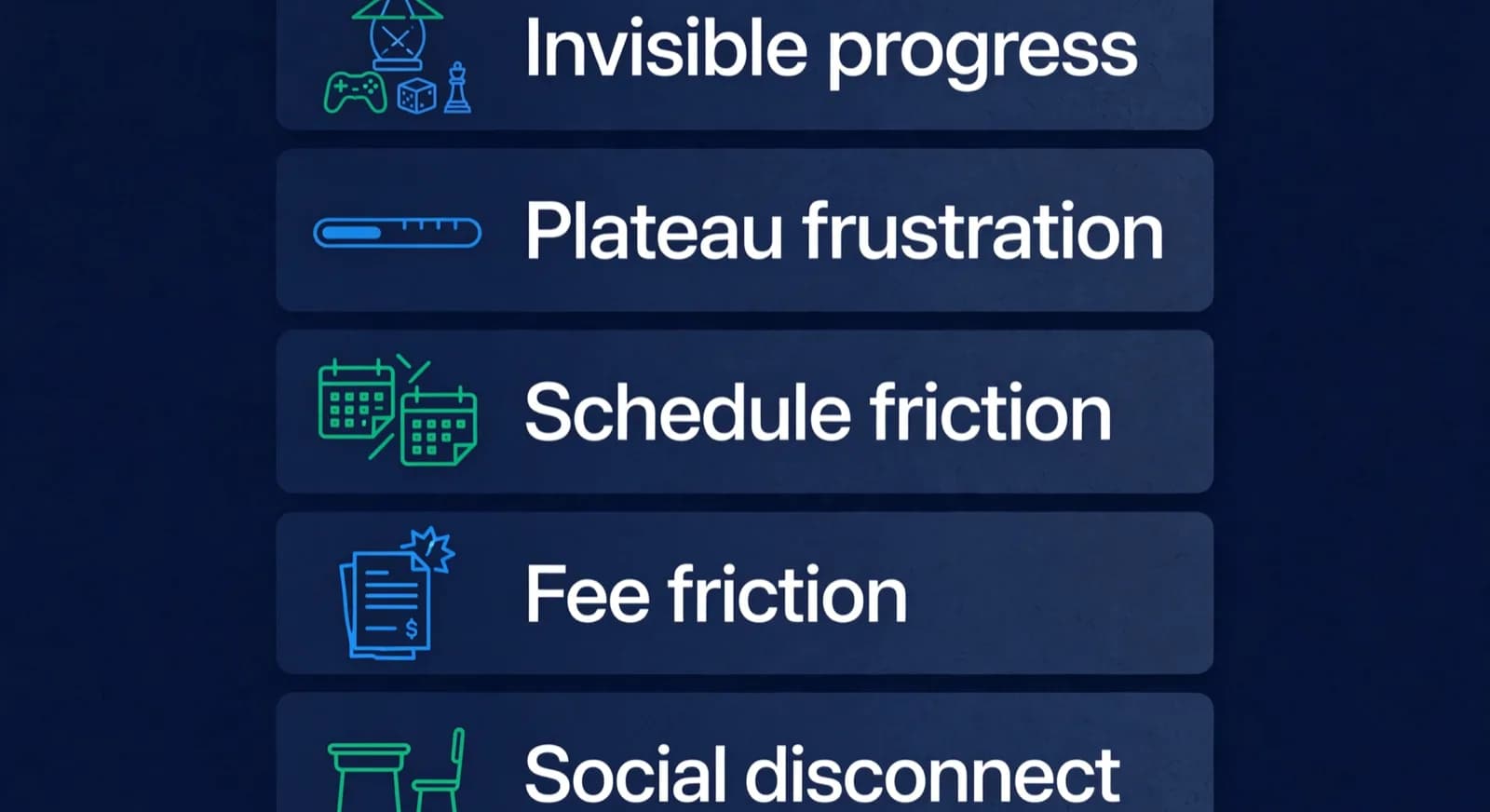
Reasons families give for leaving can be sorted under five working headings: progress the family cannot see, plateau frustration, schedule friction, fee friction and social disconnect. These are categories to investigate, not ranked findings, and no source gives a standard share for each in chess academies. World Chess's list of why kids quit the game (article dated 11 January 2026) can be sorted under them: parents taking over and losing no longer being okay are plateau pressure, bad coaching and teaching that never changes are progress the family cannot see, and loneliness is social disconnect [5].
| Possible driver | Question to ask | Evidence to look at |
|---|---|---|
| Progress the family cannot see | Can the parent point to something the child has learned this month? | The last progress note, annotated games, milestones |
| Plateau frustration | Has the rating stayed flat, and has anyone explained why that can happen? | Rating history and recent game reviews |
| Schedule friction | Does the slot still work around school and exams, and were missed classes offered back? | Attendance and make-up records |
| Fee friction | Has something changed in payment timing, or in what the family expects the fee to buy? | Invoice history and any questions about invoices |
| Social disconnect | Does the child know anyone else in the batch? | Batch roster and team events |
World Chess, writing about kids leaving chess rather than leaving a paid academy, ties each of its reasons to an adult behaviour you can change, and each one lands on a driver in the table [5]. Parents taking over (plateau pressure): the parent tracks top-100 lists and tournament choice more tightly than the child does; the academy action is to talk to the parent about effort and ideas, not rating protection, and to keep the child in the review conversation. Bad or overly serious coaching (invisible progress): lessons that only catalogue what went wrong; the action is one genuine question the student enjoyed, and homework that is not framed as punishment. Losing no longer being okay (plateau pressure): the child starts playing to avoid a loss; the action is a non-rating goal for the next four weeks. Loneliness (social disconnect): the room is silent competition; the action is a team event or a friend in the same batch. Teaching that never changes (invisible progress): the same tactics set at 8 and at 12; the action is to change the method when the student changes. World Chess cites a National Alliance for Youth Sports figure that 70 percent of kids quit organized sports by age 13; that figure is youth sports, not chess-academy churn, and should not be quoted as an academy dropout rate [5].
Start by checking whether the parent can see the progress the child is making. A student can be improving, with deeper calculation or cleaner endgames, while the parent sees only a rating that has not moved and a fee that arrives every month. If that is the situation, it is a communication gap rather than a coaching gap, and you can close it with evidence you already hold: two positions from last month and two from this month, shown side by side.
Plateau frustration is the same gap with a number attached. Elo-style rating systems are built so that a rating moves with results against expectation, which means an improving player can sit at a flat number for long stretches while their play consolidates [1]. A family that does not know this may read a flat rating as wasted money. A family that has had it explained, with the student's own games as evidence, can read the same number as a normal stage. Our guide to the chess rating plateau covers the coaching side; the retention side is making sure the explanation happens before the frustration does.
The remaining three headings are partly in your hands. Schedule friction responds to batch design and a fair make-up class policy: a family that misses several classes in an exam month and loses them all may conclude the academy does not flex for real life. Fee friction can be about predictability more than price, so ask what changed before assuming it is cost. Social disconnect is a student with no friend in the room; batch placement and team events can help, though you cannot manufacture a friendship.
How do parent pressure and burnout show up in a student?
Parent pressure shows up when the adult is more upset about a loss than the child is, and burnout shows up as lost enthusiasm, avoided games and a fear of making mistakes. ChessWorld's guide for coaches lists the signs as loss of motivation, a sudden drop in enthusiasm, increased frustration or irritability, avoiding games or lessons, and fear of making mistakes [7]. For young students it names three causes: an overemphasis on winning, too many tournaments and excessive correction [7].
- A parent who tracks placements and picks events to protect a rating, while the child starts to treat chess as a chore [5]
- Lessons that only catalogue faults, and homework that feels like a penalty for losing [5]
- A child who plays to avoid losing rather than to find good moves [5]
- A full tournament calendar and correction on every move, the burnout causes ChessWorld names for young players [7]
- For teenagers, plateau frustration and competing academic pressure, which ChessWorld lists separately from the causes in younger children [7]
The weekly signals catch the operational drift; pressure and burnout are the human layer underneath them. If a parent writes about ratings more than the child talks about games, the conversation to have is with the adult, about effort and ideas, not a discount. If the child avoids games but still attends, cut tournament load and correction volume before changing anything about the fee. Ask the child how lessons feel as well as asking the parent, because the two answers often differ.
Which dropout signals should you track every week?
Five signals, checked once a week across the roster, give you a place to start a conversation with a family while there is still time to have it. Each is a prompt to ask a question and each maps to a first response, not a verdict.
- Attendance dip: two misses in three weeks from a student who rarely missed before. The save play is a friendly logistics check-in, not a warning.
- No new games for two weeks on the synced account: this can mean the student stopped playing, or plays on another account or over the board. The save play is a friendly question about what they have been playing. The Lichess API shows recent games only for the account you sync [2].
- Flat rating with no review loop: a plateau plus no recent game reviews means frustration is building with no counter-narrative. The save play is a review session plus a parent note explaining the plateau.
- Fee friction: a previously punctual family paying late, or asking detailed questions about the invoice, may be doubting value or facing a budget change. The save play is to ask what changed: evidence of progress for a value doubt, a pause or an agreed payment arrangement for a budget problem.
- Parent gone quiet: updates that used to get a reply within the hour now get a read tick and silence. The save play is one message with a specific, true observation about the child, not a reminder about attendance.
Treat each signal as a reason to ask a question, not as proof that a family is leaving. A dip can mean exams, travel or a new timetable, and the records only tell you where to start the conversation; the family supplies the explanation. The table pairs each signal with the concern it usually points to and the first response worth trying.
| Signal | Concern to ask about | Matched first response |
|---|---|---|
| Attendance dip | Schedule friction or a fading routine | A friendly logistics check-in offering a make-up or a better slot |
| No new games on the synced account | A pause, play on another account or over the board, or disengagement | Ask what they have been playing, then set a small playing goal if they want one |
| Flat rating, no recent review | Plateau frustration or doubts about value | A review session and a parent note explaining the plateau with evidence |
| Late fee from a punctual family | Affordability, administration or value | Ask what changed, then agree support that fits the stated concern |
| Parent gone quiet | A busy family, or uncertainty about progress | One specific observation about the child to reopen the thread |
The weekly check works only if the underlying records exist, which is why attendance discipline and game syncing are retention infrastructure rather than admin chores. Our guide to the register behind the signals covers the attendance side. Keep the habit short: scan the roster, flag students showing two or more signals, and book one conversation per flagged family for that week.
Check which rating the family is watching before you explain a plateau. Lichess calculates ratings with the Glicko-2 method, and its FAQ notes that FIDE still uses the Elo system, advising against comparing ratings across organisations [8]. A child can be flat on one number and climbing on the other, so name the rating and show the games behind it. The Lichess API shows recent games only from the account you sync [2]; it cannot see play on another account or over the board, so ask before assuming a quiet account means a quiet player.

Lucas M.
Batch B2 · Thursdays · joined Aug 2025
1342
Academy rating · Lichess games synced
Won vs. 1410 · French Defense
Best gameMissed fork on move 23
Homework setWhat do you say to a family that is drifting?
Lead with evidence, not with the absence. A message that opens with attendance reads as an attendance demand and invites a defensive reply. A message that opens with something specific and true about the child's chess reopens the conversation the family has been quietly closing, and makes the logistics question easy to answer honestly.
The structure is deliberate: one concrete observation that proves the coach is paying attention, one open logistics question that lets the family name the real problem, and one low-effort next step. Send it in the family's existing WhatsApp thread rather than by email, because that is where the conversation already lives and where a reply costs the parent ten seconds [3]. If the reply names schedule trouble, offer the make-up route. If it names money, ask whether a pause or an agreed payment arrangement would help, and record its terms; showing progress does not solve a budget problem. If it names fading interest, you have reached the honest case, which the next section covers.
Parent updates · this week
14 of 14 sentWeekly recap · Lucas M.
Lucas attended Thursday's class and won 2 arena games. His September report is in your portal.
Receipt · October fee
$180 received via card AutoPay. Receipt saved.
9:42 AMRecap approved by Coach Elena
Open the guardian portal
Own login · nothing to install
How do you track retention for one cohort of students?
Track retention on a roster you can count: take the students enrolled at the start of a term and record who is still enrolled at the start of the next. The glossary explains how to calculate retention rate; the worksheet below adds two columns most rosters need, transfers and agreed pauses, so a student who moved batch or paused for exams is not counted as a loss. This guide gives no normal rate to compare against because it has no sourced figure for chess academies. Compare each cohort with your own earlier terms instead.
| Cohort (term and batch) | Starting roster | Continuing at next term start | Moved batch or coach | Agreed pause | Left |
|---|---|---|---|---|---|
| ____ | ____ | ____ | ____ | ____ | ____ |
| ____ | ____ | ____ | ____ | ____ | ____ |
| ____ | ____ | ____ | ____ | ____ | ____ |
Count a transfer as continuing in the academy and note the batch change. Keep an agreed pause out of the left column until the pause ends. Then compare the same batch term over term rather than the whole academy at once, because a dip in one batch points to that batch's schedule, coach or fit. Write a reason beside each departure in the family's own words. After two or three terms those reasons are your own evidence about why students leave your academy.
What does a chess student retention system need from software?
A chess student retention system needs three things from software: between-class practice a coach can see, progress a parent can see, and an early warning built from attendance and work. Features do not keep a family on their own. They make the weekly scan and the monthly proof cheap enough to run every week, which is the part academies skip when it depends on memory.
| Capability to ask for | What it shows | Driver it supports |
|---|---|---|
| Between-class practice tracking (puzzles, synced games) | Whether the child is still playing outside class | Plateau frustration, social disconnect |
| A parent-visible progress view or monthly report | What the fee bought this month | Invisible progress, fee friction |
| An attendance and practice early warning | Which families are drifting this week | Schedule friction, every driver |
| A make-up credit ledger | Whether missed classes were offered back | Schedule friction |
| Predictable billing with receipts | No surprise invoices, no disputed months | Fee friction |
Name no vendor's retention claim as a forecast for your academy. In a demonstration, ask to see a student whose practice has stopped, the parent's view of progress and an attendance warning, then decide who on your team reads each one and what they do next. If a tool cannot show you those three screens with real-looking data, it will not run the weekly scan for you.
Why do teenagers quit around exam years?
Teenagers leave competitive chess when school and chess start bidding for the same hours, and when the school system around them gives chess little credit. A Chess.com blog dated 28 May 2026 frames that as a time split between chess and exams, plus weak university recognition in some Western systems [6]. We suggest treating that as an academy churn risk too: a student who stops tournament travel may also stop the paid weekly class in the same term.
The useful academy move is to treat exam season as a scheduled dip, not a loyalty test. Cut homework volume, keep one slow game a week so the habit survives, and tell the parent in writing that a flat month through boards is success. After exams, offer a specific route back (a holiday camp or the next term's batch) rather than a guilt message. The same Chess.com post includes the author's line that "some estimates suggest" a large share of juniors leave in adolescence; that phrasing is the author's, not a Chess.com-published statistic, so do not quote a percentage from it [6].
How is keeping students different in online chess classes?
Online classes change what a quiet student looks like. Attention competes with the whole device, progress is harder for a parent to see, and the friendships that form before and after a physical class have less room to start. The format itself can teach as well as a room: Kingdom of Chess summarises Dimitrova (2022), a study of 37 competitive players aged 10 to 13 rated between 1050 and 1400 at four Bulgarian clubs, which found no meaningful difference in topic test scores between online and in-person groups taught the same 15 topics [9]. That is one small study, not a retention rate, and it assumes a live coach.
| Online signal | Alternatives to rule out first | First response |
|---|---|---|
| Camera that stays off | Privacy, bandwidth, a shared device or low confidence, as well as withdrawal | Ask the family privately what would help and agree another way to take part, such as board activity |
| Falling participation in chat or on the board | A technical problem, or a format that has become passive for this child | A paired exercise that makes taking part low-stakes again |
| No games between classes | Another account, offline or over-the-board games, a planned pause, or disengagement | Ask what they have been playing and offer a small playing goal |
| Parent silent on updates | A busy family, or uncertainty about what the screen time buys | A concrete observation from a real game, not an attendance reminder |
Design the session so every student is doing something. Open with a warm-up puzzle on each child's own board, teach in short segments that each end in a task, and use paired work at least once so the class is social rather than a broadcast. Keep batch membership stable and use named pairs so regulars expect each other. A student who never turns the camera on may still be taking part, so read board activity before drawing a conclusion, and start with a question rather than a churn prediction.
Billing is a separate lever. Silver Knights Chess Academy wrote in January 2021 that it made its online club month to month, with a full refund for cancelling in the first two weeks, and included drop-in tournaments and broadcast lessons in the membership [10]. The same post reported more than 90% of students choosing to continue each month [10]. That is one academy's self-report from its first online year, not a category benchmark, and it does not show that monthly billing caused the result; when you quote a continuation rate, name the billing cycle behind it.
When should you let a student go gracefully?
Some quits are correct, and fighting them damages you. A student who has genuinely lost interest after a fair run, or one drowning in school workload, is not a retention failure; they are a person whose priorities changed. Retention plays aimed at these families read as sales pressure, and sales pressure is what former customers remember when someone asks them about your academy.
The graceful exit has three parts. First, accept quickly and warmly, with no guilt: thank the family for the seasons they gave you. Second, send a short progress summary of what the student actually achieved, the rating arc, the skills built, a memorable game, so the chapter ends with proof it was worth it. Third, leave the door open with a specific route back, such as a holiday camp or a casual club night, because some lapsed students do return. Close the records in the same message: confirm the last class date and how any remaining fees or unused make-up credits will be settled, so the departure ends with clear records as well as a kind conversation.
How does showing progress change retention?
Showing progress addresses one cause you can check directly: whether the parent can see what the fee buys. A documented climb is easier to value than an invisible service, and a plateau is easier to accept when it sits on a chart beside the climbs that came before it.

Ratings alone are not enough, because ratings lag skill by design [1]. The evidence that lands with parents is layered: the rating trend for the long arc, an annotated position from a real game for the proof of skill, and a one-line coach observation for the human signal. A shared Lichess study of the student's best games gives a family something concrete to open at home, and it doubles as the review loop that keeps the student playing between classes [4]. Our guides to showing parents rating progress and to building progress reports cover the formats; what matters here is the cadence, because evidence sent monthly beats a brilliant report sent once.
Frequently asked questions
How do you keep students in chess class after the initial excitement fades?
Make progress visible on a fixed cadence: a short monthly note to the parent with one annotated position, the rating trend and one coach observation. Pair it with a weekly signal check (attendance, games played, rating movement, fee timing, parent replies) so a drifting family gets a specific question while there is still time. Showing evidence early is usually a better first step than persuading at the end, but ask the family what they are experiencing before assuming the cause.
How early can you spot a student who is about to drop out, and is there a normal churn rate?
Attendance and practice changes can prompt a conversation weeks before a quit notice, but they do not prove a student will leave or say how many weeks you have. Check the roster weekly for missed classes, no recent games, a flat rating without review, a late fee from a punctual family and unanswered parent messages, and ask what changed when several appear together. There is no honest churn benchmark or established peak month for chess dropout: World Chess notes that chess does not track its own dropout rate, and the 70 percent figure it quotes concerns organised sports by age 13 [5]. Track your own term-over-term continuation rate instead, and look at the five churn drivers when it worsens.
How do you stop students dropping out of online chess classes?
Make every student active and make progress visible. Teach in short segments that each end in a task on the child's own board, use paired work so the class is social, and keep the same children together each week. Watch for a camera that stays off, falling participation and no games between classes, rule out privacy, bandwidth and another account first, and answer each with a private, specific check-in. Send online parents a short monthly update with one real position from their child's games, because they cannot see the classroom.
Should you offer a discount to a family that is about to quit?
Ask first. If the real concern is progress the family cannot see, or a plateau, a discount may confirm the suspicion that the service was overpriced and only delay the decision. Show evidence of progress first, and fix schedule friction if that is what the family names. If money is the stated problem, a pause or an agreed payment arrangement may help, and you can record its terms. Reserve fee flexibility for genuine hardship rather than using it as a general retention lever.
When is quitting chess the right call for a student?
When interest is genuinely gone after a fair run, or when school workload makes the commitment unhealthy, leaving is correct and should be made easy. Accept warmly, send a short summary of what the student achieved, and leave a specific route back such as a holiday camp. A graceful exit keeps the family recommending the academy; a pressured one creates a critic at the school gate.
Do parents taking over ratings push kids out of chess?
World Chess (essay dated 11 January 2026) lists parents taking over as the first reason kids quit the game: ratings, rankings, and tournament selection become the parent's project, and the child starts to treat chess as a chore [5]. In an academy that shows up as a parent who is more upset about a loss than the student is. The fix is a progress conversation that names effort and ideas, not rating protection, and that keeps the student in the room when the rating is discussed.
Sources
- [1]Elo rating system · accessed 2026-06-10
- [2]Lichess.org API documentation · accessed 2026-06-10
- [3]WhatsApp Business · accessed 2026-06-10
- [4]Lichess Study: shared analysis boards · accessed 2026-06-10
- [5]Why kids quit chess, World Chess · accessed 2026-10-16
- [6]Why so many teenagers quit chess, Chess.com blog · accessed 2026-10-02
- [7]Avoiding Burnout in Chess Students, ChessWorld · accessed 2026-10-16
- [8]Lichess FAQ: ratings · accessed 2026-10-16
- [9]Does Online Chess Learning Work? Kingdom of Chess · accessed 2026-10-16
- [10]Surviving 2020, Silver Knights Chess Academy (22 January 2021) · accessed 2026-10-16
Written by Abhishek Tiwari
ChessCore
Drafted with AI, fact-checked and approved by a human before publishing, the same guardrail our product applies to every report it sends. Read our editorial standards.
See drift before it becomes a quit notice
ChessCore puts attendance, synced games and rating trends on one student record and drafts parent updates for your team to review, so a change shows up beside the family it belongs to.
- Roster import from the spreadsheets you already keep
- Lichess and Chess.com connections, batches, and fee plans
- First reports in week one, after your approval
- Free plan, no credit card required