On this page11 sections, 29 min read
- How do you start a chess program in a school?
- How do you assess interest before you start?
- How do you get buy-in from school leadership?
- Who should run a school chess program: a teacher or an external coach?
- What curriculum should a school chess program follow?
- What equipment and space does a school chess program need?
- Club or timetabled class: which format fits your school?
- How do you run a weekly school chess club session?
- How do you fund a school chess program?
- How does a school chess program work in India when an academy runs it?
- How do you measure whether a school chess program works?
- Frequently asked questions
Bottom line
To start a chess program in schools, win leadership buy-in first, then decide who will run it (a teacher or an external coach), pick a simple curriculum, gather a few sets, choose a club or timetabled format, and launch one weekly session with a single group. Expand after you can show attendance and progress.
TL;DR
- A school chess program needs six decisions in order: buy-in, staffing, curriculum, equipment, format, and how you will measure it.
- Buy-in comes from tying chess to goals a head teacher already owns, such as focus, inclusion, and a low-cost enrichment offer.
- You do not need a strong player to run a club: a reliable adult with a simple curriculum and a free online board is enough to start, and a second named adult keeps it running.
- Start with one weekly session and one group, keep the equipment list short, and let a full, happy club earn the case for expansion.
- The India-specific version of this playbook, with boards and federation specifics, lives in a separate companion guide.
Key facts
- FIDE, the international chess federation, runs a global rating and event structure, so a school program that produces competitive players can point ambitious students toward an official pathway, though most pupils never need it.[1]
- Lichess studies are free shared analysis boards, letting a school run structured lessons and set homework positions on any browser at zero software cost.[2]
- The US Chess Sales beginner's guide, a retailer's advice for US clubs, lists completing any required background checks for all adult volunteers as a step before the first club meeting. Your own school's policy decides what applies to you.[6]
- ChessKid states that it has no chat, uses auto-generated usernames and offers child activity reports, which is why some primary schools prefer a kid-focused site to an open adult platform.[4]
- The US Chess Sales beginner's guide says the main thing a club mentor needs is the desire to encourage children to play, with basic knowledge and time, not playing strength.[6]
- CHESS+, run by the All India Chess Federation with Navodaya Vidyalaya Samiti, launched in 2026 with a pilot in 30 Jawahar Navodaya Vidyalayas.
How do you start a chess program in a school?
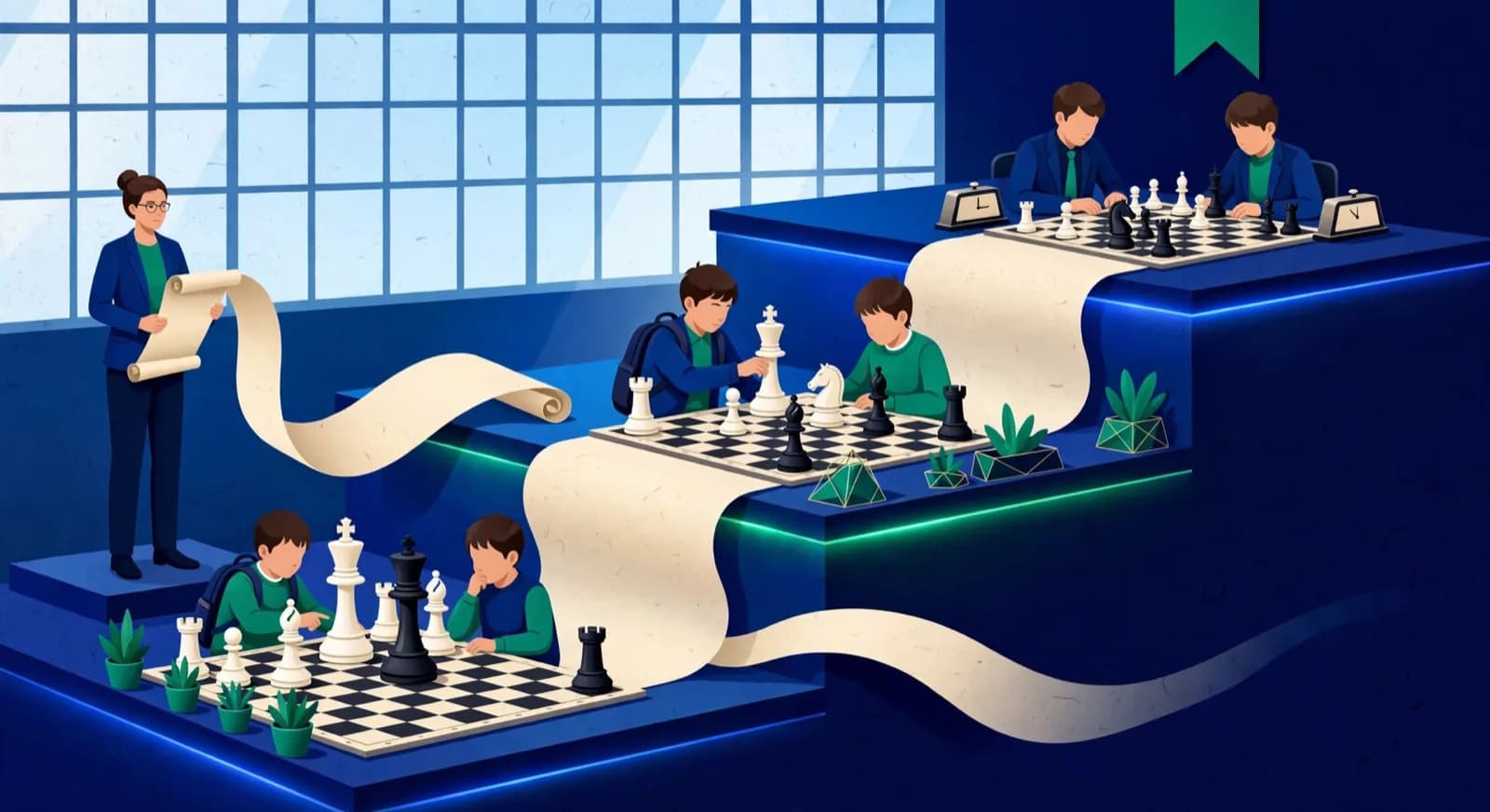
To start a chess program in a school, assess interest first, secure leadership buy-in, appoint someone to run it, choose a light curriculum, gather a handful of sets, and launch one weekly session in a club or timetabled format. Everything after that is refinement. The programs that survive begin small, prove they work with one enthusiastic group, and expand from evidence rather than from ambition or a launch-day assembly.
A common mistake is starting with the wrong scale. A well-meaning teacher announces chess for the whole school, orders forty sets, and discovers three weeks later that one adult cannot manage sixty mixed-age children with no curriculum. A program is not an event; it is a weekly routine that has to run for years on modest effort. So the first job is sequencing: get the seven building blocks below in the right order, and let a single successful group carry the rest.
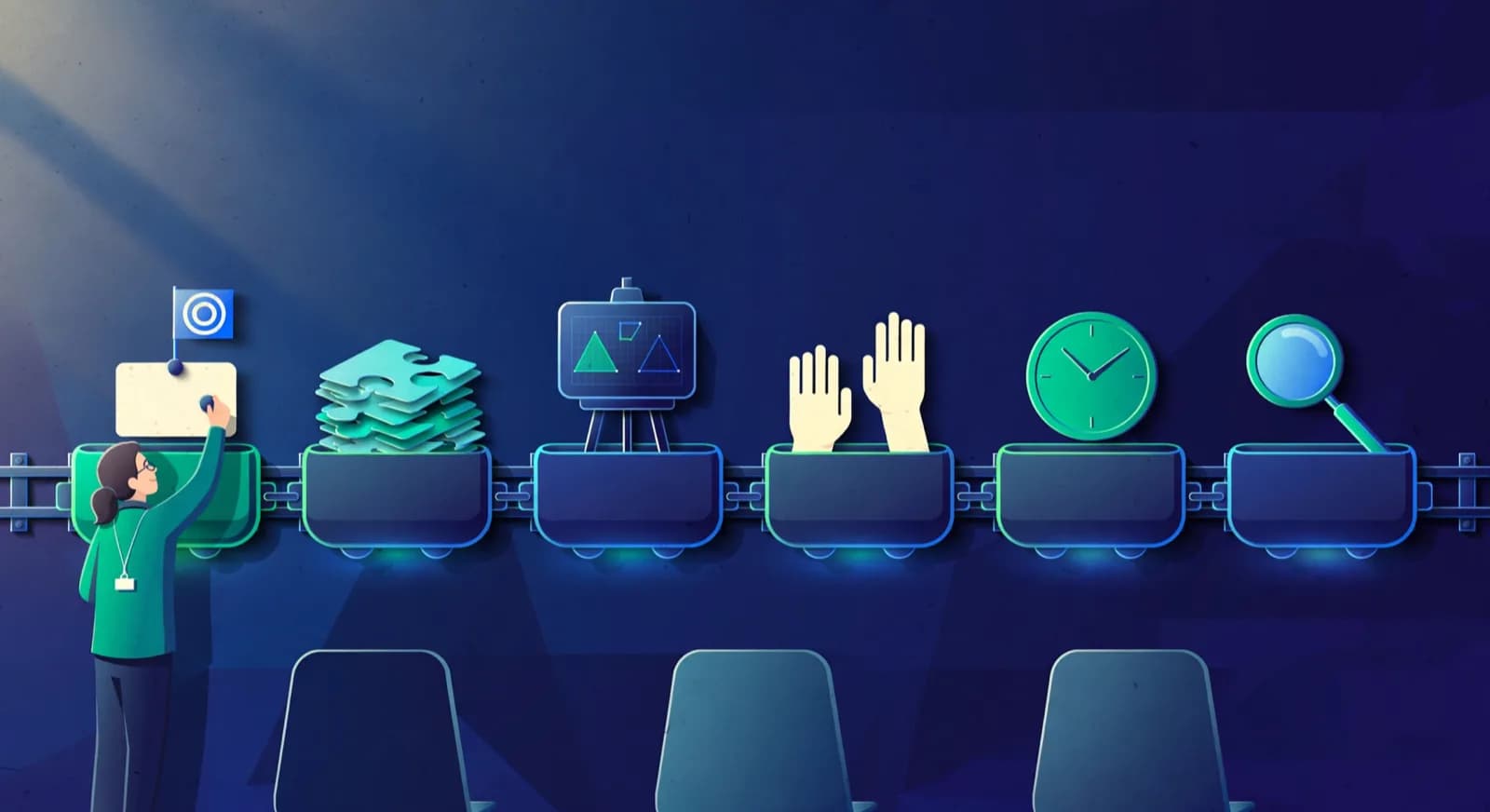
- Assess interest: survey students and staff before you buy anything or ask for a slot, so you know whether the demand is really there and what children want from it.
- Buy-in: get a head teacher or senior leader to back the program and protect its slot in the week.
- Staffing: decide who runs sessions, a teacher, a parent volunteer, or an external coach, and who covers absences.
- Curriculum: pick a simple, repeatable lesson sequence so every session has a plan and a takeaway.
- Equipment: gather enough sets, a demonstration board or a screen, and a safe place to play online if you go digital.
- Format: choose an after-school club, a lunchtime club, or a timetabled class, and pick one weekly slot to start.
- Measurement: agree from day one how you will show the program is working, so you can defend and grow it.
This guide is the general playbook for any school. If you are an academy or an external coach partnering with a school in India, the India section further down covers the provider's side of the table: the delivery models, the programmes already running in Indian schools such as CHESS+ and the National School Chess League, and a revenue share worked out in rupees. Use the rest of this guide when the school itself is the one deciding and running the program. The cluster goes deeper on the curriculum itself and on what scholastic chess means.
How do you assess interest before you start?
Assess interest by surveying students and staff before you spend any money or ask for a weekly slot, so your purchasing, scheduling, and pitch to leadership all rest on real demand rather than a guess.
Keep the survey short and free. Ask students and staff whether they want competitive play, casual fun, or structured lessons, then use their answers to choose a format before committing to it. The same survey can double as your first recruitment list: anyone who says they would help run or supervise sessions is a candidate for the second adult every program needs, and anyone who says their child is keen is a parent you can call on for the first ten sign-ups.
How do you get buy-in from school leadership?
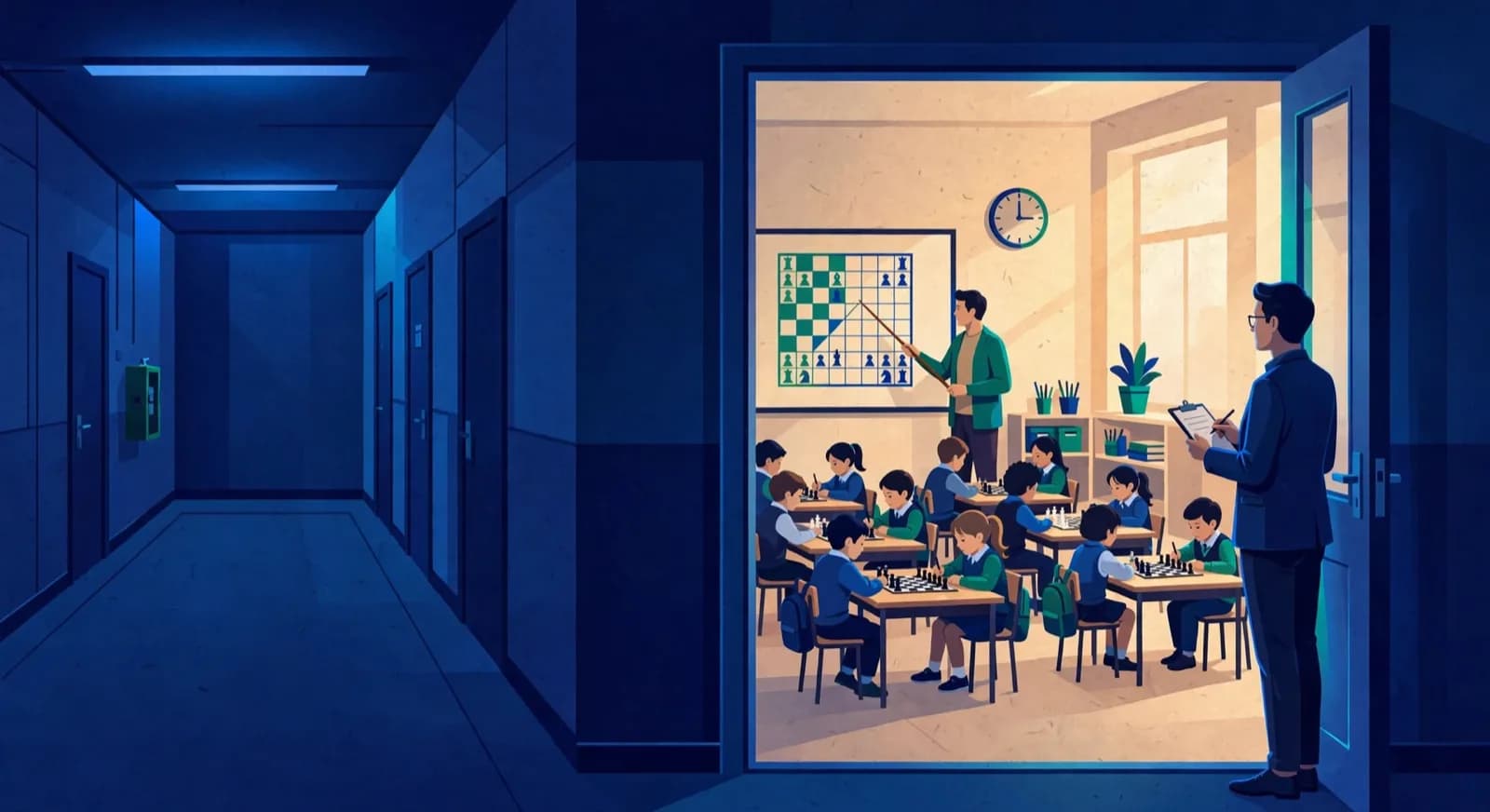
You get buy-in by connecting chess to goals a head teacher already owns, then asking for something small and specific rather than a blanket endorsement. Leaders do not fund hobbies; they fund outcomes they are accountable for, such as focus, inclusion, enrichment, and a low-cost activity that reaches children who do not shine at sport. Frame chess as a means to those ends and the conversation changes from whether to how.
Before you pitch, understand what a school leader is weighing. Their week is a fight for two scarce resources: staff time and room time. Any new activity is a cost against both, so an unfunded proposal that needs a teacher, a room, and a recurring slot will lose to things already timetabled. Your job is to make the cost visible and small, and the benefit concrete and aligned with the school's stated priorities. A chess program is unusually easy to make cheap, because a viable version needs one adult, one room the school already has, and equipment that can start at almost nothing on a free online platform.
Bring a one-page proposal, not an enthusiasm. It names the audience, the format (a lunchtime or after-school club to begin, avoiding timetable disruption), the adult who will run it and a backup, the equipment cost with a free-to-start option, the weekly slot you are asking to protect, and how you will report back. Leaders say yes far more readily to a small, time-boxed pilot with a defined review point than to an open-ended commitment. The table shows the fields filled in for a hypothetical school, so you can copy the structure. All values are made up, and it is written from the school's side, not from an academy's sales pitch.
| Proposal field | Hypothetical filled entry |
|---|---|
| School lead and backup | A Grade 5 class teacher leads; a PE teacher is the named backup and can run a games-only session |
| Interested pupils | 23 of 140 pupils surveyed in Grades 3 to 6 said yes; the pilot group is 12, with a waiting list for the rest |
| Proposed slot and room | Tuesday lunch break, 35 minutes, in the library |
| Local safeguarding approval | The school's safeguarding lead approves the adults and the room before the first session, and the date of approval is written on the proposal |
| Equipment access | Six sets borrowed from the sports store and a wall board from the maths department, so no purchase for the pilot |
| Total staff time | Lead: 35 minutes teaching, 20 minutes preparation and 10 minutes admin, which is 65 minutes a week, or about 11 hours over a 10-week pilot. Backup: 35 minutes in any week they cover |
| Funding owner | The head teacher approves no new spend for the pilot; later spend comes from the enrichment budget holder |
| Review date | The Friday of week 10, with attendance, pupil feedback and skills shown |
Speak to the outcomes leaders already report on. Chess is a low-cost enrichment activity that needs no expensive kit and no minimum height or fitness, and it may suit children who prefer a quiet, focused activity to sport. It can give a school something to show at open evenings and in newsletters, and it creates a pipeline toward inter-school events and, for the few who take it far, the official competitive structure that FIDE, the international chess federation, administers worldwide [1][5]. You do not need to overclaim academic miracles to make the case; a calm, well-run, popular club is a modest win a leader can put their name to, and that is enough. Our overview of what scholastic chess is can give you the language to describe the wider movement your program joins.
Who should run a school chess program: a teacher or an external coach?
Either can work, and reliability and a plan matter more than playing strength. A committed teacher or parent volunteer with a simple curriculum can run a good beginner club without being a strong player; an external coach buys expertise and continuity but adds cost. Whichever you choose, a school-owned routine is easier to keep going than one that depends on a single person, so plan for two adults from the start.
The reason an in-house adult usually wins for the core club is continuity. School programs die when the one person holding them up leaves or gets too busy, so the resilient model is a school-owned routine rather than a dependence on a single expert. A teacher who follows a written lesson sequence, uses a free online board to demonstrate ideas, and keeps a register can deliver real progress to beginners, because early chess teaching is about clear explanation and consistent practice, not about the teacher being able to beat everyone in the room. If nobody on staff plays, that is fine: the curriculum carries the knowledge, and our guide to teaching chess to beginners is written precisely for the non-expert adult in that position.
| Consideration | In-house teacher or parent | External coach |
|---|---|---|
| Cost | Low, usually part of existing duties | A recurring fee to budget for |
| Chess expertise | Carried by the curriculum | High, brought by the coach |
| Continuity risk | Lower if two adults share it | Depends on the coach's availability |
| Best for | The everyday beginner club | Competitive players and teacher training |
| Safeguarding | Already covered by school policy | Requires the school's vetting checks |
When you do bring in an external coach, treat it as a role with requirements, not a favour. The coach must clear the school's safeguarding and vetting checks, follow the school's behaviour policy, and, ideally, upskill a member of staff as they go, so the program does not collapse the term the coach moves on. A good arrangement pairs a coach with a teacher for a term or two, deliberately transferring the routine into the school. Whether you use a coach for the whole club or only for a top group, protect against the single-point-of-failure trap by making sure at least two adults can run a session.
Safeguarding requirements come from your school and local rules, and they differ by country and by school. Ask the school office which checks and permissions apply to each adult before the first session, including a parent volunteer. As one example of retailer advice for US clubs, US Chess Sales (retailer) publishes a beginner's guide that lists contacting the school principal or activities director, completing any required background checks for all adult volunteers, and identifying a faculty advisor as steps before the first meeting, alongside setting a date and collecting permission slips if the school requires them [6]. Treat that as one source of ideas, not as your school's policy.
Plan for the day the founding teacher leaves. A named backup should hold four things before that day: the room booking for the slot, access to the lesson boards and online accounts under a school-owned login rather than a personal one, the attendance register, and the parent contact list with the responsibility to tell families about any change. If any of the four sits only with the founding teacher, the program has a single point of failure.
What curriculum should a school chess program follow?
A school chess program should follow a simple, spiralling curriculum: the rules and piece values, basic checkmates, the opening principles, elementary tactics, and enough endgame to finish a won game, revisited at rising depth each term. You do not need a bespoke syllabus; you need a fixed sequence so every session has a clear objective and every child knows what they are learning today. Consistency of structure matters more than cleverness of content.
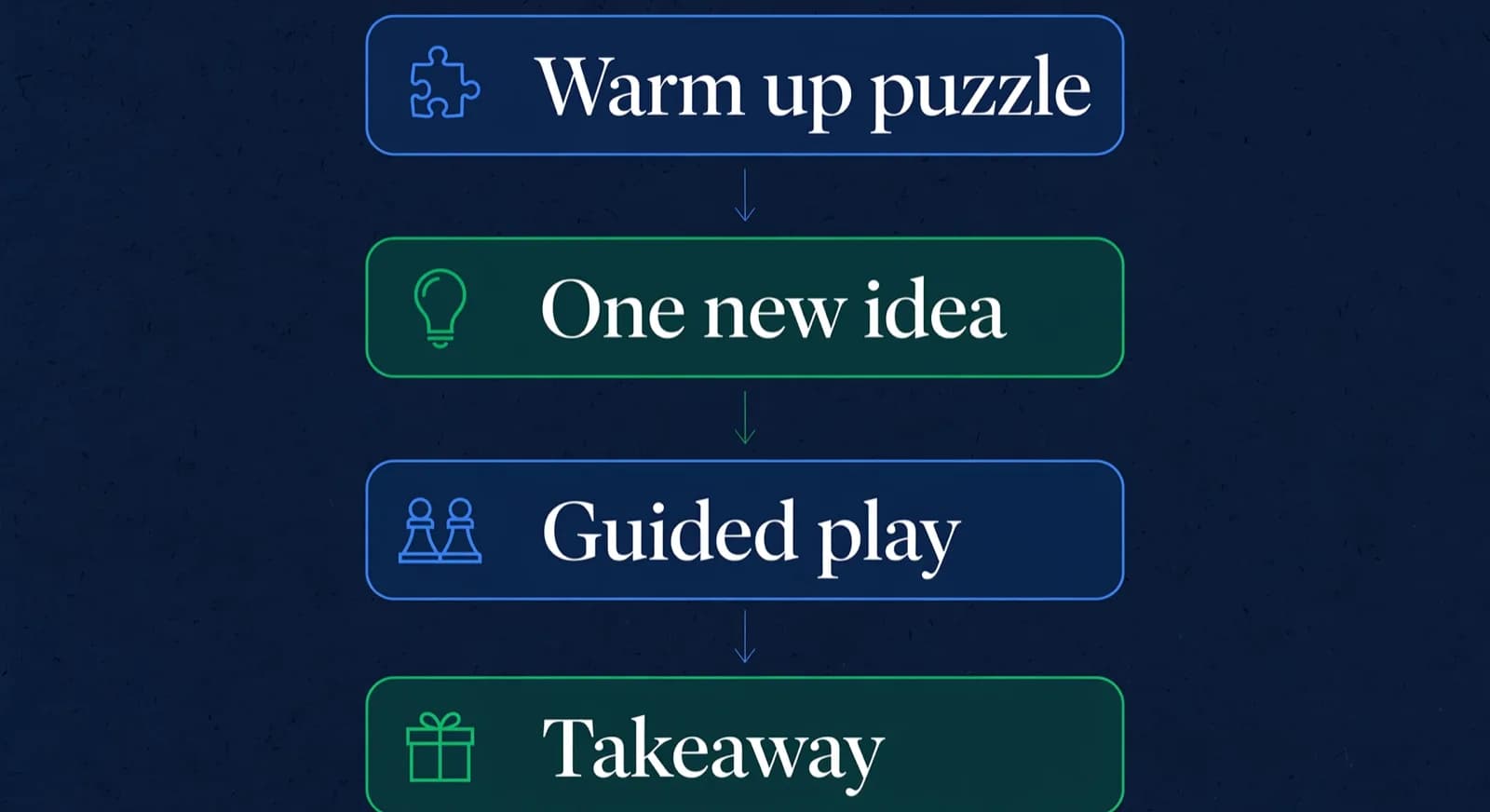
Because the lesson shape is fixed, the adult running it only has to prepare the one new idea. The week-by-week shape belongs to the club, and our guide to running a school chess club sets it out in full; the term-by-term sequence, assessment tasks and published packs are in our chess curriculum for schools. Group children loosely by experience rather than age so beginners are not lost and experienced children are not bored.
Free online tools carry part of the curriculum. Lichess studies are shareable analysis boards you can pre-load with the day's positions, so a teacher can set up a lesson once and reuse it [2], and Lichess is a free, open-source platform with puzzles built in [3]. For younger children, ChessKid, which states it has no chat and uses auto-generated usernames, is often the better home for online play [4].
What equipment and space does a school chess program need?
A school chess program needs one set for every two children, a way to demonstrate to the whole group, and a room with tables, and nothing more to begin. A pure online program can start with even less: a computer room or a set of tablets and a free platform. Resist the urge to buy tournament clocks, scorebooks, and fancy boards on day one; those are rewards for a club that has grown, not requirements to start one.
| Item | Minimum to start | Add once the club is established |
|---|---|---|
| Chess sets | One per pair of children | Enough for one each, plus spares |
| Demonstration | A screen or a large wall board | A magnetic demo board for away days |
| Space | Any room with tables | A regular, bookable room slot |
| Online play | A free platform on existing devices | Managed accounts for each child |
| Clocks and scoresheets | None needed | A few clocks when you run events |
Two decisions drive the equipment list: physical or online, and the age of the children. For young children in person, standard plastic tournament sets with a demonstration board or a screen are all you need, and a room where the same tables can be laid out the same way each week helps the ritual settle. For older students, or for a school with a good device budget, an online-first program removes the storage and setup entirely and gains automatic puzzles, saved lessons, and visible ratings; the trade is that you must plan for safe, supervised play, which is why a child-focused platform matters for the youngest groups [4]. A safe middle path many schools use is physical boards for teaching and a small block of online play for practice and homework, keeping the screen time supervised and purposeful.
Club or timetabled class: which format fits your school?
Choose an after-school or lunchtime club to start, because it needs no timetable change and no leadership fight over curriculum time, and consider a timetabled class only once the club has proven demand. A club is voluntary, easy to launch, and self-selecting for keen children; a timetabled lesson reaches everyone but competes with the rest of the curriculum for one of the scarcest things a school has, which is minutes in the school day.
Each format has a clear best use. A lunchtime club is the lowest-friction start of all: no transport issues, no parental pickup to coordinate, and it fits children who cannot stay late. An after-school club gives you longer sessions and a calmer setting, at the cost of needing pickup arrangements. A timetabled class, whether a rotation within a wider enrichment block or a dedicated lesson, is the ambitious end state that reaches children who would never volunteer, and it is where a program can claim genuinely whole-school reach, but it is also where you will meet the hardest resistance because you are asking for curriculum time. The sensible path is almost always club first, class later, using the club's attendance and waiting list as the evidence that earns the timetable slot.
Whatever format you choose, a fixed weekly slot is the backbone of the whole thing. Children, parents, and cover staff all need to know that chess is Tuesday lunchtime, every week, without exception, because a routine that moves is a routine that dies. Once you run more than one group, or blend a lunchtime beginners club with an after-school improvers session, keeping the slots, rooms, and rosters straight becomes the real administrative work, and a shared timetable that everyone can see prevents the double-booked-room and forgotten-session failures that quietly kill programs. The next section sets out what happens inside that slot each week: the session shape, mixed levels, rules and the termly event.

Week of 12 October · all batches
0 conflictsMake-up credit · Mia G. · Sat 4:30 PM
Absent Thursday with notice · booked by Noor
Class reminders sent to 148 families
Timing changes update everyone at once
How do you run a weekly school chess club session?
Run every session on the same three-part shape: a warm-up puzzle while children arrive, one small teaching idea for the whole group, then most of the time given to games while the leader circulates. A fixed shape turns weekly preparation into choosing one puzzle and one theme, instead of building a lesson from nothing.
| Segment | 40-minute slot | 75-minute slot | What happens |
|---|---|---|---|
| Arrival and warm-up puzzle | 5 min | 10 min | One puzzle on the board or a screen while the room settles |
| Teaching idea | 5 min | 10 min | One theme for everyone: a pattern, a plan or a rule |
| Games and coaching | 25 min | 45 min | Paired games while the leader walks the room and asks questions |
| Review and pack-up | 5 min | 10 min | Note who played, tease next week, every set back in its box before the bell |
| Total | 40 min | 75 min | Both columns add up to the slot, arrival and pack-up included |
Both columns are illustrative, not standard school periods. Take the length your school gives you, count arrival and pack-up inside it, and give the games block what remains; in a 40-minute slot a 10-minute lecture leaves under 20 minutes of play, so shorten the teaching first. During games, ask a question rather than giving the answer: what is your opponent threatening, is there a check here. Save each week's teaching position in a free Lichess study so next year's leader starts from a library [2], and let an online puzzle trainer pitch tactics to each child's level so a beginner and a strong player are both stretched from one station [7]. A chess lesson plan template turns a term of single themes into a sequence you can reuse.
A school club almost always spans total beginners and confident players in one room, so plan for the spread instead of teaching to the middle. Pair games by rough strength so contests are close, seat each newcomer with a stronger buddy for the teaching idea, set the week's puzzle in easy, medium and hard versions of the same theme, and let the strongest children play up with harder opponents or a puzzle race. Once members have played a few rated games online, their ratings give you a number to pair from instead of a guess.
| Hard case | What to do | Who supervises |
|---|---|---|
| An odd number of children | One child takes the puzzle station or plays the leader; a different child sits out next week, never the same child twice running | The club leader |
| A beginner arrives mid-term | Buddy for the teaching idea, then a first game against another newer player | The club leader, checking in at the start of games |
| A much stronger player with no close opponent | Odds games against a peer, a puzzle race, or preparing next week's puzzle set, never teaching the whole session | The club leader, who may play them once |
| The leader is absent | The school's named backup adult runs games and puzzles from the saved study with no new teaching; with no approved adult, the club does not meet and parents hear in advance | A named adult, never a pupil |
Set three kinds of rules before the first meeting and fit them on one sheet the school can show a parent: respect (talk to opponents, not about them, and no mocking a blunder), participation (phones away, play the game you are paired for, ask before leaving the room) and play decorum (touch-move if you use it, clocks started together, a handshake at the end). The beginner's club guide from US Chess Sales, a retailer, recommends shared expectations reviewed often and enforced gently, and notes that the child who struggles to focus may be the one who needs the club most [6].
Rotate a few formats so no two weeks feel identical: a simul where the leader plays every child at once, a puzzle ladder on the wall, team days that score by table, themed weeks such as knights and pawns only, and an occasional loud bughouse session. If you run a ladder, write it as a house rule: a member may challenge anyone up to two places above, a win swaps the places, a draw changes nothing, an absent member keeps their place and a new member starts at the bottom.
Once a term, run a small in-house Swiss event across one or two sessions, with a certificate for every child who takes part. Swiss pairing suits a club because nobody is knocked out, and FIDE's Swiss rules give sound house practice: declare the number of rounds beforehand, never pair the same two players twice, and give one player a bye when numbers are odd [8]. Plan rounds against your time with the Swiss Tournament Rounds Calculator, read how Swiss pairings work before the first event, and announce a tie rule before round one, because a few rounds rarely produce a single clear winner. When the event grows to age sections, outside entrants or official ratings, it becomes a full event, and the guide on how to organize a chess tournament covers that job.
How do you fund a school chess program?
Fund a school chess program from the smallest source that fits its size. A borrowed-room, teacher-led version can need no new equipment purchases, but it is not free: it uses staff time. As it grows, draw on the school's enrichment budget, a modest optional parental contribution, sponsorship or grants. Make the first version cheap enough that cost is never the reason it does not start.
There are several routes, and most programs blend them. A school enrichment or extracurricular budget is the natural home once the club is established. A small, optional parental contribution can cover an external coach for those who want an improvers group, as long as a free place remains for children who cannot pay. Local sponsorship from a business, a parents' association or a community chess club can cover a one-off equipment purchase. Some governments and charities offer enrichment grants, and any grant or eligibility rule must be checked on the funder's own official site before it goes into a plan; this guide names none. Start cheap, show value, then fund growth from the source that fits the school.
- School enrichment or extracurricular budget, the natural home for an established, valued club.
- A small optional parental contribution for coach-led improver groups, with a free tier preserved for inclusion.
- Local sponsorship for one-off equipment, often welcomed because it is visible and finite.
- Grants for enrichment or chess, which a coordinator can apply for once the program has a track record.
- Fundraising tied to a school chess event, which doubles as promotion and community building.
Here is one illustrative year-one calculation in US dollars for a 30-week program. Every figure is hypothetical, so replace it with your own quotes. It separates one-time equipment, paid session fees, venue or device costs, staff time and a contingency, because a borrowed-room option can have zero new equipment purchases and still use many staff hours.
| Cost line | A: teacher-led, borrowed sets | B: coach-led, new sets |
|---|---|---|
| One-time equipment | $0 (six sets borrowed) | $210 (six sets at $25 plus a $60 wall board) |
| Paid session fees | $0 | $1,500 (30 sessions at $50) |
| Venue or devices | $0 (the library and an existing screen) | $0 |
| Contingency (10% of cash costs) | $0 | $171 |
| Total cash cost | $0 | $1,881 |
| Staff time | 65 minutes a week for the lead, about 32.5 hours over 30 weeks | 35 minutes a week for the school adult who supervises, 17.5 hours over 30 weeks |
Read the two columns together. Option A costs nothing in dollars and about 32.5 staff hours, and option B costs $1,881 in cash and about 17.5 staff hours. Neither is free or cheap in every sense, and the head teacher decides which resource is scarcer: money or teacher time.
One efficient way to raise both money and profile at once is to run a small in-school or inter-school event, which our guide to running a scholastic chess tournament covers end to end. An event gives sponsors something concrete to attach their name to, gives parents a reason to contribute, and gives the whole program a visible milestone that makes the case for next year's budget far easier than any written proposal could. When an outside academy runs the program, consent and payment pages in the school’s own logo and colours tell parents at a glance that the request comes from their school.
How does a school chess program work in India when an academy runs it?
In India most school programmes are run by an outside academy, so start by naming who pays. A school that funds lessons from its budget is your customer; an optional after-school batch is sold to parents while the school lends a room and a slot; a weekend club is closer to renting a venue. In every version the principal's real question is whether the programme will cost staff time or cause complaints.
| Model | Who usually pays | Best fit | Main risk |
|---|---|---|---|
| In-period, in the timetable | The school, as a flat session or annual fee | Schools that want enrichment for every child without parent billing | Large classes and one payer who can cancel at budget time |
| After-school batches | Parents, with a share or space charge to the school | Academies that want committed, paying students on campus | Too few enrolments to cover the coach's time and travel |
| Weekend or holiday club | Parents, with flat room rent to the school | Tournament-track students pooled across grades and schools | Supervision and room access outside school hours |
Split the work before launch. The academy owns lesson preparation, the coach, attendance, fee records and progress reports; the school names one coordinator, confirms the room and slot, and signs off each notice that goes to parents. Do not assume you will receive parent phone numbers: ask how the school introduces optional activities and collects consent. Give the principal one sentence to repeat at a parents' meeting (weekly lessons, an attendance record and a termly report for every child), bring a sample report, and never promise a rating or an exam result.
Check which programme the school has already joined before you pitch, because two large ones arrived in 2026. CHESS+ is run by the All India Chess Federation with Navodaya Vidyalaya Samiti, with an AICF curriculum, coaches, trained teacher-mentors and inter-school events, piloting in 30 JNVs (13 in Haryana, 15 in Uttar Pradesh, 2 in Delhi) [9]. The National School Chess League 2026 is free for schools, with digital lessons, assignments, monthly assessments, school and national leaderboards, a national final and optional paid advanced training [10]. Private providers such as Indian Chess School also sell a chess-in-schools syllabus, teacher training and tournament support [11].
A free national league changes the pitch: an academy cannot win by offering lessons and a leaderboard. Sell what a digital league lacks, which is a coach in the room every week, review of each child's own games, a termly report written for that child and a person the coordinator can call. Many schools will run both, the league for online practice and competition, the academy for teaching. Never borrow another programme's name in a proposal unless the school is actually enrolled in it.
Write the revenue share as a calculation before the first class. Take an illustrative after-school batch of 16 children paying 1,500 rupees a month: 24,000 rupees in, a 15 percent facilitation share of 3,600 rupees to the school, 20,400 rupees left. A coach paid 1,200 rupees a session for eight sessions costs 9,600 rupees, plus about 1,600 rupees of travel, so 11,200 rupees, leaving the academy 9,200 rupees before materials, admin and tax. At ten children the same terms leave 1,550 rupees, and at eight children the batch loses about 1,000 rupees. Coach and travel alone break even at nine children (11,200 divided by 1,275 rupees net per child, rounded up), so write a minimum batch size above nine into the agreement, letting a thin batch pause instead of running at a loss. These figures are illustrative, not market rates; the chess academy fee structure guide covers how to explain the charges to families.
Plan the Indian exam-and-holiday calendar into the agreement from the start. Publish the paused weeks up front, state whether those weeks are billed or skipped, and say where a make-up class is owed. The agreement also names who collects from parents, the payout date, and what happens to a mid-term joiner or a missed payment. For the wider business of running an academy that serves schools, see the guide on how to start a chess academy in India.
How do you measure whether a school chess program works?
Measure a school chess program with a few simple, honest signals recorded from the first session: sessions actually held, attendance as a fraction of those enrolled, what pupils say, and skills pupils can demonstrate. Agree the targets, and the capacity for expansion, with the school before launch. You do not need academic-study machinery to defend a club. You need a one-page review record for the meeting you promised when you asked for buy-in.
Lucas M.
Batch B2 · Thursdays · joined Aug 2025
1342
Academy rating · Lichess games synced
Won vs. 1410 · French Defense
Best gameMissed fork on move 23
Homework setAttendance and retention are strong signals because children choose to come or not. Record a simple register from the first week, because you cannot show a trend you did not record. A falling line is a prompt to look at the sessions, the slot or the group size early. For progress, a short list of named skills each child can demonstrate, from a basic checkmate to spotting a simple fork, is a valid record for a club that plays mostly over the board. Online ratings are optional: they can rise, flatten or dip, and a rating movement is not proof that the program works.
The review record below is an illustrative week-10 entry, written for a hypothetical pilot. The numbers add up, and none of them is a pass mark: the school decides in advance what it would count as continuing, expanding or stopping.
| Measure | Illustrative week-10 entry | What it shows and what it does not |
|---|---|---|
| Sessions held | 9 of 10 planned (one lost to an exam week) | Reliability of the slot; says nothing about quality |
| Attendance | Average 10 of 12 enrolled pupils per session (83%) | Whether pupils keep choosing to come; not whether they learn |
| Pupil feedback | Three questions asked of all 12 pupils: enjoyed it, would come again, one thing to change | Enjoyment and practical fixes; self-reported |
| Demonstrated skills | 8 of 12 pupils can set up the board and give a checkmate with a queen and king | Skills the school named in advance; it does not prove an academic benefit |
| Rating movement | Optional: not collected in this pilot | Would show results against opponents only |
Frequently asked questions
How do I start a chess program in a school with no budget?
Start with free online tools, a few borrowed sets and one weekly lunchtime club run by an existing adult. Lichess is a free platform with puzzles and shareable study boards, so software can cost nothing, and one set for every two children covers a small over-the-board club cheaply. This is not free: it uses staff time, so count the hours. Ask leadership for one term, one group and one room rather than a budget line, then use the club's attendance and feedback to make the case for funding once it has proven itself.
Do you need to be a good chess player to run a school chess club?
No. You need reliability, a simple curriculum, and the willingness to learn one lesson ahead of the children. Early chess teaching is about clear explanation and consistent practice, not about the adult being able to beat everyone in the room, and a written lesson sequence carries the chess knowledge for you. Many excellent school clubs are run by teachers or parent volunteers who started as non-players, using a fixed weekly lesson shape and a free online board to demonstrate ideas. Bring in a stronger coach only for the children who outgrow the beginner club.
Should a school chess program be a club or a timetabled class?
Start as an after-school or lunchtime club, because it needs no timetable change and no fight over curriculum time, and consider a timetabled class only once the club has proven demand. A club is voluntary, easy to launch, and self-selecting for keen children, which makes it the low-risk way to begin. A timetabled lesson reaches every child but competes for scarce curriculum minutes and meets far more resistance, so most schools earn the class later using the club's waiting list and attendance as evidence.
Is there a free school chess programme in India?
Yes. The National School Chess League 2026 is free for participating schools, according to ChessBase India's March 2026 report, and runs online with lessons, assignments, monthly assessments and leaderboards, with optional paid advanced training. An academy can sit alongside it by offering a coach in the room, review of each child's own games and a termly report.
What are the benefits of chess in schools for pupils?
Chess is a low-cost enrichment activity that needs no special kit, and it may suit children who prefer a quiet, focused activity to sport. It can give a school something to show at open evenings and a pathway toward inter-school events. For the keen few, it also leads to an official competitive structure that FIDE administers. Claims that chess raises academic results are not established, so most schools value it for the calm, popular club it can create. That is a modest, defensible win on its own.
What safeguarding checks and permissions does a school chess program need?
Safeguarding and permission requirements come from your own school and local rules, and they differ by country and school. Ask the school office which checks apply to each adult before the first session, including a parent volunteer. As one example, the US Chess Sales (retailer) beginner's guide lists completing any required background checks for all adult volunteers and collecting permission slips where the school requires them, alongside naming a faculty advisor [6]. Treat that as an example from a US retailer, not as your school's policy.
Sources
- [1]FIDE: International Chess Federation · accessed 2026-06-28
- [2]Lichess Study: free shared analysis boards · accessed 2026-06-28
- [3]Lichess: free and open-source chess platform · accessed 2026-06-28
- [4]ChessKid: chess platform for children · accessed 2026-06-28
- [5]FIDE (International Chess Federation) · accessed 2026-06-28
- [6]The complete beginner's guide to starting a scholastic chess club (US Chess Sales, retailer) · accessed 2026-10-16
- [7]Lichess puzzle training · accessed 2026-06-28
- [8]FIDE Swiss rules C.04.1: basic rules for Swiss systems (rounds declared beforehand, byes, same-score pairing) · accessed 2026-10-16
- [9]Government of India and AICF launch CHESS+ (ChessBase India, 26 July 2026) · accessed 2026-10-16
- [10]India's National School Chess League opens 2026 onboarding for schools (ChessBase India, 12 March 2026) · accessed 2026-10-16
- [11]Indian Chess School, Chess-in-Schools programme and Education Partner · accessed 2026-10-16
- [12]Goods and Services Tax (GST) portal, Government of India · accessed 2026-07-15
Written by Abhishek Tiwari
ChessCore
Drafted with AI, fact-checked and approved by a human before publishing, the same guardrail our product applies to every report it sends. Read our editorial standards.
See how a coordinator keeps a program organised
Book a walkthrough to see how ChessCore keeps session timetables, attendance and student records in one place, so the evidence for your program is ready when the review meeting comes around.
- Roster import from the spreadsheets you already keep
- Lichess and Chess.com connections, batches, and fee plans
- First reports in week one, after your approval
- Free plan, no credit card required