On this page9 sections, 20 min read
- What is the Swiss system in chess?
- Which FIDE Swiss rules are current right now?
- How do score groups decide who plays whom?
- How does the Swiss system balance colours?
- What happens when there is an odd number of players?
- How many rounds should a Swiss tournament have?
- How do tiebreaks decide final standings?
- Who runs the pairings, and can software do it?
- How is the Swiss system different from round-robin and knockout?
- Frequently asked questions
Bottom line
Swiss system chess pairing matches players with similar running scores each round while eliminating nobody: after every round players are sorted into score groups, and within each group the higher half meets the lower half (a simplified Dutch-style illustration), balancing colours and avoiding rematches. Nobody is eliminated, a bye covers an odd number of players, and tiebreaks separate level scores.
TL;DR
- The Swiss system lets a large field play a fixed number of rounds without knockout eliminations, so winners gradually meet winners and losers meet losers.
- Each round players are grouped by score, and within a score group the top half is paired against the bottom half in tournament pairing number order.
- Colour allocation aims to give every player a near-equal number of whites and blacks and avoid three of the same colour in a row.
- An odd number of players produces a bye, and players level on points are separated by tiebreaks such as Buchholz and Sonneborn-Berger.
- The pairing rules are mechanical and are almost always run by an arbiter using FIDE-endorsed pairing software rather than by hand.
Key facts
- The Swiss system pairs players with the same or similar scores each round and eliminates no one, so a field far larger than the round count can still be ranked.[1]
- Under the FIDE Dutch system, players within a score group are ranked by tournament pairing number (TPN), the group is split in half, and the top of the upper half is paired against the top of the lower half.[1]
- Colour allocation tries to equalise each player's whites and blacks across the event and avoids giving anyone the same colour three times in a row.[1]
- When the number of players is odd, one player receives a bye, and under FIDE rules the pairing-allocated bye normally scores a full point.[2]
- Buchholz, the sum of a player's opponents' scores, is one of the most common tiebreaks used to separate players who finish on equal points.[8]
- FIDE publishes the official pairing rules (the Dutch system is the most widely used) and endorses the pairing programs that arbiters run.[2]
- The current FIDE Swiss rules took effect 1 February 2026, covering the revised Basic Rules (C.04.1) and the revised Dutch system (C.04.3); older Handbook chapters marked effective till 31 January 2026 are superseded.[7]
What is the Swiss system in chess?
The Swiss system is a tournament format that pairs players with similar running scores each round while eliminating no one, so a large field can be ranked fairly in far fewer rounds than a round-robin would need [1]. Every entrant plays the same fixed number of rounds, and the pairing method keeps steering players toward opponents on their own score, so leaders meet leaders and the final standings reflect who beat whom rather than who survived a bracket.
The name comes from a tournament held in Zurich in the late nineteenth century, and the format spread because it solved a real problem: a round-robin, where everyone plays everyone, is fair but needs one round fewer than the number of players, which is impossible for an open event with a hundred entrants and a weekend to fill [1]. The Swiss system trades exhaustive fairness for scalability. You do not learn how every player compares to every other player, but after enough rounds the top of the table has genuinely been tested against strong opposition, because winning keeps raising the strength of your next opponent.
Which FIDE Swiss rules are current right now?
The current FIDE Swiss rules are the versions effective from 1 February 2026: the revised Basic Rules for Swiss Systems (C.04.1) and the revised FIDE Dutch System (C.04.3), which FIDE confirmed in a March 2026 reminder to organizers and arbiters [7]. Older rule texts are still easy to find online, so check the effective date on any Handbook page before relying on it.
How do score groups decide who plays whom?
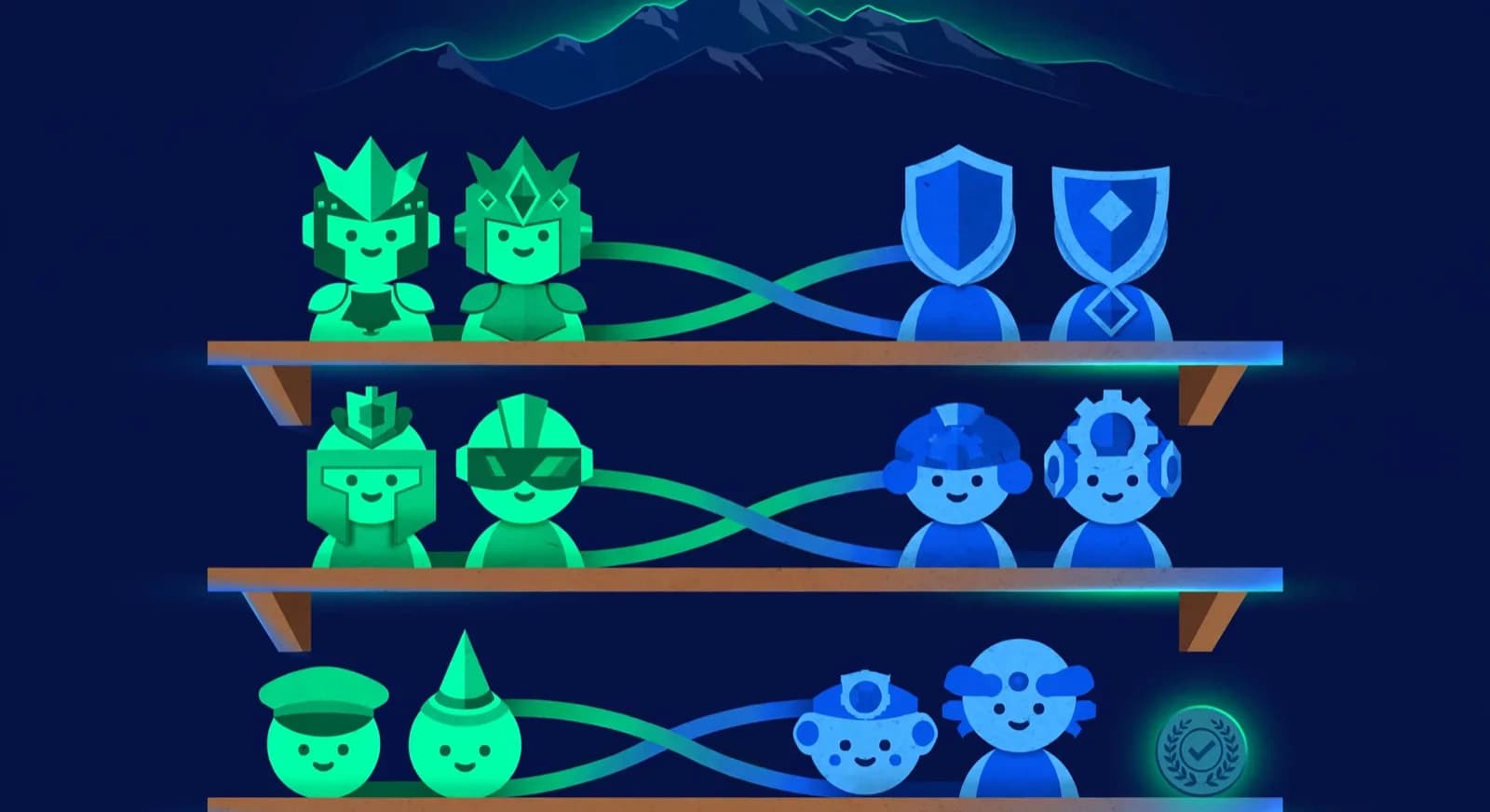
After each round the arbiter sorts every player into score groups: all players on the same score sit in one group, and pairing happens inside each group from the top of the table downward [1]. Under the FIDE Dutch system the players in a bracket are ranked by tournament pairing number (TPN) in ascending order, the bracket is split into an upper half and a lower half, and the top player of the upper half is paired against the top player of the lower half [6]. Other FIDE-approved systems (Dubov, Burstein, Lim) pair differently, so treat this as one system's shape, not the only Swiss algorithm.
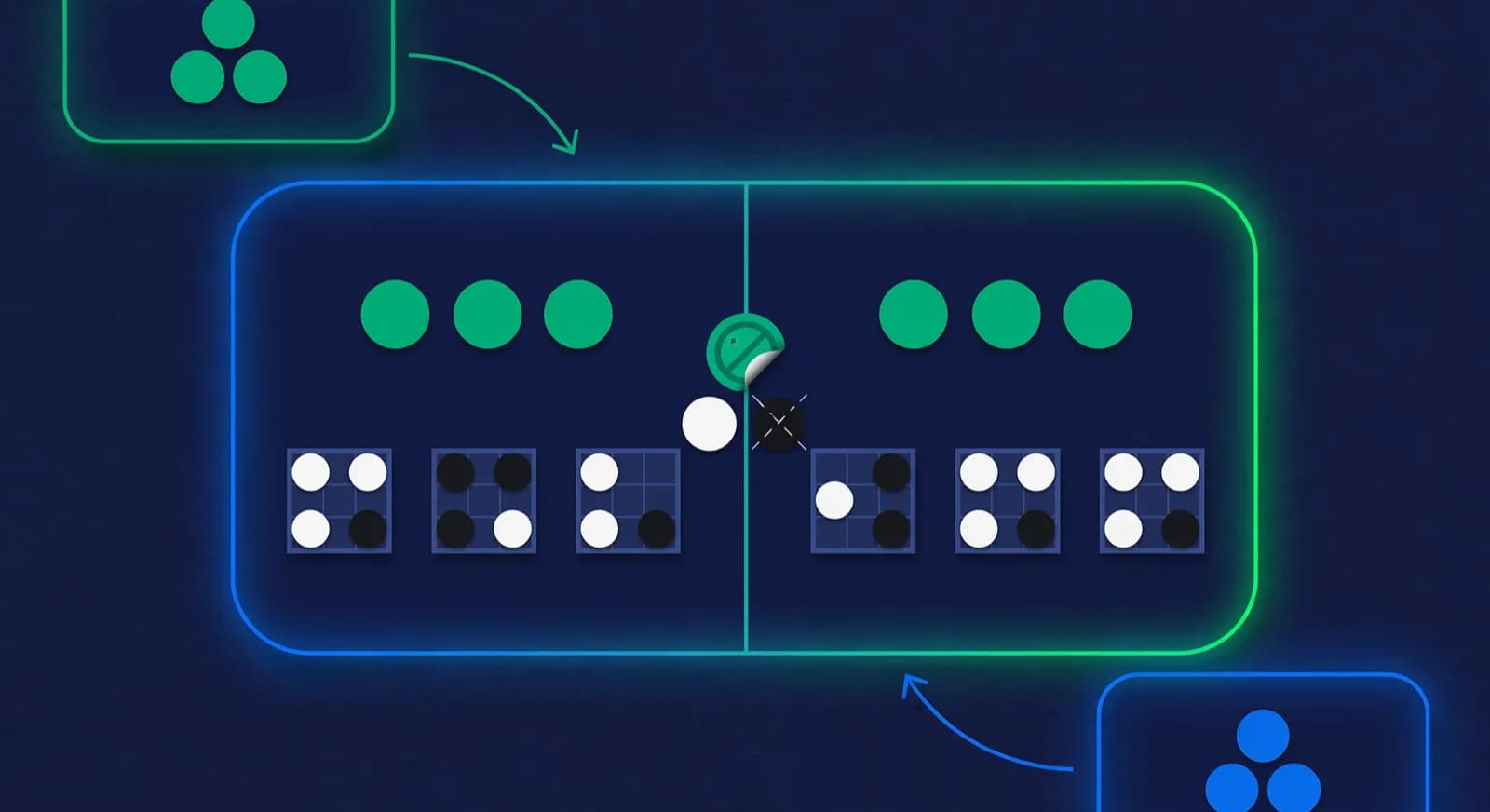
The worked example below is a labelled teaching illustration, not a record of a real event. Eight players carry seeds A to H, where A has TPN 1 (the top seed) and H has TPN 8. Colours start from a drawing of lots before round one: the higher-ranked player of each pair receives the drawn initial colour (White here) when their TPN is odd, and the opposite colour when it is even [6]. We paired all three rounds by hand against the FIDE Dutch absolute criteria and then ran a short script that checks every round for rematches, colour differences outside minus two to plus two, and the same colour three times in a row; the sequence below passes all of those checks. It is a legal pairing a Dutch engine could produce, not a claim that it is the only output the engine would give.
Round one splits the field into an upper half (seeds A to D) and a lower half (seeds E to H), then pairs one against five, two against six, three against seven and four against eight: A plays E, B plays F, C plays G, D plays H. Suppose every upper-half seed wins. After round one, A, B, C and D have one point and E, F, G and H have zero. Round two now has two score groups. In the one-point group the Dutch split pairs A against C and B against D; in the zero-point group it pairs E against G and F against H. Say A and C draw, B beats D, E beats G, and F beats H. Scores are now B on two; A and C on one and a half; D, E and F on one; G and H on zero.
| Player (TPN) | R1 result | R2 result | R3 result | Score | Colours |
|---|---|---|---|---|---|
| A (1) | White, beat E | Black, drew C | White, drew B | 2.0 | W B W |
| B (2) | Black, beat F | White, beat D | Black, drew A | 2.5 | B W B |
| C (3) | White, beat G | White, drew A | Black, beat D | 2.5 | W W B |
| D (4) | Black, beat H | Black, lost B | White, lost C | 1.0 | B B W |
| E (5) | Black, lost A | White, beat G | Black, lost F | 1.0 | B W B |
| F (6) | White, lost B | Black, beat H | White, beat E | 2.0 | W B W |
| G (7) | Black, lost C | Black, lost E | White, beat H | 1.0 | B B W |
| H (8) | White, lost D | White, lost F | Black, lost G | 0.0 | W W B |
Round three shows the two standing adjustments that make a Swiss more than a simple split. B leads on two points alone, so B cannot be paired inside an empty score group and floats down to the one-and-a-half group to meet A, who has not yet played B. That leaves C in the one-and-a-half group with no partner at that score, so C floats down into the one-point group and is paired against D. This downfloat, a player moved to the next bracket because an odd count left them unpaired, is decided by the Dutch ordered criteria that minimise the number and scores of floaters [6], not by a blanket lowest-player rule. The remaining one-point players E and F pair each other, and the zero-point players G and H pair each other. Every round-three pairing avoids a rematch: B had never met A, D had met B but not C, E and F had not met, and G and H had not met.
Colours follow the same criteria. A player's colour difference is their number of whites minus blacks, and it must stay between minus two and plus two, with no player taking the same colour three rounds running [5]. In the example D arrives at round three on two blacks (colour difference minus two), which is an absolute preference for White, so D takes White against C. H arrives on two whites (plus two), an absolute preference for Black, so H takes Black against G. The draw between A and C in round two, and the float of C in round three, are the parts a beginner misses when pairing by hand, which is exactly why the script that checks them earns its place before anyone calls a sequence correct.
So the priorities the pairing follows, in order, are: never repeat a game, keep players paired within their own score group where possible, split each group into halves and pair across them, respect the colour rules covered next, and only then float a player up or down. Doing this by hand for eight players across three rounds is manageable; doing it for two hundred players across nine rounds is not, which is why organizers run endorsed software rather than pencil and paper. Understanding the mechanics is what lets an organizer answer a player who asks, correctly and calmly, why they were paired the way they were.
- Sort all players by score into score groups, highest score group first.
- Rank the players inside each bracket by tournament pairing number (TPN) in ascending order [6].
- Split the bracket into an upper half and a lower half of equal size.
- Pair the top of the upper half against the top of the lower half, and so on down.
- Transpose players to avoid a rematch, then float a player down to the next bracket by the ordered criteria [6].
- Apply the colour rules and adjust the pairing to satisfy them where possible [5].
How does the Swiss system balance colours?
The Swiss system tries to give every player a near-equal number of games with white and with black across the event, and it avoids assigning anyone the same colour three times in a row [1]. Because white carries a small first-move advantage, a fair format cannot let one player have five whites while another has five blacks, so colour history is tracked for every player and factored into each round's pairing alongside the score-group rules.
In practice each player carries two colour attributes into a pairing: their colour difference (how many more whites than blacks they have had) and their colour history (the sequence of recent colours). When two players are paired, the system gives white to whichever player is more owed it: the one whose difference leans toward black, or the one who had black most recently. The first round sets the pattern from a draw: the Dutch rules determine an initial colour by drawing of lots before round one, and the higher-ranked player of a pair receives that initial colour when their tournament pairing number is odd, else the opposite colour [6]. Every later round works to bring each player's running colour difference back toward zero. Where the score-group pairing and the colour rules conflict, the software applies FIDE's ordered criteria to decide which small compromise does the least damage [2].
A named edge case shows why colour is not always decided by preference alone. Take seed C in the worked example above. After two rounds C has played White twice (colour difference plus two), so C has an absolute preference for Black in round three. C would ordinarily float into the one-point group and the natural partner by rank might be a player C has already met; the rematch rule forbids that pairing outright, so the system transposes to D instead, whom C has not played. D arrives on two blacks, an absolute preference for White. The two absolute preferences happen to agree, so the pairing gives D White and C Black and satisfies both the no-rematch rule and the colour limits at once. When they conflict instead, the FIDE ordered criteria rank the no-rematch rule and the colour-difference limits above a player's mild preference, so the engine accepts the smallest colour compromise that keeps the pairing legal.
What happens when there is an odd number of players?
When the number of players is odd, one player cannot be paired and receives a bye for that round. Under FIDE rules the pairing-allocated bye normally scores a full point [5]. The Dutch criterion minimises the score of the bye assignee [6], so it usually lands near the bottom of the standings rather than with a contender, but the recipient is decided by the ordered criteria and is not promised to the same lowest-rated player under every configuration. Eligibility has a hard bar: a player who has already received a pairing-allocated bye, or who has already scored a win's points in a round without playing, cannot receive another one [5].
There is a second, different kind of bye that organizers should not confuse with the first. A requested or half-point bye is one a player asks for in advance because they cannot play a particular round (a late arrival, a clash with school, a religious observance). It is usually worth half a point and is announced in the tournament rules, with a deadline for requesting it. The distinction matters for communication: a full-point pairing bye is something the system allocates, while a half-point bye is something a player elects, and stating both policies plainly in the entry information prevents most of the disputes that byes cause.
How many rounds should a Swiss tournament have?
Treat the number of rounds as a planning heuristic, not a guarantee. A common rule of thumb is that the field size should not exceed two raised to the number of rounds, which suggests at least four rounds for sixteen players, five for thirty-two and six for sixty-four [1]. That formula only sets the floor at which a single undefeated player is arithmetically possible. It does not promise one clear winner: draws between the leaders, or several players finishing on the same score, are common, which is why tiebreaks exist and why most organizers add a round or two beyond the minimum so late-round games between the leaders actually decide the event.
A quick counterexample makes the point. Six rounds for sixty-four players allow an undefeated run of six wins, but if the two front-runners draw when they meet in the last round, they can finish level on five and a half points each, and the round count has not produced a unique winner at all. The standings are then settled by the published tiebreak order, not by adding rounds. Plan the round count to give the event a credible finish, and rely on tiebreaks, not arithmetic, to separate players who tie.
The round count is really a scheduling decision, because rounds multiply by the time control to fill your day. A weekend open with long time controls might manage five or six rounds in two days, while a blitz event can run nine rounds in an afternoon. Decide the round count and the time control together, sanity-check that the field size supports a decisive finish, and publish the round times before entries open so players can plan travel and byes around them. Our companion guide to choosing tournament time controls covers how the clock setting interacts with the round count, and the swiss rounds calculator turns your expected field size into a suggested number of rounds in one step.
Lucas M. · first session to today
Every game, report, and payment on one timeline
Aug
Joined at 1240Nov
First tournamentJan
Back-rank drills setOct
1342 · October report drafted
How do tiebreaks decide final standings?
Tiebreaks separate players who finish on the same score, and most of them reward the player who faced tougher opposition on the way to that score. FIDE's Tie-Break Regulations define the standard measures and group them by what they draw on, from a player's own results to their opponents' final scores [8]. Because a Swiss does not have everyone play everyone, two players can finish on the same points against very different fields, so a tiebreak such as Buchholz adds up each player's opponents' scores: beat strong opponents and your Buchholz is higher. Organizers must choose and publish the tiebreak order before the event, because applying it after the fact invites disputes.
| Tiebreak | What it measures | When organizers use it |
|---|---|---|
| Buchholz | Sum of all your opponents' final scores | Default strength-of-schedule tiebreak in most opens |
| Buchholz Cut-1 | Buchholz with the lowest opponent score removed | Reduces distortion from an opponent who withdrew |
| Sonneborn-Berger | Opponents' scores weighted by your result against them | Common secondary tiebreak after Buchholz |
| Direct encounter | The result of the game between the tied players | When the tied players actually met each other |
| Number of wins | How many games you won outright | Rewards decisive play over draws |
The practical rule is to pick a short, published stack: a primary tiebreak, one or two backups, and a final method that can never itself tie (a drawing of lots or board-order rule for the very last resort). Buchholz variants and Sonneborn-Berger both lean on opponents' scores, which is why they can move as later-round results come in, so never announce placings until the final round is complete and all scores are settled. For scholastic and rated events the tiebreak choice also feeds how results are reported upward, and once a coach records a result, the record view makes a student's rating history visible for a family to follow.

Lucas M.
Batch B2 · Thursdays · joined Aug 2025
1342
Academy rating · Lichess games synced
Won vs. 1410 · French Defense
Best gameMissed fork on move 23
Homework setWho runs the pairings, and can software do it?
Pairings are the responsibility of the arbiter, and in any event beyond a handful of players they are generated by FIDE-endorsed pairing software rather than by hand [2]. The arbiter enters results after each round, the program applies the score-group, rematch, colour, and float rules in the correct order, and the arbiter checks and publishes the output. FIDE's Basic Rules require the pairing rules to be transparent enough that the person in charge of the pairing can explain them [5].
Online platforms automate the same logic end to end. On Lichess, for example, the Swiss tournament format pairs, times, and scores an event automatically, which is why clubs and academies can run internal Swiss events without an arbiter present [3]. Chess.com similarly hosts tournaments that handle pairing and standings for the organizer [4]. Automation does not remove the organizer's job, though: someone still sets the round count, the time control, the tiebreak order, and the bye policy, and someone still answers the human questions when a player disputes a colour or a float. Choosing the tool that fits your event is its own decision, and our guide to chess tournament software compares the options for organizers who have outgrown a spreadsheet.
How is the Swiss system different from round-robin and knockout?
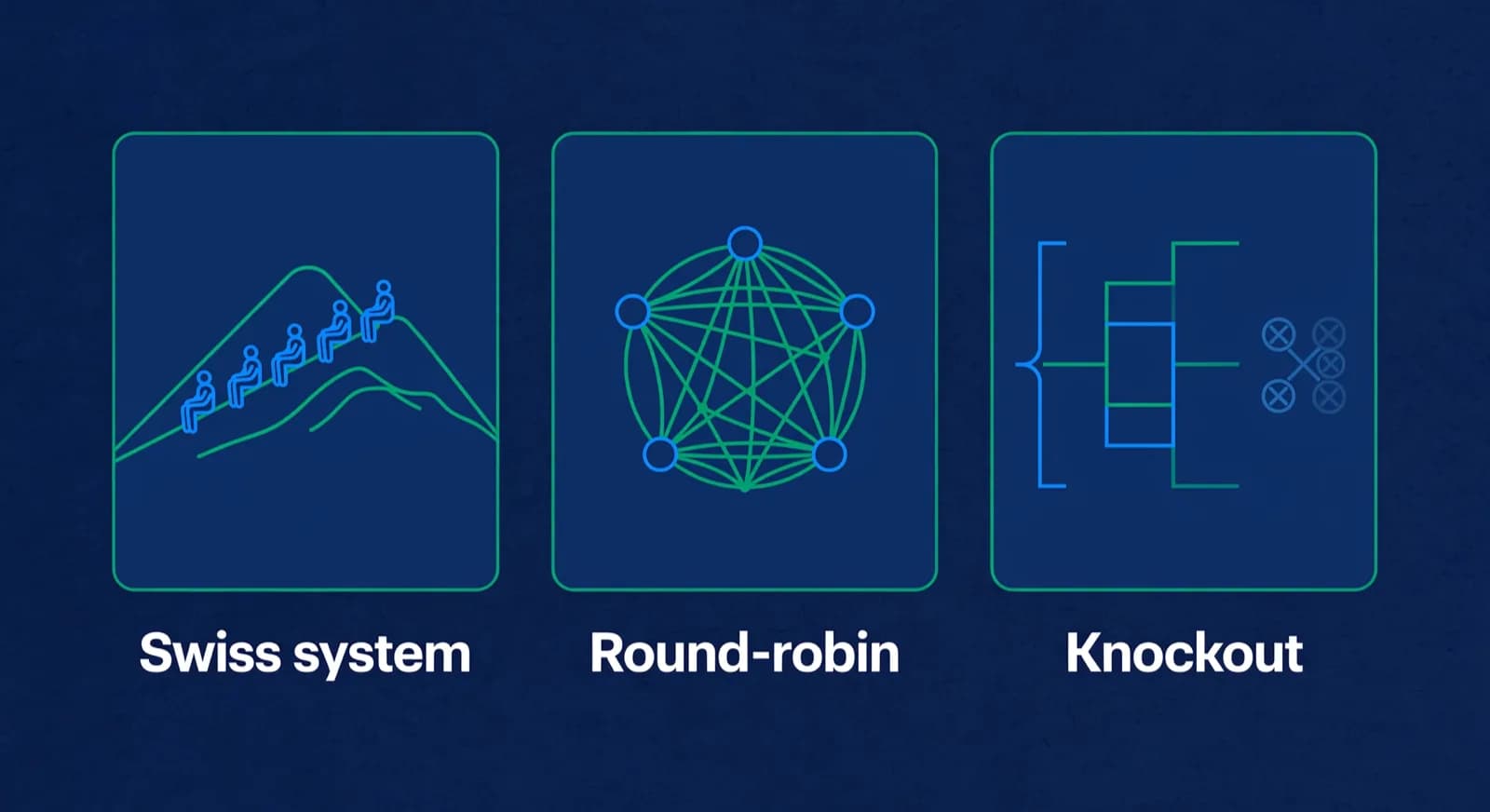
The Swiss system, round-robin, and knockout are three answers to the same question of how to rank a field, and they trade off fairness, size, and drama differently. A round-robin has everyone play everyone and is the fairest ranking, but it only works for small fields because the round count grows with the number of players. A knockout eliminates the loser of each match and is the most dramatic, but it discards most players quickly and can crown a winner who never met the second-strongest entrant. The Swiss sits between them: it suits events with too many entrants for a full round-robin where eliminating competitors before the end is undesirable, and it ranks the field without needing a round for every opponent [1].
| Format | Rounds needed | Eliminations | Best for |
|---|---|---|---|
| Swiss system | A planning floor near log base two of the field size, usually with a round or two added | None; nobody is eliminated (byes and absences excepted) | Large open events, weekend tournaments |
| Round-robin, even field of n | n minus 1 rounds, every player paired each round | None; everyone meets everyone | Small, elite, or league sections |
| Round-robin, odd field of n | n rounds, because one player sits out each round | None; everyone meets everyone | Small sections with an odd entry count |
| Knockout | Log base two of the field size | Loser of each match is out | Spectator events and playoffs |
This post is about the pairing mechanic itself: score groups, colours, byes, and tiebreaks. The wider job of actually staging an event, from venue and entries to arbiters, prizes, and the day-of schedule, is covered in our main guide on how to organize a chess tournament, and the specific regulations an organizer must enforce live in our guide to tournament rules for organizers. If your event is for schoolchildren, running a scholastic chess tournament has its own considerations around byes, round length, and parent communication that build on the pairing logic here. For rated events in India, how a Swiss result becomes an official rating is covered in our explainer on the FIDE rating pathway in India.
Frequently asked questions
How do Swiss pairings work in a chess tournament?
Swiss pairings sort players into score groups after each round and pair within each group by splitting it into a top half and a bottom half, then pairing the top of one half against the top of the other. The system avoids repeating any game two players have already played, balances each player's white and black games, and floats an odd player down into the next score group. Nobody is eliminated (byes and absences excepted), and players who finish on the same score are separated by tiebreaks. In any real event this is run by pairing software that an arbiter checks and publishes.
What is the Swiss system in chess explained simply?
The Swiss system is a format where players are paired each round against opponents on a similar score, and nobody is eliminated. Win your games and you face progressively stronger opponents; lose and you face easier ones, so after a few rounds almost everyone is playing someone with a comparable record. It lets a large field play a fixed, manageable number of rounds and still produce a fair final ranking, which is why it is the standard format for open tournaments.
How does a chess tournament handle an odd number of players?
When the field is odd, one player each round cannot be paired and gets a bye. The pairing-allocated bye usually scores a full point under FIDE rules, goes to an unpaired player chosen by ordered criteria that minimise the assignee's score, and cannot go to a player who already received one or already scored a win's points in a round without playing. This is separate from a half-point bye, which a player requests in advance when they cannot play a round and which is normally worth half a point. Stating both bye policies clearly in the entry information prevents most disputes.
How are colours decided in Swiss system chess?
Colours are tracked for every player so the system can keep each player's number of whites and blacks close to equal and avoid giving anyone the same colour three times in a row. When two players are paired, white goes to whichever of them is more owed it based on their recent colour history and their running white-minus-black difference. Where the ideal opponent pairing and the colour rules conflict, FIDE's ordered criteria decide which small compromise to accept, because a lopsided colour split is treated as a genuine unfairness.
What tiebreaks are used in a Swiss chess tournament?
The most common tiebreaks reward the player who faced tougher opposition. Buchholz sums each player's opponents' scores, Buchholz Cut-1 removes the weakest opponent to reduce distortion, and Sonneborn-Berger weights opponents' scores by the result against them. Direct encounter (the game between the tied players) and number of wins are also used. Organizers should choose and publish the tiebreak order before the event starts, and only announce final placings once every result is in, since these tiebreaks can shift as late scores settle.
How many rounds should a Swiss tournament have?
Use the round count as a planning heuristic, not a guarantee of a single winner. As a rule of thumb the field size should not exceed two raised to the number of rounds, so sixteen players suggest at least four rounds, thirty-two suggest five and sixty-four suggest six. That only sets the floor at which an undefeated run is possible; it does not stop two leaders drawing and finishing level, which is why most organizers add a round or two and rely on tiebreaks to separate tied scores. Choose the round count together with the time control so the whole event fits the schedule you publish.
Sources
- [1]Swiss-system tournament · accessed 2026-10-02
- [2]FIDE: International Chess Federation · accessed 2026-07-01
- [3]Lichess API and tournament formats · accessed 2026-07-01
- [4]Chess.com · accessed 2026-07-01
- [5]C.04.1 Basic rules for Swiss Systems (effective from 1 February 2026), FIDE Handbook · accessed 2026-10-16
- [6]FIDE Dutch system (effective from 1 February 2026), FIDE Handbook · accessed 2026-10-16
- [7]FIDE reminds organizers and arbiters of updated Swiss Rules effective February 1, 2026 · accessed 2026-10-02
- [8]FIDE Handbook C.07 Play-Off and Tie-Break Regulations (effective from 1 March 2026) · accessed 2026-10-16
Written by Abhishek Tiwari
ChessCore
Drafted with AI, fact-checked and approved by a human before publishing, the same guardrail our product applies to every report it sends. Read our editorial standards.
See how ChessCore tracks a season of events
Book a walkthrough to see how ChessCore keeps player records, ratings, and event timelines in one place, so results from every Swiss you run feed each student's progress automatically.
- Roster import from the spreadsheets you already keep
- Lichess and Chess.com connections, batches, and fee plans
- First reports in week one, after your approval
- Free plan, no credit card required