
On this page9 sections, 20 min read
- What rules must a chess tournament organizer know?
- How does the touch-move rule work?
- What do you do when a player makes an illegal move?
- How are chess clocks handled during a game?
- How should players record their moves?
- How do byes and defaults work?
- What conduct and arbiter rules keep an event fair?
- How can players appeal an arbiter's decision?
- How are draw claims handled?
- Frequently asked questions
Bottom line
Chess tournament rules for organizers come down to knowing the FIDE Laws of Chess well enough to rule quickly and consistently on touch-move, illegal moves, clocks, move recording, conduct, byes, and defaults.
TL;DR
- The FIDE Laws of Chess are the authoritative rulebook, and an organizer's job is to apply them consistently rather than invent local rules.
- Touch-move and the illegal-move procedure cause most floor disputes, so brief players on both before round one and rule on them the same way every time.
- Clocks, move recording, and mobile-phone rules belong in the entry information and must be enforced identically for every player.
- Byes and defaults are scoring rules: a requested bye and a no-show are handled differently, and both must be defined in the regulations in advance.
- Appoint a chief arbiter and publish how a player appeals that arbiter's decision, because the Laws keep a right of appeal unless the event regulations say otherwise.
Key facts
- The FIDE Laws of Chess govern over-the-board play and are the reference most national federations adopt for their rated events.[1]
- Under the touch-move rule, a player who deliberately touches one of their own pieces must move it if that piece has a legal move.[1]
- The Swiss system lets a large field play a fixed number of rounds without early elimination, which is why most open tournaments use it.[3]
- Algebraic notation on a scoresheet, exportable as PGN, is the record that settles disputes about what was actually played.[4]
- In India, the All India Chess Federation is the national body whose regulations sit alongside the FIDE Laws for rated events.[5]
- FIDE Laws Article 6.7.1 sets the default time to zero unless the event regulations specify otherwise, so a player arriving after it loses the game unless the arbiter decides otherwise.[6]
What rules must a chess tournament organizer know?
A chess tournament organizer must know a small set of practical rule areas well enough to answer questions instantly: touch-move, the illegal-move procedure, clock handling, move recording, player conduct, and how byes and defaults are scored. All of these live in the FIDE Laws of Chess taking effect from 1 January 2023 [6], which is the authoritative rulebook that national federations adopt for rated play. Your job is not to memorize every article; it is to apply the same rules the same way at every board.
The mental model that keeps a floor calm is simple. The Laws of Chess are the rulebook, an arbiter is the referee who interprets them, and the regulations you publish before the event fill the gaps the Laws leave to the organizer, such as the time control, the number of rounds, the pairing system, and the tie-break order. FIDE is the international federation that maintains the Laws and the rated-competition framework the whole system runs on [2]. As of 16 October 2026, FIDE's 24 March 2026 reminder states that updated Swiss Rules came into effect on 1 February 2026, and the Handbook still lists the related competition texts in the General Regulations for Competitions chapter [7][8]. Most disputes at club and scholastic level are not close calls; they are questions from players who were never told the rule, which is why a two-minute briefing before round one prevents more arguments than any amount of on-the-spot adjudication.
| Rule area | What it governs | Organizer action |
|---|---|---|
| Touch-move | Which piece a player must move once touched | State it in the briefing; rule consistently |
| Illegal moves | What happens when an impossible move is played | Follow the fixed FIDE procedure, not house rules |
| Clocks | Time control, pressing, and flag-fall | Publish the time control; check clocks before rounds |
| Move recording | Keeping a scoresheet in notation | Provide scoresheets; explain when recording pauses |
| Conduct | Phones, behaviour, and fair play | Set a phone rule and a penalty ladder in writing |
| Byes and defaults | Scoring for absences and no-shows | Define bye value and default time in regulations |
How does the touch-move rule work?
Under touch-move, a player who deliberately touches one of their own pieces must move that piece if it has a legal move, and a player who touches an opponent's piece must capture it if a legal capture exists (Article 4.3) [6]. If neither is legally possible, the touch carries no penalty and play continues (Article 4.5) [6]. The rule exists to stop players from testing moves by hovering pieces around the board, and it applies from the first move to the last.

Two details cause almost every touch-move argument, so pre-empt both. First, a player who wants to adjust a piece on its square must say so before touching it; the common convention is the French phrase used in the Laws, but at scholastic level it is enough to require the player to announce the intention to adjust out loud before their hand moves. Second, the Laws distinguish a move that has been made on the board from a move that has been completed: under Article 6.2.1, a player completes the move by pressing the clock after making it, unless the move itself ends the game [6]. A piece placed and released on a legal square cannot be taken back, while a piece still held may be redirected to any legal square. In practice, coach the players before the round: touch means move, adjust means announce first, and released means the move has been made. Once they know the boundary, they police themselves, and the arbiter is called only for genuine disagreements about what was touched.
What do you do when a player makes an illegal move?
When a player completes an illegal move, stop the clock, restore the position to just before the illegal move, and apply Article 7.5.5 of the Laws: for the first completed illegal move the arbiter gives the opponent two extra minutes; for the second completed illegal move by the same player the arbiter declares the game lost, unless the opponent cannot checkmate by any possible series of legal moves, in which case the game is drawn [6]. An illegal move is completed once the player has pressed the clock (Article 7.5.1).
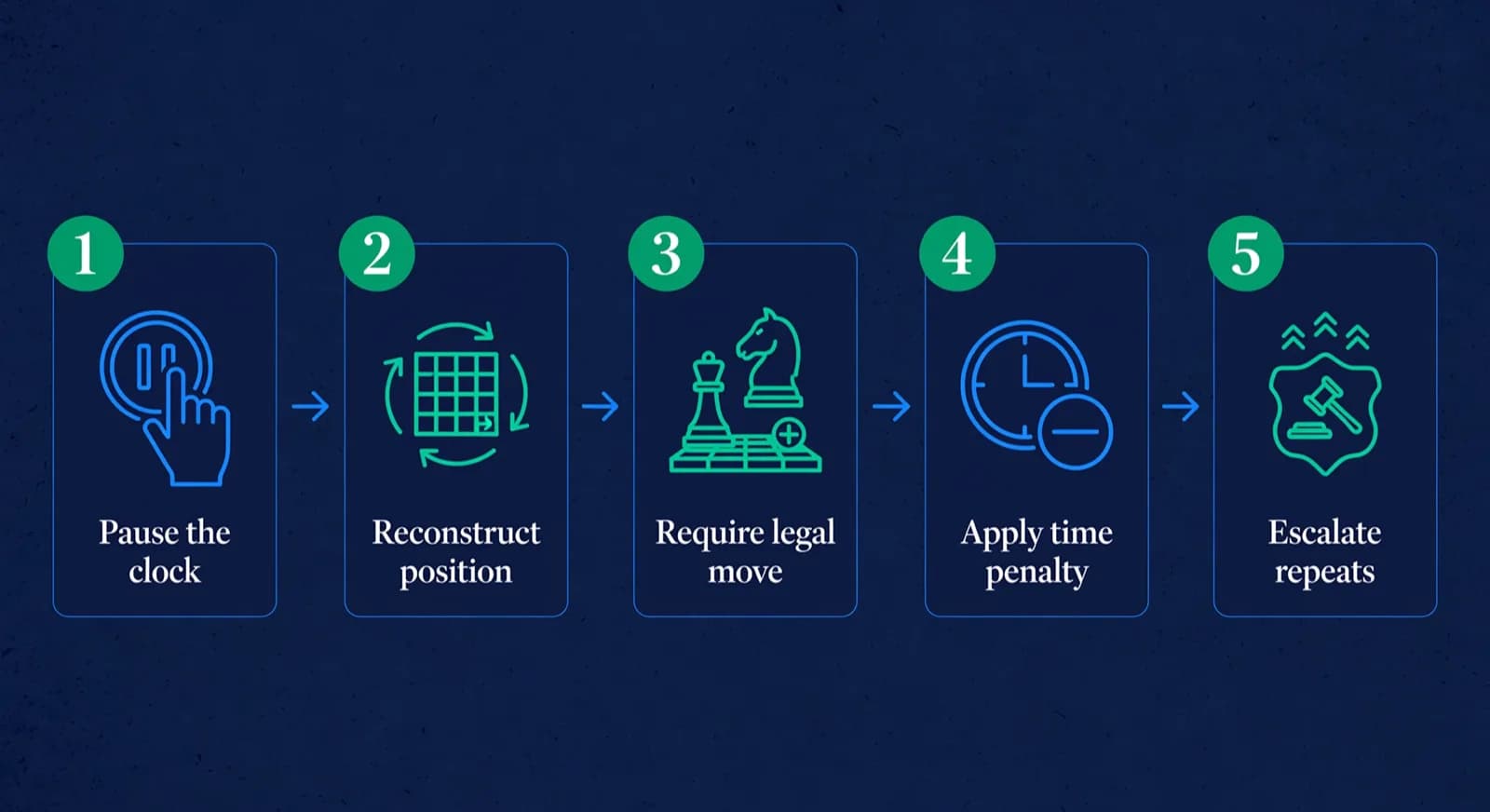
- Pause the clock as soon as the illegal move is noticed, so no player gains or loses time during the ruling.
- Reconstruct the position immediately before the illegal move, using both scoresheets if there is any doubt about the sequence.
- Require the offending player to make a legal move, honouring touch-move on the piece that was touched if a legal move exists.
- Apply the time penalty the Laws specify for that time control, giving added time to the opponent as the article directs.
- For repeated illegal moves in a standard game, escalate to the loss of the game as the Laws provide, and record the incident.
Faster time controls change the first-offence minutes and the supervision regime, not the second-offence loss. Appendix A.3 sets rapid penalties in Articles 7 and 9 at one minute instead of two [6]. Blitz does not default to an instant loss on a claimed illegal move. Appendix B says a fully supervised blitz game (one arbiter per game, recorded) uses the Competitive Rules, including Article 7.5.5; otherwise blitz follows Rapid Articles A.2, A.3 and A.5, where an illegal move can stand if neither the arbiter nor the opponent claims before the next move [6]. Event regulations must say which blitz regime applies (B.2 or B.3). This is why you read the matching appendix before you set the clocks, and why our guide to chess tournament time controls belongs next to this page.
| Time control | Supervision regime | First illegal move | Governing article | Who decides |
|---|---|---|---|---|
| Standard | Competitive Rules | Opponent gains two minutes; second completed illegal move loses, unless no mate is possible, then draw | 7.5.5 and 6.9 [6] | Arbiter, on observation or a valid claim |
| Rapid | A.4 (one arbiter to at most three recorded games) or A.5 | One minute to the opponent under A.4; under A.5 the move can stand if nobody claims before the next move | A.3, A.5, 7.5.5 [6] | Arbiter under A.4; opponent's timely claim under A.5 |
| Blitz | B.2 (one arbiter per recorded game) or B.3 | As standard under B.2; as rapid A.5 under B.3, so an unclaimed illegal move can stand | B.2, B.3, A.5 [6] | Arbiter under B.2; opponent's timely claim under B.3 |
Read the card down your own control and supervision regime, because the first-offence minutes and who may act both change with it, while the second completed illegal move in a standard game stays a loss. The one part that never bends is the flag-fall and second-offence exception: the game is drawn only if the opponent cannot checkmate the player's king by any possible series of legal moves (Articles 6.9 and 7.5.5), which is a test of whether a mate exists at all, not a count of material on the board [6]. A lone bishop or lone knight against a bare king is a draw by this test, because no series of legal moves can ever produce mate; a single extra pawn is not, because it can promote and then mate, so the player who ran out of time loses. Apply the possible-mate test to the actual position rather than tallying pieces.
How are chess clocks handled during a game?
Each player presses their own clock with the same hand they moved with, after making a move, and that press completes the move under Article 6.2.1 [6]. A game is lost on time when a player does not complete the prescribed moves in the allotted time, but Article 6.9 draws the game if the opponent cannot checkmate the player's king by any possible series of legal moves [6]. The organizer sets the time control, ensures every board has a working clock configured identically, and rules on flag-fall claims. Clocks are where fairness becomes visible, so they deserve a check before every round.
Set the clocks in advance and verify them, because a clock configured with the wrong increment or a missing delay quietly corrupts a game. Decide and publish whether you use an increment (seconds added each move) or a simple time control, since increments change how the last minutes and the scoresheet rules behave under the Laws [6]. When a flag falls, Article 6.8 treats it as fallen when the arbiter observes it or a player makes a valid claim. The arbiter then applies the possible-mate test in Article 6.9 rather than awarding the win automatically. Write the exact clock setting on the entry information so every board starts the round with the same configuration.
Lucas M. · first session to today
Every game, report, and payment on one timeline
Aug
Joined at 1240Nov
First tournamentJan
Back-rank drills setOct
1342 · October report drafted
How should players record their moves?
In standard-play games, each player must record their own moves and the opponent's in algebraic notation on the scoresheet, move by move, as legibly as they can (Article 8.1.1) [6]. The scoresheet is the official record of the game, and its export format is PGN, the portable notation that stores the moves in plain text [4]. The organizer provides scoresheets and pens, explains that recording is required, and knows the exceptions where it pauses.

The main exception is time trouble: Article 8.4 excuses a player from recording for the rest of that period if they have less than five minutes left and do not receive an increment of 30 seconds or more per move [6]. Rapid and blitz players do not need to record moves (Appendix A.2, and blitz that follows A.2), but they keep the right to claims that a scoresheet would normally support [6]. This matters for two reasons the organizer cares about. First, a complete scoresheet is the evidence that resolves an illegal-move reconstruction or a claim about the number of moves played, so incomplete sheets weaken your ability to rule. Second, notation is the bridge from the board to analysis and rating: the same PGN that proves what happened is what a coach later reviews with a student, and what feeds a game into a rating calculation. For scholastic events, teach notation before the tournament rather than at it, because a child who cannot record moves cannot defend their own position in a dispute. Our walkthrough of reviewing a student game in fifteen minutes shows what that finished scoresheet becomes afterwards.
How do byes and defaults work?
A bye is a round a player sits out with an agreed score, while a default is an unplayed game caused by absence at the board. They are different events with different scoring, and both must be defined in your regulations before round one. A requested half-point bye is a courtesy for a player who cannot attend a round; a full-point bye is the pairing bye given when an odd number of players leaves someone unpaired; a default is a forfeit for not appearing within the default time you set.
| Situation | Typical scoring | Organizer decision to publish |
|---|---|---|
| Requested half-point bye | 0.5 point, no game played | How many are allowed and the request deadline |
| Pairing (full-point) bye | 1 point to the unpaired player | Who receives it under the pairing rules |
| Default (no-show) | 0 to the absent player, opponent scores the win | The default time before a game is forfeited |
| Both players absent | Usually 0 to both | State it so the round scores cleanly |
Byes interact with pairings, so decide the rules before the software or the arbiter makes the first pairing. How the full-point pairing bye is allocated in a Swiss, and who is eligible for it, belongs to the pairing rules, which our guide to Swiss system pairing sets out in full. What the organizer owns here is the requested half-point bye and the default: cap how many half-point byes a player may take and set a request deadline so a late request cannot be used to dodge a strong opponent, and publish the default time (how long after the round start a missing player forfeits), where a zero default forfeits instantly at the start while a fifteen or thirty minute window is common at club level. Our guide to organizing a chess tournament covers how these choices fit the entry form.
What conduct and arbiter rules keep an event fair?
Conduct rules cover behaviour, mobile phones, and fair play, and the arbiter is the person who enforces them consistently. The FIDE Laws set a baseline: players must not distract or annoy opponents (Article 11.5), must not use any notes, source of information, or advice, or analyse on another board in the playing area (Article 11.3.1), and the arbiter has a penalty ladder from a warning up to loss of the game and expulsion (Article 12.9) [6]. Your job as organizer is to publish the specifics the Laws leave open and then back the arbiter who applies them.
The device rule is the one most events get wrong by treating a ringing phone as the whole rule, so separate three things the Laws treat separately. Possession: Article 11.3.2 forbids a player to have any electronic device not approved by the arbiter in the playing venue [6]. Storage: Article 11.3.2.1 lets the event regulations permit a device in a player's bag, completely switched off, with the bag placed as the arbiter agrees and not used without permission [6]. Use, or a device found on the person: Article 11.3.2.2 is that if it is evident a player has such a device on their person in the playing venue, the player loses the game and the opponent wins, though the regulations may set a different, less severe penalty [6]. So decide and publish which you require: devices switched off and bagged, or handed in, where the bag goes, and the exact penalty for a device on the person or in use. A separate sound alone is a conduct matter under the Article 12.9 ladder, not automatically the 11.3.2.2 loss. A scholastic event may choose a gentler first-offence penalty under 11.3.2.2, as long as the rule and its consequence are written down and applied to everyone equally. The same principle governs behaviour: a first distraction earns a quiet word, a repeat earns a formal warning, and only persistent or serious breaches reach the loss of a game (Article 12.9) [6]. Writing the ladder down before the event turns a heated moment into a lookup rather than a judgement call under pressure, and it protects the arbiter from the accusation of favouritism.
Fair play is the area where scholastic organizers most need a plan, because the temptation and the tools have both grown. Keep phones and smart devices out of the playing hall, do not let spectators stand over boards or signal players, and separate the analysis room from the playing area so a finished player cannot feed a friend a line. If you suspect assistance, the correct response is procedural, not accusatory: note the concern, increase observation, and let the arbiter act on what is actually seen rather than on suspicion alone. National regulations layer on top of the Laws here, and in India the All India Chess Federation publishes the framework its rated events follow [5]. The stabilizing announcement is not that the chief arbiter is beyond appeal. It is that rulings are recorded, and that Article 11.10 preserves a right of appeal unless your published regulations specify otherwise [6].
One arbiter should own the first call even if several helpers run the floor. Distributed authority is how a tournament ends with two different rulings on the same situation, which is the fastest way to lose the players' trust. Appoint a chief arbiter, let assistants handle pairings, results entry, and routine questions, and route every genuine dispute to that person so the first ruling is consistent and recorded. After the event, the results and any rating changes become each player's record, which is what a coach keeps to show a family how a season of events moved the number.

Lucas M.
Batch B2 · Thursdays · joined Aug 2025
1342
Academy rating · Lichess games synced
Won vs. 1410 · French Defense
Best gameMissed fork on move 23
Homework setHow can players appeal an arbiter's decision?
Players can appeal an arbiter's decision unless the event regulations say they cannot. Article 11.10 of the Laws states that a player may appeal against any decision of the arbiter, even after signing the scoresheet, unless those regulations specify otherwise [6]. The chief arbiter's ruling is the first official decision, not an unreviewable last word.
Publish the appeal path before round one: who receives the appeal, the deadline, and whether a deposit is required. A verbal protest at the board is not an appeal until it follows that path. Article 11.9 also gives a player the right to ask the arbiter to explain a particular point in the Laws [6]. For FIDE events the Handbook also lists Appeals Committee procedural rules as a separate competition text; club events can name two independent officials instead. Write the local version on the one-page rule sheet so a parent argument becomes a form, not a lobby negotiation.
How are draw claims handled?
Draw claims are handled under Article 9 of the Laws: a correct threefold-repetition or fifty-move claim by the player to move draws the game at once; an incorrect claim adds two minutes to the opponent and the game continues [6]. Event regulations may restrict voluntary draw offers (Article 9.1.1). A claim under 9.2 or 9.3 also counts as a draw offer (Article 9.1.2.3).
- Offer: after making a move and before pressing the clock; no conditions; it stays valid until accepted, orally refused, or rejected by touching a piece to move or capture (Article 9.1.2.1) [6].
- Threefold: the player to move claims when the same position is about to appear or has just appeared (Article 9.2) [6].
- Fifty-move: the player to move claims when 50 moves by each side have been made, or will be made by the indicated next move, with no pawn move and no capture (Article 9.3) [6].
- Incorrect claim: the claim cannot be withdrawn; add two minutes to the opponent; if it was based on an intended move, that move must be played (Article 9.5) [6].
- Automatic draws: fivefold repetition or 75 moves by each side without a pawn move or capture end the game without a claim, except checkmate on the last move (Article 9.6) [6].
Pause the clocks when a 9.2 or 9.3 claim is made (Article 9.5.1). Both players must help reconstruct the game, including draw claims (Article 11.11) [6]. Rapid first-offence time additions in Article 9 are one minute rather than two (Appendix A.3). Write on the rule sheet whether short draws need arbiter consent, because that is an event-regulation choice, not a house invention.
Frequently asked questions
What are the basic chess tournament rules an organizer must enforce?
The core rules an organizer enforces are touch-move, the illegal-move procedure, clock and flag-fall handling, compulsory move recording in standard play, conduct and phone rules, and the scoring of byes and defaults. All of these come from the FIDE Laws of Chess, which national federations adopt for rated events, so the organizer applies them rather than inventing local versions. The practical skill is consistency: brief players on the rules before round one, keep a printed copy of the Laws at the arbiter's table, and rule the same way at every board so nobody can claim they were treated differently.
Where can organizers find the official laws of chess?
The official rules are the FIDE Laws of Chess taking effect from 1 January 2023, published as Handbook chapter E.01 [6]. FIDE also maintains General Regulations for Competitions as Handbook chapter C.05, and on 24 March 2026 it reminded organizers that updated Swiss Rules took effect on 1 February 2026 [7][8]. Most national federations, including the All India Chess Federation in India, adopt the Laws for rated events and add their own entry, pairing, and tie-break regulations. Keep a current printed copy of the Laws at the event and read the articles that match your time control, because first-offence illegal-move minutes change between standard and rapid play.
What are the chess arbiter rules basics for a small event?
For a small event, the arbiter's basics are to brief players before round one, apply the FIDE Laws consistently, and record the first ruling on every dispute. Handle touch-move and illegal-move claims by the book, pausing clocks before ruling and reconstructing positions from the scoresheets. Publish a phone rule and a simple penalty ladder from warning to loss of game, and keep signed scoresheets and results at rated events. Article 11.10 still lets a player appeal that ruling unless your regulations say otherwise, so name the appeal path on the rule sheet rather than calling any decision final.
How does the touch-move rule work in tournaments?
Touch-move means a player who deliberately touches one of their own pieces must move it if it has a legal move, and one who touches an opponent's piece must capture it if a legal capture exists. A player who wants to straighten a piece must announce the intention to adjust before touching it. A move becomes final only when the piece is released on a legal square, so a held piece can still be redirected but a released one cannot be taken back. Brief players on this before the first round, because most touch-move disputes come from players who never heard the rule stated plainly.
How are byes and defaults scored in a chess tournament?
A requested half-point bye scores 0.5 with no game played, a pairing (full-point) bye scores 1 for the unpaired player when the field is odd, and a default scores a win for the player who showed up against an opponent who did not appear within the default time. These are scoring rules the organizer must define in the regulations before round one, including how many half-point byes are allowed, the request deadline, and the default time after which a missing player forfeits. Setting these in advance keeps the round scores clean and stops late bye requests from being used to dodge a strong pairing.
Do phones and recording rules differ at scholastic events?
The underlying FIDE Laws are the same, but scholastic organizers may set gentler first-offence penalties as long as the rule and its consequence are written down and applied to every player equally. A common scholastic choice is a first-offence warning for a phone rather than instant loss of the game, paired with a firm requirement that devices are switched off and out of sight. Recording rules can also be relaxed for very young beginners, but it is better to teach algebraic notation before the event, because a child who can keep a scoresheet can defend their own game in a dispute and produce a record a coach can review afterwards.
Sources
- [1]FIDE: International Chess Federation and the Laws of Chess · accessed 2026-07-01
- [2]FIDE · accessed 2026-07-01
- [3]Swiss-system tournament · accessed 2026-07-01
- [4]Portable Game Notation · accessed 2026-07-01
- [5]All India Chess Federation · accessed 2026-07-01
- [6]FIDE Laws of Chess taking effect from 1 January 2023 · accessed 2026-10-16
- [7]FIDE reminder: updated Swiss Rules effective 1 February 2026 · accessed 2026-10-16
- [8]FIDE Handbook: General Regulations for Competitions (C.05) · accessed 2026-10-16
Written by Abhishek Tiwari
ChessCore
Drafted with AI, fact-checked and approved by a human before publishing, the same guardrail our product applies to every report it sends. Read our editorial standards.
Keep results and ratings in one place after the event
See how ChessCore stores each student's tournament results, rating changes, and reviewed games on one record page, so a season of events becomes evidence you can show families.
- Roster import from the spreadsheets you already keep
- Lichess and Chess.com connections, batches, and fee plans
- First reports in week one, after your approval
- Free plan, no credit card required