On this page8 sections, 19 min read
- Why review games in 15 minutes instead of an hour?
- What do you do before the student arrives?
- How do you pick the one moment that matters?
- How do you run the conversation?
- What do you write down at the end?
- How do you turn that note into the week's homework?
- Is there a review sheet you can copy for each game?
- How does this scale across a batch?
- Frequently asked questions
Bottom line
To review a student chess game in 15 minutes, run the engine pass before the student arrives and mark the two or three biggest eval swings. Then spend minutes 0 to 8 of the session on one chosen moment with student-led recall, minutes 8 to 12 naming the concept behind the mistake, and minutes 12 to 15 writing a one-line note that becomes the week's homework.
TL;DR
- The engine pass happens before the lesson, never during it: pre-scan the game, mark the two or three biggest eval swings, and walk in with a shortlist.
- One teachable moment, fully worked through, is the design choice of this method: it is easier to check and to turn into a drill than ten moments covered in passing.
- Open with "what did you see here", never with "the engine says"; the student's recall of their own thinking is the lesson.
- The review ends with a one-line note (concept, position, drill) that feeds directly into the week's homework and gets checked at the next review.
- As a planning assumption, twelve students fit into three hours of review contact on one evening (12 x 15 minutes), with the pre-scans done in a separate block beforehand.
Key facts
- Stockfish is a free and open-source chess engine, so the pre-scan step of this method costs nothing regardless of which tools an academy uses.[1]
- Portable Game Notation (PGN) is the standard plain-text format for recording chess games, and both Lichess and Chess.com export student games in it.[3]
- The Lichess API allows fetching a player's games programmatically and for free, which makes collecting a whole batch's games before an evening of reviews practical.[2]
- Lichess studies are free, shareable analysis boards, so a marked-up position from a review can be handed to the student at zero cost.[4]
- Lichess puzzles are unlimited on a free account, so the drill named in each review note can be assigned without any paid subscription.[5]
Why review games in 15 minutes instead of an hour?
Because the hour-long review does not fit a real teaching week, and this method rests on the idea that one well-worked moment is easier for a student to remember and practise than ten covered in passing. That idea is the design premise here, not a measured result. A 15-minute review is something a working coach can run for every student, every week. An hour-long deep dive is something that happens once a term, for the keenest student, when nothing else goes wrong.
There is also a confidence cost to the long review that coaches underestimate. A student who sits through sixty minutes of their own errors leaves with a vague sense that they played badly everywhere. A student who works through one mistake, names the concept behind it, and leaves with a drill attached to it walks out with something they can actually fix by Thursday. What engine output means for coaching decisions more broadly is its own topic, and our pillar on engine analysis for chess coaching covers it; this post is only about the review meeting itself.
| Minutes | What happens | Output |
|---|---|---|
| Before the lesson (3 to 4 minutes per game, a planning assumption) | Engine pre-scan of the game, done without the student | Two or three eval swings marked as candidate moments |
| 0 to 8 | Student-led recall on one chosen moment | The student's own account of what they saw and planned |
| 8 to 12 | Coach names the concept behind the mistake | One nameable idea, such as loose pieces or king safety |
| 12 to 15 | Write the one-line coaching note | Concept, position reference, and the drill for the week |
What do you do before the student arrives?
You run the entire engine pass before the student sits down, so that the 15 minutes of contact time contains no waiting for analysis. Collect the game as a PGN file, the plain-text standard both major platforms export [3], run it through Stockfish [1], and mark the two or three biggest eval swings, read from the student's side: a score that rises for White is a loss for a student playing Black. That shortlist is your preparation; you do not need anything else.
Collection is the part most coaches do inefficiently. If your students play on Lichess, their games can be fetched in bulk through the free Lichess API [2] rather than asking each child to email a file. Chess.com games can be downloaded as PGN too. Treat the three to four minutes per game as a planning assumption: how long a full game takes depends on the engine's depth, the number of lines and your hardware, so time one real game before you plan an evening around it. A graph of the evaluation over the game makes the big swings visually obvious.

Lucas M. vs. Hana K.
Rapid · synced from Lichess · Tue 7:42 PM
14...Qe6? drops the knight
Eval swings +2.1 · the move to review first
Missed fork on move 23
Same pattern as last Tuesday · drill it
Endgame conversion was clean
Won vs. 1410 · French Defense
Resist the urge to prepare a lecture during the pre-scan. The marks are candidates, not a syllabus. A blunder that loses a queen to a one-move tactic produces the biggest swing on the graph, but it is often the least teachable moment in the game, because the student already knows exactly what went wrong. The pre-scan finds where the evaluation moved; the next step decides which of those moments is worth the lesson.
How do you pick the one moment that matters?
Pick the swing the student had the best chance of understanding and avoiding, not the swing with the biggest number next to it. The teachable moment is usually a decision the student made with time on the clock, in a position type they will meet again, where the mistake belongs to a pattern you have seen in their other games.
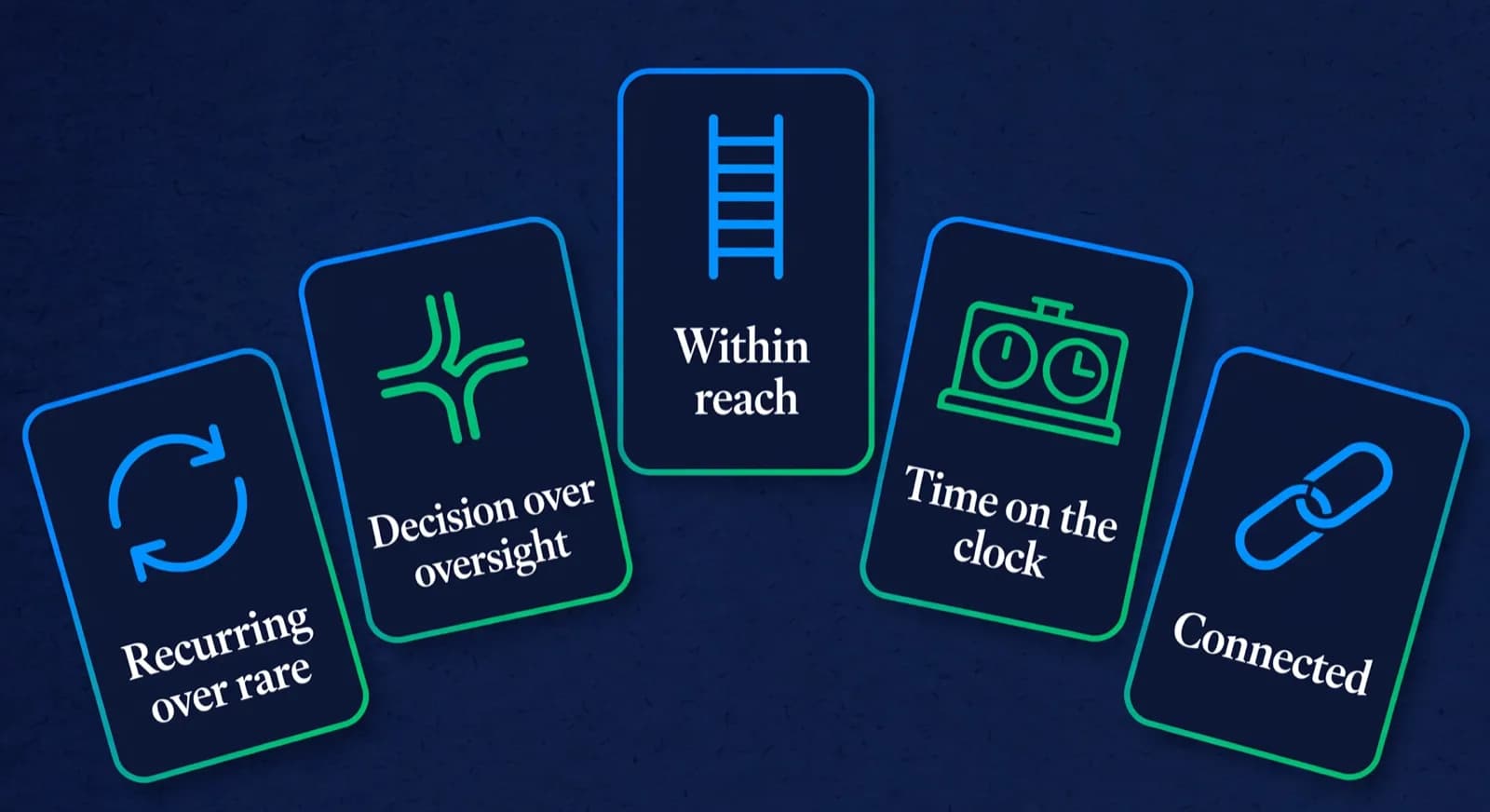
- Recurring over rare: a mistake you have seen in two or three of their games beats a one-off accident.
- Decision over oversight: a wrong plan teaches more than a missed two-move tactic, which is puzzle homework, not lesson material.
- Within reach: the correct idea should be one the student could plausibly have found at their level.
- Time on the clock: a mistake made with twenty minutes left reveals thinking; a mistake made on increment reveals only time trouble.
- Connected: prefer a moment that links to whatever theme the batch is currently training.
This selection step is also where rating context matters. A student stuck on a plateau tends to produce the same category of eval swing week after week, and picking that recurring category every time is how the plateau breaks; our post on the chess rating plateau goes deeper on reading those patterns across months rather than single games.
How do you run the conversation?
Set up the position one move before the chosen moment, ask "what did you see here?", and then stay quiet. The student's recall of their own thinking is the lesson. You are not presenting analysis; you are retrieving the thought process that produced the mistake, because that thought process, not the move itself, is the thing you are trying to change.
Recall-first rests on a simple premise: when a child reconstructs what they considered, what they dismissed, and what they never saw at all, the gap in their thinking becomes visible to both of you at the same time. When the coach simply announces the gap, the student can nod, agree, and repeat the mistake a fortnight later. This page does not measure that effect; it is the reason the method is built this way. The eight minutes this step gets are mostly silence and short questions, and that is the design, not a failure of preparation.
The phrase to ban from this conversation is "the engine says". Stockfish did its job before the lesson [1]; quoting it during the lesson converts a thinking exercise into an appeal to authority, and students stop reasoning the moment an oracle enters the room. The engine evaluation is the coach's instrument for finding the moment. It is never the argument for why a move was wrong. If you cannot explain the problem with the move in chess terms a student can verify on the board, you picked the wrong moment.
- "What did you see here?" Open with pure recall and let the silence do its work.
- "What was your plan with this move?" Move from perception to intention.
- "What did you think your opponent wanted?" Test whether the opponent's idea was ever considered.
- "If you could take one move back in this area of the game, which one?" Let the student locate the mistake themselves.
- "What would you look for next time you get this kind of position?" Convert the finding into a forward-looking habit.
Here is a short authored rehearsal, so you can hear the pacing. The game is the first one in a made-up sample set, and the student is invented, so the answers are illustrative and not an observed conversation. The position is one move before the mistake, with Black (the student) to play after 5.Bg5.
- Coach: What did you see here? Student (illustrative): I saw I could take the pawn on e4 with my knight.
- Coach: What was your plan with the knight? Student (illustrative): Take the pawn and then attack the bishop.
- Coach: Look at the bishop on g5. Which squares does it look along? Student (illustrative): Down to d8. That is my queen.
- Coach: So what was your knight doing for your queen? Student (illustrative): Standing in the way. I should not have moved it.
- One-line note: Concept: a pinned piece is not free to move. Game: vs Liam, move 5. Drill: 10 pin puzzles before Thursday.
Two things go wrong in a real session, and the slot has to survive both. Neither is a reason to run over.
| What goes wrong | What you do | How the slot stays bounded |
|---|---|---|
| The student cannot recall what they were thinking | Do not supply the answer. Reset the position to one move before the mistake and give the student a minute of fresh calculation: every check, capture and threat for both sides. Then ask what they would play now. | The recall block still ends at minute 8. Write 'could not recall, recalculated' on the sheet and carry on to the concept. |
| The position is beyond the student's level | Choose a simpler moment: the next-largest swing, or a recurring mistake from an earlier game that the student can see on the board. Note the harder moment for later. | Decide at the pre-scan if you can, or within the first minute of the session, so the 8 minutes are spent on a moment the student can reach. |
Minutes 8 to 12 belong to the concept. Once the student has located the mistake, give it a name they can carry out of the room: loose pieces drop off, every check needs a question, the pawn structure decides where to attack. One concept, stated once, connected to where else it has appeared in their games. Naming matters because the student cannot watch for a pattern they cannot say; a named concept becomes a checklist item in their next game, while an unnamed one evaporates by the car park. If the moment you chose resists being named in one phrase, it was probably two ideas, and you should teach the simpler one and save the other.
What do you write down at the end?
One line with three parts: the concept, the position reference, and the drill. Something like "Concept: loose pieces. Game: vs Novak, move 23. Drill: 20 undefended-piece puzzles before Thursday." That single line is the bridge between this review and the next one, and it is the input to the week's homework.
The format earns its keep at the next review, because checking last week's note takes thirty seconds and tells you whether the drill happened and whether the concept showed up in the new games. Turning the note into an actual set of exercises is its own playbook, covered in our guide to building chess homework from games. The free tooling is good here too: the key position can live in a Lichess study the student opens at home [4], and themed follow-up puzzles are available at no cost on the Lichess training pages [5].
Lucas M.
Batch B2 · Thursdays · joined Aug 2025
1342
Academy rating · Lichess games synced
Won vs. 1410 · French Defense
Best gameMissed fork on move 23
Homework setHow do you turn that note into the week's homework?
The one-line note already names the concept and the drill, so building the homework is mechanical: each recurring mistake type maps to a drill format, and the whole pipeline runs on free tools. Homework built from the student's own mistakes targets the specific habit costing them rating points, which a generic puzzle set cannot do, and a position from their own game is easier for a child to care about.
| Recurring mistake | Drill format | Weekly dose |
|---|---|---|
| Hanging pieces | Undefended-piece puzzle sets plus a board-scan rule applied in two slow games | 15 puzzles and 2 games with the scan habit |
| Premature attacks | Count-the-developed-pieces exercise on the student's own attacking positions | 5 positions, write the piece count before judging the attack |
| Weak king safety | King-safety puzzles plus castling-timing decisions pulled from their games | 10 puzzles and 3 castling decisions |
| Endgame technique | One technical endgame drilled until it can be played out without error | 1 ending, such as king and pawn, repeated across the week |
| Time trouble | Rapid games with a per-move time target, then a review of the clock usage | 2 games with the target, note where the clock spiked |
The doses are illustrative starting points, a ceiling for a school-age student with a fifteen-minute daily slot rather than a floor; adjust them after the first week using what the student actually completed. Themed puzzle sets for the tactical categories are free on the Lichess training pages [5], Lichess studies are free shareable boards [4], and Stockfish is free to run on any game [1], so no step of the mistake-to-drill pipeline requires a paid tool.
To build a personal set from a real game, export it as PGN [3], mark the evaluation swings with Stockfish (the same marks the review already produced), create a Lichess study with one chapter per marked position set up one move before the mistake, and hide the moves so the student faces the decision cold rather than a memory test [4]. Add one sentence of instruction per chapter naming the concept, and top the set up with themed puzzles from Lichess training when the student's own games have not yet produced enough material [5]. Over a term these studies accumulate into a personal mistake library the student can page back through as hard evidence of progress.
- Item one: the personal study built from their own positions, five to eight chapters across the week.
- Item two: a themed set from the free training pool matching the same category, around ten to fifteen puzzles [5].
- Item three: one slow online game where the only goal is applying the named habit, submitted for the next review.
Item three is what makes this a loop rather than a list: the game played with the scan rule becomes the game that gets pre-scanned next week, and the review either confirms the category is fading or picks the next moment from the same family. Keep the week to three items, since each item past three tends to lower the completion rate of all of them; that is a coaching rule of thumb, not a measured result.
Checking homework costs the first two minutes of the next review. A shared study link conveys a position; it carries no record that the student solved it, so keep the answer key in your own notes and ask for the first move they would play, the line they looked at, and one sentence on why. If the student plays through a Lichess Class account, the Class page describes monitoring of games and puzzles and posting studies and homework to a class bulletin board [6]; it does not say a study link reports whether a chapter was solved, so treat a link as delivery and the attempt as evidence.
| Evidence | What it shows | What it misses |
|---|---|---|
| "I did it" | The student remembers the task | Whether they tried, and how |
| Opened link or chapter | A position reached the student | Any attempt, move or reason |
| Attempted move plus a reason | The student faced the decision and can say why | Whether the habit holds in a real game |
| The next submitted game | The habit under clock and pressure | Which drill caused it |
October progress report · Lucas M.
1 of 14 drafts for Batch B2
Lucas attended 4 of 5 classes this period and played 18 rated games, moving from 1310 to 1342.
His endgame conversion improved clearly. Next month the focus is back-rank defense, based on the mistakes tagged in his last three games.
Highlighted numbers come from your attendance and rating records. The AI cannot change them.
Goes to the Müller family after approval
For a student who keeps skipping homework, shrink the assignment, tie it even more tightly to their own games, and never punish. The common causes are mundane, the set was too hard, there was no quiet device time on weekdays, or the student never understood the drill's purpose, and each has a cheap fix: drop the difficulty one band, move the slot to the weekend and halve it, or spend thirty seconds connecting the drill to the exact moment it came from. A completed small task rebuilds the habit faster than a string of ignored big ones, and a one-line mention of the week's homework in whatever recap goes home recruits the household to the routine.
Is there a review sheet you can copy for each game?
Yes. Copy the six-row sheet below for each reviewed game: game record, key moments, concept, homework line, phase check, and error tally. It is an original layout built for this 15-minute method, with key moments capped at one to three so it fits on one page. The right-hand column shows it filled in for the first game of a made-up sample set (legal moves, invented players, played on 8 September 2026 in the sample). The sample is a teaching fixture, not a student's record.
| Field | What to write on the sheet | Filled example (made-up game) |
|---|---|---|
| Game record | Event, date, round, result; White and Black names; circle the student | Knight's Gate synthetic pin example 1, 2026.09.08, round 1, 1-0; Liam (White), Yuki S. (Black, circled) |
| Key moments (1 to 3) | Move number, what happened, and the better idea for each | 5...Nxe4 moved a knight pinned against the queen on d8, and 6.Bxd8 won the queen. Better ideas: 5...Na5 or 5...h6. |
| Concept | The one named idea from minutes 8 to 12 | A pinned piece is not free to move |
| Homework line | Concept, position reference, drill, and due date | Pinned piece. vs Liam, move 5. 10 pin puzzles. Due Thursday. |
| Phase check | Opening, middlegame, endgame: strong, adequate, or weak, one note each | Opening: weak, moved a pinned knight on move 5. Middlegame and endgame: not reached, the game ended on move 7. |
| Error tally | Count of tactical, positional, time, and opening-prep errors | Tactical 1, positional 0, time 0, opening-prep 0 |
To check the example, set up the position on a board: the FEN before 5...Nxe4 is r1bqkb1r/ppp2ppp/2np1n2/4p1B1/2B1P3/3P1N2/PPP2PPP/RN1QK2R b KQkq - 2 5. In a local Stockfish 19 run at depth 16 with one line, the score for that position was -0.24 from White's side, and after 5...Nxe4 it was +8.96 for White. Our pillar on engine analysis for chess coaching shows how to read those numbers and the settings behind them. Keep the original scoresheet or PGN next to the sheet, since the sheet records the review rather than the moves. Leave any row blank when the game gives it nothing; the sheet is working space, not a report card.
How does this scale across a batch?
As a planning assumption, a twelve-student batch is three hours of review contact time (12 x 15 minutes), which fits one evening, and the pre-scans are batched separately so the evening itself contains no analysis work. The method scales because the expensive part, the engine pass and the moment selection, happens in one concentrated block beforehand.
Week of 12 October · all batches
0 conflictsMake-up credit · Mia G. · Sat 4:30 PM
Absent Thursday with notice · booked by Noor
Class reminders sent to 148 families
Timing changes update everyone at once
The batching workflow looks like this: collect every student's most recent serious game the day before, either through the Lichess API [2] or platform exports as PGN files [3], run the engine pass on all of them in one sitting, and mark candidate moments as you go. If a pre-scan takes three to four minutes per game, twelve of them take about 45 minutes; that figure is an assumption, so time your own setup first. You are reading evaluation graphs, not playing through games move by move. On the evening itself, students rotate through in 15-minute slots while the rest of the batch plays training games or works on puzzles.
Two things break the system at scale, and both are discipline failures rather than method failures. The first is skipping the note at minute 12 because the conversation was going well; without the note there is no homework and no continuity, and the review becomes a pleasant chat. The second is letting a review drift to 25 minutes because the game was interesting; every overrun is borrowed from the last student in the queue, who is usually the one who most needs the attention. The clock is part of the method.
Frequently asked questions
How do you analyze student games fast?
Batch the analysis away from the lesson: collect games as PGN, run the engine pass on all of them in one sitting, and mark only the two or three biggest eval swings per game, read from the student's side. Fast analysis for coaching is not about reading every move; it is about finding the small number of moments worth a conversation, and an evaluation graph surfaces those quickly.
What is a good game review method for coaching groups?
Pre-scan every game before the session, then run fixed 15-minute slots per student: eight minutes of student-led recall on one chosen moment, four minutes naming the concept behind the mistake, and three minutes writing a one-line note that becomes the week's homework. The fixed slot length is what makes the method survive a twelve-student batch evening.
Do you need a paid engine or tool for the pre-scan?
No. Stockfish, the engine that produces the evaluations, is free and open source, and Lichess offers free server-side analysis, free studies for sharing positions, and a free API for collecting games in bulk. The 15-minute method has no required spend; paid tools change the convenience of the workflow, not the method itself.
What if the student played a nearly perfect game?
Review it anyway, but flip the lesson: pick the best decision in the game instead of a mistake and run the same recall conversation about it. Students learn from articulating why a good move was good, and a review meeting that only ever convenes around errors teaches children to dread it. The note still gets written, with a drill that extends the strength.
Is there a copyable coach review sheet?
Yes. The sheet above has six rows: game record, one to three key moments, the concept, the homework line, a phase check, and an error tally, and it is filled in once for a made-up sample game. It is an original layout for the 15-minute method. Keep the scoresheet or PGN alongside it, since the sheet records the review, not the moves.
How many games per student should you review each week?
One serious game per student per week is the sustainable default for this method. The constraint is coach attention, not student supply: a student who plays twenty online blitz games produces plenty of material, but one well-reviewed game with a checked-up note beats five skimmed ones. Pick the most serious recent game, ideally at a slow time control.
Sources
- [1]Stockfish: strong open-source chess engine · accessed 2026-10-16
- [2]Lichess.org API documentation · accessed 2026-06-10
- [3]Portable Game Notation, Wikipedia · accessed 2026-06-10
- [4]Lichess studies: shared analysis boards · accessed 2026-06-10
- [5]Lichess training: free tactics puzzles · accessed 2026-06-10
- [6]Lichess Class: manage and teach classes of students · accessed 2026-10-16
Written by Abhishek Tiwari
ChessCore
Drafted with AI, fact-checked and approved by a human before publishing, the same guardrail our product applies to every report it sends. Read our editorial standards.
See a batch evening run on real games
Bring one student's PGN to a walkthrough and watch the pre-scan, the flagged eval swings, and the note-to-homework loop run on your own data in minutes.
- Roster import from the spreadsheets you already keep
- Lichess and Chess.com connections, batches, and fee plans
- First reports in week one, after your approval
- Free plan, no credit card required