On this page9 sections, 19 min read
- What is a chess study plan and why do you need one?
- What does a weekly chess study plan you can copy look like?
- Can I copy a printable weekly chess study tracker?
- How should you split your study time between tactics, endgames, and openings?
- How should your chess study plan change as you improve?
- How much time should you spend on tactics, and how?
- When should you study endgames, and how much opening theory do you really need?
- How do you review your own games as part of the plan?
- How do you track progress and know the study plan is working?
- Frequently asked questions
Bottom line
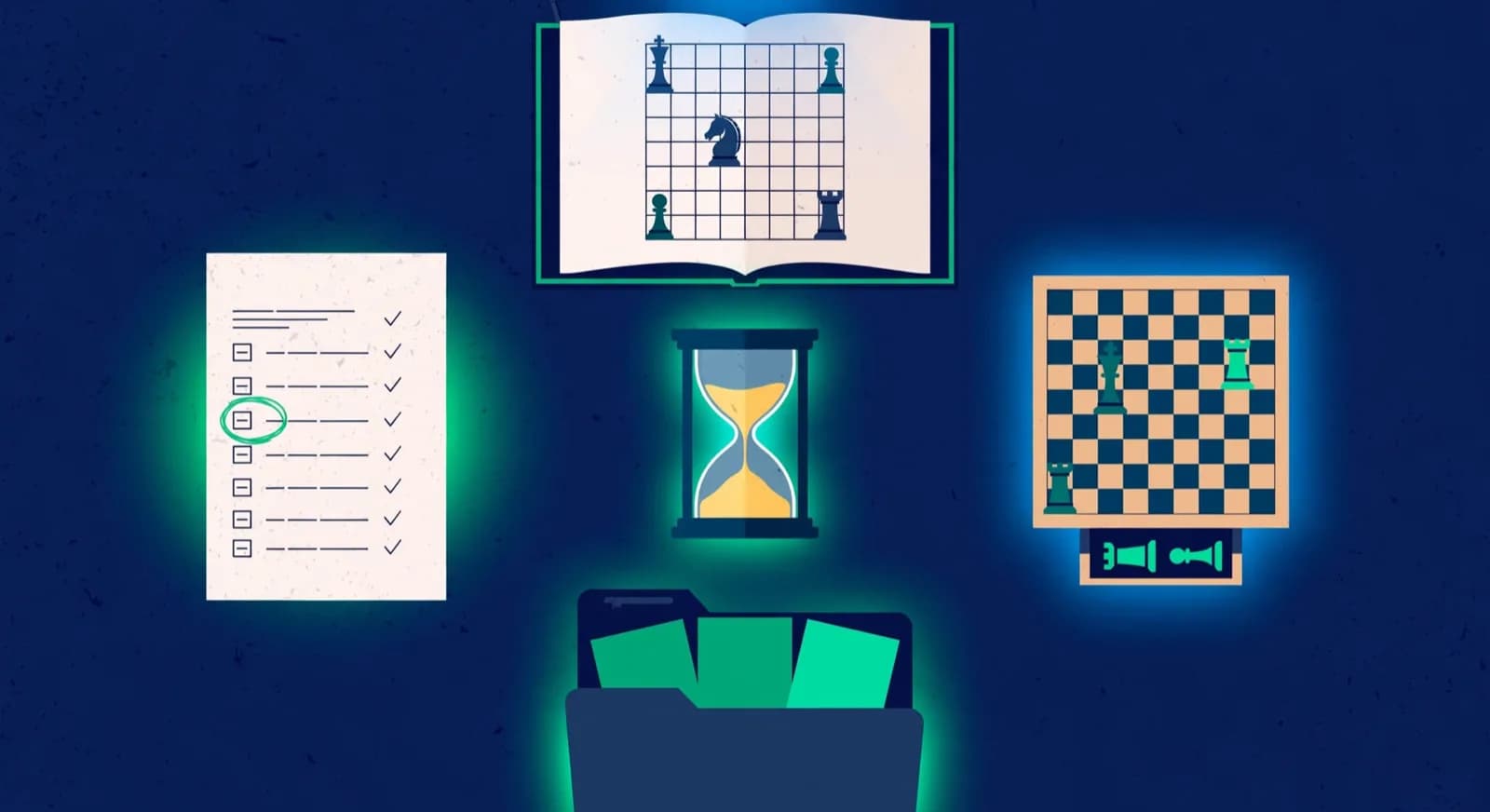
A chess study plan splits your week between lessons across four areas: tactics on most days, a small steady dose of endgames, light opening work and honest review of your own games. The weekly plan below totals 125 focused minutes (85 tactics, 20 review, 10 endgame, 10 opening), with slow games on top. Adjust it from what your reviewed games show.
TL;DR
- The best chess study plan is short and frequent: twenty to forty minutes on most days beats one long session once a week.
- In this plan tactics get the largest single slice for students below expert level, because puzzles train the calculation every other area depends on.
- Endgames and openings both matter, but endgames deserve a steady small slice early while openings stay light until tactics stop deciding your games.
- Reviewing your own losses is the habit that tells you what to change, because your mistakes show what to study next.
- This plan is what a student follows alone between lessons; the coach's session structure is a separate document covered in the lesson plan guide.
Key facts
- Lichess offers a free tactics trainer that adapts puzzle difficulty to your rating, so a student can practise tactics daily at no cost.[1]
- Lichess studies are free shared analysis boards where a student can save annotated games, endgame positions, and a personal opening file.[2]
- Online platforms rate players with Elo-derived systems, so a student has a visible number to watch over weeks; it reflects results, not study directly.[6]
- Stockfish produces the engine evaluations behind a game review, flagging the exact moves where a game turned, which is what makes self-review reliable.[4]
- Lichess puzzles are built from positions in real user games and are unlimited on a free account, so daily tactics practice needs no paid subscription.[1]
- Chess.com describes its rating as a Glicko rating with a rating deviation, and Lichess sorts a game into bullet, blitz, rapid or classical by its clock, so a rating from one pool is not interchangeable with another.[9]
What is a chess study plan and why do you need one?
A chess study plan is a simple weekly routine that decides what you practise between lessons and roughly how much time each part gets. You need one because unplanned study drifts toward whatever is comfortable, usually playing fast games and skimming openings, and comfortable study is rarely the study that raises your rating. A plan replaces that drift with a short list of things you do most days, so your effort points in one direction instead of scattering.
The plan matters more than any single resource. Two students with the same puzzle app and the same books can improve at very different rates purely because one studies twenty minutes on five days and the other crams two hours the night before a lesson. Chess skill is built by repetition and pattern recognition, and patterns stick when you meet them often, not when you binge them once. So the first rule of a study plan is frequency: a little on most days. The second rule is balance: every plan needs tactics, endgames, some opening work, and game review, in proportions that shift as you get stronger. The rest of this guide sets those proportions by level and shows you exactly what to do in each slice.
What does a weekly chess study plan you can copy look like?
A weekly chess study plan names each day's activity and minutes, including when you play slow games and when you review them. Below is an adaptable example for an improver. Treat the minutes as a starting shape and adjust them to your school week and energy; this is not a promised route to any rating. The sections further down show how to shift the balance for your level.
| Day | Tactics | Endgame or opening | Slow game | Review |
|---|---|---|---|---|
| Monday | 15 min puzzles | 10 min endgame study | none | none |
| Tuesday | 15 min puzzles | none | One slow game (15+10 or longer) | none |
| Wednesday | 15 min puzzles | none | none | 10 min reviewing Tuesday's game |
| Thursday | 15 min puzzles | 10 min opening ideas | none | none |
| Friday | 15 min puzzles | none | One slow game (15+10 or longer) | none |
| Saturday | 10 min puzzles | none | none | 10 min reviewing Friday's game |
| Sunday | Rest or catch-up on any missed day | none | none | none |
Add the columns. Tactics are five days of 15 minutes and one of 10, so 85 minutes. Endgame study is 10, opening ideas 10 and game review two sessions of 10, so 20. That is 85 + 10 + 10 + 20 = 125 focused-study minutes in the week. The two slow games are additional and variable, so they are not in the 125. Play them in the pool your signpost rating comes from: on Lichess, a 15+10 game counts as rapid (900 seconds plus 40 times the 10-second increment is 1,300 seconds, under the 1,500-second line for classical) [8].
This shape gives two serious slow games a week with a review session for each, short daily tactics and a rotating slot for endgames and openings. It matches the weekly schedule chess teacher Waleed Naeem suggests in his OnlineChessTeacher blog on Chess.com: two or three serious games, two review sessions, short daily tactics and one rest or catch-up day [7]. The Sunday catch-up slot is deliberate: a plan with no slack gets abandoned the first week something goes wrong, and a missed Monday is not a failed plan if Sunday absorbs it.
| Study minutes you have in a week | Illustrative split (minutes) | Total |
|---|---|---|
| 60 | Tactics 30 (three sessions of 10), game review 20 (one game), endgame 10 | 60 |
| 125 | Tactics 85, review 20, endgame 10, opening 10 (the table above) | 125 |
| 180 | Tactics 95, review 45, endgame 30, opening 10 | 180 |
Pick the row nearest to the time you really have, not the time you wish you had. A plan you finish at 60 minutes is worth more than one you abandon at 180.
Can I copy a printable weekly chess study tracker?
Yes. Copy the blank tracker below and fill it in as the week happens. The weekly plan decides what to study; the tracker records whether you did it, what the week revealed, and what changes next week.
- Week of: ___ Current goal (one line, tied to your level band above): ___
- Mon tactics done: Y/N Games completed: ___ Games analyzed: ___
- Tue tactics done: Y/N Games completed: ___ Games analyzed: ___
- Wed tactics done: Y/N Games completed: ___ Games analyzed: ___
- Thu tactics done: Y/N Games completed: ___ Games analyzed: ___
- Fri tactics done: Y/N Games completed: ___ Games analyzed: ___
- Sat tactics done: Y/N Games completed: ___ Games analyzed: ___
- Sun: rest or catch-up used for: ___
- Recurring error this week (named in one sentence): ___
- Next week's adjustment (more endgame, more review, lighter openings): ___
The field that matters most is the recurring error line. Naeem's advice is to measure actions, not only rating: track games analysed, positions solved carefully and recurring errors corrected, because rating fluctuates while habits show whether the process works [7]. If the same mistake, say missing back-rank tactics or playing too fast in won endgames, shows up two weeks running, shift next week's balance toward it. For what to change when the rating stops moving at all, read what to change when the rating stalls.
Here is one illustrative adjustment. Suppose your reviewed games from the last two weeks show two endgames you should have held. Move the 10 opening minutes to endgame review: the week becomes 85 tactics, 20 review and 20 endgame, still 125 minutes in total. If there are no useful games to review one week, or school exams cut your time, shrink the week but keep one small review task, such as replaying your last game from memory, and carry the unfinished work forward instead of expecting the rating to move.
How should you split your study time between tactics, endgames, and openings?
Split your study time so tactics get the largest share, game review comes second, endgames get a steady small slice and openings get the least until you are past the beginner stage. In the weekly plan above, the 125 minutes divide as 85 on tactics (68 percent), 20 on review (16 percent), 10 on endgames (8 percent) and 10 on openings (8 percent). These proportions are a starting point, not a law, and your own games tune them.
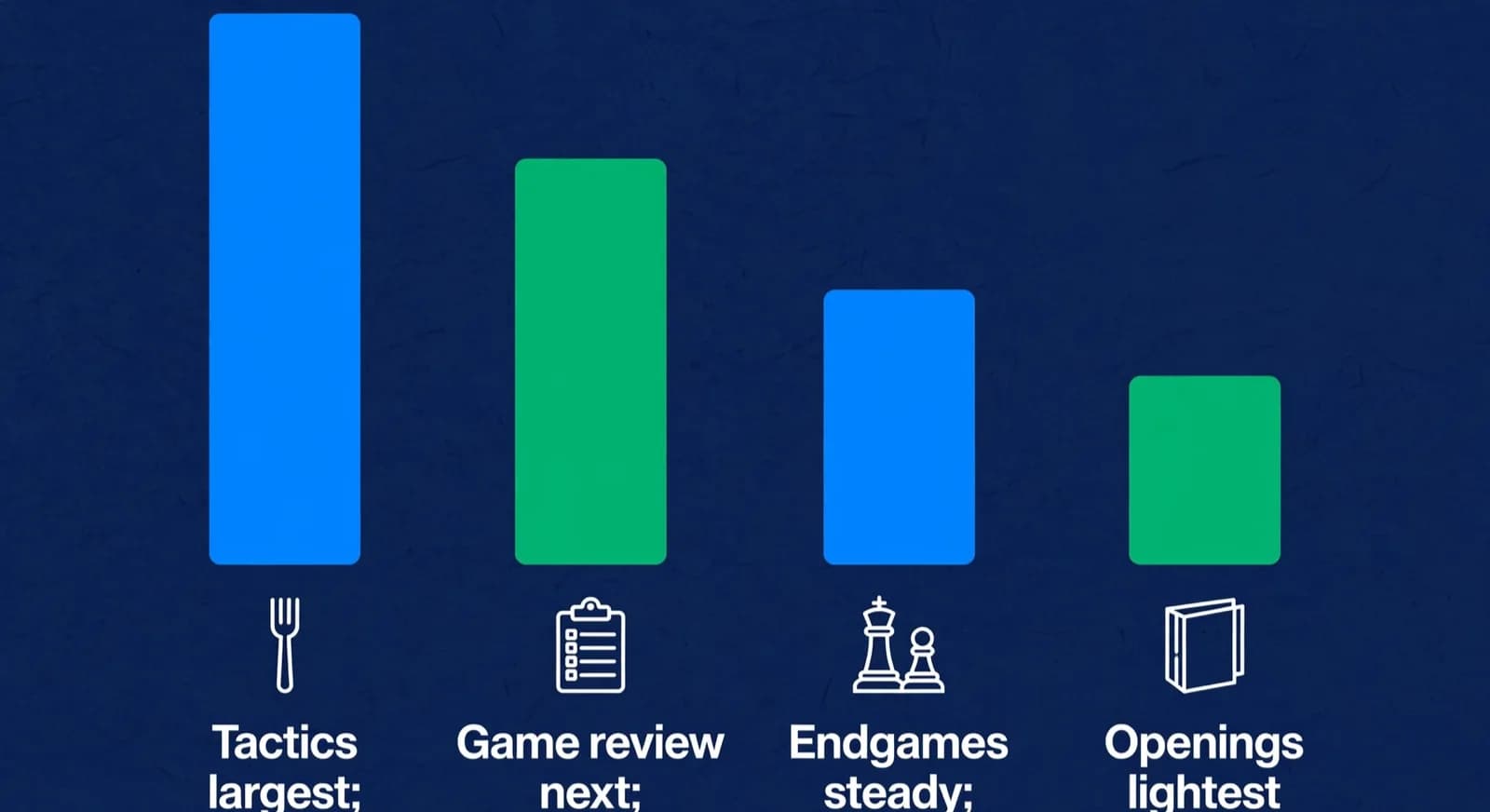
- Tactics: the biggest slice in this plan for students below expert level, because puzzles train the calculation that every other area depends on.
- Game review: your second priority, because analysing your own losses tells you which of the other areas is costing you points right now.
- Endgames: a small steady slice from early on, since a handful of essential positions come up again and again and the knowledge does not go out of date.
- Openings: the smallest slice until you are an intermediate player, and even then aimed at understanding plans and avoiding early disasters, not memorising long lines.
A common mistake among self-taught students is inverting this order: hours poured into opening theory while the same one-move blunders decide game after game. Opening study feels productive because it is concrete and there is always more to learn, but for most students under roughly 1600 it is the least urgent use of a study hour. If you are unsure how to weight your own plan, let the games decide. Play, note where each loss actually went wrong, and give more time to whichever area shows up most often in those notes. That feedback loop, covered in the section on reviewing your games below, turns a generic split into a plan built for you.
How should your chess study plan change as you improve?
Shift the balance according to what your reviewed games show, and use your rating only as a rough signpost. Beginners spend nearly all their time on tactics and not hanging pieces, improvers add endgames and game review, and intermediate players give real time to structured openings. The rating bands below refer to a rating in one online pool, such as your Lichess rapid rating. Ratings on Chess.com, Lichess, FIDE and an academy's own ladder are separate pools: Chess.com, for one, describes its rating as a Glicko rating with a rating deviation [9], and Lichess sorts a game into bullet, blitz, rapid or classical by its clock [8]. Pick one pool and one time control, and do not convert between them.

| Signpost (rating in one pool) | What reviewed games usually show | Tactics and review | Endgames | Openings |
|---|---|---|---|---|
| Under about 1000 | Pieces left hanging, missed one-move threats | Easy puzzles daily; check every game for hung pieces | Basic checkmates (K+Q, K+R) | Principles only, no memorised lines |
| About 1000 to 1400 | Tactics still decide most losses; endgames start to matter | Rising difficulty; analyse every loss for the turning point | King and pawn, basic rook endings | One opening per colour, ideas not lines |
| About 1400 to 1800 | More losses come from worse positions, not single blunders | Daily puzzles plus themed sets; deep review of losses and close draws | Rook endings, opposition, key theory | A small repertoire, understand the plans |
| About 1800 and up | Losses come from calculation depth and technique | Harder sets and calculation drills; full annotation, then compare with the engine | Practical technique and study positions | Repertoire depth and novelties |
Read the table as a centre of gravity that moves rightward as you improve. A beginner can start with two habits: solving easy tactics until basic patterns like forks, pins and back-rank ideas feel familiar, and checking after every move whether a piece is simply hanging. Opening theory can wait until you have stopped hanging pieces. Keep the whole plan to twenty to thirty focused minutes on most days and let the volume of easy puzzles build the patterns.
In the improver band, roughly 1000 to 1400, a real study plan starts to pay off. Tactics stay central but the puzzles get harder, and two new habits earn their place. First, basic endgames: king and pawn positions, the opposition, and how to hold or win simple rook endings. Unlike opening lines, this knowledge is permanent. Second, systematic game review: after every loss, find the single move where the game turned and name the mistake in one plain sentence. That habit quietly rewrites your tactics and endgame priorities, because it shows what is really costing points.
From about 1400 upward the plan broadens. You can give openings genuine time, but the goal is the plans and pawn structures of a small repertoire, not twenty moves of theory you may never see. If you want a tool to hold that repertoire, which repertoire trainer to use is compared in a separate guide. Endgame study deepens into rook-ending technique, and tactics become themed and harder. Above 1800 the differences between players come down more to depth, calculation discipline and the quality of self-review. At every level the two constants are the same: solve tactics regularly and review your own games honestly.
If you plan to play rated tournaments in India, getting a FIDE rating in India has its own guide; this page does not cover registration.
How much time should you spend on tactics, and how?
Spend the single largest slice of your study time on tactics, ideally a short session almost every day rather than a long one occasionally. For most students that means ten to twenty minutes of puzzles daily, done properly: calculate the full solution in your head before you move, rather than guessing and letting the trainer correct you. Volume matters, but only if each puzzle is real calculation, because guessing trains speed at the cost of the accuracy you are actually there to build.
A free adaptive tactics trainer is the ideal tool because it feeds you puzzles near your own level and adjusts as you improve, so you are always working at the edge of what you can calculate [1]. The right difficulty is where you solve most puzzles but have to think, not where every answer is instant and not where you are lost. Two ways to raise the value of each session: when you get one wrong, pause and understand why before moving on, and periodically do themed sets, a batch of pins one day, forks or back-rank ideas another, so a whole pattern family becomes automatic rather than meeting each type at random. Chess.com and Lichess both offer puzzle training, and either works well for daily practice [3].
When should you study endgames, and how much opening theory do you really need?
Start endgames early and keep openings light. A small amount of endgame study pays off from your first months of serious play, because a handful of essential positions decide a large share of games and the knowledge never expires. Openings, by contrast, should stay minimal until you stop losing games to tactics; before then, memorised lines just delay the moment your real weaknesses show up. Learn opening principles and the plans of one setup per colour, and leave deep theory for later.
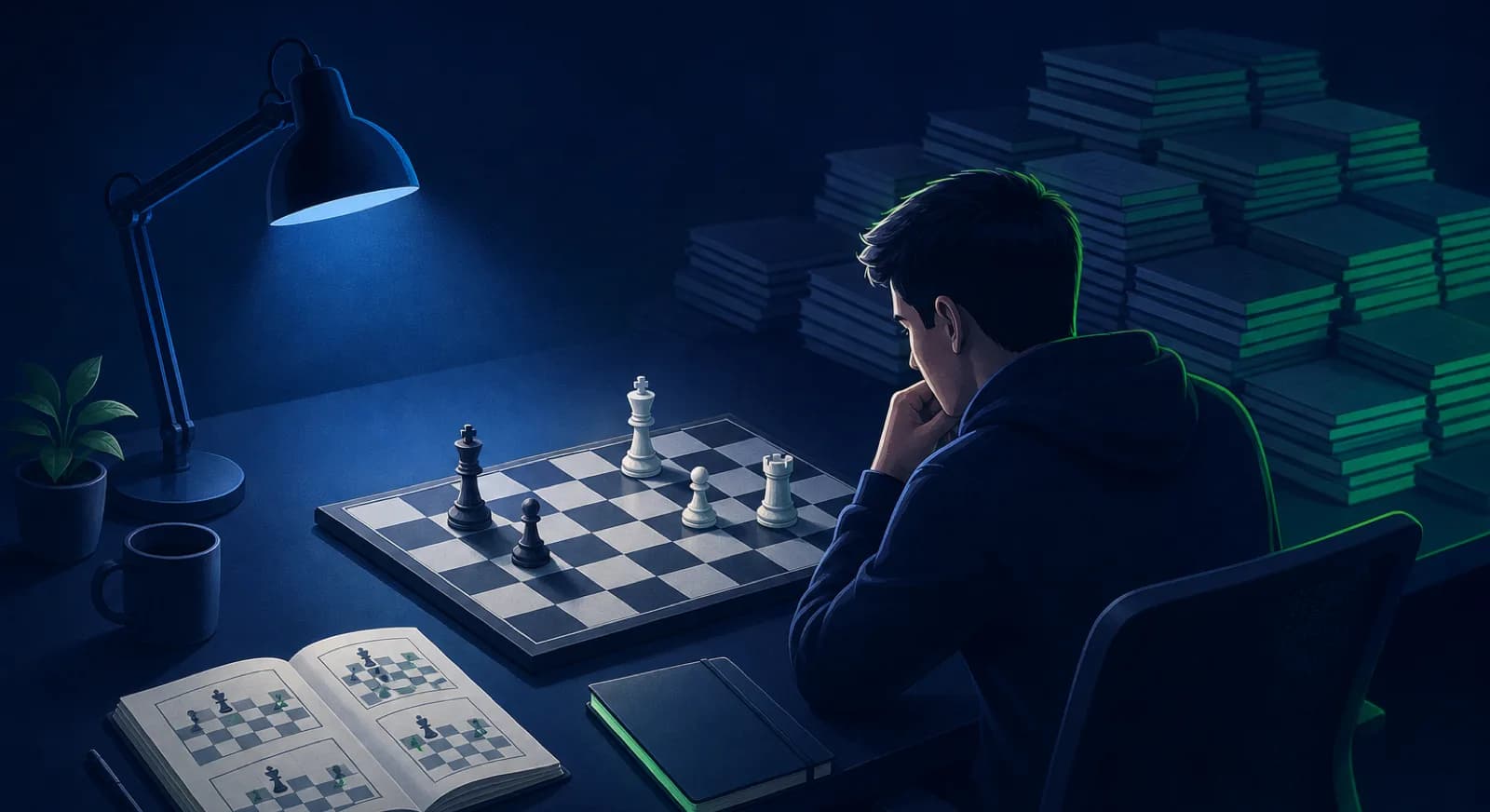
For endgames, work in order of frequency. King and pawn endings and basic checkmates come first because they appear constantly and teach the ideas, like the opposition and the value of an outside passed pawn, that everything else builds on. Then basic rook endings, since rooks are the last pieces off the board more often than not. A free study board is perfect for this: set up a position, play it out against a friend or the computer, and save the ones you keep getting wrong so you can return to them [2]. You do not need dozens of positions. A small set of the truly essential ones, known cold, outperforms a vague memory of many.
For openings, resist the temptation that swallows most improving players. The purpose of opening study below intermediate level is to reach a playable middlegame without walking into a disaster, not to win the game in the first ten moves. Pick one opening as White and one defence against each of the main first moves as Black, and learn the ideas: where your pieces belong, what pawn breaks you are aiming for, and the two or three traps to avoid. Keep a short personal opening file rather than a fat repertoire, and only add depth once your losses stop coming from tactics and start coming from genuinely worse positions out of the opening. That is the signal that opening study has finally become your highest-return slice, and not a moment before.
How do you review your own games as part of the plan?
Review your own games by looking at every loss first, finding the single move where the game turned, and naming the mistake in one plain sentence before you touch an engine. Self-review is the habit that steers the whole plan because your own games are a targeted syllabus: they show exactly which tactics you miss, which endgames you fumble, and which openings leave you worse. Do the thinking yourself first, then check with an engine, not the other way around.
The order matters. If you run the engine before thinking, you learn what the best move was but not why you failed to find it, and the failure is the lesson. So play through the game from memory, mark where you felt the position slip, and write down what you think went wrong. Only then turn on a game review. Modern engines built on Stockfish evaluate every move and flag the exact points where the evaluation swung, which is what makes self-review reliable rather than guesswork [4]. Save your annotated games so patterns across them become visible: if the same kind of mistake keeps appearing, that is your next study priority, chosen for you by evidence. Games are shared and stored in Portable Game Notation, the standard format every major tool reads, so a game you played on one site can be reviewed anywhere [5].

Lucas M. vs. Hana K.
Rapid · synced from Lichess · Tue 7:42 PM
14...Qe6? drops the knight
Eval swings +2.1 · the move to review first
Missed fork on move 23
Same pattern as last Tuesday · drill it
Endgame conversion was clean
Won vs. 1410 · French Defense
If you take one habit from this guide, make it this one. Reviewing a loss for ten focused minutes, before any engine, points your study at your real gap instead of a generic one. This is also where your study plan connects to your coach: the mistakes you surface reviewing your own games are what a good lesson then works on. Our companion guide to turning your games into study homework goes deeper on building that review-to-practice loop, and the fifteen-minute review routine shows the same process a coach uses on a student's game.
How do you track progress and know the study plan is working?
Track progress with two things: your rating over time and the pattern in your game notes. Rating is the honest long-run signal, since online platforms rate you with Elo-derived systems and the number moves as your results change, but read it over weeks and months, not single sessions [6]. Your game notes are the short-run signal: when the mistakes you record start changing type, from hanging pieces to subtler positional errors, the plan is working and it is time to shift its balance.
Do not judge the plan by a bad afternoon. Ratings swing, and a losing streak often means you are playing tired or tilted, not that the study failed. Watch the trend across a month and the composition of your mistakes. A rating that climbs while your notes show fewer one-move blunders and more genuinely hard decisions is exactly what a working plan looks like. When that happens, revisit the by-level table above and nudge your time allocation toward the next stage: a little less pure tactics, a little more endgame and opening depth. Keep that loop visible as a rating line and a page of notes, so the evidence that the plan works is something you can point at rather than a feeling.
Lucas M.
Batch B2 · Thursdays · joined Aug 2025
1342
Academy rating · Lichess games synced
Won vs. 1410 · French Defense
Best gameMissed fork on move 23
Homework setFrequently asked questions
How do I study chess as a beginner?
As a beginner, spend nearly all your study time on two things: solving easy tactics puzzles most days, and checking after every move whether a piece is hanging. Add only the basic checkmates (king and queen, king and rook) and general opening principles, and leave memorised opening lines for later, because at this stage tactics decide most games before opening theory matters. Keep sessions short, around twenty minutes on most days rather than one long weekly cram, since patterns stick through frequent repetition. Review every game you lose to find the one move where it went wrong.
What is a good daily chess study routine?
A concrete daily budget is 10 minutes of tactics calculated in full, plus 10 minutes reviewing a recent game, plus 5 to 10 minutes on an endgame or opening idea, which totals 25 to 30 minutes of focused study on days you do all three. That budget is separate from playing time: two or three slow games a week, often 30 to 60 minutes each including the game itself, sit on top of the study minutes. Frequency beats volume: twenty focused minutes on five days beats two hours once a week. Rotate endgames and openings through the last slot instead of covering both every day.
How should a chess study plan change by rating level?
The balance shifts rightward as you improve. Under 1000, almost everything is tactics and not hanging pieces. From 1000 to 1400, tactics stay central while you add basic endgames and systematic review of every loss. From 1400 to 1800, you give openings real time (understanding plans, not memorising lines) and deepen your endgame technique. Above 1800, the areas even out and the difference comes down to calculation depth and the quality of your self-review. At every level, daily tactics and honest game review are the two constants that never leave the plan.
How much time should I spend on chess openings?
Keep openings light until roughly 1400. Below that, opening study is usually the least urgent use of a study hour because the same one-move tactics keep deciding your games. Learn opening principles, pick one opening per colour, and understand the plans and the two or three traps to avoid rather than memorising long lines. Give openings real time once your losses stop coming from tactics and start coming from genuinely worse positions out of the opening.
How do I know if my chess study plan is working?
Judge it over weeks, not single sessions, using two signals. The first is your rating trend in one pool and time control: a number that climbs across a month suggests the plan is landing, though ratings from different sites are not interchangeable. The second is the changing pattern of your mistakes: when your game notes shift from simple hung pieces to subtler positional errors, you are improving even if the rating is briefly flat. Ignore single bad afternoons, since ratings swing with tiredness and tilt.
Sources
- [1]Lichess Puzzles: free adaptive tactics trainer · accessed 2026-06-30
- [2]Lichess Study: free shared analysis boards · accessed 2026-06-30
- [3]Chess.com Puzzles · accessed 2026-10-16
- [4]Stockfish: open-source chess engine · accessed 2026-06-30
- [5]Portable Game Notation · accessed 2026-06-30
- [6]Elo rating system · accessed 2026-06-30
- [7]Waleed Naeem (OnlineChessTeacher blog on Chess.com): How to Create a Chess Study Plan That Actually Works, 24 July 2026 · accessed 2026-10-16
- [8]Lichess FAQ: how Bullet, Blitz, Rapid and Classical are decided · accessed 2026-10-16
- [9]Chess.com Help: How do ratings work on Chess.com? · accessed 2026-10-16
Written by Abhishek Tiwari
ChessCore
Drafted with AI, fact-checked and approved by a human before publishing, the same guardrail our product applies to every report it sends. Read our editorial standards.
See how coaches track a study plan's results
Book a walkthrough and see how ChessCore turns synced games into Stockfish game reviews and a rating history, so a coach can see whether a student's between-lesson study is actually working.
- Roster import from the spreadsheets you already keep
- Lichess and Chess.com connections, batches, and fee plans
- First reports in week one, after your approval
- Free plan, no credit card required