On this page11 sections, 18 min read
- What goes in a chess lesson plan template for one class?
- What is a chess lesson plan?
- What are the parts of a good chess lesson?
- What does the six-phase lesson look like for a 60-minute class?
- What does a complete 45-minute beginner lesson look like, filled in?
- How do you adapt the plan when the class changes?
- How long should each part of a chess lesson be?
- How do you set one clear objective for a lesson?
- How do you run the guided practice and play phases?
- How do you review the lesson and set homework?
- How is a lesson plan different from a study plan and a curriculum?
- Frequently asked questions
Bottom line
This chess lesson plan template plans a single class in six timed parts: objective, warm-up, teach, guided practice, play and review. It includes a filled 45-minute beginner example and a line to record whether the student showed the skill. Set one objective, keep teaching short, and turn one mistake into homework.
TL;DR
- This is a single-class template: six phases with minutes, reused every week, so only the objective and the material change.
- Set exactly one can-do objective per lesson, make every other part serve it, and record whether the student showed it.
- Give guided practice and play most of the minutes, because those are the parts where the student makes the decisions.
- End by reviewing the game and turning one mistake into homework, so the next lesson has a starting point.
- Term planning, a student's study routine and teaching the basics each have their own guide, linked from this page.
Key facts
- Lichess studies are free, shareable analysis boards, so a coach can run the teaching block on a shared screen and save homework positions at no software cost.[1]
- Lichess training offers themed, difficulty-rated puzzles that work as a repeatable warm-up bank a coach can pull from at the start of any lesson.[2]
- Games are stored as PGN, so the game a student plays in the play phase can be replayed move by move in the review phase of the same lesson.[3]
- An Elo-derived rating gives a student a visible number to watch over a term, which is why a good plan ends with evidence, not just a nice session.[4]
- In the demo academy, Coach Elena reviews Batch B2's game the same week it is played and turns one mistake into that batch's homework.
- Under the FIDE Laws of Chess a rook moves along its file or rank and may not move over intervening pieces, and a king is never captured: the game ends at checkmate.[8]
What goes in a chess lesson plan template for one class?
Copy this single-class template into a document and fill it in before each class. You write the minutes for every phase, and the phases must add up to the length of the class. The filled 45-minute beginner lesson further down shows every blank completed. If you are planning a whole term, use a term-long school chess curriculum instead, and for one session of a school club see a weekly school club session.
- Student or batch: ___ Level: ___ Date: ___ Class length: ___ min (the phase minutes below must add up to this)
- Objective (one can-do sentence, 2 to 3 min): ___
- Materials (board, pieces, puzzle set, demo board, paper): ___
- Warm-up (___ min): positions or puzzle theme, tied to last week's homework: ___
- Teach (___ min): one or two model positions: ___
- Guided practice (___ min): three to five positions matched to the objective: ___
- Play (___ min): game or drill, opponent and time control: ___
- Review (___ min): one mistake tied to the objective, found during replay: ___
- Homework (due next lesson): one puzzle or one line: ___
- Objective demonstrated? Yes / Partially / Not yet. What you saw in play: ___
Fill the objective, materials, warm-up, teaching positions and guided-practice positions before class. Fill the play and review lines in the room, because they depend on what the student actually does. The last line is the record: it tells you whether to repeat the objective next week or move on. Copy the text into a document and print from there; this page does not give you a print view of the template.
What is a chess lesson plan?
A chess lesson plan is a written structure for a single class that lists the objective, the activities and the time each part gets, so you walk in knowing what happens and why. It is not a curriculum or a course map. The phases stay the same from week to week; the objective and the material change. A fixed shape also guards against the common failure of lecturing for most of the hour and leaving no time to play. If you need to decide what to teach a complete beginner and in what order, teaching chess to beginners from move one covers it; this page holds a single lesson together once you know the material.
What are the parts of a good chess lesson?
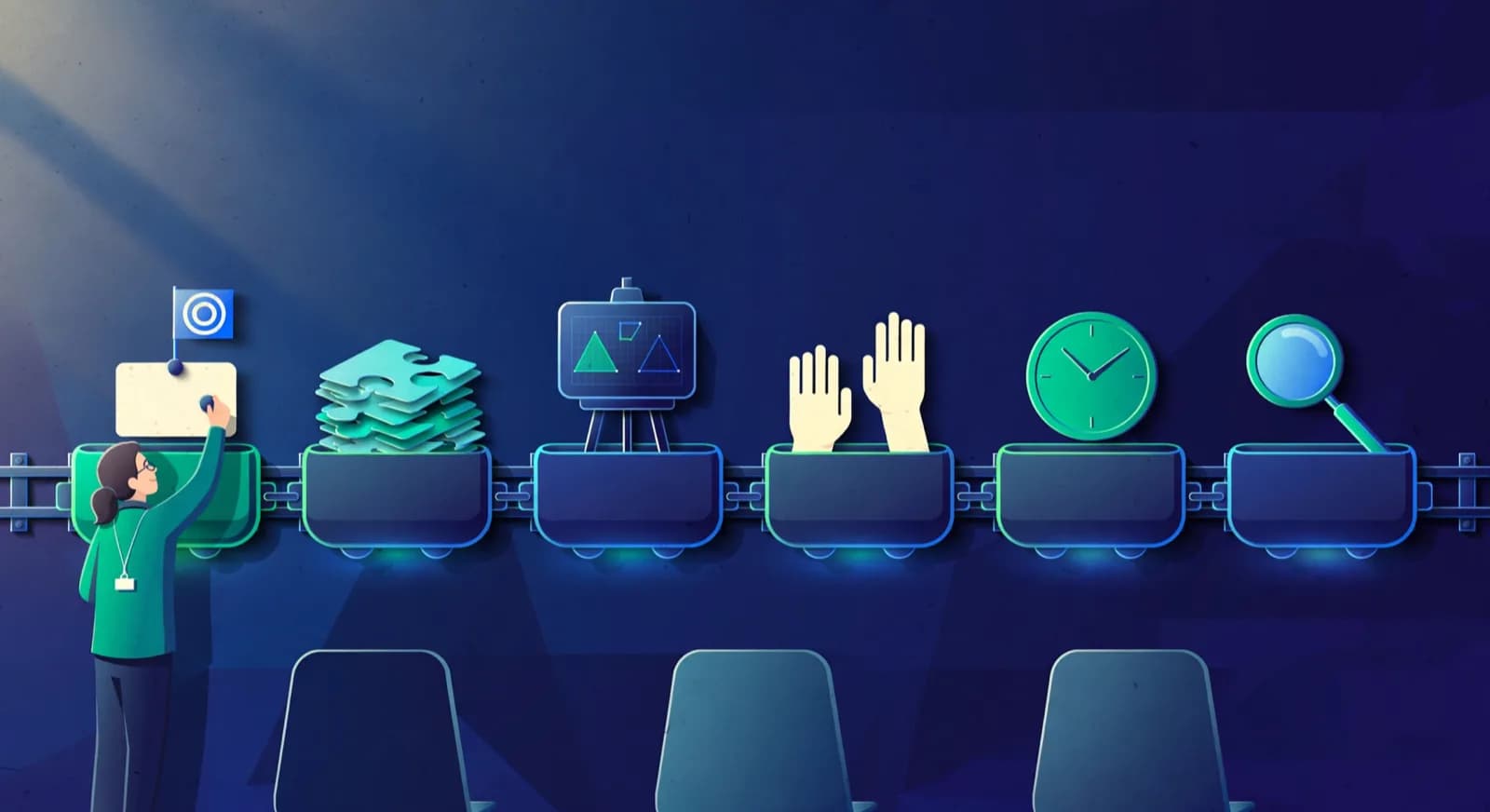
A good chess lesson has six parts in order: an objective that names what the student should be able to do by the end, a warm-up that gets them thinking, a short teaching block, guided practice where you steer, free play where they decide, and a review that closes the loop. Each part has a different job, and skipping one usually shows up as a weakness later.
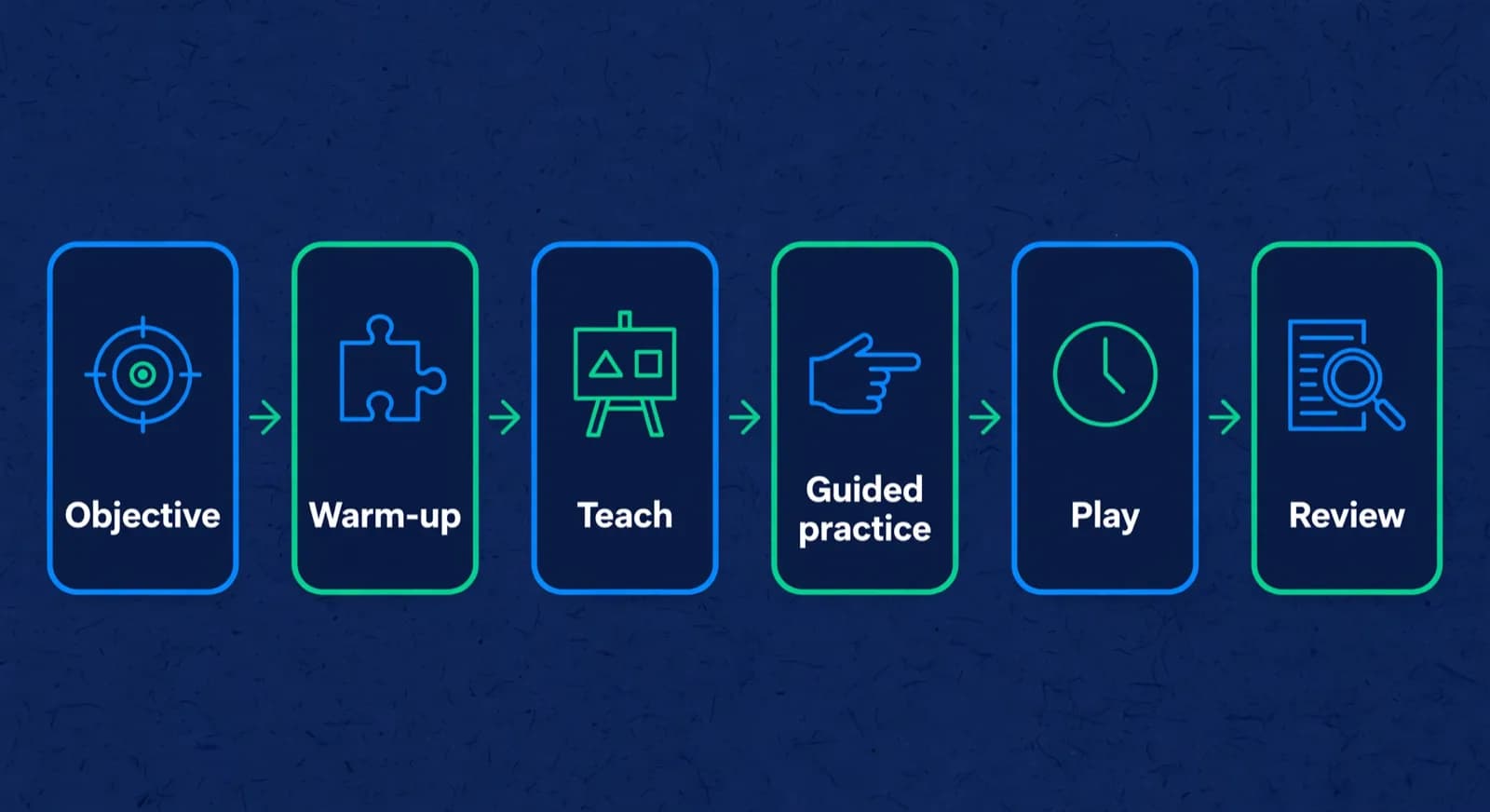
- Objective: one sentence naming the single skill the lesson builds, phrased as something the student can do, such as recognise and play a back-rank checkmate.
- Warm-up: three to five quick puzzles or a recap question that wakes up the student's calculation and links to last week, drawn from a puzzle bank so setup is instant [2].
- Teach: a short, concrete explanation of the day's idea using one or two model positions on a shared board, kept under ten minutes so it does not become a lecture [1].
- Guided practice: positions where the student tries the idea while you prompt, ask questions, and correct in real time, so mistakes surface where you can catch them.
- Play: a full or partial game, ideally on the theme, where the student makes decisions without you steering, because independent play is where the skill actually forms.
- Review: replay the game they just played, find one clear mistake tied to the objective, and set it as homework so the next lesson has a starting point [3].
The order matters. A warm-up first means the student is engaged when the new idea arrives. Guided practice before free play means they meet the idea with support before using it alone. Review last means every lesson ends with a record of what happened and a next step instead of trailing off when the clock runs out.
What does the six-phase lesson look like for a 60-minute class?
A 60-minute class has a row for each of the six phases, with columns for the time, the activity and the purpose. The minutes below are illustrative defaults to adjust to your students, not rules. What carries over from class to class is the proportion: little time goes to talking and most goes to the student practising and playing.
| Phase | Minutes (60-min class) | What you do | Why it matters |
|---|---|---|---|
| Objective | 2 | State the one skill for today in a single sentence the student repeats back | A named target stops the lesson wandering and gives the review something to measure against |
| Warm-up | 8 | Three to five themed puzzles or a recap of last week's homework | Engages calculation before new material and links today to the last lesson |
| Teach | 10 | Explain the day's idea with one or two model positions on a shared board | Short and concrete keeps attention and leaves time for practice, which is where learning happens |
| Guided practice | 15 | Student attempts positions on the theme while you prompt and correct | Surfaces mistakes while you can catch them, before the idea is used unsupported |
| Play | 15 | A full or themed game where the student decides without steering | Independent decisions under real conditions are where the skill actually forms |
| Review | 10 | Replay the game, find one mistake tied to the objective, set it as homework | Closes the loop, leaves evidence, and hands the next lesson a starting point |
Four blanks are filled before the lesson and two are left for the room: you decide the objective, the warm-up puzzles, the model positions and the guided-practice positions beforehand, and you fill the play and review lines live. Preparation removes the friction that eats lesson time, and the live lines keep the lesson about what the student actually does.
Two habits make the template hold across a term. Keep one running document per student or batch with each lesson's filled-in template, so you can see what you covered and what the last homework was. And tie the warm-up to the previous review: if last week's homework was a back-rank motif, start this week with two back-rank puzzles. How weekly objectives sequence across months belongs to a study plan, which has its own guide.
ChessKid's Classroom Planner is built the same way: it describes each unit as a mini lesson plan with a suggested time, educational objectives and classroom materials prepared ahead of the session [7]. Use it as a second example of the format, not as a substitute for your own objective.
What does a complete 45-minute beginner lesson look like, filled in?
This is the template completed for a first class built around the rook, with the board already set up in front of the student. The 45 minutes are an illustrative budget, and they add up: 2 + 5 + 8 + 15 + 10 + 5.
Equipment: one physical or digital chessboard per student (or one demo board the group can see), a full piece set, and a timer if you are using one. Set the board so each player has a light square at their bottom right corner, with rooks in the corners, knights beside the rooks, bishops beside the knights, the queen on her own matching color, and the king on the remaining central square; pawns fill the second row [6].
| Phase | Minutes | Filled content for this lesson | Purpose |
|---|---|---|---|
| Objective | 2 | By the end, the student can set up the board correctly and move a rook to a called-out square without touching other pieces | Narrow and testable in the review |
| Warm-up | 5 | Student names all six piece types by pointing at them on the set-up board | Checks recognition before movement is introduced |
| Teach | 8 | Demonstrate board setup once, then show the rook moving any number of empty squares along a file or rank, forward, backward or sideways, and that it cannot move over other pieces [6][8] | One concrete rule, shown rather than only described |
| Guided practice | 15 | Place a single rook on an empty board; call out target squares; student moves the rook there in one legal move while you confirm or correct | Surfaces illegal-move mistakes immediately, before free play |
| Play (a drill, not a game) | 10 | Movement drill on an empty board: one rook, two target squares marked with coins. The student moves the rook from its start square to each target in as few legal moves as possible, then picks two new squares for a partner | Independent decisions with the one piece just taught |
| Review | 5 | Replay the drill once; find one moment where the rook could have reached a target in fewer moves, and record whether the objective was demonstrated | Closes the loop on the exact objective |
The play step is a movement drill, not a chess game. There is no opposing king and nothing is captured, so there is no check to handle. Do not turn it into a race to put a rook next to a king: that is not chess, because it ignores check, a king is never captured, and the objective of the game is checkmate [8]. A first legal game such as king and rook against king needs check and checkmate taught first.
Assessment for this lesson: during the drill, did the student reach each called square in one legal move without touching another piece? Record Yes, Partially or Not yet on the last line of the template. Homework is small on purpose: set up the board from memory three times and move a rook from one corner to the opposite corner in the fewest moves. That should take under five minutes, because the aim is a habit, not a workload.
How do you adapt the plan when the class changes?
Keep the objective and change the positions or the minutes. Three cases come up in most groups, and each can be resolved inside the same 45-minute budget. The minutes below are illustrative, not a recommended split.
| What changes | What you do | Minutes after the change (45 in total) |
|---|---|---|
| Mixed levels in one group | Everyone shares the objective: move the rook to a called-out square. Newer students use an empty board. Stronger students get a position with a second piece in the rook's path, so they must route around it, because a rook may not move over pieces [8]. | 2 / 5 / 8 / 15 / 10 / 5, unchanged. The positions differ; the budget does not. |
| A student arrives 15 minutes late | The student joins at the start of guided practice. Spend 2 minutes giving them the objective and one demonstration of the rook's move, taken from your guided-practice time. | The late student gets 13 minutes of guided practice instead of 15. Everyone else is unchanged, and the late student joins the drill and the review. |
| The group solves the prepared positions in 9 of 15 minutes | Move straight to the prepared harder position, a blocked path that needs two moves. Give the 6 spare minutes to it and to a longer drill. | 2 / 5 / 8 / 13 (9 on the planned positions, 4 on the harder one) / 12 / 5. |
In every case the review asks the same question: did the student show the objective? A student who arrived late or worked a different position can still answer yes or not yet on the last line of the template.
How long should each part of a chess lesson be?
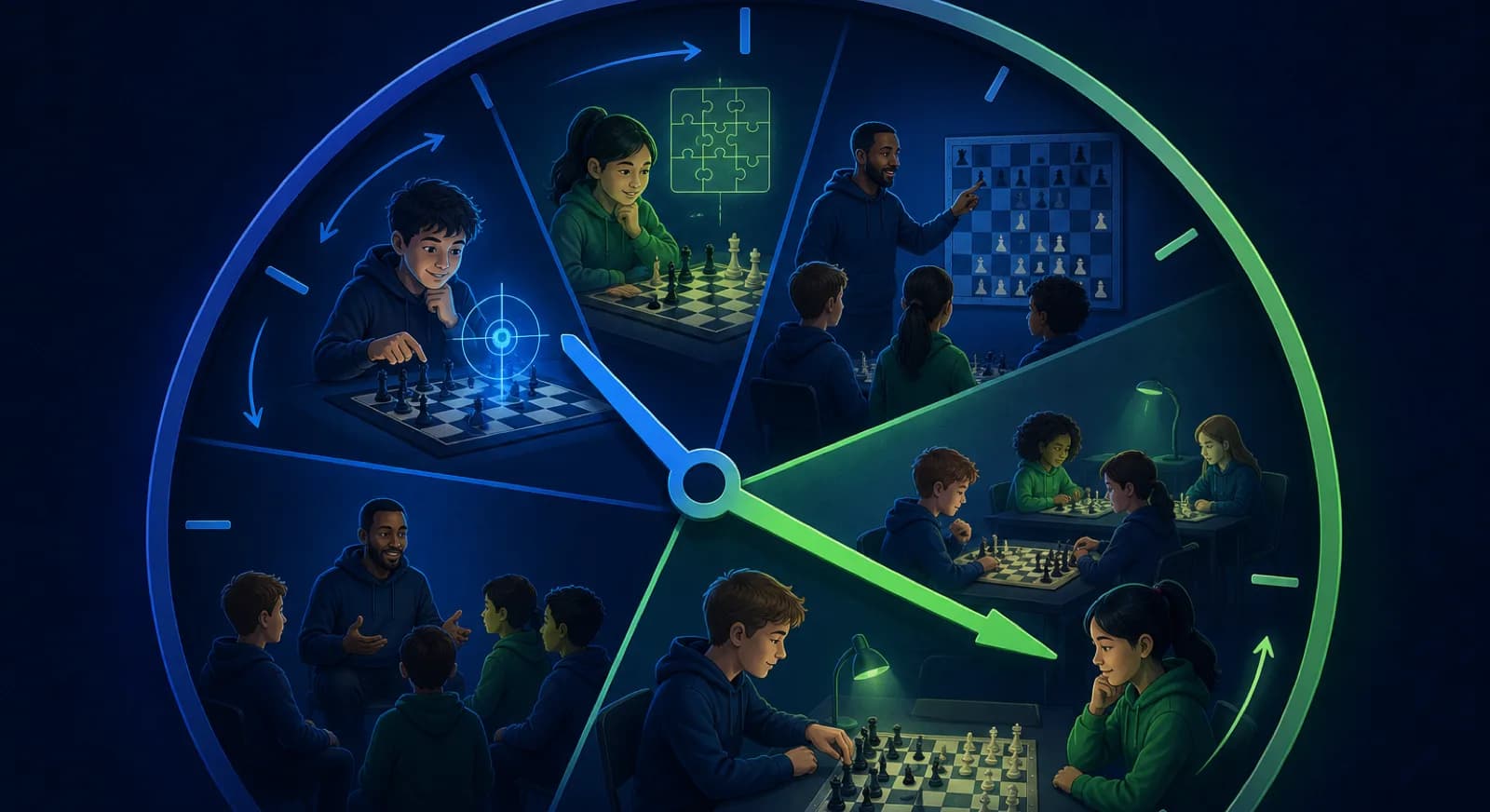
As a planning default, keep talking to about a fifth of the lesson and give at least half of it to guided practice and play combined. In a 60-minute class that is roughly ten minutes of teaching and thirty on practice and play. The exact minutes flex with lesson length and student age. These proportions are an authored default, not a research result.
| Phase | 45-min lesson | 60-min lesson | 90-min lesson |
|---|---|---|---|
| Objective | 2 | 2 | 3 |
| Warm-up | 6 | 8 | 12 |
| Teach | 8 | 10 | 15 |
| Guided practice | 10 | 15 | 22 |
| Play | 12 | 15 | 25 |
| Review | 7 | 10 | 13 |
Younger children need shorter blocks and more of them, so for very young beginners halve every block and add movement between them; teaching chess to a six-year-old shows what a short first session looks like. Older and stronger students can take longer teaching and deeper practice, and for competitive players the play phase can grow into a full slow game reviewed across two sessions. When a lesson runs over, the time usually comes out of the review, which is the part that leaves a record, so cut the teach block first.
How do you set one clear objective for a lesson?
Set one objective per lesson, phrase it as something the student can do rather than something they will learn about, and make it narrow enough to practise in a single class. Good: the student can spot and execute a back-rank mate. Weak: the student understands endgames. The test is whether you can build a warm-up, a set of practice positions, and a review question around it. If you cannot, the objective is too broad.
One objective is a discipline, not a limitation. Chess has a large surface area, and the instinct is to cover more: some opening theory, a tactic and an endgame in one hour. That gives a tour, not a lesson. A single objective tells you which puzzles to use for the warm-up, which idea to teach, which positions to practise and what to look for in the review. When the review question echoes the objective, did the back-rank idea show up in the game, you get a clear read on whether the skill showed up or needs another week. Choosing the right objective week after week is where a single lesson meets a study plan, which a chess study plan for students covers.
How do you run the guided practice and play phases?
Run guided practice by handing the student positions on the theme and prompting rather than solving: ask what they are trying to do, let them commit to a move, and correct in the moment. Then step back for the play phase and let them play a game, ideally on the theme, without steering, because the point of play is that the student, not the coach, is making the decisions.
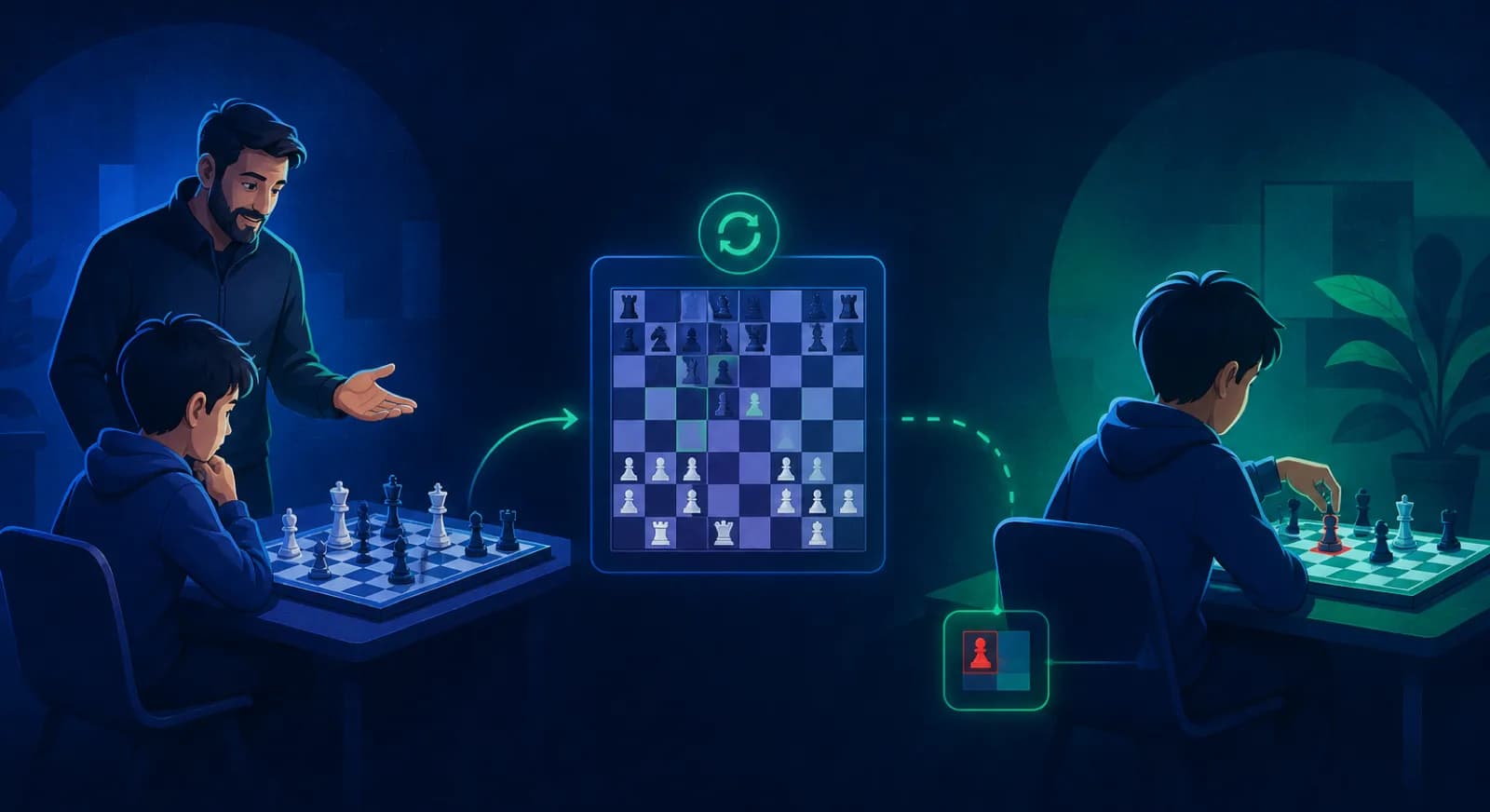
The shift between these two phases is the heart of the lesson, and it is where most coaches either hover too much or disappear too soon. In guided practice you are a spotter: you keep the student in the theme, you ask questions instead of giving answers, and you let them feel a mistake before you name it. A free analysis board or study works well here because you can set up any position instantly and reset it to try a line again [1]. Then, in the play phase, you deliberately go quiet. Resist correcting every inaccuracy in real time. The mistakes the student makes when you are not steering are the most valuable thing in the whole lesson, because they are the ones that will happen in a real game, and you want them on the board where the review can catch them. A themed puzzle rush at the start and a themed game in the middle, both drawn from a puzzle and training bank, keep the whole hour pointed at one idea [2].

Week of 12 October · all batches
0 conflictsMake-up credit · Mia G. · Sat 4:30 PM
Absent Thursday with notice · booked by Noor
Class reminders sent to 148 families
Timing changes update everyone at once
How do you review the lesson and set homework?
Review by replaying the game the student just played, stopping at one clear mistake tied to the lesson's objective, and turning that single moment into homework. Do not annotate the whole game or list every error; find the one position that best teaches the day's idea, and send the student home with it as a puzzle to solve or a line to study before next week.
October progress report · Lucas M.
1 of 14 drafts for Batch B2
Lucas attended 4 of 5 classes this period and played 18 rated games, moving from 1310 to 1342.
His endgame conversion improved clearly. Next month the focus is back-rank defense, based on the mistakes tagged in his last three games.
Highlighted numbers come from your attendance and rating records. The AI cannot change them.
Goes to the Müller family after approval
The review is the easiest phase to skip and the one that leaves a record. When a lesson runs long it gets cut, so protect it: one game, one mistake, one piece of homework. Whether the student played on Lichess or on a Chess.com account [5], the game exports as PGN, so you can replay the exact moves and pause on the critical position instead of relying on memory [3]. The homework should be small enough to finish and pointed at the objective, so next week's warm-up begins where this lesson ended. Our guide to chess homework from games goes deeper on turning a played mistake into practice. If you run several groups, assigning homework to a batch is covered on the student training page. Over a term, the rating is one visible number that shows whether the lessons are paying off [4], alongside what you recorded on the last line of each plan.
Lucas M. vs. Hana K.
Rapid · synced from Lichess · Tue 7:42 PM
14...Qe6? drops the knight
Eval swings +2.1 · the move to review first
Missed fork on move 23
Same pattern as last Tuesday · drill it
Endgame conversion was clean
Won vs. 1410 · French Defense
How is a lesson plan different from a study plan and a curriculum?
A lesson plan is the structure of one class. A study plan is what one student does between classes, week by week. A curriculum is the term-long sequence of objectives for a group. They nest, and this page covers only the first.
If your question is bigger, go to the guide that owns it: what to teach a brand-new player first is teaching chess to beginners from move one, how a student should practise between lessons is a chess study plan for students, and how a school plans a whole term is a term-long school chess curriculum. Get the single-lesson template working first, because the other two are ways of arranging many lessons.
Frequently asked questions
What should a chess lesson plan template include?
A chess lesson plan template should include six phases in order: an objective, a warm-up, a teaching block, guided practice, play and review, each with minutes and a note on what you do, plus a line recording whether the student showed the objective. Set one objective per lesson, keep the teaching block short, and give at least half the class to guided practice and play combined. The template stays the same every week; only the content changes.
How do I make a chess class plan for a group?
Use the same six-phase structure as a one-to-one lesson, but choose an objective that suits the middle of the group's range and lean harder on the warm-up and guided-practice phases where a coach can circulate. In a group, the play phase becomes students playing each other on the theme while you move between boards, and the review can be one shared game everyone learns from rather than an individual one. Keep a single running plan per batch so you know what the group covered and what the collective homework was.
How long should a chess lesson be?
Most chess lessons run between 45 and 90 minutes, with 60 minutes being a common default for school-age improvers. Whatever the length, keep the proportions steady: roughly a fifth of the time teaching, at least half on guided practice and play combined, and a solid closing block for review and homework. Younger children need shorter total lessons with more frequent breaks, while competitive players can sustain longer sessions and deeper practice.
What is a good lesson structure for coaching chess?
A good coaching structure moves from objective to warm-up to a short teach, then to guided practice, free play, and review. The logic is that students should meet a new idea while engaged, practise it with support before using it alone, and end every session with a game reviewed down to one mistake that becomes homework. This structure keeps the coach from over-lecturing and guarantees the lesson ends with something concrete to build on next week.
Do I need a new lesson plan for every class?
No, you need one reusable template and a fresh objective for each class. The six phases stay identical week to week; what changes is the objective, the warm-up puzzles, the teaching positions and the guided-practice material. Four of the six blanks are filled before the lesson and two are filled live from what the student does, so you rebuild only the parts that change.
Can I copy or print a free chess lesson plan template?
Yes. The blank template at the top of this page has fields for level, objective, materials, positions, minutes for each phase, homework and a check on whether the objective was shown. Copy the text into a document and print from that document. There is no separate downloadable PDF for this template, and this page does not produce a print view of it.
Sources
- [1]Lichess Study: free shared analysis boards · accessed 2026-06-30
- [2]Lichess Training: puzzles by theme and difficulty · accessed 2026-06-30
- [3]Portable Game Notation · accessed 2026-06-30
- [4]Elo rating system · accessed 2026-06-30
- [5]Chess.com · accessed 2026-06-30
- [6]Chess.com: How to Play Chess, 7 Rules to Get You Started (board setup and piece movement) · accessed 2026-10-16
- [7]ChessKid: How to use the ChessKid Classroom Planner · accessed 2026-10-16
- [8]FIDE Handbook: Laws of Chess effective 1 January 2023 (Articles 1, 3 and 5) · accessed 2026-10-16
Written by Abhishek Tiwari
ChessCore
Drafted with AI, fact-checked and approved by a human before publishing, the same guardrail our product applies to every report it sends. Read our editorial standards.
See a coaching week run from one place
Book a walkthrough to see how ChessCore keeps schedules, synced games, and game reviews together, so your lesson planning and post-lesson review live in one system instead of five apps.
- Roster import from the spreadsheets you already keep
- Lichess and Chess.com connections, batches, and fee plans
- First reports in week one, after your approval
- Free plan, no credit card required