On this page10 sections, 24 min read
- How do you teach chess to a complete beginner?
- How do you set up the board and teach the first move?
- What order should you teach the pieces in?
- When and how should you teach castling, promotion, and en passant?
- What are the first checkmates to teach?
- How do you test check, stalemate and castling with legal positions?
- What opening principles should beginners learn?
- How should beginners practise between lessons?
- What are the most common beginner mistakes, and how do you fix them?
- What does a first-lessons sequence look like?
- Frequently asked questions
Bottom line
To teach chess to beginners, introduce the goal and the board, then one piece at a time, moving on when the student can use the current piece. Teach check, checkmate and stalemate with legal example positions, add the special moves, then opening principles and basic tactics, and review the student's real games so each recurring mistake becomes the next lesson.
TL;DR
- Teach movement one piece at a time and let the student play tiny drills with each piece before adding the next; move on when the student is ready, not on a fixed date.
- Checkmate is the goal of the game, so teach check, then a couple of easy mates like the ladder and back rank early, before openings or tactics, using legal example positions.
- Give beginners three opening principles (control the centre, develop pieces, castle the king to safety) instead of memorised opening moves.
- Short daily practice on free tools is a practical default: puzzles for pattern recognition and slow games for decision-making.
- Review the student's own games and turn each recurring mistake into the theme of the next lesson.
Key facts
- Lichess Study gives a teacher a free shared analysis board where a beginner lesson, its diagrams, and its homework positions all live in one saved place.[1]
- Lichess offers free tactics training that adapts to a player's level, so beginners can drill checkmate and basic tactic patterns at their own strength.[2]
- Online platforms rate players with Elo-derived systems, so a new student acquires a visible strength number that can start moving within their first weeks of play.[3]
- Stockfish is a free, top-strength engine whose per-move evaluations power the game reviews a coach uses to show a beginner exactly where a game turned.[4]
- The board is set up so each player has a light square in the bottom right-hand corner, and the player with the white pieces always moves first.[6]
- Under the FIDE Laws of Chess, checkmate ends the game and a king is never captured; a game is drawn by stalemate when the player to move has no legal move and is not in check.[7]
How do you teach chess to a complete beginner?
To teach a complete beginner, start with the goal of the game and one piece at a time, not with a full board of thirty-two pieces and a rulebook. Explain that chess is a race to checkmate the enemy king, then teach how a single piece moves, let the student use that piece in a small drill, and add the next piece once the last one feels natural. This guide treats small, winnable positions as the way in, and treats lecturing at a full starting array as the thing to avoid.
The biggest mistake new teachers make is trying to transfer everything they know in the first session. A strong player sees the whole board; a beginner sees a confusing grid of pieces that all move differently. Your job is to shrink the game until it is winnable, then grow it. Teach one idea per lesson, let the student do most of the moving and talking, and resist the urge to correct every suboptimal move.
Keep the emotional temperature low. Beginners can lose interest when chess feels like a test they keep failing, so frame every mistake as information rather than a verdict, and praise legal, sensible moves before optimal ones. The same applies to a six-year-old and to a retired adult, though the pacing differs. Very young children have their own patience curve, covered in teaching chess to a six-year-old in our guide to teaching a child chess at home, and whether a child is ready at all is the subject of when a child is ready to start. This pillar is the general beginner method that the rest of our teaching-chess guides build on.
How do you set up the board and teach the first move?
Set up the board so each player has a light-coloured square at their own bottom right corner, then place the pieces in the same arrangement every game: pawns fill the second row, rooks sit in the corners, knights next to the rooks, bishops next to the knights, the queen on the square matching her own colour, and the king on the one square left over [6]. White always moves first, then play alternates, one move each, until the game ends.
Teach setup before movement, not after, because a beginner who cannot rebuild the starting position cannot practise on their own between lessons. Have the student set up both sides from an empty board at least once under your watch rather than copying a pre-set board, since copying hides the one memory check that matters: can they do it from nothing. A simple memory aid helps it stick, such as light on the right, queen on her own colour, and the two rules answer most setup mistakes a beginner makes in the first weeks.
- Place a light-coloured square at each player's bottom right corner.
- Fill the second row on each side with pawns.
- Put a rook in each corner.
- Put a knight next to each rook.
- Put a bishop next to each knight.
- Put the queen on the remaining square that matches her own colour.
- Put the king on the one square left over.
- White moves first; players then alternate one move each.
What order should you teach the pieces in?
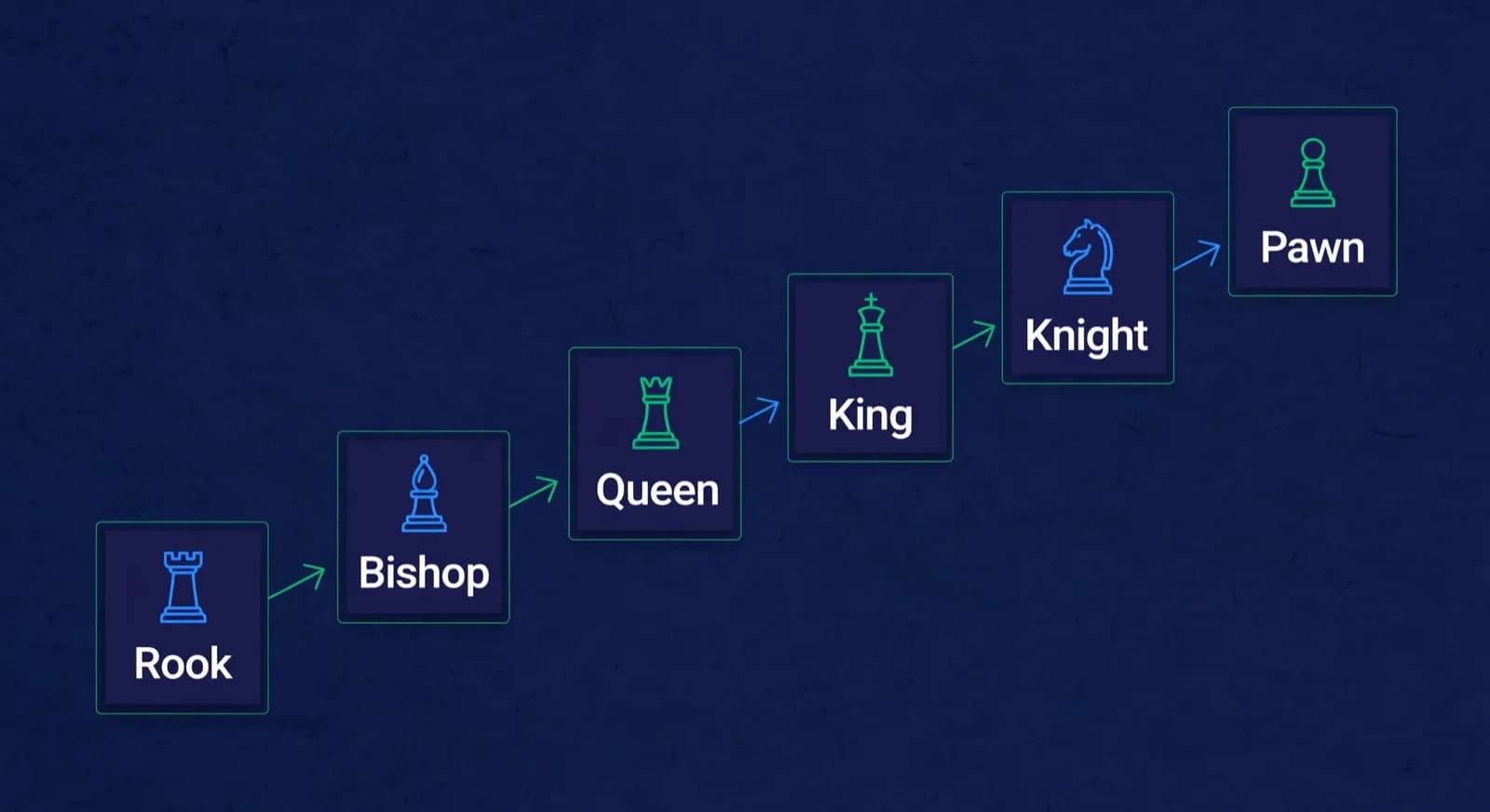
Rook-first is a good route for learners who are comfortable with board coordinates and straight lines: rook, then bishop, then queen, then king, then knight, with pawns woven throughout. The rook moves in straight lines, the bishop adds diagonals, and the queen is a rook and bishop combined, so each new piece reuses the last. The knight comes late because its L-shaped jump is the hardest to picture, and pawns get careful treatment because their rules have the most exceptions. The decision criterion is readiness to use the current piece. For a young child, some teachers start with pawn-only games instead, which is covered in teaching a young child pawns first.
| Order | Piece | Legal movement and capture rule | Why here | Drill to run (not a full game) |
|---|---|---|---|---|
| 1 | Rook | Moves any number of empty squares in a straight line (up, down, left, right); captures by landing on an enemy piece; cannot jump over any piece, friend or foe | Straight lines, easiest to see and control | Rook captures loose pawns on an otherwise empty board |
| 2 | Bishop | Moves any number of empty squares diagonally; captures the same way; stays on one square colour for the whole game and cannot jump over pieces | Adds diagonals; contrasts with the rook | A bishop captures scattered pawns of one colour |
| 3 | Queen | Combines the rook and bishop: any number of empty squares in a straight line or diagonal; captures the same way; cannot jump over pieces | Just a rook plus a bishop, so it reuses both | Queen captures scattered pawns in as few moves as possible |
| 4 | King | Moves exactly one square in any direction (straight or diagonal); captures by moving onto an enemy piece; may never move into a square where it would be captured | Slow and precious; teaches safety and opposition | King walks to the far rank past a few enemy pawns, never stepping onto a square a pawn attacks |
| 5 | Knight | Moves in an L shape, two squares in one direction then one square at a right angle; is the only piece that can jump over other pieces to get there; captures by landing on an enemy piece | The hard jump; needs the most reps | Knight collects pawns on a quiet board |
| 6 | Pawn | Moves one square straight ahead (two on its very first move); captures one square diagonally forward only; cannot capture straight ahead and cannot move backward; promotes on reaching the far rank | Most exceptions: two-square start, capture, promotion, en passant | Pawn wars: pawns only, first side to promote wins |
State the blocking rule explicitly the first time it matters. Under the FIDE Laws of Chess the bishop, rook and queen may not move over intervening pieces, and no piece may move to a square occupied by a piece of its own colour [7]. The knight jumps, and castling is a special move that moves two pieces at once, so teach it on its own. Beginners who are only shown the shapes of the moves, straight lines, diagonals, the L, often assume every piece can hop like a knight, and that wrong assumption produces many of the illegal moves you will correct in the first few lessons. Say the rule out loud every time you demonstrate a new piece: can it jump, or does it stop at the first piece in its path.
Run each piece as a small, self-contained drill before moving on. The classic exercise puts a lone piece against a scatter of pawns and asks the student to capture them all in as few moves as possible, which teaches the movement and a first taste of efficiency. These drills are played on boards without both kings, so they are exercises, not chess games. Pawn wars, where each side has only pawns and tries to promote first, teach capturing, blocking and the value of a passed pawn without a word of theory. When you finally set up the full board, the student is assembling pieces they already understand.
Introduce piece values once the movements are solid, because values are the beginner's first decision-making tool. The conventional scale, pawn one, knight and bishop about three, rook five, queen nine, is enough to answer the question every beginner asks: is this trade good? The king has no trade value because it is never captured: the game ends when it is checkmated [7]. You are not teaching precise evaluation, only a rule of thumb so they stop giving away rooks for pawns. Practise it with a simple drill: show two possible captures and ask which wins more material and why.
When and how should you teach castling, promotion, and en passant?
Teach the three special moves, castling, promotion and en passant, as their own short lesson once the student knows how every piece moves, and before you tell them they know every rule. A student who meets one mid-game feels ambushed rather than taught. Castling needs the most practice since it has the most conditions; promotion is the easiest and most exciting; en passant is rare but causes the most confusion when it happens unexplained.
| Special move | Conditions | How to introduce it |
|---|---|---|
| Castling | Neither the king nor that rook has moved before; no piece sits between them; the king is not in check and does not pass through or land on a square that is attacked | Demonstrate kingside and queenside castling on an otherwise empty board first, then quiz the four conditions one at a time before allowing it in a game [6][7] |
| Promotion | A pawn that reaches the far rank must become a queen, rook, bishop, or knight, never a king and never staying a pawn | Run pawn wars (from the piece-order table above) so promotion already feels familiar, then confirm the student knows they can choose any piece, not only a queen [6] |
| En passant | An enemy pawn moves two squares on its first move and lands beside your pawn; you may capture it as if it had moved only one square, but only on your very next move | Set up the exact scenario on the board, let the student try the capture, then show that the window closes if they play a different move first [6] |
Put this lesson before the moment you tell a student they now know every rule. Early drills and mini-games do not need these moves, but a full game can reach a position where castling, promotion or en passant is the right move, and a student who was never shown it will miss it. Teach the three special moves as their own session, confirm the student can execute each one correctly on an empty board, and then say: now you know every rule, let's play a full game. The paired positions in the next section show how to test castling and check at the board.
What are the first checkmates to teach?
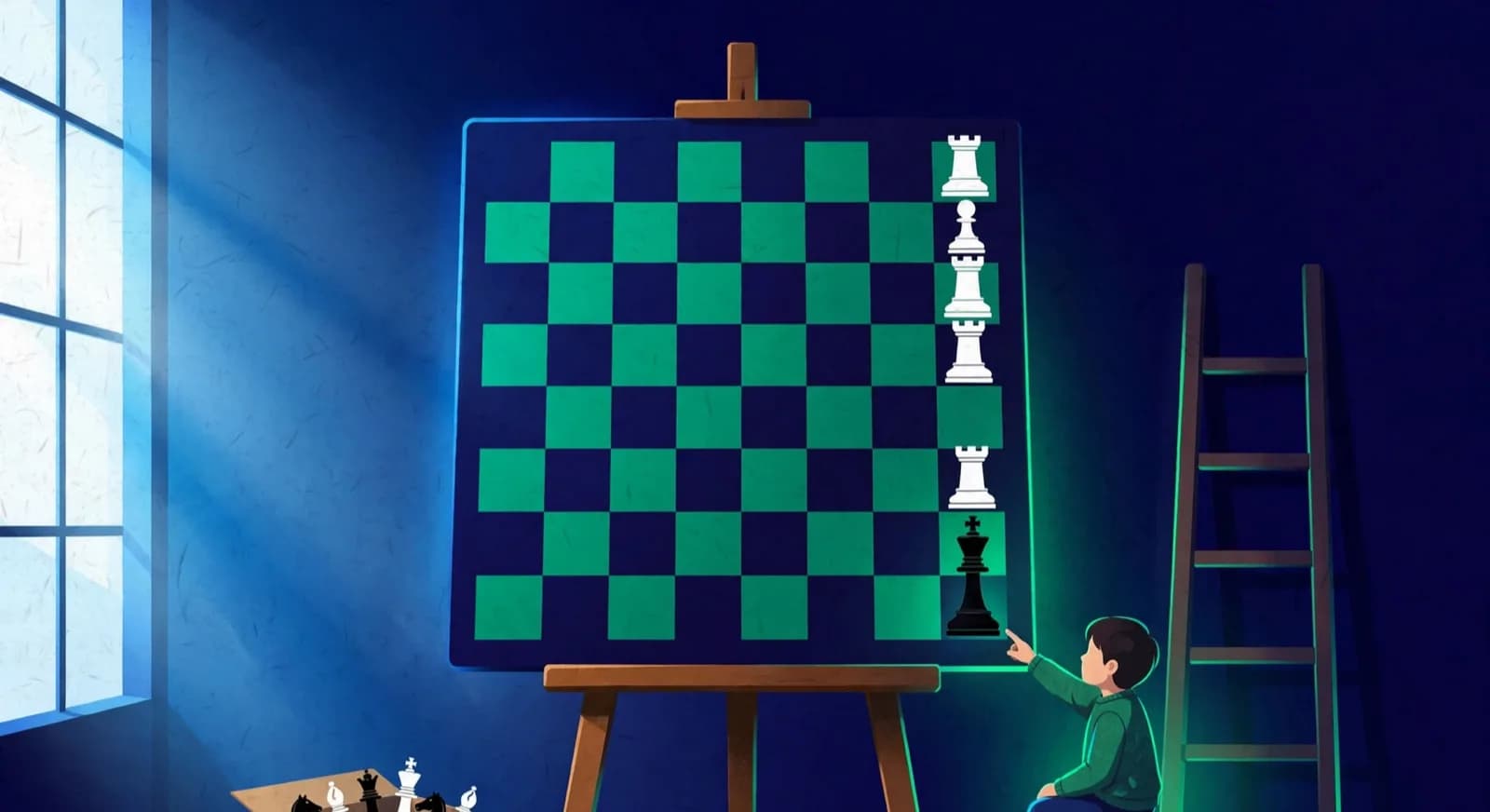
Teach check first, then the two easiest forced mates: the ladder mate with two rooks (or a queen and rook) and the back-rank mate. Checkmate is the object of the whole game, so a beginner who cannot finish a winning position never enjoys winning. Start with check (the king is attacked) and the ways to answer it: move the king, block the check, or capture the checking piece. Some checks allow fewer answers; a knight check cannot be blocked, and a double check leaves only king moves. Then show that checkmate is a check with no legal answer [7]. Once that clicks, the ladder and back-rank patterns give the student a first repeatable way to win a game.
- Check and the ways to answer it: move the king, block the check, or capture the checking piece. A beginner must find which of these exist in a position before mate makes sense.
- The ladder (or lawnmower) mate: two rooks, or a queen and rook, walk the enemy king to the edge one rank at a time. It is the clearest picture of how heavy pieces cooperate.
- Back-rank mate: a rook or queen delivers mate on the first rank against a king trapped behind its own unmoved pawns. This one doubles as a safety lesson about luft.
- King and queen versus lone king: the core endgame mate every beginner needs, taught with the box method and a constant warning about stalemate.
- King and rook versus lone king: harder, taught later, but the natural next step once the queen mate is automatic.
The two lessons hiding inside these mates are more valuable than the mates themselves. The ladder teaches that pieces win by cooperating, not by charging in alone, and the back-rank mate teaches king safety from the losing side, which is why beginners who learn it soon start making a little escape square for their own king. Drill each pattern until the student can deliver it without prompting, because a mate they can only find with your hints is not yet theirs. Free tactics trainers are ideal here, since they serve an endless stream of checkmate positions at the right level and mark each attempt instantly [2].
How do you test check, stalemate and castling with legal positions?
Test understanding with pairs of legal positions that differ by one small detail, so the student has to apply the rule rather than recognise a picture. Each position below is a legal chess position. Set it up in the board editor to set up a teaching position, ask the prompt, and let the student answer before you do.
| Position (FEN) | Side to move | What is true | Teacher prompt |
|---|---|---|---|
| 7k/5Q2/8/8/8/8/8/6K1 b - - 0 1 | Black | Black is not in check and has no legal move: stalemate, a draw. The queen on f7 takes away g8, g7 and h7, the only squares the king could reach. | Is the king attacked right now? List every square it could go to and say why each is not allowed. |
| 5Q1k/8/8/8/8/8/8/6K1 b - - 0 1 | Black | Black is in check from the queen on f8. The only legal reply is Kh7. Blocking and capturing are impossible because Black has no other pieces. | The queen moved one square from the first position. What changed: check or stalemate? Which of the three ways to answer a check exist here? |
| 5rk1/8/8/8/8/8/8/4K2R w K - 0 1 | White | White cannot castle kingside: the king would cross f1, which the rook on f8 attacks. White's legal king moves are Kd1, Kd2 and Ke2. | Which squares does the king stand on, cross and land on? Is any of them attacked? |
| 6kr/8/8/8/8/8/8/4K2R w K - 0 1 | White | White can castle kingside even though the rook on h1 is attacked, because only the squares the king stands on, crosses and lands on matter [7]. | The rook is attacked. Does that stop castling? Check the three king squares one at a time. |
The first pair separates check from stalemate by a single queen move. The second pair separates a king that crosses an attacked square from a rook that is merely attacked. If a student answers wrongly, go back to the rule, not to the answer: a position is stalemate when the player to move has no legal move and is not in check, and castling is prevented while the king stands on, crosses or lands on an attacked square [7].
What opening principles should beginners learn?
Teach beginners three opening principles instead of memorised opening moves: control the centre, develop your minor pieces toward the centre, and castle your king to safety early. These three ideas give a student reasonable first moves in many games and, unlike a memorised line, they keep working when the opponent plays something unexpected.
Give each principle a concrete test the student can apply at the board. For the centre, ask whether a move fights for the e4 and d4 squares. For development, ask whether every knight and bishop has left its starting square before the queen goes adventuring or the same piece moves twice. For king safety, treat castling as a near-automatic early goal and point out that an uncastled king in an open position is the most common way beginner games are lost. Frame these as questions the student asks themselves, not rules you enforce, so they build judgement rather than obedience.
| Principle | What it means | The question to ask at the board |
|---|---|---|
| Control the centre | Fight for the central squares with pawns and pieces | Does this move help me own e4 and d4? |
| Develop your pieces | Get knights and bishops off the back rank toward the centre | Is a new piece coming into the game this move? |
| Castle early | Tuck the king behind pawns and connect the rooks | Is my king safe, or still stuck in the centre? |
| Do not move the same piece twice | Avoid wasting time in the opening unless there is a reason | Am I developing a new piece or repeating one? |
| Bring the queen out late | An early queen gets chased and loses time | Will this queen move get attacked and pushed back? |
Avoid teaching named opening theory to beginners; it is the most common way a well-meaning coach wastes a student's time. A first-year player does not lose because they chose the wrong response to the Sicilian, they lose because they left a piece hanging or forgot their king in the centre. Save opening repertoires for when a student is already winning games on principles and asking specific questions. If you want a ready-made structure for turning these principles into a single teachable session, our chess lesson plan template lays out a warm-up, teaching block, guided practice, play and review you can reuse every week.
How should beginners practise between lessons?
A practical default is short, frequent practice split between tactics puzzles and slow full games, not one long weekly session. Fifteen focused minutes most days gives repeated exposure to patterns. The two ingredients are puzzles, which train the eye to spot tactics and mates, and slow games, which train the harder skill of making decisions with a clock running and no hints.
Structure the practice so it has a purpose beyond playing for its own sake. Set a small daily puzzle target on a free trainer that adapts to the student's rating, so every puzzle sits just above their current ability and each solved one is a small win [2]. For games, steer beginners toward slower time controls on a free platform such as Lichess or Chess.com rather than one-minute bullet, because a beginner playing bullet has little time to apply the principles you taught, while a ten or fifteen minute game leaves room for them [5]. A free study board lets you save annotated example games and homework positions in one place the student can open between lessons [1]. Two or three slow games plus a short daily puzzle set is a workable beginner routine.
Make the practice measurable so both you and the student can see it working. Online platforms attach an Elo-derived rating to every player, so within a few weeks a beginner has a number that starts to move, which turns an abstract activity into progress a child and a parent can both follow [3]. Keep a light record of what each student practised and how their rating trends over the term; that trail is what a parent wants to see at a progress check.

Lucas M.
Batch B2 · Thursdays · joined Aug 2025
1342
Academy rating · Lichess games synced
Won vs. 1410 · French Defense
Best gameMissed fork on move 23
Homework setWhat are the most common beginner mistakes, and how do you fix them?
The most common beginner mistakes are hanging pieces, ignoring the opponent's threats, bringing the queen out too early, neglecting king safety, and never developing the whole army. Many beginner losses trace back to one of these five, and each has a simple corrective habit you can install through repetition. The fix is rarely more knowledge; it is a routine the student runs before every move until it becomes automatic, and your lessons are where that routine gets built and reinforced.
- Hanging pieces: teach the before-you-move check, ask is my piece defended and is anything of mine attacked, on every single move until it is a reflex.
- Ignoring threats: after the opponent moves, the first question is always what does that move attack, before thinking about your own plan.
- Early queen sorties: show how a queen that raids on move three simply gets chased around while the opponent develops with tempo.
- King left in the centre: make castling an early habit and show a few sharp miniatures where the uncastled king is checkmated.
- One-piece attacks: point out that a lone piece rarely mates or wins material, and steer them to bring a second and third attacker before striking.
The single most effective way to fix these mistakes is to review the student's own games rather than generic positions, because a mistake in their own game carries emotional weight that a textbook example never will. Sit with a recent game, stop at the moment it turned, and ask the student what the opponent was threatening before you say a word. A neutral engine review makes this concrete: it marks the exact move where evaluation swung, so instead of arguing about it you can point to the position and let the student see the hanging rook they missed. Stockfish, a free top-strength engine, produces those per-move evaluations, and the numbers come from the engine rather than from your memory of the game [4]. Our guide to reviewing a student's game in fifteen minutes turns this into a repeatable routine you can run every lesson.
Lucas M. vs. Hana K.
Rapid · synced from Lichess · Tue 7:42 PM
14...Qe6? drops the knight
Eval swings +2.1 · the move to review first
Missed fork on move 23
Same pattern as last Tuesday · drill it
Endgame conversion was clean
Won vs. 1410 · French Defense
Turn every recurring mistake into the theme of the next lesson, and you have a curriculum that targets what the student actually needs. If three of last week's losses came from hanging pieces, next week's warm-up is a defended-or-not drill and the practice game has a one-rule focus: check every piece before you move. This loop, play, review, extract the theme, teach it, practise it, is the backbone of the game-analysis approach we detail in our guide to engine analysis for chess coaching.
What does a first-lessons sequence look like?
A first-lessons sequence moves from movement to mate to full games, adding one new idea per lesson. The ten lessons below are an adaptable example, not the number of lessons any learner needs: the pace depends on age, prior knowledge and practice between classes. The order matters more than the pace: the board and pieces, then the special moves, then check and the easy mates, then the opening principles, then basic tactics, and only then full games with all of it in play. For the first class itself, a lesson plan for the first class gives you the timed phases.
| Lesson | Focus | Student can do by the end |
|---|---|---|
| 1 | Board setup, the goal, rook and bishop | Set up the starting position from memory and play a rook-and-pawn mini-game |
| 2 | Queen and king | Move the queen and king correctly and judge a simple trade using piece values |
| 3 | The knight and basic pawn moves | Move every piece legally, including the knight's jump, on an otherwise empty board |
| 4 | Castling, promotion, and en passant | Execute all three special moves correctly on a demonstration board |
| 5 | Check, checkmate, and stalemate | Finish a king-and-queen mate without stalemating |
| 6 | Ladder and back-rank mates | Deliver both mates unprompted |
| 7 | Play a full legal game for the first time | Play one complete, rule-correct game start to finish, however roughly |
| 8 | Opening principles: centre, develop, castle | Play a sensible, principled first ten moves |
| 9 | Basic tactics: forks, pins, and skewers | Spot a one-move fork or pin in a puzzle |
| 10 | Play and review a full slow game | Play a whole game and name one thing to fix |
Adjust the sequence for adults. An adult who can already demonstrate a rule can skip the drill for it and move on. Revisit the exact rule they missed when it shows up in a game, instead of re-teaching the lesson it came from. A young child usually needs more drills and shorter sessions, not a different order.
By lesson ten the student is playing complete games and reviewing them, which is the point where they can start improving between sessions. From here the path forks by goal. A student who wants steady improvement needs a longer-term structure of themes, practice targets, and rating checkpoints, which is exactly what a study plan provides, and we lay out a beginner one in our guide to building a chess study plan for students. A student who is content playing for fun simply keeps the play-and-review loop going. Either way, resist rushing ahead: add a lesson only when the last one can be demonstrated.
Add a short notation exercise once basic legal play is established, around lesson seven or eight, so the student can start recording and replaying their own games rather than relying on memory. Show one recorded move in algebraic notation (for example Nf3, knight to the f3 square) using the file letters a through h and rank numbers 1 through 8 that label every square, then give the student a short sequence of three or four moves to find on the board one at a time. Finish by having them write down a few moves of their own mini-game and replay it from the notation alone. This is a small, five-minute add-on, not a new lesson, but it opens every later tool, from reading a diagram in a book to pulling up their own game for review.
If you are teaching several beginners rather than one, the sequence above is also your curriculum backbone, and the operational side, tracking who is on which lesson, whose practice is slipping, and what to tell each parent, is where solo teaching becomes running a practice. That transition from teaching one student to organising many is its own subject, covered in our guide to becoming a chess coach. This pillar stays focused on the teaching itself, because getting the sequence right is what makes everything downstream easier.
Frequently asked questions
What is the best way to teach chess to a beginner?
The best way is to teach one piece at a time and let the student play small, winnable drills with each piece before adding the next, rather than explaining the whole board at once. Start with the goal of the game (checkmate the king), then movement, then check and the easy mates, then opening principles and basic tactics. Keep sessions short, let the student do most of the moving and thinking, and review their own games so every mistake becomes the next lesson.
In what order should you teach the chess pieces?
One route is rook first (straight lines), then bishop (diagonals), then queen (rook plus bishop combined), then king, then the knight, with pawns handled carefully throughout because they have the most exceptions. Run a small drill with each piece, such as capturing scattered pawns, before introducing the next. Move on when the student can use the current piece, not at a set age. For very young children, some teachers start with pawn-only games instead.
What should you teach first, openings or tactics?
Teach neither named openings nor deep tactics first; teach checkmate and safe piece movement first, then simple opening principles, then basic tactics like forks and pins. Many beginner games are decided by hanging pieces and an unsafe king, so memorised opening lines are low priority early on. Give them three principles (control the centre, develop pieces, castle early) instead of theory, and introduce one-move tactics through puzzles once they can play a full legal game and finish a basic mate.
How long does it take to teach someone the basics of chess?
It depends on age, prior knowledge and practice between lessons. A motivated beginner can learn basic piece movement in one or two focused sessions, and the special moves (castling, promotion, en passant) complete the rules. The example sequence in this guide takes ten lessons to reach full games and reviewing them, but treat it as adaptable, not a standard length. Short daily puzzles and a couple of slow games each week support the lessons. Being able to play is not the same as playing well; improvement is the ongoing play-and-review work that follows.
How do you teach chess to a child versus an adult?
The sequence is the same for both (movement, checkmate, principles, tactics, then full games), but the pacing and framing differ. Children need shorter sessions, more drills and constant encouragement, and a very young child needs a patient approach, covered in the six-year-old section of our guide to teaching a child chess at home. An adult who can already demonstrate a rule can skip its drill and revisit only the rule they missed in a game. Adults can tolerate longer explanations but may be self-critical, so keep mistakes framed as normal and early wins visible.
Sources
- [1]Lichess Study: free shared analysis boards · accessed 2026-06-30
- [2]Lichess: free adaptive tactics training · accessed 2026-06-30
- [3]Elo rating system · accessed 2026-06-30
- [4]Stockfish: open-source chess engine · accessed 2026-06-30
- [5]Chess.com · accessed 2026-06-30
- [6]Chess.com: How to Play Chess, 7 Rules to Get You Started (board setup, piece movement, special rules) · accessed 2026-10-16
- [7]FIDE Handbook: Laws of Chess effective 1 January 2023 (Articles 1, 3 and 5) · accessed 2026-10-16
Written by Abhishek Tiwari
ChessCore
Drafted with AI, fact-checked and approved by a human before publishing, the same guardrail our product applies to every report it sends. Read our editorial standards.
See how coaches track beginner progress
Bring one student roster to a walkthrough and see how ChessCore keeps attendance, game reviews, and rating history in one place, so a coach's time goes into teaching beginners, not paperwork.
- Roster import from the spreadsheets you already keep
- Lichess and Chess.com connections, batches, and fee plans
- First reports in week one, after your approval
- Free plan, no credit card required