On this page7 sections, 13 min read
- What age should a child start chess?
- Is my child ready for chess?
- What is the best age to learn chess seriously?
- Can a four year old learn chess?
- Is my child too old to start chess?
- How should you introduce chess to a child, whatever their age?
- How do you know a young beginner is enjoying chess?
- Frequently asked questions
Bottom line
There is no single right age to start chess: readiness shows in whether a child enjoys short games, takes turns and wants another go, not in a birthday. One grandmaster coach finds most children ready between five and seven, but says emotional readiness matters more than age. Start with play at home, watch a short class, or try a beginner group, depending on what your child shows interest in.
TL;DR
- There is no single right age to start chess, and readiness shows in a child's interest in short games rather than in a number of years.
- One grandmaster coach writes that most children are ready between five and seven but that emotional readiness, such as losing a game without tears, matters more than age [7].
- Younger children can enjoy chess as play, with piece names and moving one piece across a board, and no pressure to play a full game.
- Choose the next step from what your child shows: play at home, watch a short class, or try a beginner group.
- An older beginner has not missed a window: a grandmaster coach says a child who starts at nine rather than five has lost essentially nothing [7].
Key facts
- ChessKid is a child-focused chess platform with lessons, puzzles and a guided interface built for young beginners rather than adult players.[2]
- FIDE's 2026 World Cadets cycle has under 8, under 10 and under 12 categories, and a player must not have reached the 8th, 10th or 12th birthday respectively before 1 January 2026.[5]
- A grandmaster coach who teaches children says most are ready between five and seven, that starting at nine rather than five loses essentially nothing, and that emotional readiness matters more than age. This is one coach's experience, not a research finding.[7]
- FIDE administers official ratings and titles, which become relevant only once a child enters rated events, usually well after the first stage of learning.[4]
- The All India Chess Federation is India's national chess federation; entry rules, age cut-offs and membership differ by event, so read the specific notice before entering.[6]
What age should a child start chess?
There is no universally correct age to start chess, and a birthday tells you less than how a specific child behaves at a table. A grandmaster coach who has taught hundreds of children says most are ready between five and seven, adds that a few three and four year olds can learn piece movements as a game of shapes, and says emotional readiness matters more than the exact age [7]. That is one experienced coach's view, not a developmental study, so use it as a starting point and not as a norm.
A more useful way to think about it is in choices. A child who likes handling the pieces can play at home with short games. A child who likes watching other children can watch a class. A child who asks for a group can try a beginner group. Competitive, rated play sits on top of all of that and comes later, not first. Our main guide to the benefits of chess for kids covers why the game is worth introducing at all; this post is about when and how.
Is my child ready for chess?
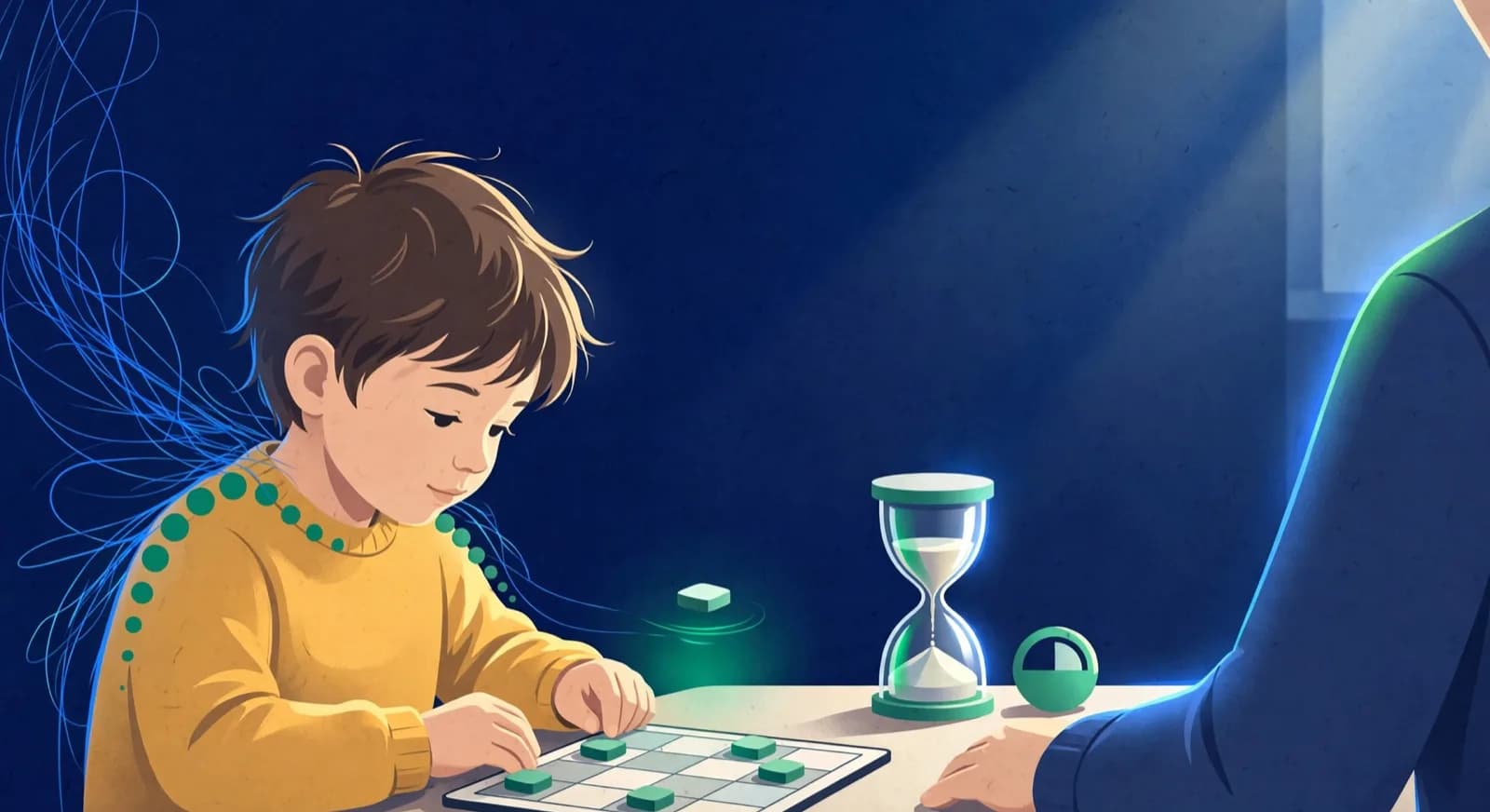
You can find out whether your child is ready for chess by trying a five-minute turn-taking game and watching what they do. This is an informal activity for choosing what to try next. It is not a test, it has no pass mark, and it does not measure intelligence, development or clinical readiness.
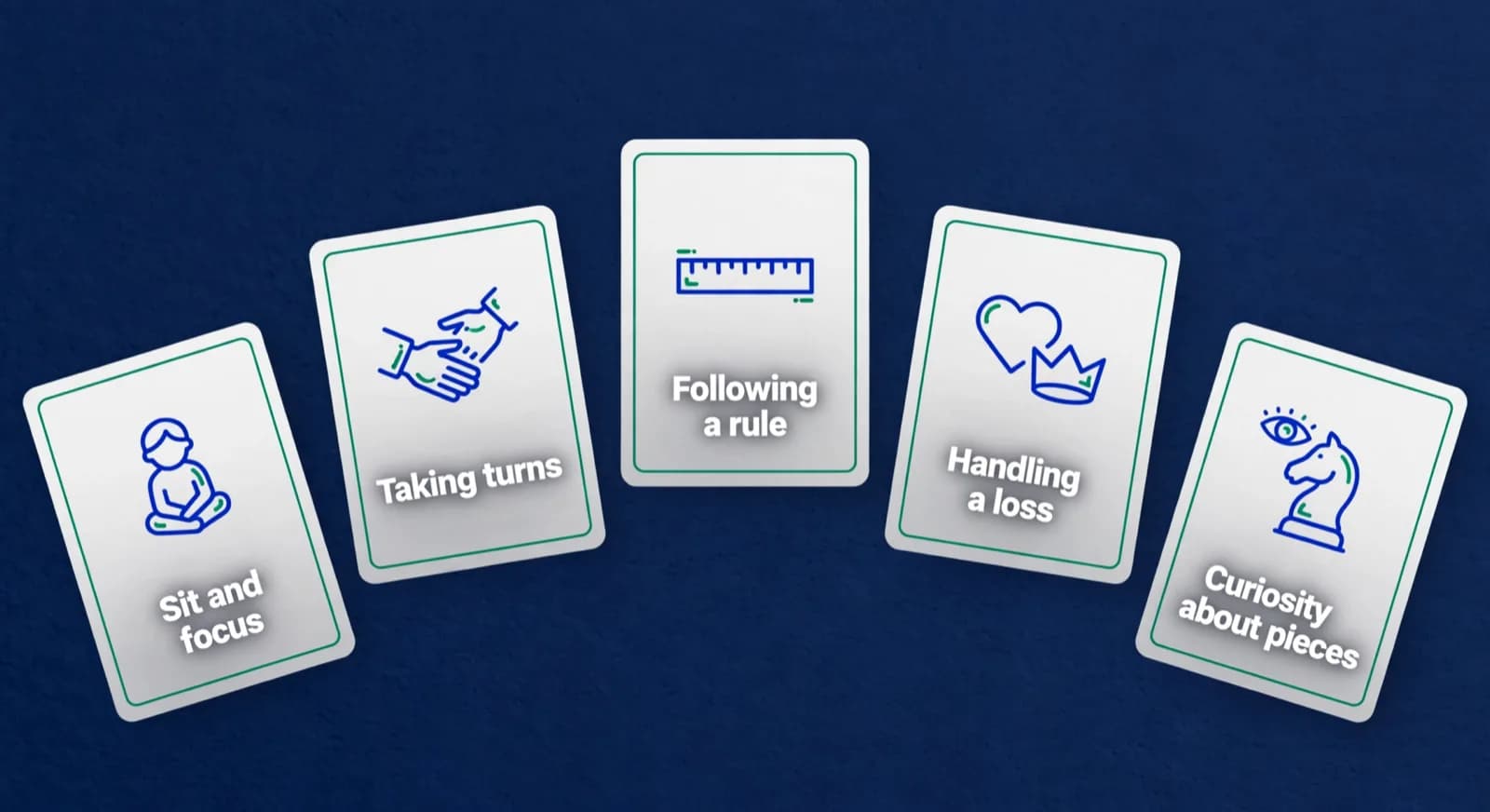
- Set out three pawns each on a board, as in the pawn race in our guide to teaching a child chess at home.
- Show how a pawn moves and ask your child to show you.
- Play one short race, taking turns, and let your child decide how long it lasts.
- Afterwards ask: do you want another turn?
- Make a note of what you saw: did they take turns, did they ask a question about the pieces, how did they respond when you captured a pawn?
The notes tell you what to try next, not whether your child passes. A child who asks for another turn can keep playing short games at home. A child who loses interest after two moves may enjoy the pieces more as a toy for now. A child who is upset at a capture may need a few more weeks of simpler turn-taking games first. The grandmaster coach quoted above suggests one more question: can the child lose a game of anything, such as cards or checkers, without the evening ending in tears [7]? None of this requires reading or advanced maths. Our guide to chess for kids at home has more low-pressure starting activities.
What is the best age to learn chess seriously?
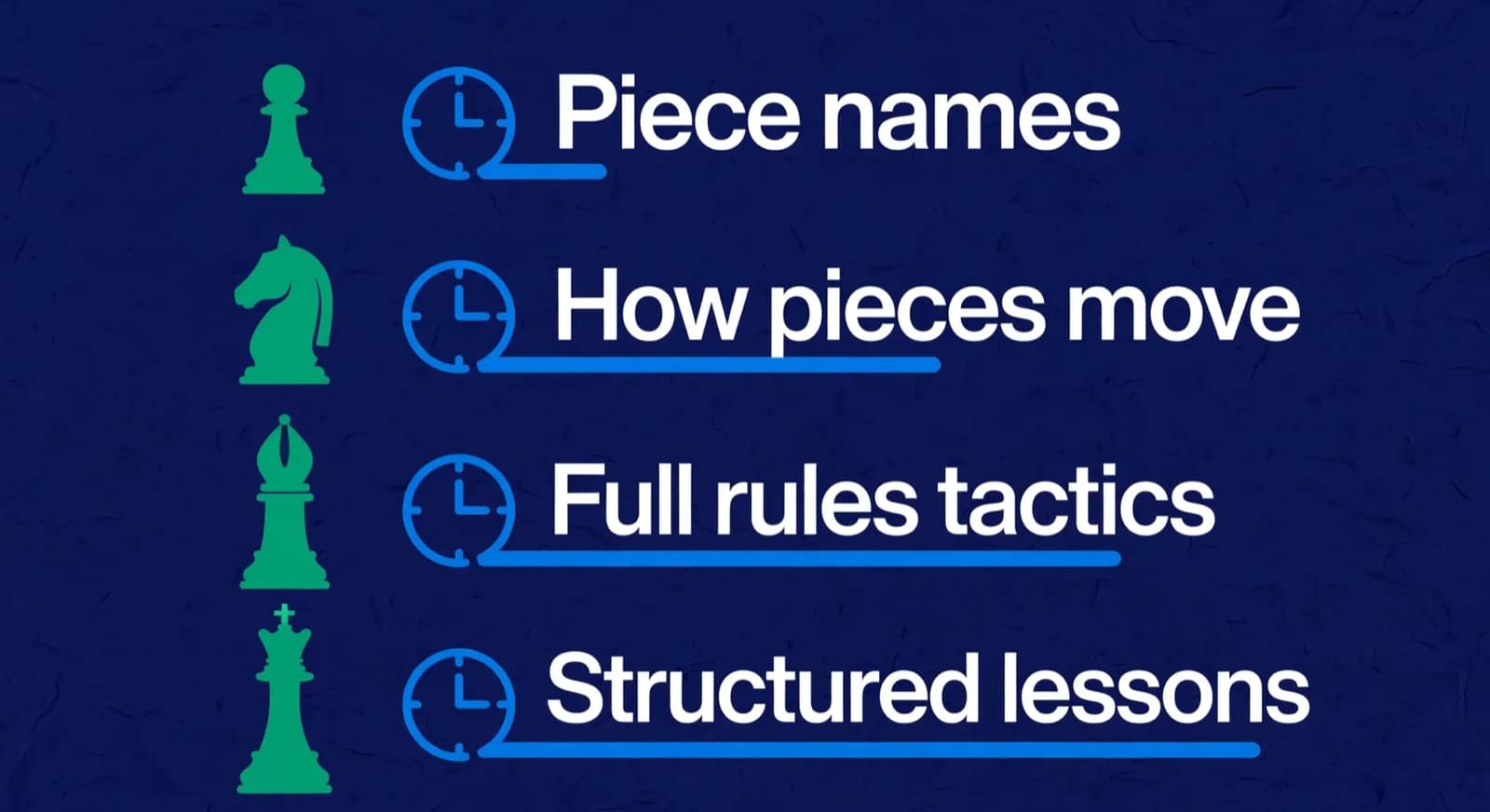
The right moment to move from playing for fun to learning chess more seriously is when the child asks to get better, whatever their age. Seriously does not mean tournaments and pressure. It means structured lessons, regular practice and a coach or class that teaches ideas in an order, rather than only casual games at home. The trigger is the child's own interest, not a target age you set for them.
There is a reason to avoid rushing this step. A child who is pushed into formal coaching before they enjoy the game often learns to associate chess with obligation, and that is the fastest way to lose them. A child who asks to play, who wants to beat a parent or a sibling, and who is disappointed when a session ends, is telling you they are ready for more structure. At that point, a good class adds three things a kitchen-table game cannot: a sensible sequence of ideas (piece values, then simple tactics, then basic checkmates), honest feedback on their own games, and other children at a similar level to play against. Our guide on how to choose a chess class for your child walks through what a good beginner class actually looks like and the questions worth asking before you enrol.
At this stage free tools help. Each puzzle on Lichess is a single self-contained task, so a child can solve a few and stop [1]. Kid-focused tools exist too: ChessKid is built around lessons and puzzles designed for young beginners rather than adult players [2], and a shared study board on Lichess lets a coach or parent save a position and set a small piece of homework [3]. None of this is about pushing a child toward competition. It is about giving a child who has shown interest some structure.
Rated chess is a further step, and entering an event is a different question from being ready to learn. A child does not need to think about official ratings or federations to be a serious learner. FIDE administers the official rating system [4]. Event eligibility is set by the organiser: FIDE's World Cadets championships for 2026, for example, use under 8, under 10 and under 12 categories, and a player must not have reached the 8th, 10th or 12th birthday respectively before 1 January 2026 [5]. In India, start from the national federation, the All India Chess Federation [6], and read the specific notice for any event you are considering, because age cut-offs, membership and rating requirements differ, and our guide to first rated events in India explains the route. Whether your child can enter an event and whether they want to are two separate questions. Enjoyment first, structure second and competition much later is the order most likely to keep a child playing.
Can a four year old learn chess?
A four year old can enjoy chess pieces, but at that age it should look like play, not lessons. A few young children learn piece movements as a game of shapes, while most gain more from naming pieces, sorting colours and moving one piece across the board [7]. The goal at four is delight and familiarity, not competence.
The practical approach with the very young is to teach one piece at a time and play tiny games with just those pieces. A common starting point is a game with only pawns, where each player tries to get a pawn to the far side: it uses one simple movement and ends quickly [7]. Keep every session short, stop while your child is still enjoying it, and treat lost interest halfway through as normal. If your four year old only wants to build with the pieces, that counts as chess play at this age. A child who leaves the board smiling is more likely to come back than one who is drilled, and neither outcome predicts how they will play later.
Is my child too old to start chess?
No, a child is not too old to start chess because of their age, and an eight, ten or twelve year old who wants to learn has not missed a window. The grandmaster coach quoted above says a child who starts at nine instead of five has lost essentially nothing, and that children aged eight to twelve can learn the full rules quickly [7]. That is one coach's experience, not a study, but it matches what a family needs to know: interest is the starting signal.
Whether starting later limits how far a player can go at the very top of the game is a narrow question that this guide cannot answer, and it is irrelevant for most families. For enjoyment, school clubs and casual events, the best time to start is when the child becomes interested. If your child has just discovered chess at eleven, treat that interest as the green light. The section on how to teach chess to a six year old in our guide to teaching a child chess at home is written for the youngest end, but short lessons and one idea at a time also suit an older beginner.
How should you introduce chess to a child, whatever their age?
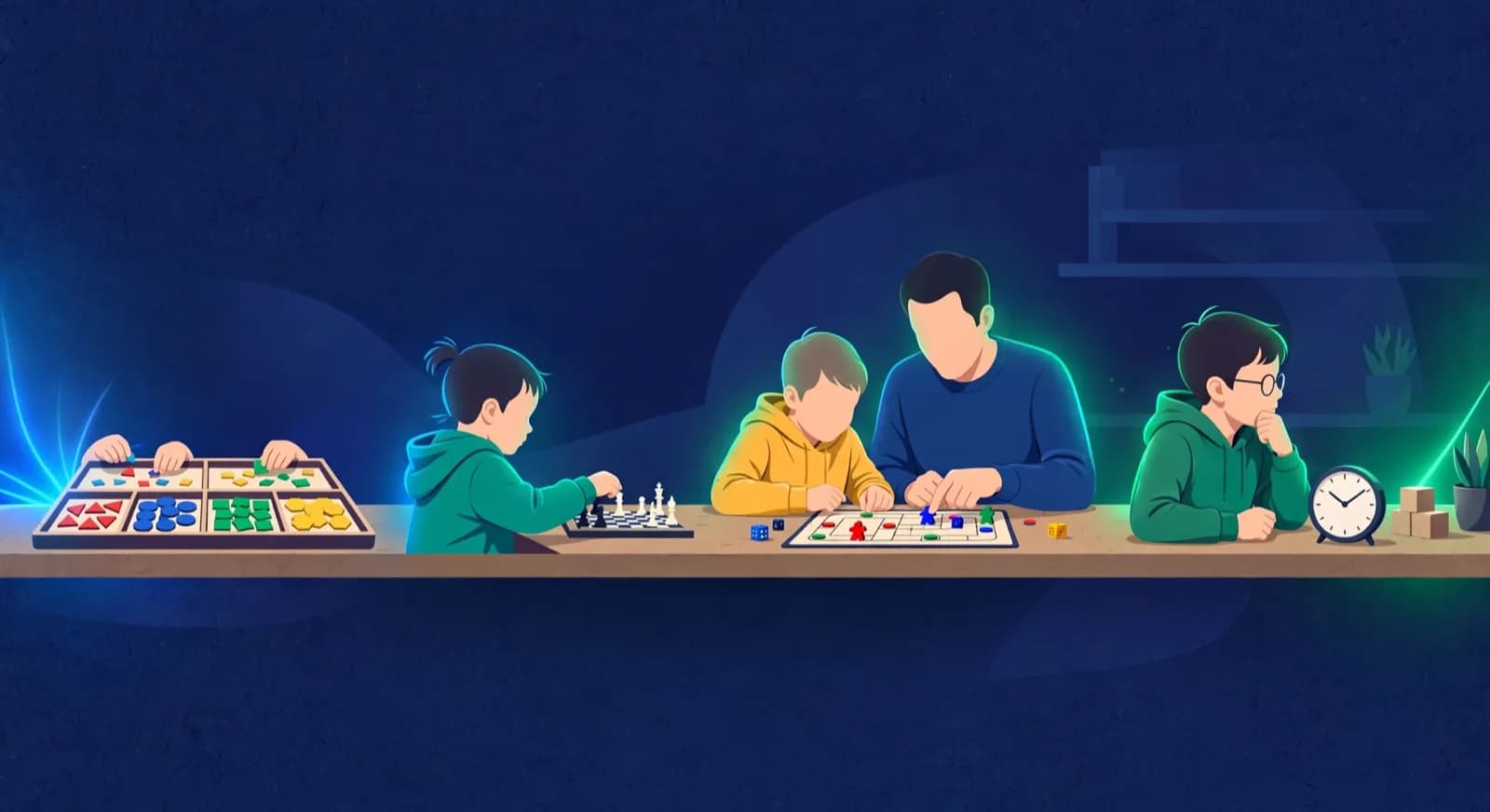
Introduce chess by what your child shows interest in: play at home if they enjoy handling pieces, observe a short class if they like watching other children, and try a beginner group if they ask for one. Ages are approximate and vary widely, so the table pitches the next step to the child rather than the birthday.
| What you see | Next step to try | What to check | Where to read |
|---|---|---|---|
| Your child likes handling the pieces and wants to play with you | Play at home: pawn games, then one new piece at a time | Do they ask for another turn, and can you stop when they want to? | Our guide to teaching a child chess at home |
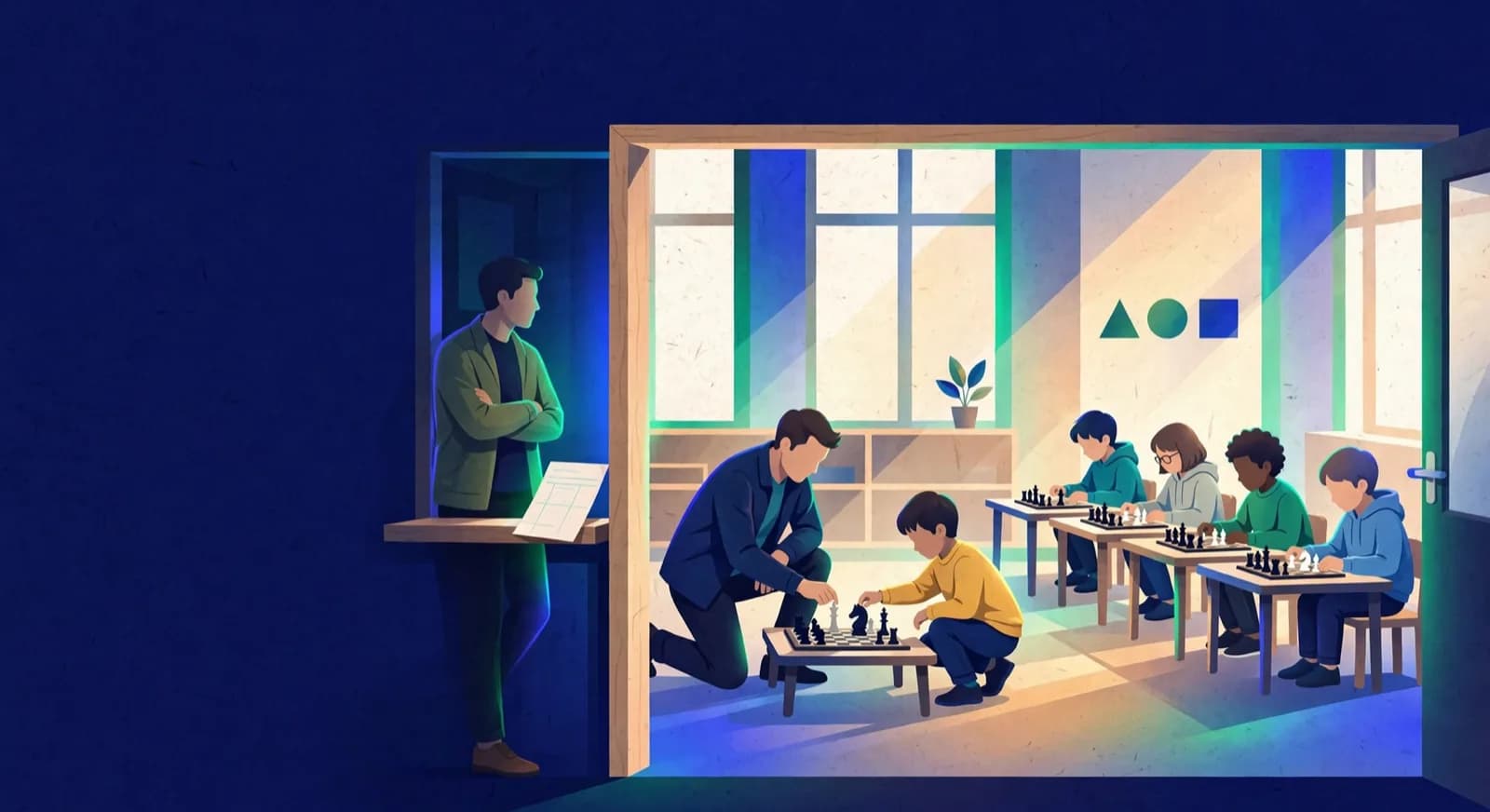
| Your child likes watching other children play | Observe a short class before enrolling | Does the coach explain one idea in plain words and let children try it? | Our guide to how to choose a chess class for your child |
| Your child asks for a group and can follow a short explanation | Try a beginner group trial with the actual coach and batch | Is the group at a level your child can join, and are the terms in writing? | Our guide to how to choose a chess class for your child |
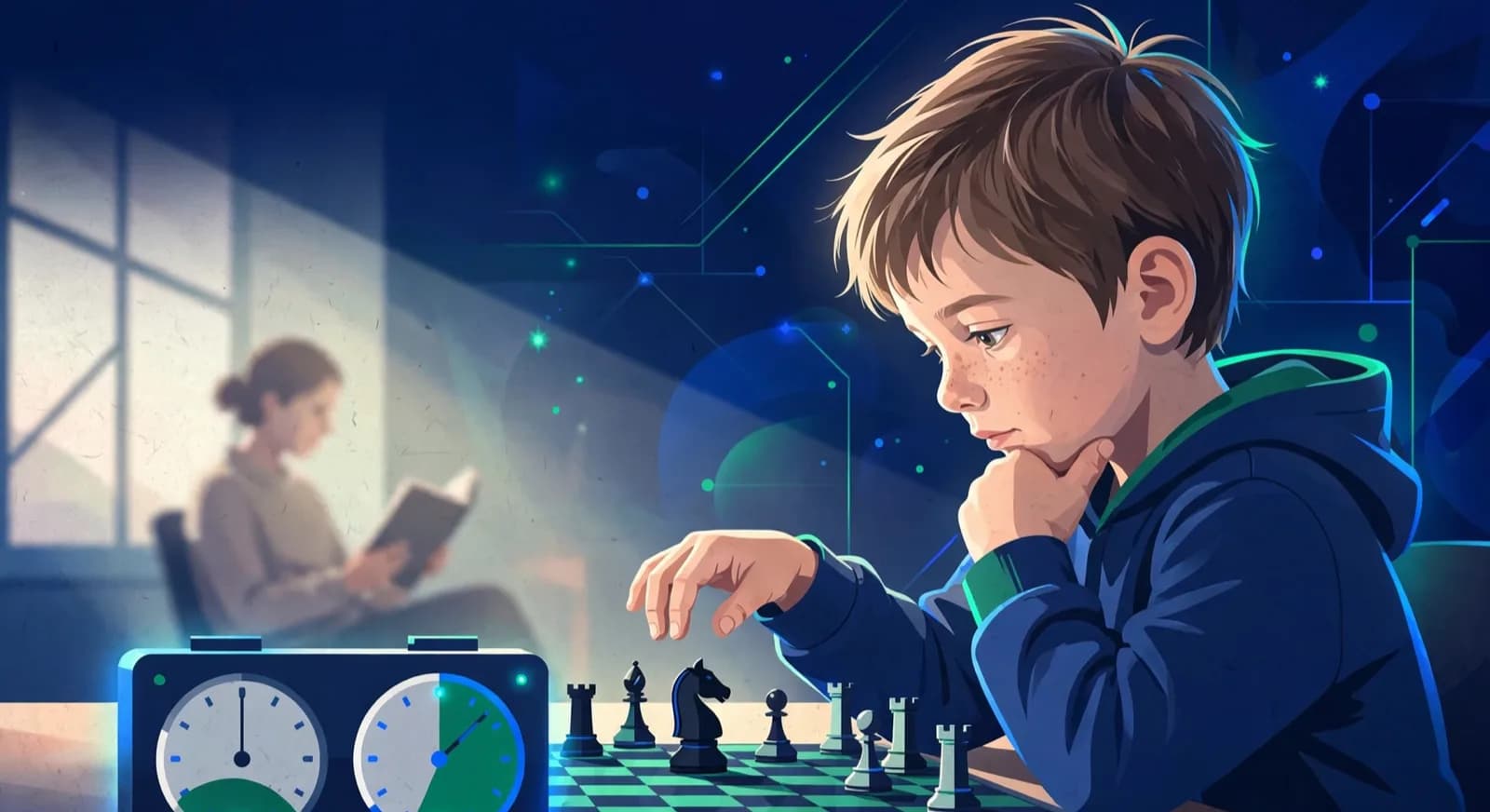
Two principles run across every row. First, keep sessions short and stop early, because a good five-minute session beats a frustrating twenty-minute one; the grandmaster coach quoted above recommends ten to twenty minutes for young children [7]. Second, the tools should follow the child, not lead them. A physical board and a patient adult are all a young beginner needs; puzzle apps and study boards help once a child is playing. If you want a structured teaching sequence rather than a list of tools, our guides on how to teach chess to beginners and the wider teaching hub lay out lesson plans in order.
| Edge case | What the parent can try next | What to avoid |
|---|---|---|
| An interested four-year-old who only wants to play with the pieces, not play a game | Let them name, sort and march the pieces. Offer a one-piece mini-game and stop if they leave. Ask whether they want another go next time | Insisting on a full game, or reading their play style as a sign of how they will learn later |
| A ten-year-old beginner who wants to join a first group | Watch a trial with the real coach and batch, ask whether newcomers are paired with others at a similar level, and check written terms | Assuming they are behind other children, or choosing the group on price alone |
These two cases are illustrative. There is no score to reach, no waiting period and no forecast of how fast a child will learn, because none of that can be known in advance. Try the next step, watch how your child responds, and change course if it is not working.
How do you know a young beginner is enjoying chess?
You can tell a young beginner is enjoying chess when they keep choosing to play and are not dreading their sessions. Progress at the start is uneven and easy to miss day to day, so watch a couple of simple signals over several weeks instead of judging a single game: whether they ask to play, and whether their play is slowly getting less random.
Once a child plays online or joins a class, you may also see a rating. It can rise, flatten or dip, and individual games swing widely, so treat it as one input and not as proof that your child is getting better. A class can also keep a simple record of what a child has learned, which is more useful than a number.

Lucas M.
Batch B2 · Thursdays · joined Aug 2025
1342
Academy rating · Lichess games synced
Won vs. 1410 · French Defense
Best gameMissed fork on move 23
Homework setThe other half of knowing is communication, because at these ages the parent is often not in the room. Ask a class how and how often you will hear about your child, and what a normal update says. A short, specific note about what your child worked on tells you more than a scoreboard does.
Parent updates · this week
14 of 14 sentWeekly recap · Lucas M.
Lucas attended Thursday's class and won 2 arena games. His September report is in your portal.
Receipt · October fee
$180 received via card AutoPay. Receipt saved.
9:42 AMRecap approved by Coach Elena
Open the guardian portal
Own login · nothing to install
Frequently asked questions
What age should a child start playing chess?
There is no single right age. A grandmaster coach who teaches children finds most are ready between five and seven, but says emotional readiness matters more than age [7]. Watch for readiness instead: whether your child enjoys short games, takes turns and wants another go. If those are present, the exact age barely matters, and if they are missing, waiting a few months costs nothing.
What is the best age to learn chess?
The best age to learn chess is whenever a specific child becomes interested, because interest sustains learning better than a target birthday. Younger children can enjoy the pieces as play, and older children can learn the rules quickly. Moving to structured lessons makes sense once a child enjoys the game and asks to get better. Rated play is a much later step and should never be the reason a young child starts.
Can a 4 year old learn chess?
Yes, a four year old can enjoy chess, but it should look like play rather than lessons. Most four year olds enjoy the piece names, colours and moving one piece, and a few can learn how some pieces move. Short games with just one or two pieces are enough. Keep sessions brief, teach one piece at a time and stop while they are still enjoying it. The aim at four is familiarity and delight, not skill.
Is my child ready for chess?
There is no pass mark. Try a five-minute turn-taking game with three pawns each and watch what your child does: do they take turns, do they ask a question about the pieces, and do they want another go? Those observations help you choose what to try next. They are not a test of intelligence or development. If your child is upset at losing, a few weeks of simpler turn-taking games costs nothing.
Is my child too old to start chess at 10 or 12?
No, a ten or twelve year old is not too old to start chess and has not missed a window. A grandmaster coach writes that a child who starts at nine instead of five has lost essentially nothing [7]. Older beginners can often follow explanations more easily, though the right pace is your child's. Whether a late start matters at the very top of the game is a narrow question that is irrelevant to almost every family. If your child is interested now, start.
Sources
- [1]Lichess Training: free chess puzzles · accessed 2026-06-29
- [2]ChessKid: chess for kids · accessed 2026-06-29
- [3]Lichess Study: free shared analysis boards · accessed 2026-06-29
- [4]FIDE: International Chess Federation · accessed 2026-06-29
- [5]FIDE World Cadets' Championships cycle 2026 (under 8, 10 and 12) invitation and eligibility · accessed 2026-10-16
- [6]All India Chess Federation · accessed 2026-10-16
- [7]How to Teach a Child Chess, ChessMind AI (GM Mauricio Flores Rios) · accessed 2026-10-16
Written by Abhishek Tiwari
ChessCore
Drafted with AI, fact-checked and approved by a human before publishing, the same guardrail our product applies to every report it sends. Read our editorial standards.
See how a class keeps parents informed
Bring your academy's roster to a walkthrough and see how ChessCore keeps attendance, rating history and parent updates in one place, so families of young learners can follow what their child is doing.
- Roster import from the spreadsheets you already keep
- Lichess and Chess.com connections, batches, and fee plans
- First reports in week one, after your approval
- Free plan, no credit card required