On this page8 sections, 18 min read
- How to choose a chess class for your child: what matters most?
- Online or in person: which chess class suits your child?
- How do you judge a chess coach's credibility?
- What group size and class structure should you look for?
- How should a good chess class report progress to parents?
- Is the chess class safe, and what should you check?
- How much do chess classes for kids cost, and what is worth paying for?
- How do you compare chess classes before you commit?
- Frequently asked questions
Bottom line
Here is how to choose a chess class for your child: watch the coach teach, check the group’s level and supervision, and compare progress updates, safety and total cost. Use a trial or observation to test whether your child participates and understands the lesson. Choose the class that fits your child’s needs and your family’s routine.
TL;DR
- The coach matters more than the brand: a class is only as good as the person teaching it, so judge teaching ability and how they explain a child's mistakes, not just their rating.
- Choose online or in person by attention, supervision, teaching quality and the weekly journey; compare actual quotes rather than assuming one format costs less.
- Ask about the size and level of the actual batch, then check that quiet children receive individual attention during the trial.
- A class worth considering shows concrete progress through reviewed games, skill examples and regular communication, with ratings used in context.
- Use a trial or observation and a consistent comparison checklist; an attractive price cannot compensate for a class that does not fit your child.
Key facts
- ChessKid is a chess site built specifically for children, with safety controls and a guided curriculum aimed at young beginners and schools.[1]
- Lichess offers free lessons, puzzles, and shared study boards, so a good class can set homework and practice at zero cost to families.[2]
- Chess.com ratings change with results, opponent ratings and confidence in the ratings; compare that evidence with reviewed games and skill examples [6].[6]
- FIDE administers official ratings and trainer titles, which are relevant mainly for classes aimed at competitive, rated juniors rather than beginners.[4]
- A trial comparison should check participation, level fit and the feedback your child receives, using the same questions for each class.
How to choose a chess class for your child: what matters most?
Choose a chess class by watching the teaching, checking the actual group your child would join, and comparing safety, progress reporting and the full cost. Ask for a trial or observation before committing. A coach’s reputation matters less than whether your child can participate, ask questions and understand the lesson.
It helps to know what you are actually buying. For a young beginner, a chess class sells three things: structured progress your child could not get from an app alone, a calm environment where they concentrate, and honest communication so you know it is working. For an older or competitive child, it sells a stronger coach, a study plan between lessons, and a path toward rated events. Deciding which of these your family needs makes every later choice easier, and it is worth reading our guide to the benefits of chess for kids first if you are still weighing whether classes are the right step at all.
Readiness matters more than matching a birthday to a generic age band. Ask whether your child can follow a short explanation, take turns and stay comfortable when a game goes badly. Then ask which age and experience range the specific class accepts. A young beginner may need frequent changes of activity and help using the board, while an experienced child may need more demanding positions. Our guide to the right age to start chess explores those readiness signals in more detail.
Online or in person: which chess class suits your child?
Choose in person when your child benefits from an adult beside the board and a supervised room; consider online when travel or access to a suitable coach is the main constraint. Test attention and participation in the actual class. Neither format guarantees better teaching or a lower fee.
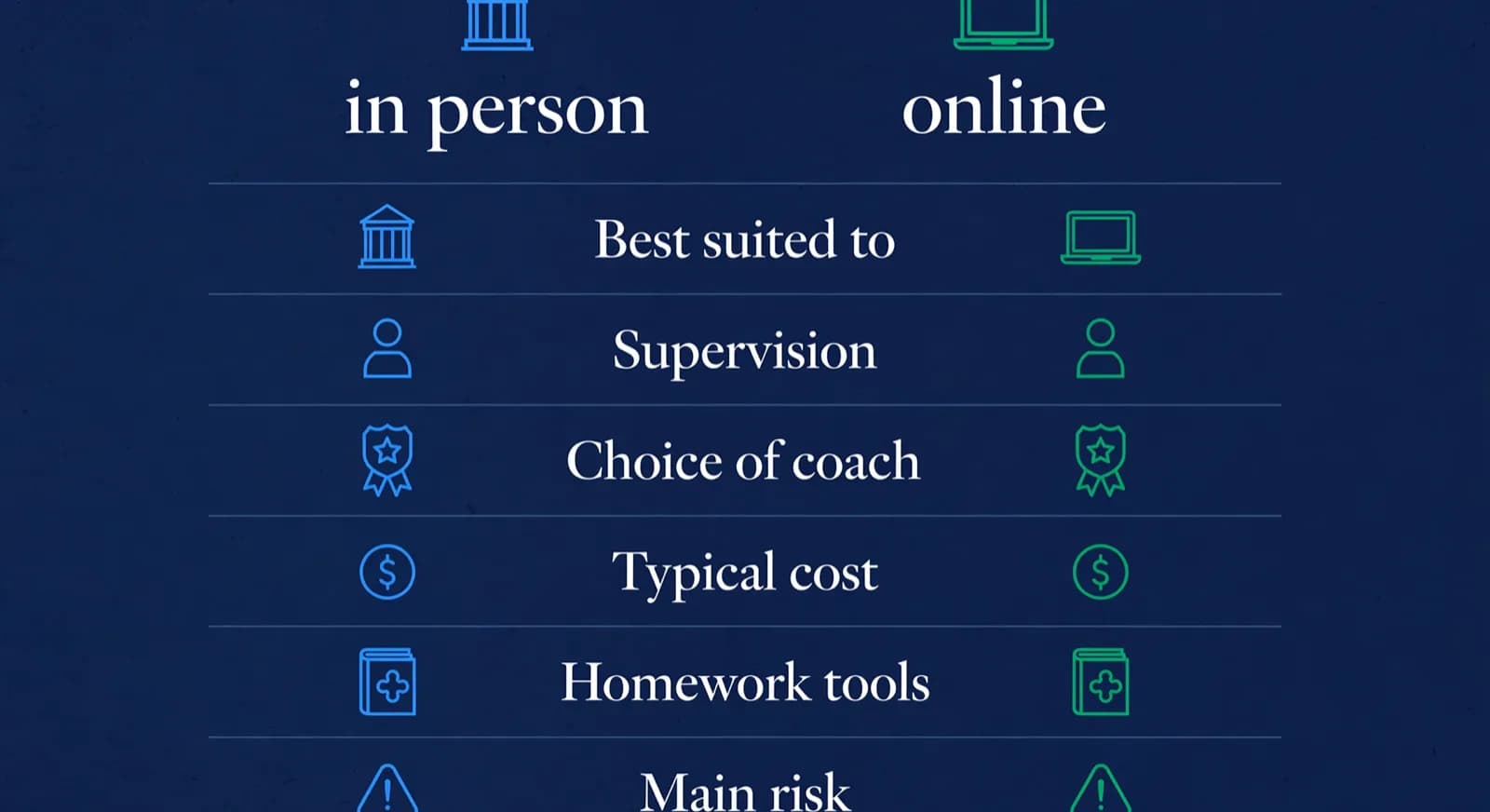
| Factor | In person | Online |
|---|---|---|
| Best suited to | Children who benefit from direct supervision | Children comfortable participating through a screen |
| Supervision | An adult physically in the room | Depends on you being nearby |
| Choice of coach | Whoever teaches locally | The best coach in any city |
| Cost to compare | Tuition plus travel and required materials | Tuition plus equipment and required subscriptions |
| Homework tools | Books, boards, worksheets | Free Lichess lessons and puzzles [2] |
| Main risk | Limited local options | Attention drifting off camera |
Test attention rather than assuming it. Does a young child stay engaged on a screen for the whole trial lesson, and is a parent expected to sit nearby? ChessKid, for example, states that it has no chat, auto-generated usernames and child activity reports, and that 2000+ schools use it [1], so ask whether the online class teaches on a child-focused platform or an open one. Older students can ask a different question: does the class point to real games on Lichess or Chess.com and use a live rating sensibly [2][3]? If you lean online, our guide to chess for kids at home covers how to support practice between lessons so class time is not spent re-teaching the basics.
How do you judge a chess coach's credibility?
Judge a chess coach on teaching ability first and playing strength second: the skill you are paying for is the ability to explain a child's mistake in one plain sentence and keep them engaged, not the coach's own tournament results. A strong club player who teaches beginners patiently is a better choice for a six year old than a titled professional who cannot hold the room. Watch a coach with children before you read their rating.
Credentials do carry some information, so it helps to know what they mean. Parents often confuse two different things. The first is a playing title (Candidate Master, FIDE Master, International Master, Grandmaster), earned through rated tournament results under FIDE's system [4]. A playing title shows the coach is strong. It does not, by itself, show they can teach a distracted eight year old. The second is a trainer title, awarded by FIDE's Trainers' Commission after seminars and an exam. FIDE says it can be regarded as a certified trainer where a jurisdiction requires one, and only a trainer with a valid licence may use the title as an official certification [5]. So ask whether the licence is current, and read our guide to chess coach certification routes for the detail. For competitive, rated juniors these credentials matter more, and in India the pathway into rated play runs through the All India Chess Federation, so a coach who works with tournament children should be able to explain that route to you [7].
| FIDE trainer title | What FIDE says it is for | What to ask |
|---|---|---|
| Developmental Instructor | Trainers who teach the first steps and bring a player to a FIDE-rated tournament; typically teaching players rated up to 1200 [5] | The usual title to expect for a beginner class. Ask for the licence and how long the coach has taught beginners |
| National Instructor | Trainers who can grow talent for national and international cadet and regional youth championships; typically players rated 1201 to 1700 [5] | Ask which championships past students entered |
| FIDE Instructor | Trainers who improve a student's foundation for national, regional and international youth championships; typically players rated 1701 to 2200 [5] | Ask how the coach sets a study plan between lessons |
| FIDE Trainer | Trainers who played at a professional level and help students pursue title norms; typically players over 2200 [5] | Well beyond a first class, so ask whether the coach also teaches beginners |
| FIDE Senior Trainer | Awarded for distinct service to chess for longer than 10 years at a high level, and to classical world champions [5] | A recognition of service, so it says little about a particular beginner batch |
For most families choosing a first class, the useful questions are practical rather than about titles. Ask the coach who they usually teach, because a coach whose students are mostly your child's age and level will have a curriculum that fits. Ask how they handle a child who is struggling or bored, because the honest answer reveals their teaching philosophy in a sentence. Ask to see, even anonymised, how they track a student's progress over a term, because a coach who cannot show you that has not been measuring it. Ask what a normal lesson looks like minute to minute, since a good coach can describe the shape of a class (a warm-up, one theme, guided play, a takeaway) without hesitating. And ask what happens between lessons, because improvement lives in the homework, and a class that sets none is really just supervised play. A coach who answers these calmly and concretely is showing you the thing that actually matters: that they have a system, they have taught children like yours, and they will tell you the truth about where your child stands. That is credibility you can verify, unlike a rating on a profile page that tells you how well the coach plays but nothing about how well they teach.
What group size and class structure should you look for?
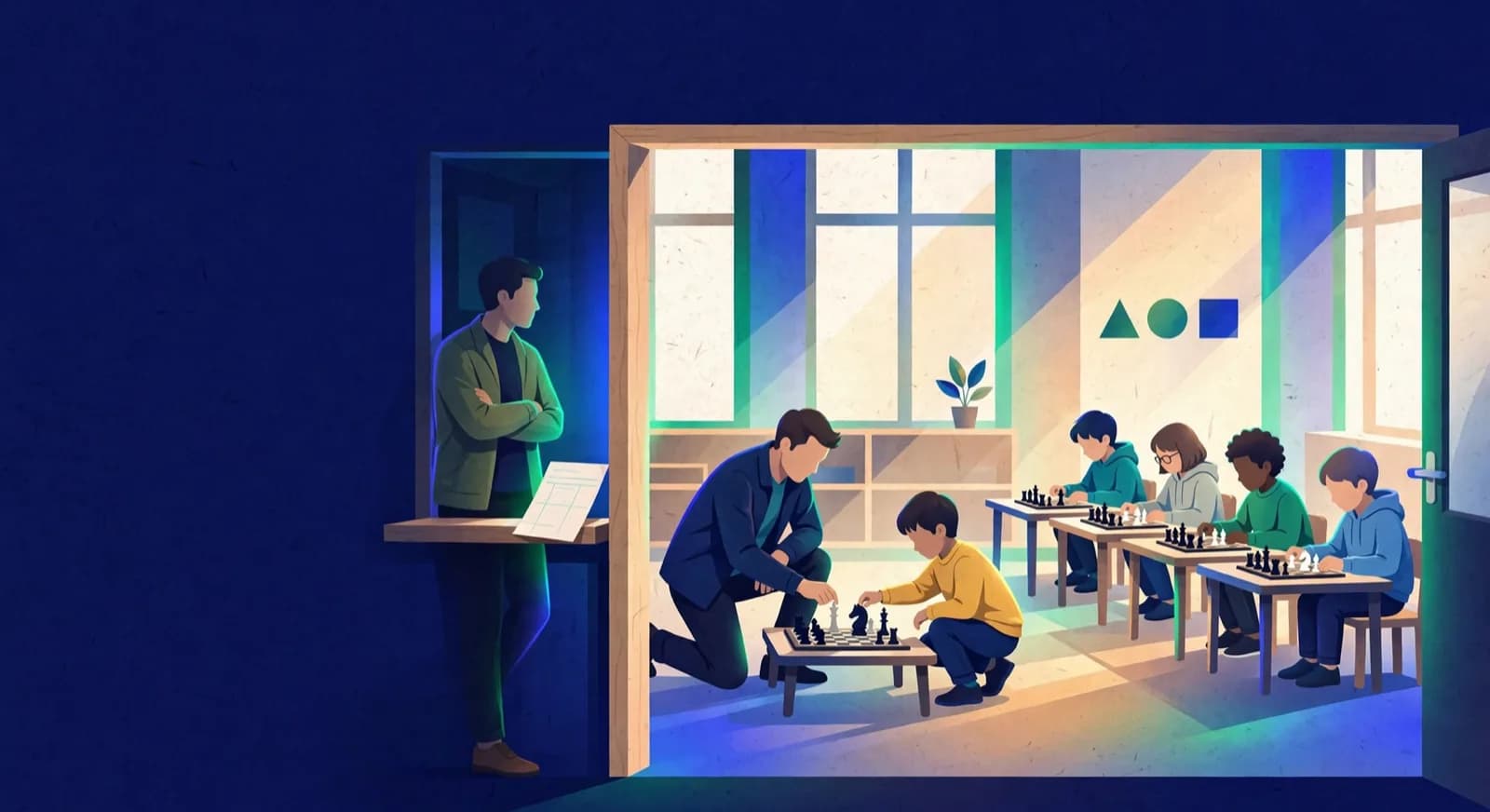
Look for a group in which your child gets time to think, play and receive feedback, with peers at a compatible level. Ask for the actual enrolled batch size and watch how the coach includes quieter children. A small advertised maximum is useful only if the lesson itself gives each learner attention.
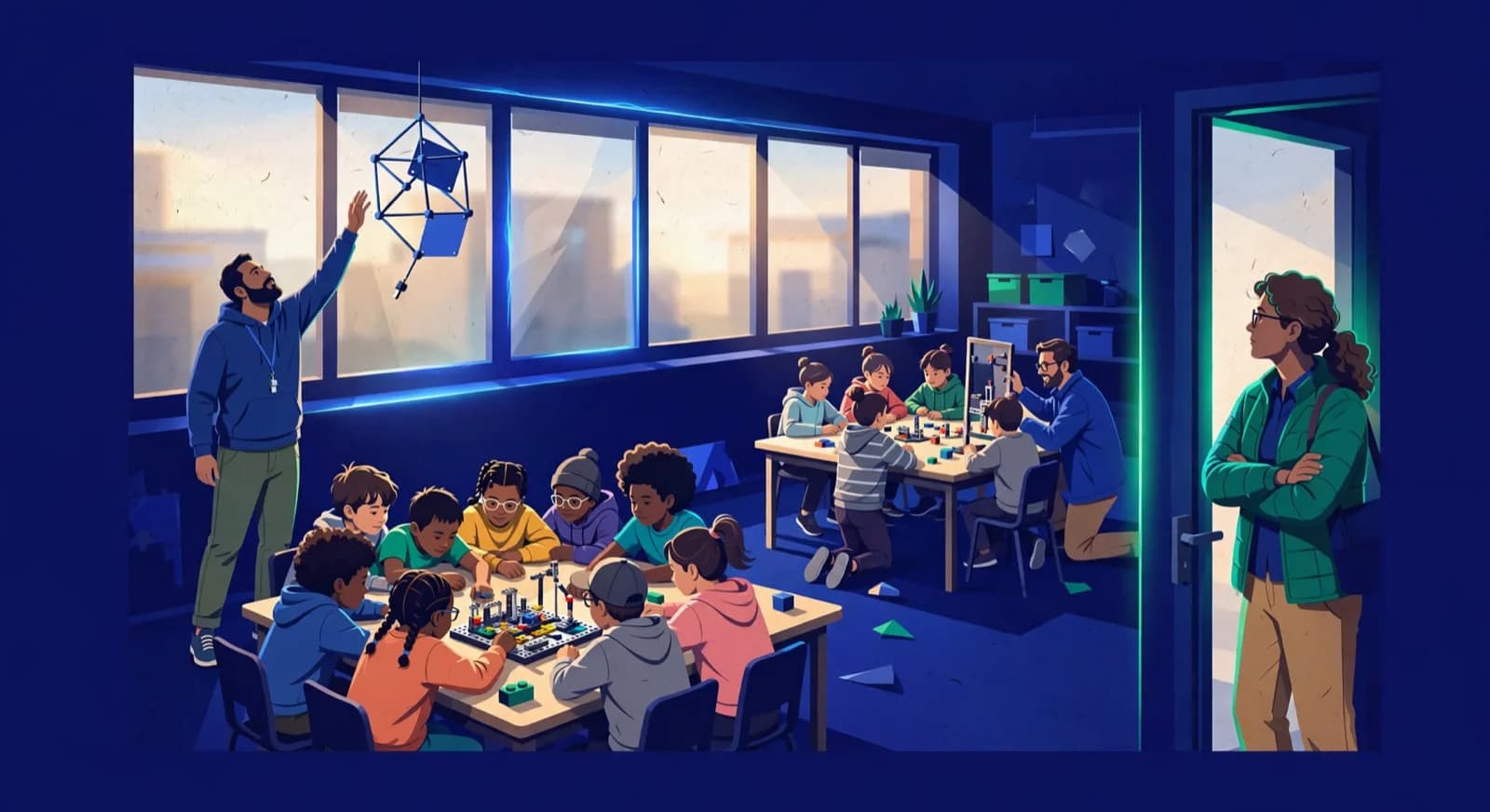
- Ask how many children are in the specific batch your child would join, not the maximum the class allows.
- Ask how children are grouped by level, and whether there is a path to move up when your child outgrows the group.
- Ask what one lesson contains: a warm-up, a single teaching theme, guided play, and a takeaway to practise at home is a healthy shape.
- Ask how absences are handled, because a make-up policy tells you whether the class respects the fees you pay.
- Ask what your child does between lessons, since puzzles and reviewed games are where the improvement actually happens.
Structure is what separates a class from a chess-themed babysitting hour. A well-run class repeats a recognisable weekly shape so children know what to expect and the coach is not improvising, and it sends every child home with something concrete: a puzzle set, a named checkmate pattern to show you, or a game to review. Ask to see an example of the takeaway and how the coach checks it at the next lesson. For the full anatomy of a well-run session, our guide to how a school chess club runs its sessions lays out the shape in detail. If your child is at a school that runs chess, our guide to scholastic chess explains how school programs and outside classes fit together so you are not paying twice for the same beginner content.

Lucas M.
Batch B2 · Thursdays · joined Aug 2025
1342
Academy rating · Lichess games synced
Won vs. 1410 · French Defense
Best gameMissed fork on move 23
Homework setHow should a good chess class report progress to parents?
A good chess class reports progress on a schedule and in concrete terms: attendance, what was taught, and an example of something your child can now do, not a vague reassurance that your child is doing well. Chess is hard for parents to evaluate directly, so clear reporting is how you find out whether the class is working. A report is evidence that the class tracks progress. It is not proof that the teaching is good.
Treat a rating as one piece of evidence, not a promise of steady improvement. Chess.com ratings respond to results, opponent ratings and rating uncertainty [6]; they do not tell you on their own whether the child can explain a plan, spot a threat or recover calmly after a loss. Ask the coach to show a recent game and describe what the child now does differently. If they present a rating chart, ask which platform and type of game it measures, and keep that context consistent when comparing progress. Our guide to showing parents rating progress explains how to discuss those numbers without turning every lesson into a score target.
Beyond the numbers, ask how and how often you will hear about your child. A short update after each block of lessons (what your child worked on, what improved, what to practise) is one good answer. Ask what happens if a problem comes up between updates, and who you can reply to privately. Ask for an anonymised example of a normal update, and compare it with what a useful progress report contains. A promise of constant communication with no clear owner or schedule is worth less than a modest rhythm that someone is responsible for. Ask whether the answer is written in the class terms, not only said at the trial.
Is the chess class safe, and what should you check?
Check safety on two fronts: the physical or online environment your child is in, and the platform they play on. For in-person classes, ask about supervision, the ratio of adults to children, and how the venue is run; for online classes, ask which platform is used and how contact between children and strangers is limited. Safety is not paranoia, it is a basic question any responsible class expects and answers without defensiveness.
For young children playing online, the platform is part of the safety question. ChessKid states that it has no chat, auto-generated usernames and child activity reports [1]. The mainstream sites are open to the public, so ask a class that uses them how contact with other players is limited and whether a parent can watch [2][3]. If your child has attention or focus differences, our guide on whether chess is good for children with ADHD covers how structure and the right environment change the experience.
How much do chess classes for kids cost, and what is worth paying for?
Compare the complete cost of the classes you are considering, including the billing period, lesson length, materials and any required subscriptions. Get the quote in writing and ask about missed lessons, refunds and renewal. Do not assume a typical local price, or that online tuition is automatically cheaper; compare the written quotes you actually receive.
Cost per class is more useful than the headline monthly fee, and cost per teaching hour is more useful still when lessons differ in length. Divide the total monthly cost, including any mandatory extras, by the classes you actually receive, then divide by the hours taught. The quotes below are hypothetical, to show the method; they are not a price survey, and we are not quoting any real class. For what academies in India actually charge, see our guide to what chess academies in India charge.
| Hypothetical quote | Monthly cost | Classes and length | Teaching hours | Cost per class | Cost per teaching hour |
|---|---|---|---|---|---|
| A: group | $120 plus $96 a year in mandatory materials, so $128 a month | 8 classes of 60 minutes | 8 | $16 | $16 |
| B: small group | $192 | 8 classes of 60 minutes | 8 | $24 | $24 |
| C: group, shorter lessons | $144 | 12 classes of 45 minutes | 9 | $12 | $16 |
| D: private | $40 a session, 4 sessions | 4 classes of 60 minutes | 4 | $40 | $40 |
Class C looks cheapest per class at $12, but once lesson length is counted it costs the same per teaching hour as class A, at $16. Now test the denominator. If class A cancels 2 of its 8 lessons and offers no make-up or credit, the same $128 buys 6 classes, about $21 each. So ask in writing what happens to the fee after a cancellation, whether by the academy or by your family, and read how missed lessons and make-ups are handled in the written terms before you pay.
Decide your budget from what your child needs, not from the lowest advertised rate. A young beginner who mostly needs enjoyment, structure and a habit may be well served by an affordable, well-run group class, which is a sound choice and not a compromise. Ask whether a motivated child who has outgrown the group and wants to play rated events would gain from a stronger coach or some private time. Free tools do a lot of the practice work: Lichess lessons and puzzles cost families nothing and a class can lean on them for homework, so what you are paying the coach for is teaching and feedback [2].
How do you compare chess classes before you commit?
Compare chess classes with one ordered checklist so every option is judged on the same things rather than on whichever website looked nicest. Two checks come first and work as gates: safety and written terms. If either is unresolved, do not enrol, however good the teaching looked. Then compare the rest, and compare cost last.
- Safety (gate): who supervises, which platform is used for young children, is there a safeguarding policy you can read, and can you observe a class?
- Written terms (gate): do you have the fee, lesson length, make-up, cancellation and refund terms in writing before the first payment?
- Coach: did you watch them teach children, and did they explain at least one idea in plain language a child understood?
- Format and group: does online or in person suit your child, and how many children are in the actual batch, and are they close to your child's level?
- Structure and progress: does a lesson have a clear shape, does your child leave with something to practise, and can the class show attendance and a skill example over time?
- Communication: how and how often will you hear about your child, and can you reply easily?
- Cost: is the price fair for the coach, group size and reporting you are getting, judged last?
After comparing classes and observing a lesson, write down which option best fits the needs you identified. If the cheaper class teaches well and fits your routine, cost is a valid reason to choose it. If the more expensive class offers feedback your child needs, ask whether that difference justifies the commitment. Our guide to how a well-run academy operates describes attendance, reporting and communication from the other side of the board, if you are curious what good looks like behind the scenes. For everything else on choosing well for a child, our full set of guides for parents is the place to start.
Parent updates · this week
14 of 14 sentWeekly recap · Lucas M.
Lucas attended Thursday's class and won 2 arena games. His September report is in your portal.
Receipt · October fee
$180 received via card AutoPay. Receipt saved.
9:42 AMRecap approved by Coach Elena
Open the guardian portal
Own login · nothing to install
| Record during the trial | What to write down | Unresolved if |
|---|---|---|
| Coach and batch | Coach name, day and time, number of children, level of the group | The trial used a different coach or a demo group from the regular batch |
| What the coach did | Whether the coach explained one idea in plain words, let the child try it and responded to a mistake | Only the coach talked, or quiet children never got a turn |
| What your child could explain | Ask your child afterwards to show one move or idea from the lesson | They can repeat words but cannot use the idea |
| Safeguarding | Who supervised, whether you could observe, whether a policy exists and you read it | Any question was dodged. Do not enrol until it is answered |
| Written terms | Fee, lesson length, make-ups, cancellation, refund | Terms are only verbal. Do not pay until they are written |
| Still unverified | What the trial could not show, such as how the coach reports over a full term | You cannot name it. Ask for a second observation |
Keep it as a record, not a score. A weighted total can hide a serious problem: a class with excellent teaching and no written terms should not win because it scored well elsewhere. The table above shows what to write down during a trial and which gaps should stop you from enrolling.
Frequently asked questions
What should I look for in a chess class for my child?
Weigh a good coach, a group matched to your child's level, a clear lesson structure, honest progress reporting, sensible safety and a fair total cost. Treat safety and written terms as gates: if either is unresolved, do not enrol. Sit in on a trial class and use it as your chance to interview the class: did the coach explain an idea in plain language, did every child play or solve something, and did someone tell you afterwards what happens next.
Chess classes for kids near me or online: how do I compare them?
Build a shortlist from school activity listings, local clubs and provider websites, then compare the actual coach, batch level, participation, supervision and progress updates. For nearby classes include travel and pickup arrangements; for online classes check equipment and adult help. Ask for a trial or observation and a written total-cost quote, using the same checklist for each option.
How do I choose a chess coach for my child?
Judge teaching ability first and playing strength second, because the skill you are paying for is explaining a child's mistakes clearly and keeping them engaged. Watch the coach teach children before you read their rating, and ask practical questions: who they usually teach, how they handle a struggling or bored child, and what happens between lessons. FIDE trainer titles come with a licence, so ask whether it is current. Playing and trainer titles matter more for competitive, rated juniors than for a first beginner class.
What is the best chess class for a beginner child?
The best chess class for a beginner child is a small group of similar-level children with a patient coach who explains clearly, a repeatable lesson structure, and honest communication with parents, not necessarily the most expensive or most famous option. Beginners need enjoyment, structure, and a habit far more than tournament theory, so an affordable, well-run group class is genuinely the right choice at this stage. Save private coaching and stronger, higher-priced coaches for when your child has outgrown the group and wants to play rated events.
What ages are chess classes for, and how do I judge readiness?
Check the age and level accepted by the specific class rather than assuming a universal starting age. Watch whether your child can follow a short explanation, take turns and stay engaged when a move goes wrong. Ask how the coach changes activities and supports a child who needs help; a trial can reveal whether the format fits.
Do chess classes offer a free trial?
Ask each shortlisted class whether it offers a free trial, a paid introductory lesson or an observation. Do not assume trial access is included or that a trial creates no commitment. Confirm the charge, cancellation terms and whether your child will meet the regular coach and join the actual batch before booking.
Sources
- [1]ChessKid: chess for kids · accessed 2026-06-29
- [2]Lichess: free chess training and puzzles · accessed 2026-06-29
- [3]Chess.com · accessed 2026-06-29
- [4]FIDE: International Chess Federation · accessed 2026-06-29
- [5]FIDE Handbook: Regulations for the Titles of Trainers (effective from 20 December 2023), section 2 · accessed 2026-10-16
- [6]Chess.com: how ratings respond to game results and uncertainty · accessed 2026-10-02
- [7]All India Chess Federation · accessed 2026-06-29
Written by Abhishek Tiwari
ChessCore
Drafted with AI, fact-checked and approved by a human before publishing, the same guardrail our product applies to every report it sends. Read our editorial standards.
See what a well-run chess class looks like behind the scenes
ChessCore is academy management software for attendance, game reviews and human-approved parent updates. View a walkthrough to see examples of the records you can ask a class to show.
- Roster import from the spreadsheets you already keep
- Lichess and Chess.com connections, batches, and fee plans
- First reports in week one, after your approval
- Free plan, no credit card required