On this page9 sections, 18 min read
- What is scholastic chess?
- What do sections mean in scholastic chess?
- How do school chess teams and competitions work?
- How do scholastic chess ratings work?
- What does a scholastic chess pathway look like?
- How do school players enter the rated tournament system?
- How is scholastic chess different from a school chess club?
- What are US national scholastic chess events?
- How do I get a child started in scholastic chess?
- Frequently asked questions
Bottom line
Scholastic chess is chess organised for school-age players: clubs, school teams and competitions grouped by age or school grade. The grouping depends on the organiser: US Chess grade championships use K-12 sections, and in India national age-group events are run by the federation. Platform, national and FIDE ratings are separate pools, so a school result does not automatically become a FIDE rating.
TL;DR
- Scholastic chess is school-age chess, from clubs to age- or grade-based competitions, and the exact grouping and age limits are set by each organiser.
- It runs as individual and team events, and how a team score is formed depends on the event: board-order matches and summed individual scores are both used.
- Platform, national and FIDE ratings are separate pools, and age groups do not guarantee equal strength.
- A school chess club is the weekly teaching and play habit; scholastic competition is an optional layer that some club members enter, and most never need to.
- For India, check the specific organiser's notice for age cut-off, school or team eligibility, rating authority, membership and entry process.
Key facts
- FIDE is the international chess federation that administers the official rating and title system that competitive scholastic players climb toward.[1]
- The All India Chess Federation lists national age-group championships, such as a National Under 09 Championship held in July 2026, and separately lists international school events such as the Asian and Commonwealth Schools championships.[2]
- Many scholastic and open events use Swiss-system pairing, which lets a large field play a fixed number of rounds without early elimination.[5]
- At the December 2024 US Chess Grade (K-12) National Championships in National Harbor, Maryland, Thomas Jefferson High School won the 12th-grade team title on 16.5 of 21. This is a 2024 result, not a 2026 one.[8]
- The 2026 US Chess Grade (K-12) National Championships are scheduled for 11 to 13 December 2026 at Rosen Shingle Creek in Orlando, Florida, according to the US Chess events calendar.[7]
What is scholastic chess?
Scholastic chess is competitive and organised chess for school-age players, usually grouped into age or grade sections so children face opponents near their own level. There is no single international definition. US Chess groups its national grade championships by school grade from kindergarten to 12th grade, and Silver Knights, a US coaching vendor, describes it as clubs, tournaments and activities for K-12 students and other players age 20 or younger [6]. Those are US scopes. In other countries the term, the age limits and the organiser differ, so always read the specific event's rules. The common features are youth-level play, sections that keep games fair, and a competitive structure on top of ordinary school and club chess.
It helps to separate three layers that people often blur together. The first is casual school chess: a club, a lunchtime board, a lesson. The second is scholastic competition: inter-school matches, district and state championships, and national events where results are recorded. The third is the open rated system that adults and juniors share, administered internationally by FIDE [3] and, in each country, by a national federation such as the All India Chess Federation [4]. Scholastic chess is a bridge between the first layer and the third for children who want it, but a child can stay in the first layer for years, and many do.
For a teacher or parent, the practical meaning of scholastic chess is simple. It is the part of a child's chess that is measured. A club teaches the game; scholastic chess asks how the child performs against peers, tracks it, and gives the serious players a ladder to climb. Understanding the ladder, the sections, the team format, the ratings, and the pathway, is what lets you guide a keen child without either pushing too hard or missing the moment they are ready for more.
What do sections mean in scholastic chess?
A section is a separate competition within an event that groups players by age, grade, or rating so games stay fair and meaningful. A large scholastic tournament rarely runs as one giant field; instead it splits into sections such as under-8, under-10, under-12, and so on, and sometimes further by rating (an open section and a reserve or rating-limited section). Each section has its own standings and its own winners, so a strong seven-year-old is not thrown against a rated fifteen-year-old on day one.
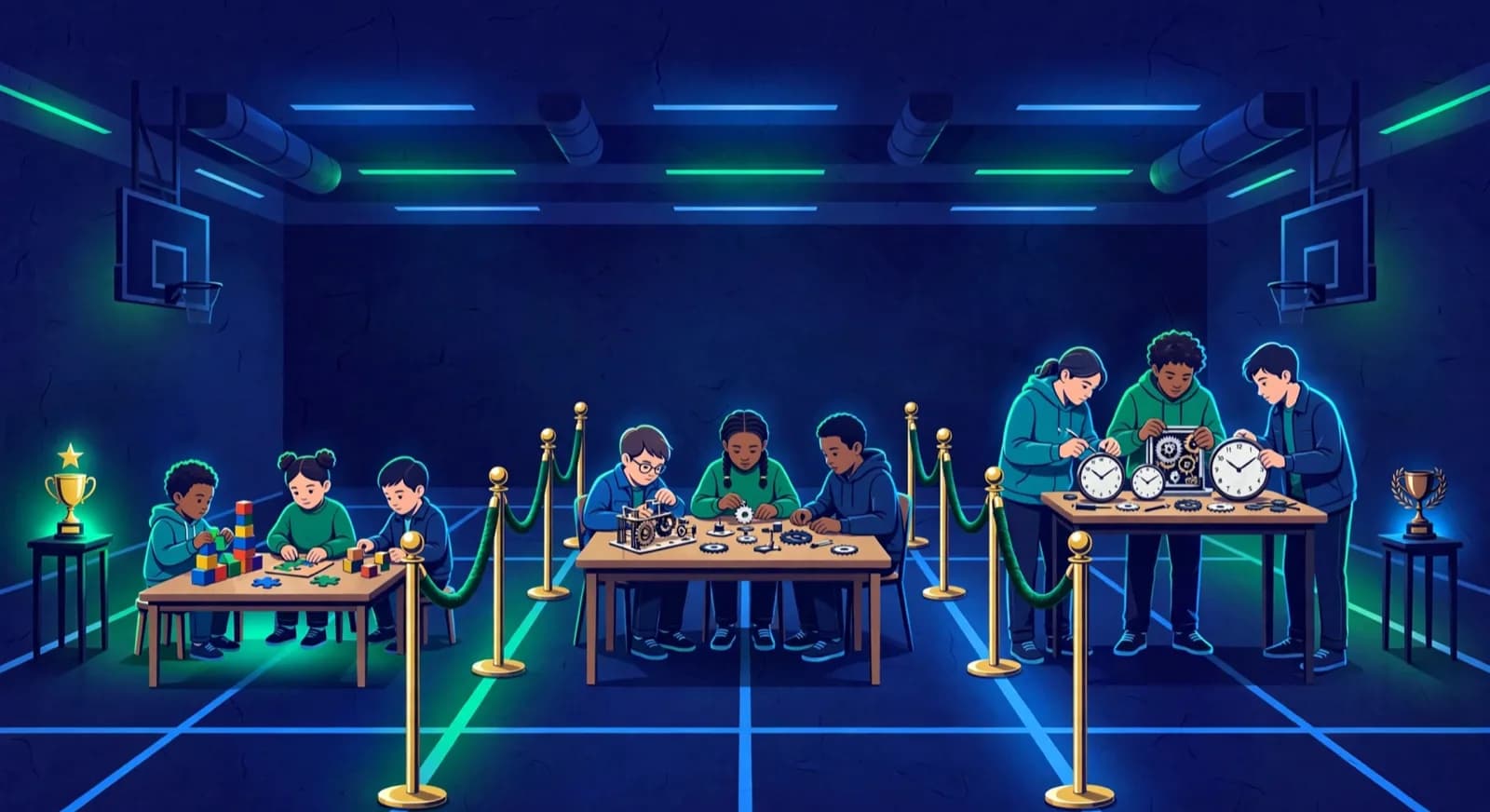
Sections exist for two reasons: fairness and development. A mismatch teaches neither player much, and a child who competes for a real placing in a section suited to them learns to handle pressure, clocks and disappointment. Section boundaries vary by organiser and country, so always read a specific event's rules. Age cut-offs are a good example. FIDE's 2026 World Cadets Championships use under 8, under 10 and under 12 categories, and a player must not have reached the 8th, 10th or 12th birthday respectively before 1 January 2026, so under 8 means born on or after 1 January 2018 [9]. An age group does not guarantee equal strength: two children of the same age can be hundreds of rating points apart.
| Section type | Grouped by | Typical example | Why it exists |
|---|---|---|---|
| Age sections | Player age on a cut-off date | Under-8, under-10, under-12, under-14 | Keeps young children with peers |
| Grade sections | School grade or year | Primary, middle, high school | Fits school-team structures |
| Rating sections | Current rating band | Open, under-1400, unrated | Balances experienced and new players |
| Team sections | School or squad, within an age band | Under-12 team event | Lets schools compete as units |
For a parent, enter a child in the section that fits their age and experience, not the one that flatters them, and read the notice for how sections are drawn. A first-time competitor in an unrated or reserve section, where one exists, may have a better weekend than the same child overmatched in an open section. Moving up a section is a choice the organiser's rules and the child's confidence decide, and it does not prove progress on its own.
How do school chess teams and competitions work?
A school chess team is a fixed set of players whose individual results are combined into a team result, but how they are combined depends on the event. In a board-order match, board one plays the opposing board one, board two plays board two, and so on, and the school with the higher combined board score wins the match. In some events, such as the US grade championships, players enter the same individual section and the school's team score is built from its best individual scores there. School chess competitions are the events, leagues and championships where teams meet, from an informal inter-school match to a national schools championship.
Board order matters more than newcomers expect. Many team events ask a team to be seated in rating or strength order, strongest on board one, so a school cannot stack a weak top board to steal points lower down; the event's rules say what applies. Reserves cover absences, and the captain manages who plays which round. Team chess rewards depth, not just one star player, and gives every child on the squad a real, countable contribution.
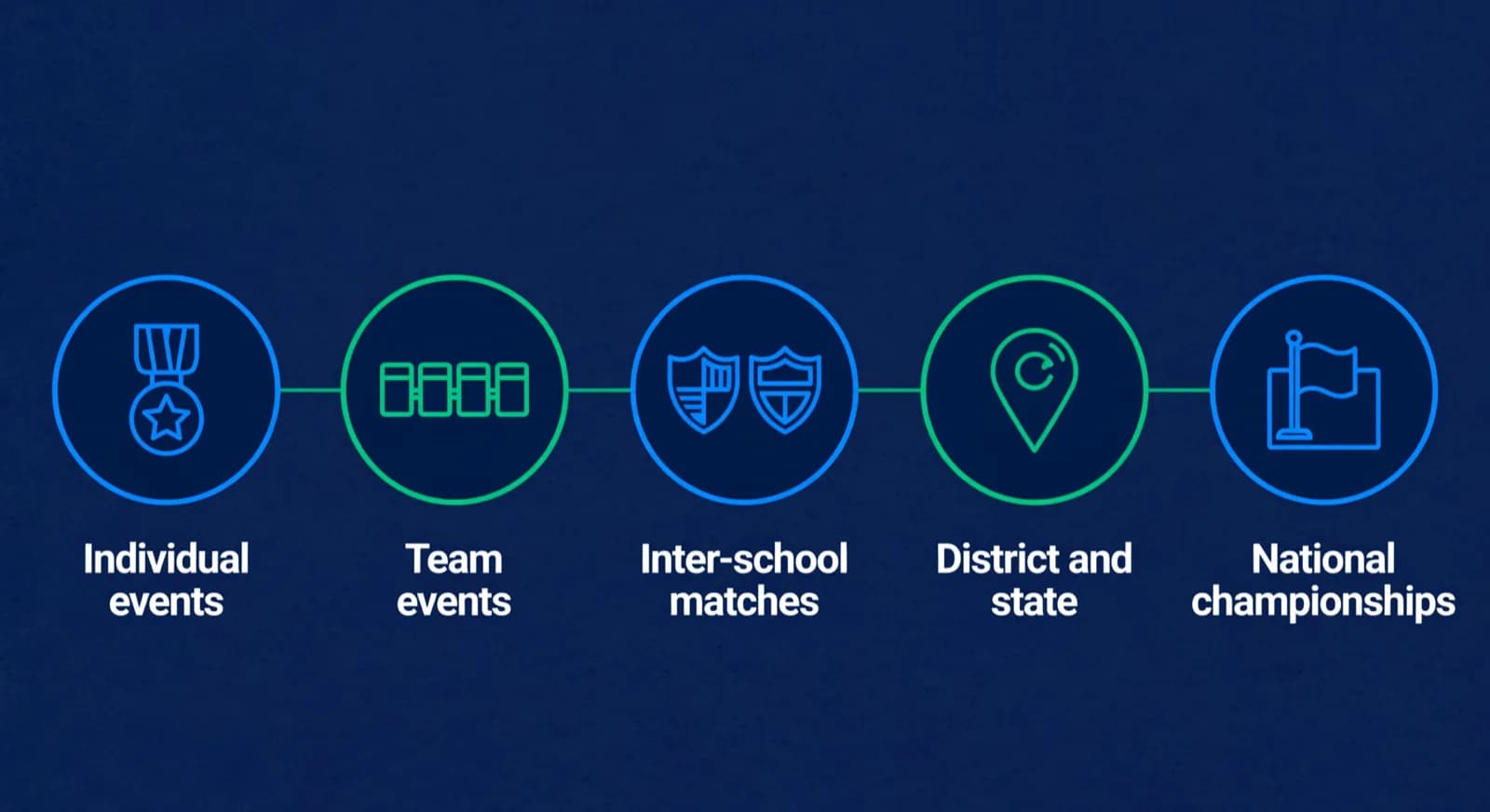
- Individual events: each child competes for their own placing within an age, grade, or rating section.
- Team events: a school fields a set number of boards and the team result is the sum of the individual board results.
- Inter-school matches: two schools meet across matched boards, often as a league fixture or a friendly.
- District and state scholastic championships: qualifying events that feed regional and national competition.
- National school championships: the top scholastic events, where strong teams and individuals compete for national placings.
Formats differ, but two pairing systems dominate scholastic play. Small fields often use a round-robin, where everyone plays everyone. Larger fields use the Swiss system, which pairs players on equal scores each round so a big group can play a fixed number of rounds without anyone being knocked out early [5]. Knowing which format an event uses tells you how many games your child will get and how the standings will move, and our companion guide to how Swiss-system pairing works walks through it in plain language.
| Format | Illustrative example | Result |
|---|---|---|
| Board-order match, four boards | School A beats School B on board 1 (1 point), draws board 2 (0.5), loses board 3 (0), wins board 4 (1) | School A 2.5, School B 1.5: School A wins the match |
| Summed individual scores, seven rounds, three counted players | School A's counted players score 6, 5 and 4.5; School B's score 5.5, 5 and 4 | School A 15.5 of 21 against School B 14.5 of 21: School A ranks higher |
Both examples are invented to show how the arithmetic differs, and neither describes a real event. How many players count, how ties are broken, and what a draw is worth all depend on the event, so do not carry one event's three-player score over to another national scholastic event. Read the regulations before you pick a team.
How do scholastic chess ratings work?
A rating is a number that estimates a player's strength from results against other rated players, rising when they beat stronger opposition and falling when they lose to weaker. A school player can carry several ratings at once: an online rating from a platform, an academy rating if a club keeps one, a national federation rating, and a FIDE rating. These are separate pools calculated from different games, with different formulas and different starting points, so they are not interchangeable.

Lucas M.
Batch B2 · Thursdays · joined Aug 2025
1342
Academy rating · Lichess games synced
Won vs. 1410 · French Defense
Best gameMissed fork on move 23
Homework setOnline ratings update instantly and are a fine practice signal, but they do not count toward official lists. Official ratings are published by national federations and, at the top, by FIDE, which administers the international rating and title system [1]. A child earns an official rating by playing in rated events recognised by the relevant federation, and in India that federation is the All India Chess Federation [2]. A rating from one pool does not convert automatically into another, and only the official lists count toward titles and national selection.
For guiding a child, watch the trend and not the last game. One bad tournament dips a rating, and a rating can also rise or fall for reasons unrelated to readiness, such as the strength of the opposition. Keep a simple record of each event, the section, the score and the rating after it, and read it with what the child says about the games. A rating is one input, and it does not decide when a child is ready for a tougher section. The FIDE rating pathway in India covers how the official number is earned.
What does a scholastic chess pathway look like?
The scholastic chess pathway runs from a school club, through local and school competitions, into rated tournaments, and for the strongest players toward national selection and titles. It is a ladder, and most children stop at the rung that suits them, which is entirely healthy. A clear map of the rungs lets a teacher or parent meet a child where they are and offer the next step only when they want it, rather than pushing everyone toward the top or capping a keen player too early.
The first rungs are about habit and enjoyment. A child learns the game, joins a school club and plays casually, often online, where they may pick up a first platform rating. The club is the engine here: a regular time to play, a coach or teacher who reviews games, and friends at the board. Nothing on this part of the ladder needs a federation or a fee. It needs consistency, and it is where many scholastic players happily remain, getting real benefit from the game without ever entering a rated event.
The middle rungs are the competitive step. A child enters their first scholastic tournament in an age-appropriate section, plays timed, recorded games, and experiences a real result. From inter-school matches they move to district and state scholastic championships, and the ones who place there qualify onward. This is where team events matter: representing a school, sitting on a numbered board, and adding a point to a squad total teaches responsibility that individual play does not. It is also where a young player decides, for themselves, whether they enjoy competition enough to train for it, and that decision should be theirs.
The upper rungs are the rated and titled system, shared with adults. Here a player earns an official rating through federation-recognized events, and the strongest pursue norms and titles administered internationally by FIDE [1], entering that system in India through the All India Chess Federation [2]. Very few scholastic players reach this level, and that is the point of understanding the whole ladder: it lets you support the many who stop lower down as warmly as the few who climb. Our pillar on starting a school chess program covers building the club that feeds this pathway, and the guide to running a scholastic chess tournament covers organizing the events on the middle rungs.
Lucas M. · first session to today
Every game, report, and payment on one timeline
Aug
Joined at 1240Nov
First tournamentJan
Back-rank drills setOct
1342 · October report drafted
How do school players enter the rated tournament system?
School players enter the rated system by registering with their national federation and playing in rated tournaments it recognizes. The exact steps depend on the country, but the shape is consistent: the national federation, such as the All India Chess Federation in India [2], maintains the rating list and sanctions rated events, while FIDE administers the international rating and title system above it [1]. A player earns an official rating from their results in those recognized events, and from there the ladder toward norms and titles is the same one adults climb.
The practical sequence for a keen player is usually: keep playing and improving through the school club and online, then, when the child wants more, register with the national federation and enter a first rated event. There is no rule that a child must win school or local events first. What matters is the specific organiser's notice, which sets who can enter. An unrated player has to play rated games before a first official number is published. The India-specific steps, federation registration and the route to a first FIDE-recognised rating, are laid out in our guide to the FIDE rating pathway in India.
In India, read two kinds of notice carefully. The All India Chess Federation's website lists national age-group championships, such as a National Under 09 Championship held in July 2026, and also lists international school events, such as the Asian and Commonwealth Schools championships [2]. They are different kinds of event with their own entry rules. A school-only competition is usually set up by its own organiser, so use that organiser's official page. Before entering any of them, check the fields in the table below in the actual notice.
| Field to find in the organiser's notice | What to look for |
|---|---|
| Age cut-off | The date the age is counted from and the youngest and oldest birth years allowed |
| School or team eligibility | Whether the event is for schools only, for clubs, or for individuals, and what proof of enrolment is needed |
| Rating authority | Which list the event is rated on: AICF, a state association, FIDE or none |
| Membership and registration | Whether the player needs an AICF or state registration, and a FIDE ID, before entering |
| Entry process | Where and by when to enter, the entry fee, and whether the organiser requires a team list in advance |
How is scholastic chess different from a school chess club?
A school chess club is the weekly teaching and playing habit; scholastic chess is the competitive layer that clubs feed into. The club is where children learn the game, play casually, and build the routine. Scholastic chess is what happens when some of those children start entering organized, recorded competition in age or grade sections. They are not rivals, they are two stages of the same activity, and a strong scholastic scene almost always sits on top of a healthy club.
The reason the distinction matters is that they need different things from the adults running them. A club needs a reliable time, space, boards, and someone to keep it welcoming, and most of its members will never compete, which is fine. Scholastic competition needs entries, travel, section choices, and a way to track results and ratings over a season. If you are setting up the weekly habit, our pillar on starting a school chess program is the place to begin, and our guide to running a school chess club covers keeping it alive week to week. If you are ready to take players to events, the tournament guides in the chess tournaments hub cover the competitive side, and the broader chess-in-schools hub gathers both.
What are US national scholastic chess events?
US national scholastic chess is run by US Chess as a set of grade and age-section championships through the year. The next grade championship on the calendar is the 2026 US Chess Grade (K-12) National Championships, scheduled for 11 to 13 December 2026 at Rosen Shingle Creek in Orlando, Florida [7]. These are US events, not a world calendar, and they sit beside the India and AICF pathway covered above. Check the event page for sections, dates and entry rules before booking, because the arrangements can change.
The point worth understanding before you enter a child is how a school earns a team result at these events, because it is not the league format most people picture. There are two distinct ways a team score is formed, and US national scholastics use the second one.
| Team format | How the team result is formed |
|---|---|
| League or Olympiad-style team match | Players sit in board order, board one against board one down the line, and the match awards match points for the combined board result |
| Individual-section team score | Players enter the same individual section and the school's team score is the sum of its top few individual scores from that section |
A past result shows how the individual-section method works. At the December 2024 US Chess Grade (K-12) National Championships in National Harbor, Maryland, Thomas Jefferson High School won the 12th-grade team title on 16.5 of 21 [8]. That is a 2024 result and not a 2026 one. No separate team match is scheduled: players compete in their own section, and the school total is built from individual scores. Other national scholastic events count a different number of players, so do not assume the same arithmetic elsewhere. If your family is in India, the useful next step is the AICF and FIDE rating pathway, not these US titles. Dates were last checked on 16 October 2026; confirm on US Chess before you book.
How do I get a child started in scholastic chess?
Start with a school or local club, then enter a beginner tournament once the child can move the pieces and deliver checkmate. That is the parent path on the Silver Knights starter page, a US coaching vendor's guide [6]. Keep the India and AICF rated pathway for later; the first job is a weekly habit the child still wants.
- Check the child's school for an after-school club, then search the nearest city chess club if the school has none [6].
- Use the first meetings to learn piece moves and simple play; Silver Knights says no prior knowledge is required to join a club [6].
- When the child enjoys the club, enter a tournament. Silver Knights says any child who knows how the pieces move and can deliver checkmate can enter, with sections usually by age and rating [6].
- Prepare the child for silence, clocks, scoresheets, and shaking hands after each game, which that same page lists as typical tournament expectations [6].
- If the family is in India and the child later wants rated games, use the AICF and FIDE pathway described above rather than these US national names.
The same Silver Knights page notes that many students take classes for years without entering a tournament, and that either path is fine if the child is having fun [6]. Build the weekly habit first, and do not rush a casual player into a national event list they did not ask for.
Frequently asked questions
What is scholastic chess?
Scholastic chess is organised chess for school-age players, grouped into age or grade sections and run as individual and team events. There is no single international definition: US Chess groups national grade championships by school grade from kindergarten to 12th, and a US coaching vendor describes it as clubs and tournaments for K-12 students and players age 20 or younger. In India, national age-group championships are run by the federation. Read each event's rules for its scope.
What does scholastic chess mean for a parent?
For a parent, scholastic chess means the part of a child's chess that is measured and competitive: organized events, age-appropriate sections, and results that can be tracked and rated over a season. A school club teaches the game casually; scholastic chess is the step where a child who enjoys it starts competing against peers and, if they want to, building a record. Your job is to understand the ladder well enough to offer the next rung when the child is ready, without pushing a casual player into competition they did not ask for.
How do scholastic chess sections work?
Sections split a scholastic event into separate competitions grouped by age, grade, or rating so games stay fair. A large tournament runs sections such as under-8, under-10, and under-12, sometimes divided further into open and rating-limited groups, each with its own standings and winners. Entering a child in the section that fits their age and experience, rather than the toughest one available, gives them a better competitive experience and teaches more than being overmatched would.
How do scholastic chess ratings work?
A rating estimates a player's strength from results against other rated players. A child may carry an online rating, an academy rating, a national federation rating and a FIDE rating, and these are separate pools calculated from different games, so they do not convert automatically. Only official lists count toward titles and selection. Watch the season-long trend instead of any single game, and remember a rating can rise or fall for reasons unrelated to readiness.
What are school chess competitions?
School chess competitions are the organised events where school players and teams compete, from inter-school matches and leagues to district, state and national championships. Team results form in more than one way. In a board-order match, board one plays board one and the combined board score wins. At US grade championships the players enter the same individual section and the school's score is built from its best individual scores: at the December 2024 K-12 Nationals, Thomas Jefferson High School won the 12th-grade team title on 16.5 of 21. Read each event's rules, because counted players and tie rules differ.
Is scholastic chess the same as a school chess club?
No. A school chess club is the weekly habit of teaching and casual play, while scholastic chess is the competitive layer of organized, recorded events that clubs feed into. Most club members never compete, which is perfectly healthy, and the ones who do move into scholastic tournaments in age or grade sections. The two work best together: a warm, consistent club is what produces competitive players over time, so building the club comes first and chasing competition comes second.
Sources
- [1]FIDE: International Chess Federation · accessed 2026-06-28
- [2]All India Chess Federation · accessed 2026-06-28
- [3]FIDE (International Chess Federation) · accessed 2026-06-28
- [4]All India Chess Federation · accessed 2026-06-28
- [5]Swiss-system tournament · accessed 2026-06-28
- [6]Silver Knights Chess Academy (US coaching vendor): How to get started with scholastic chess · accessed 2026-10-02
- [7]US Chess Grade (K-12) National Championships 2026, National Events Calendar · accessed 2026-10-16
- [8]US Chess: National Champions Crowned in National Harbor (December 2024 K-12 Grade Championships report) · accessed 2026-10-16
- [9]FIDE World Cadets' Championships cycle 2026 (under 8, 10 and 12): invitation and age eligibility · accessed 2026-10-16
Written by Abhishek Tiwari
ChessCore
Drafted with AI, fact-checked and approved by a human before publishing, the same guardrail our product applies to every report it sends. Read our editorial standards.
See how a season stays organised
ChessCore keeps student records, an academy rating history, attendance and a season timeline in one place. Book a walkthrough to see how a coach follows a season.
- Roster import from the spreadsheets you already keep
- Lichess and Chess.com connections, batches, and fee plans
- First reports in week one, after your approval
- Free plan, no credit card required