On this page7 sections, 18 min read
- What are the real benefits of chess for kids?
- Does chess actually improve focus and concentration?
- How does chess teach patience and problem-solving?
- Does chess help kids learn to handle losing?
- Is chess linked to better performance at school?
- What does honest progress look like, and how do you read it?
- How do you give your child the benefits without the downsides?
- Frequently asked questions
Bottom line
The benefits of chess for kids are mostly in the game itself: regular practice at concentrating, thinking before moving, planning a few moves ahead and coping with a loss. Research has not shown that these habits carry over to IQ or school grades, and the best-designed trial found no effect. Treat chess as a structured hobby that rewards patience and self-review.
TL;DR
- The clearest benefits of chess for kids are practised during the game: concentrating, thinking before moving, planning ahead and handling a loss without falling apart.
- Whether those habits carry over to schoolwork is uncertain: a meta-analysis found moderate effects, while a randomised trial of more than 4,000 children in England found none.
- Research on chess and ADHD is small and does not show that chess treats attention difficulties, so it is a hobby some children with ADHD enjoy, not a treatment.
- Children can start from roughly five or six, and the honest test of whether chess is helping is steady engagement and small visible progress, not trophies or a rating.
- A good chess class matters more than the game in the abstract: a patient coach, calm groups and clear communication with parents are what make the hobby last.
Key facts
- A meta-analysis by Sala and Gobet of 24 studies found a moderate overall effect of chess instruction on cognitive and academic skills (g equals 0.338), stronger for maths (g equals 0.382) than reading (g equals 0.248).[2]
- A randomised controlled trial of more than 4,000 children in England found no effect of chess instruction on maths, reading or science scores. Its comparison group received no extra activity, and the pupils were tested a year after the lessons ended.[3]
- Sala, Foley and Gobet report that almost no chess studies used active control groups, so the chess effect is yet to be convincingly demonstrated. They note that larger effects went with more hours of instruction across studies, which is an association between studies and does not show that any number of hours causes a gain.[4]
- Lichess offers a free, unlimited tactics trainer, so a child can practise problem-solving puzzles at their own level without any subscription or software cost.[1]
- FIDE administers the official rating and title system, so a child who takes competitive chess seriously has a long-term ladder to climb, though most children never need one.[5]
What are the real benefits of chess for kids?
The real benefits of chess for kids are mostly behavioural and social: the game gives children repeated practice at concentrating on one task, pausing before they act, planning a short sequence, coping with losing, and reviewing their own mistakes without shame. These are genuinely useful habits, and chess happens to be an enjoyable, low-cost way to rehearse them. What chess does not reliably do is make a child measurably smarter, so it is worth being clear about which claims stand up and which do not.
It helps to separate two kinds of benefit. The first is practised during chess and hard to dispute: a child who plays regularly gets better at chess, learns to sit with a problem for a few minutes, and gets more comfortable being wrong and trying again. The second is the transfer claim, the idea that skills built at the board carry over into maths, reading, attention in class or general intelligence. Transfer is where marketing outruns the evidence. A 2016 meta-analysis found moderate pooled effects, and the largest randomised trial, in England, found none. The sensible reason to start chess is that it is a good hobby your child likes, not that it will raise exam scores.
| Claimed benefit | Practised during chess | Shown to carry over outside chess | Source and limit |
|---|---|---|---|
| Focus and concentration | Yes: a game stops working if attention drifts | Not tested in the cited studies | The studies cited here measured maths, reading, science and general cognitive scores, not classroom attention [2][3] |
| Patience and thinking first | Yes: no take-backs makes a rushed move costly | Not tested in the cited studies | No cited study measured impulse control away from the board; this rests on how the game works |
| Problem-solving | Yes: puzzles and planning ahead | Uncertain | Pooled effect on cognitive skills was moderate (g equals 0.338) but almost no study had an active control group [2][4] |
| Handling losing | Yes: frequent, low-stakes losses | Not tested in the cited studies | Depends on how coaches and parents respond; no cited study measured it |
| Maths scores | Not a chess skill | Uncertain | g equals 0.382 across 24 studies [2], no effect in a 4,000-child randomised trial [3] |
| Reading scores | Not a chess skill | Weakly supported | g equals 0.248 in the meta-analysis [2]; no effect in the randomised trial [3] |
Does chess actually improve focus and concentration?
Chess gives children steady practice at concentrating, because a game stops working if you stop paying attention. Whether that focus carries over to homework or class is a separate question, and none of the studies cited in this guide measured it. What you can say is that a child in a serious game is concentrating hard for that stretch.
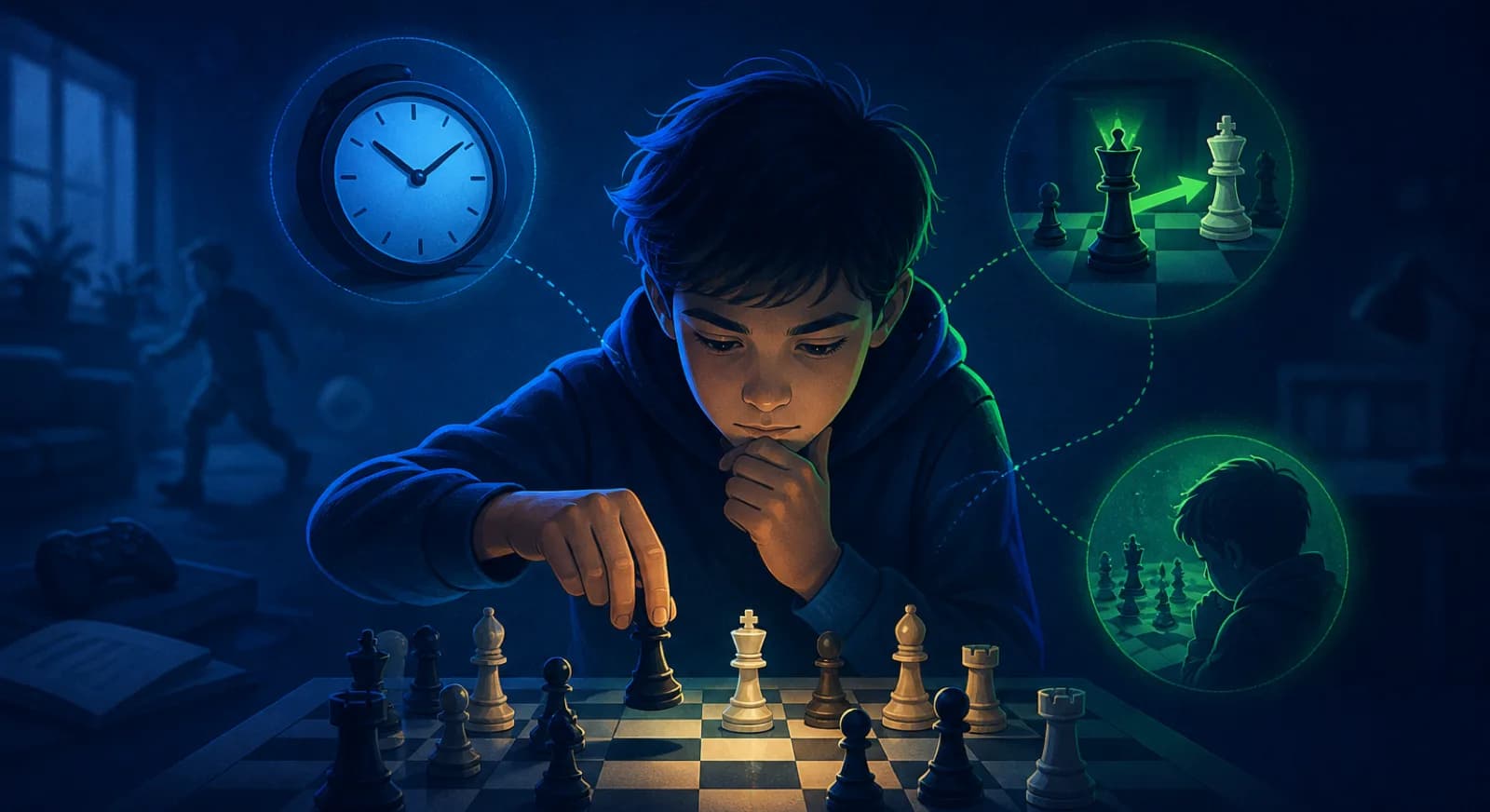
The mechanism is straightforward. In a real game there is always a threat to notice, a plan to remember and a consequence for a careless move, so attention is not optional the way it is when a child is half-watching a screen. Some parents report that their child can sit with one problem for longer after a few months. That is a parent's impression, not a measured outcome, and it may owe as much to age and to the child simply liking the game. It is also no proof that the same child now concentrates better in a maths lesson, because attention depends heavily on the task. Researchers call the hoped-for spillover far transfer, and it is the part studies struggle to confirm.
So the practical stance for a parent is to enjoy the focus you can see at the board without over-reading it. If your child learns to give a chess position their full attention for ten minutes, that is a small, real win in a world engineered to fragment their attention, and it is a habit worth protecting. If it also helps at school, treat that as a bonus you cannot bank on in advance. One thing that clearly helps focus is the format: calm, appropriately sized groups with a coach who keeps children thinking rather than waiting, which is one of the things worth checking when you choose a chess class for your child.
How does chess teach patience and problem-solving?
Chess teaches patience and problem-solving through its basic rules of play: you take turns, you cannot undo a move, and rushing is punished immediately by losing material or the game. That structure gives a child hundreds of small, low-stakes lessons in slowing down, weighing options, and living with a decision, which is the closest thing the game has to a guaranteed benefit.
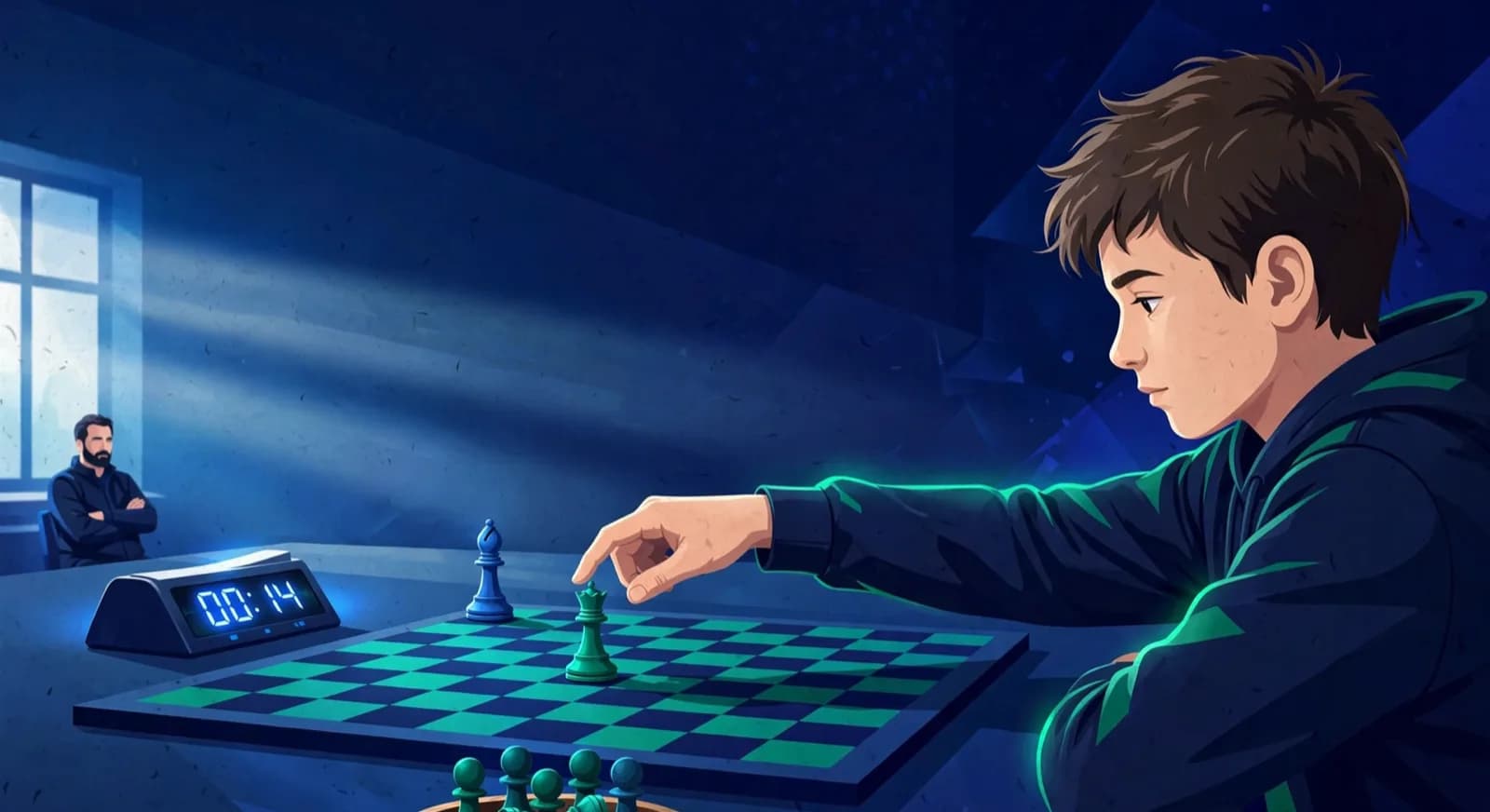
Patience shows up first as a behaviour at the board and, with a good coach, becomes a habit the child can name. Beginners move fast because they react to whatever just happened. Over time they learn to pause, check whether a piece is defended, and look for their opponent's reply before committing. That pause, thinking before acting, is the single most transferable-feeling thing chess drills, though even here you should be cautious about assuming it automatically shows up outside the game. Problem-solving works the same way. A tactics puzzle is a self-contained problem with a right answer the child can find by looking hard, and free tactics trainers make thousands of these available at a level that adjusts to the child, so practice never runs out and rarely costs anything [1].
- Turn-taking with no take-backs teaches a child that decisions have consequences they have to accept and work with.
- Checking whether a piece is safe before moving is a concrete, repeatable habit of looking before leaping.
- Tactics puzzles give a child a solvable problem with a definite answer, which builds the confidence that thinking harder actually pays off.
- Reviewing a lost game turns a failure into a specific, fixable mistake instead of a vague bad feeling.
- Planning even two or three moves ahead is early practice at holding a goal in mind while working toward it.
The deeper problem-solving benefit comes from review, not just play, and this is where a coach earns their keep. A child who only plays learns slowly by trial and error. A child who plays and then looks back at what went wrong, ideally with someone asking good questions, learns to diagnose their own mistakes, which is a more valuable skill than any single tactic. This is exactly the loop that structured coaching is built around, and it is why the quality of the teaching matters as much as the hours played. If you want your child to get the problem-solving benefit rather than just the fun of pushing pieces, look for a class or a home routine that includes going back over games, a habit our guide to chess at home explains how to build without any special equipment.
Does chess help kids learn to handle losing?
Chess can help children learn to handle losing, because it delivers frequent, clear, low-stakes defeats that are nobody's fault but their own, and that is a rare and valuable thing for a child to practise. There is no luck to blame and no teammate to hide behind, so a lost game is honest feedback, and how the adults around the child respond to those losses decides whether the experience builds resilience or just stings.
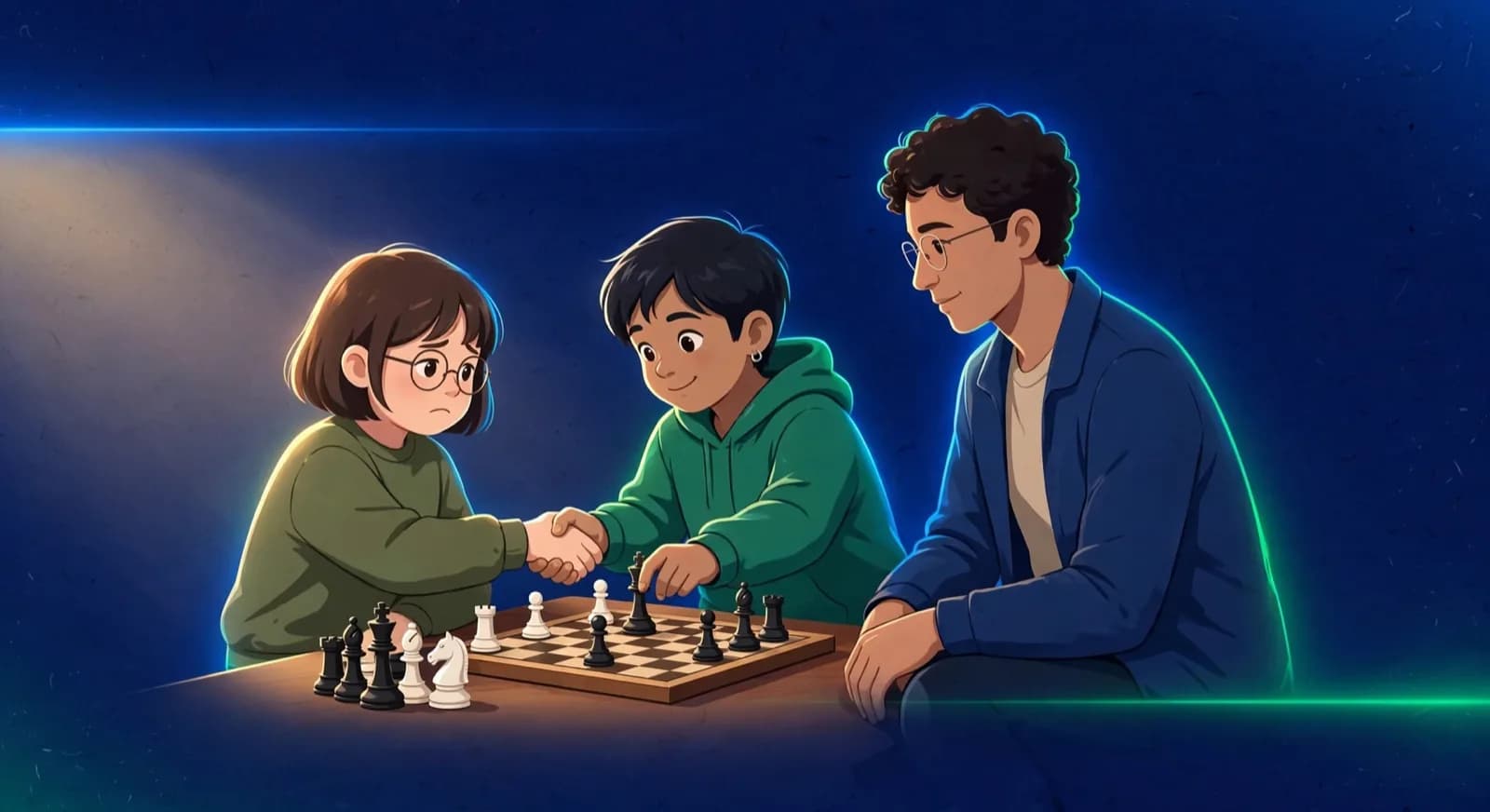
This is one of the most underrated benefits of chess for kids, and also one of the easiest to get wrong. Handled badly, losing at chess just teaches a sensitive child that they are not good at it. Handled well, it becomes a repeated, survivable rehearsal of disappointment: you lose, you shake hands, you look at what happened, and you play again in ten minutes. Because the losses are small and frequent, the emotional stakes are low enough that a child can actually build tolerance, in a way a single high-pressure exam never allows. The role of the coach and the parent is to keep the losses framed as information rather than judgement, so a defeat means here is the move that cost you, not you are bad at chess.
A caution worth stating plainly: competitive chess can also become a source of pressure, especially once ratings and tournaments enter the picture and a child starts tying their self-worth to a number. The same rating that makes progress visible can, in the wrong environment, make a child anxious about every game. Pressure is one reason children drop out of chess, and our piece on why students leave chess academies covers it. Watch for a child who stops wanting to play after losses rather than getting back up, and treat that as a signal to lower the temperature, not to push harder.
Is chess linked to better performance at school?
Chess is sometimes linked to better school performance, but the evidence is mixed and much weaker than popular claims suggest. A meta-analysis by Sala and Gobet of 24 studies found a moderate overall effect (g equals 0.338), larger for maths than reading [2], while a large randomised controlled trial in England found no effect on maths, reading or science [3]. Both can be true at once, because the studies differ in design, and the honest position is that chess might help a little at school and has not been shown to.
The trap is confusing correlation with cause. A child who plays chess and does well at school may simply be a child who would have done well anyway, and only a comparison against a control group can separate the two. That is the weakness Sala, Foley and Gobet highlight: almost none of the studies compared chess groups with an active control group doing some other engaging activity, so a placebo effect cannot be ruled out and the chess effect is, in their words, yet to be convincingly demonstrated [4]. An active control matters because a group that gets extra attention and a new activity may improve for reasons unrelated to chess. That does not mean chess is useless for school. A child who learns to focus, persist and review mistakes has built habits that could plausibly help in a classroom. It means you should not enrol a child in chess as an academic intervention expecting a grade bump, and you should not tell them chess is a chore done for marks.
| Study | Design | Sample | What it found | Limit |
|---|---|---|---|---|
| Sala and Gobet, 2016 meta-analysis [2] | Review of 24 studies, 40 effect sizes | 2,788 children taught chess, 2,433 controls | Moderate overall effect (g equals 0.338); maths g equals 0.382, reading g equals 0.248; larger with more training | Almost none of the reviewed studies used an active control group [4] |
| Jerrim et al., randomised trial [3] | Classes randomly assigned to chess or to no extra activity; scored on national exams a year after the lessons ended | More than 4,000 Year 5 children in England; about 1,965 taught chess and 1,900 controls [4] | No effect on maths, reading or science test scores | Sala, Foley and Gobet argue the one-year gap and a ceiling effect in the maths scores weaken the null result [4] |
| Sala, Foley and Gobet, 2017 review [4] | Commentary on methods, including the England trial | The same body of studies, reassessed | Effect yet to be convincingly demonstrated | Reassesses existing studies; it is not a new trial |
A common reading of the numbers is about dose. Sala, Foley and Gobet note that the meta-analysis found larger effects with more hours of instruction, and read 25 to 30 hours, about a lesson a week across a school year, as probably the minimum for a short-term effect [4]. That is an association across studies of different designs. It does not show that 25 hours causes a gain, and it does not show that fewer hours would do nothing in a particular child. The England trial gave pupils about that amount over a year and still found no difference [3], although the authors of the meta-analysis argue it tested too late to be compared with earlier studies [4]. The same split applies to what parents see: a parent's impression that a child focuses better is a different thing from a measured change in a test score, and the studies above only tell you about the second. A more dependable school benefit is smaller: a well-run club tends to give children a calm, engaged hour and a sense of belonging, which matters even if it never shows up in a test. Our overview of scholastic chess covers how school programmes are structured, and our guide to starting a school chess program covers the practical steps.
What does honest progress look like, and how do you read it?
You can tell chess is helping your child by watching two honest signals: steady engagement, meaning they still want to play after a few months, and small visible progress at the game itself. Trophies and ratings are not the measure at this stage, and a child who is enjoying chess and slowly improving is getting the benefit, whatever the scoreboard says.
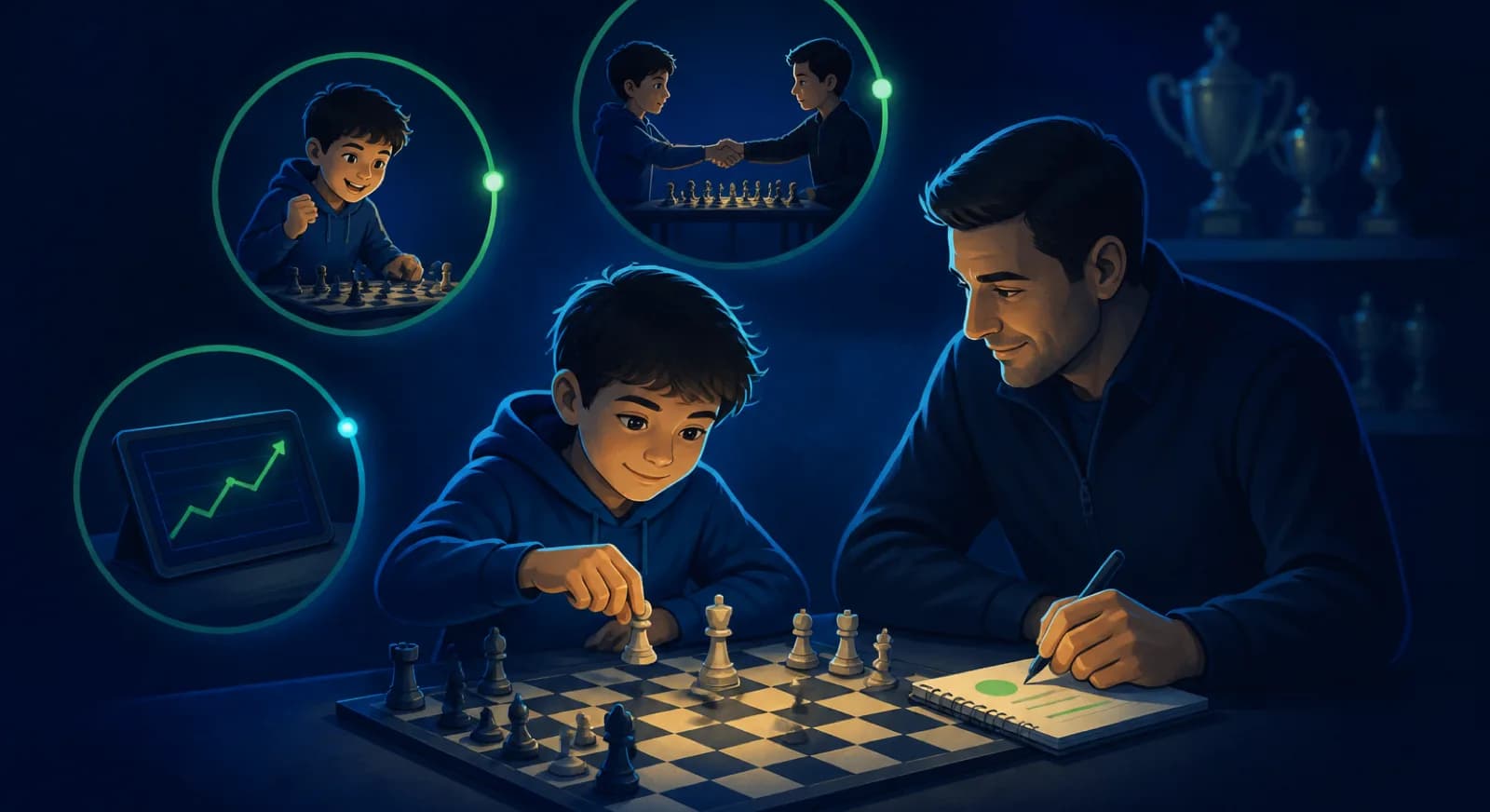
Progress in chess is easier to see than in most hobbies, which is a quiet advantage for a parent who wants to know whether the time is well spent. Once a child plays online or in a class that tracks results, they acquire an Elo-derived rating. It can rise, flatten or dip in a month, and a flat rating does not mean a child is learning nothing. Use it privately as a slow indicator, not as a stick. The human signals matter more. Picture a child who loses a game, then explains at the dinner table the one move they would change. Their rating has not moved, but they have just done what chess is good for: finding their own mistake and describing it. That is chess learning. It is not evidence of a higher IQ or better grades, and it is worth noticing for its own sake. This is an illustrative scenario, not a study result.

Lucas M.
Batch B2 · Thursdays · joined Aug 2025
1342
Academy rating · Lichess games synced
Won vs. 1410 · French Defense
Best gameMissed fork on move 23
Homework setThe other half of knowing whether chess is helping is simply being told what is happening in class, which is why the way an academy communicates matters as much as what it teaches. A short, honest note after a block of lessons, this is what we worked on, here is where your child is, is worth more to a parent than a wall of trophies, and it is the difference between feeling informed and feeling in the dark. When you are choosing where your child learns, the quality of that communication is a fair thing to ask about, and our guide to showing parents rating progress explains what informed, honest reporting actually looks like from the academy side.
How do you give your child the benefits without the downsides?
You give your child the benefits of chess without the downsides by keeping it a game they enjoy: low pressure at the start, a patient teacher, regular but unforced practice, and losses framed as lessons rather than verdicts. The benefits, focus, patience, and resilience, come from steady, happy engagement over time, and they evaporate the moment chess becomes a source of anxiety or a performance you are grading.
Two questions come up before families start. On age, there is no single right number: watch whether your child can take turns and enjoys short games, and our guide to the right age to start chess lists the readiness signs. On attention differences, the research on chess and ADHD is small and does not support treating chess as therapy, so read that guide before choosing chess for that reason.
In practice this comes down to a few choices. Start gently and follow the child's interest rather than a schedule. Choose the learning environment carefully, because a calm, well-run class with a coach who is kind about mistakes is the single biggest factor in whether chess becomes a lasting benefit or a brief, off-putting experience; our guide to choosing a chess class walks through exactly what to look for. Keep early play mostly non-competitive, and introduce ratings and tournaments only when the child is enthusiastic and steady enough to handle a loss. Mix supervised online tools, which are largely free, with real games against you or friends, so screen time is balanced by face-to-face play, and keep a child's online play in a parent-visible space rather than leaving them alone with any app [1]. And protect the fun ruthlessly: the fastest way to lose all the benefits is to turn a hobby into a chore in pursuit of gains that, as we have seen, the evidence does not even promise.
For children who take to chess and want to go further, the competitive pathway exists and is well worth understanding, but it is a choice, not an obligation. National and international federations run rated tournaments and a title system that a serious young player can aim at over years [5], and in India that pathway runs through the national federation and its affiliated events [6]. Plenty of children get the full benefit of chess without ever playing a rated game, staying with it as a hobby they enjoy and quietly improve at. Whether your child stops at the kitchen table or ends up chasing a rating, the thing that determines whether chess is good for them is the same: that it stays something they want to do. Our full library of guides for parents, from starting age to home practice, sits in the chess for kids topic hub if you want to go deeper on any one part.
Parent updates · this week
14 of 14 sentWeekly recap · Lucas M.
Lucas attended Thursday's class and won 2 arena games. His September report is in your portal.
Receipt · October fee
$180 received via card AutoPay. Receipt saved.
9:42 AMRecap approved by Coach Elena
Open the guardian portal
Own login · nothing to install
Frequently asked questions
Is chess good for kids?
Yes, chess is good for many kids as a hobby, mainly because it gives them regular practice at focusing, thinking before acting, planning ahead and handling a loss, all inside a game they enjoy. The honest caveat is that the habits are practised in the game, while the bigger claims, that chess raises IQ or guarantees better school grades, are not supported by the best-designed trial. Choose it because your child likes to think and play.
Does chess make kids smarter?
There is no strong evidence that chess makes kids measurably smarter or raises IQ. Children clearly get better at chess and at chess-related thinking, but a meta-analysis found only moderate effects on general cognitive skills, and almost none of its studies used an active control group. A randomised trial in England found no effect on school test scores. Treat any wider benefit as unproven rather than assumed.
What are the benefits of chess for children's development?
The most defensible developmental benefits are the habits chess practises: sustained attention to one task, thinking before moving, problem-solving through puzzles and planning, and recovering from frequent low-stakes losses. Whether these carry over to life outside chess has not been shown in the studies cited here. Chess can also give a sense of belonging to children who are not drawn to sport. How it is taught matters, and forced, high-pressure chess can cancel the benefits out.
Why is chess good for kids at school?
Chess can be good for kids at school less because it boosts grades, which the best-designed trial did not find, and more because a club offers a calm, engaging hour for thoughtful children who may not enjoy sport. Run well, a school chess club gives children a place to belong and rewards patience and review. Treat any gain in marks as a possible bonus, and remember that children who already do well at school may also be the ones who join.
At what age can a child start getting the benefits of chess?
Most children can start chess around five or six, once they can follow simple rules and sit with a short activity, though readiness varies more than age. Younger children can enjoy the pieces as play well before they grasp full rules, and there is no advantage in forcing an early formal start, which is the main way to put a child off. The benefits come from steady, enjoyable engagement over time, so it is better to introduce chess gently at whatever age the child shows interest and let their curiosity set the pace.
Is chess good for kids with ADHD?
Some children with ADHD enjoy chess because it is interactive and has clear consequences, and enjoying an activity is worth something. Research on chess and ADHD is small, though, and it does not show that chess treats ADHD or replaces professional care. For some children the competitive, lose-and-review side adds frustration, so introduce it gently, watch honestly and drop the pressure if it is not working. Our ADHD guide sets out the studies.
Sources
- [1]Lichess Puzzles: free tactics trainer · accessed 2026-06-29
- [2]Sala and Gobet, Do the benefits of chess instruction transfer to academic and cognitive skills? A meta-analysis, Educational Research Review 18:46-57 · accessed 2026-10-16
- [3]Jerrim et al., Does teaching children how to play cognitively demanding games improve their educational attainment? A randomised controlled trial of chess instruction in England · accessed 2026-10-16
- [4]Sala, Foley and Gobet, The effects of chess instruction on pupils' cognitive and academic skills: state of the art and theoretical challenges, Frontiers in Psychology 8:238 · accessed 2026-10-16
- [5]FIDE: International Chess Federation · accessed 2026-06-29
- [6]All India Chess Federation · accessed 2026-06-29
Written by Abhishek Tiwari
ChessCore
Drafted with AI, fact-checked and approved by a human before publishing, the same guardrail our product applies to every report it sends. Read our editorial standards.
See how a good academy shows parents real progress
Book a walkthrough to see how ChessCore keeps a child's attendance, rating history, and parent updates in one honest view, so families can tell whether chess is genuinely helping.
- Roster import from the spreadsheets you already keep
- Lichess and Chess.com connections, batches, and fee plans
- First reports in week one, after your approval
- Free plan, no credit card required