On this page8 sections, 19 min read
- What is a chess curriculum for schools?
- Where can I get a chess curriculum for schools PDF?
- How should a school chess curriculum be sequenced by level?
- What objectives should each level target?
- How do you fit the curriculum into the school's teaching calendar?
- How do you assess progress in a school chess program?
- What resources does a school chess curriculum need?
- How is a curriculum different from a lesson plan or a syllabus?
- Frequently asked questions
Bottom line
A chess curriculum for schools sets out what students learn at each level, in what order, and how teachers assess progress. Use a published curriculum as a starting point, or build a sequence around beginner, improver, and competitive bands. Match each term to an observable skill before moving students on.
TL;DR
- A curriculum is the multi-term plan, not a single lesson: it fixes the order topics are taught and the objective each term must reach.
- Sequence chess in three bands, beginner, improver, and competitive, and only move a group up when its objectives are met, not when the calendar says so.
- Every level needs written objectives, a short assessment, and a named resource, so a new or non-specialist teacher can deliver the same standard.
- Free tools carry a school program: Lichess studies hold your lesson boards and homework, and Lichess training drills tactics at each student's level.
- Rating is optional at the start: it records results against opponents, so use it as one trend beside observed tasks and never as a term grade.
Key facts
- Lichess studies are free shared analysis boards, so a school can hold an entire term of lesson positions and homework online at zero software cost.[1]
- Lichess training serves tactics puzzles adapted to a player's rating, which lets one curriculum give a mixed-ability class right-sized practice at the same time.[2]
- FIDE is the international chess federation that administers official ratings and titles, the ladder a school's most competitive students eventually climb.[3]
- The ECU Education Commission CiE package publishes a Teacher's Guide and classroom slides for 40 lessons, giving a non-specialist teacher a ready sequence to adapt.[6]
- ChessKid's curriculum page says its free chess curriculum is for use by schools, comes in English and Spanish, and may not be redistributed for commercial use.[8]
What is a chess curriculum for schools?
A chess curriculum for schools is a multi-term plan that fixes what students learn at each level, in what order, with a stated objective per term and a way to check whether they reached it. It is not a lesson and it is not a worksheet folder. It is the spine that keeps a program consistent across terms, teachers, and year groups, so a child who starts in one class and continues in another is not taught the fork three times and the endgame never. Ready-made packs are named in the next section; the six-term table later in this guide is the build-your-own sequence.
A workable school curriculum has four parts, and each one answers a question a head of department will ask. Scope and sequence answers what is taught and in what order. Objectives answer what a student should be able to do by the end of each level. Assessment answers how you know they can do it. Resources answer what a teacher needs in the room to deliver it. Get those four written down and a chess program stops depending on one enthusiastic teacher and becomes something the school owns.
This guide covers the whole arc, from a child's first game to a competitive squad, as a scholastic chess curriculum any school can adopt. It stays deliberately tool-light: the core stack is free, and nothing here needs a budget line to start. Where a single session needs building out in detail, that is a different document, and our chess lesson plan template covers one lesson end to end, while this guide stays at the term-by-term plan those lessons sit inside.
Where can I get a chess curriculum for schools PDF?
Three published packs cover most schools: the ECU Education Commission's CiE package [6], the Saint Louis Chess Club curriculum [7] and ChessKid's free curriculum [8]. Choose by the support your teacher needs: a lesson sequence, classroom activities, or training in how to teach them. Free to download does not mean free to reuse, so check each publisher's terms before you copy anything into your own materials.
| Pack | Published contents | Access and reuse, as the publisher states it | Teacher support |
|---|---|---|---|
| ECU CiE package [6] | ECU101 Curriculum: Teacher's Guide and classroom demonstration slides for 40 lessons, an 80-page course book and a puzzle set called the Chess Driving Licence | The package page does not state price or reuse terms; ask the Education Commission before copying or sharing material | A two-day training course certificated by the European Chess Union |
| Saint Louis Chess Club [7] | A curriculum covering the first 3-4 semesters of classroom instruction, developed in 2017-18 with Grandmaster Maurice Ashley, plus a curriculum by Grandmaster Yasser Seirawan | The club says it posts both for distribution; read the terms on its page before reusing | Instructional standards that the curriculum aligns with |
| ChessKid curriculum [8] | Essential questions with every concept, classroom activities and practice pages, and multiple pacing guides | Free for use by schools and not to be redistributed in any way for commercial use; English or Spanish via a download form | Tips for the teacher, coach or parent, and written for instructors new to chess |
Compare a sample lesson from each pack with your class length, equipment and your teacher's confidence before choosing one. These are different kinds of resource: the CiE package is a lesson set with a training course, the Saint Louis material is a multi-semester sequence, and the ChessKid download is a classroom curriculum with pacing guides. These details were current on 16 October 2026 and can change, so check each publisher's page.
Keep the six-term beginner, improver and competitive table in this guide if you need bands and observable objectives more than a branded script. A ready-made pack supplies lessons. The table supplies the promotion rule: move a group only when the objective is met, not when the calendar says so. Do not copy third-party PDFs into your own site or intranet unless the publisher's terms allow it.
How should a school chess curriculum be sequenced by level?
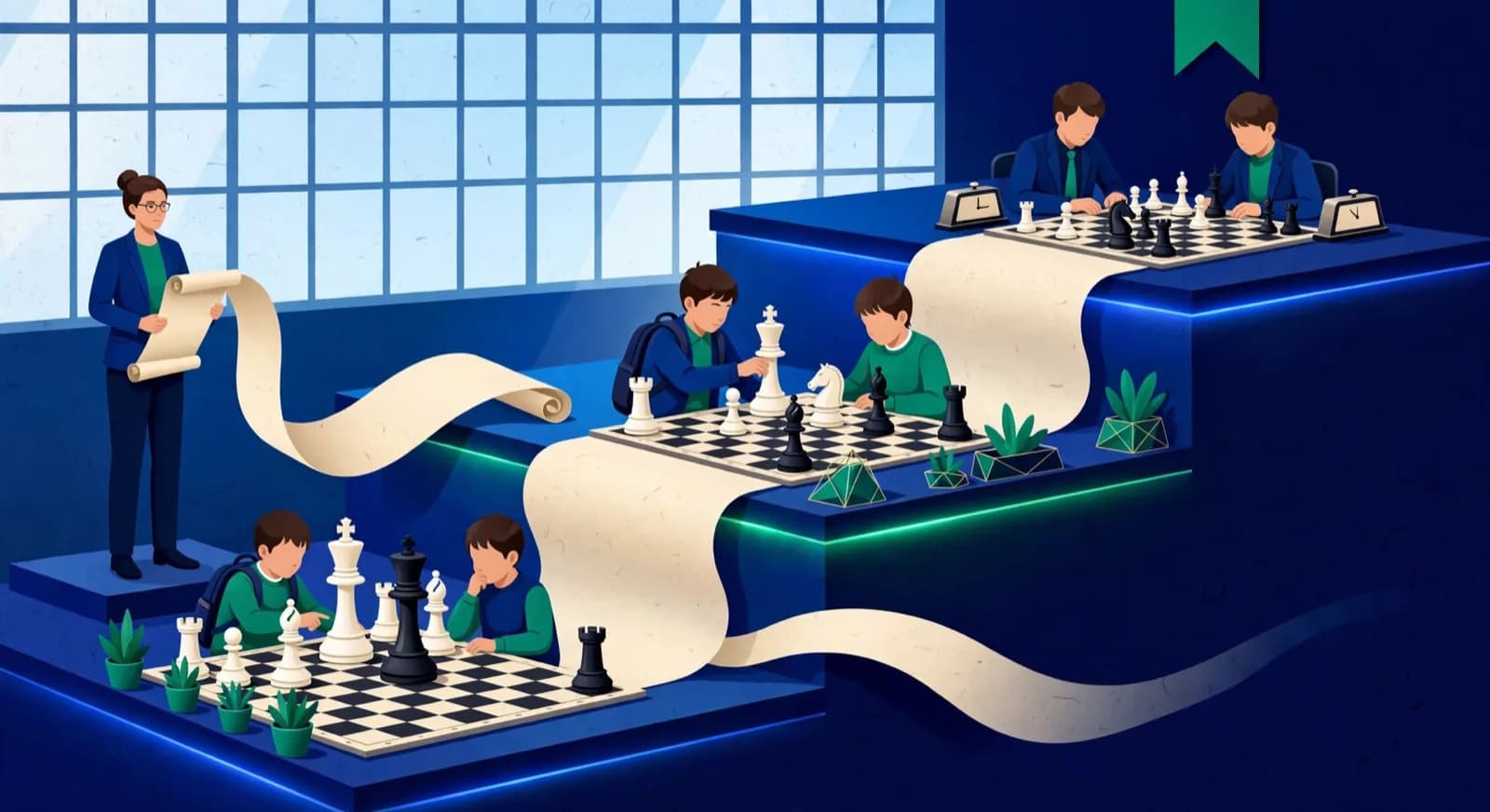
Sequence a school chess curriculum in three bands, beginner, improver, and competitive, and move a group up only when its objective is met, not when the term ends. Bands, not year groups, are the right unit because a Year 4 class and a Year 7 class can both be absolute beginners, and a mixed after-school club almost always spans two bands at once. Design for the band and let students sit in the one that fits.
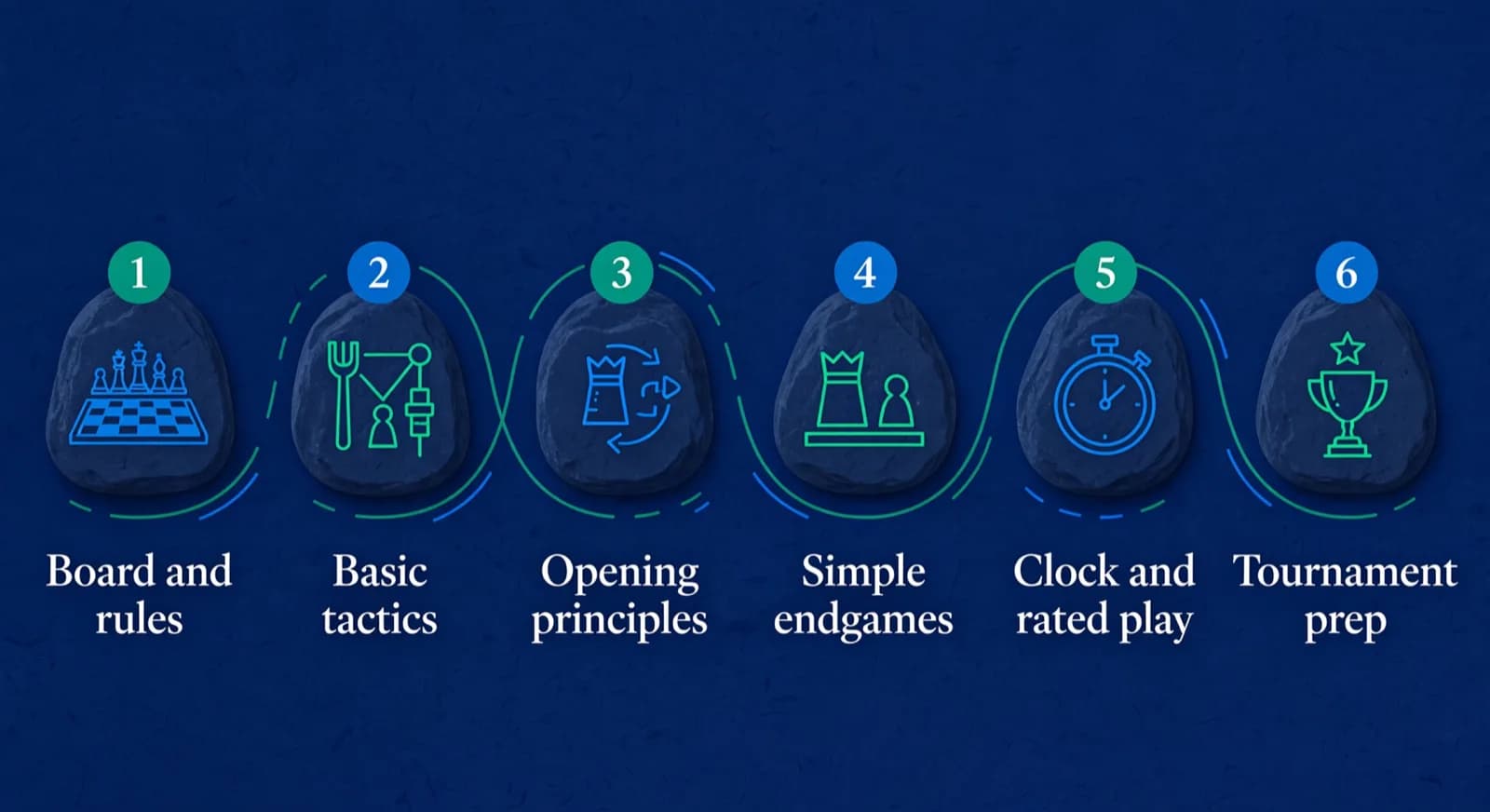
Within each band, teach in the order the game is actually learned, which is not the order a rulebook lists things. Movement and checkmate come before opening theory. Not hanging pieces comes before deep strategy. Basic tactics, the fork, pin, and skewer, come before endgame technique, because tactics are where beginners win and lose almost every game. The scope and sequence below spreads three bands across roughly six terms, two per band, with one objective per term. Treat the term boundaries as flexible: a strong class can compress two terms into one, a mixed club may spend a whole year in the beginner band.
| Term | Band | Focus topics | Objective by end of term |
|---|---|---|---|
| 1 | Beginner | Board, piece movement, check and checkmate, basic rules | Play a legal game start to finish without help |
| 2 | Beginner | Piece value, capturing safely, the fork, pin, and skewer | Spot a one-move tactic and avoid hanging a piece |
| 3 | Improver | Opening principles, king safety, simple mating patterns | Play a game where the pieces are developed and the king is safe, and explain why |
| 4 | Improver | Two-move tactics, basic endgames, king and pawn ideas | Convert a winning endgame with a clear plan |
| 5 | Competitive | Planning, calculation, common openings, clock use | Play a rated online game and review it afterwards |
| 6 | Competitive | Deeper endgames, prophylaxis, tournament preparation | Take part in an inter-school or internal event with a prepared plan |
Read the table as a ladder, not a timetable. The objective column is the load-bearing part: it is what makes the curriculum assessable and what tells a teacher when a group is ready to climb. Objectives name what a student shows in a position, so a student who castles on move eight but leaves a piece hanging has not met the term 3 objective, and one who keeps the king safe without castling has. The competitive band is where ratings and federations start to matter, because a student aiming at inter-school events and beyond is stepping onto the ladder that FIDE administers at the top [3]. Most school students never need that ladder, and the curriculum should carry the many who play for enjoyment as seriously as the few who compete. Our guide to scholastic chess explained covers where a school program hands off to rated competition, and our guide to running a scholastic chess tournament covers a first event.
What objectives should each level target?
Each level should target three or four objectives written as things a student can do, not topics a teacher covered. An objective like understands tactics is unassessable. An objective like finds a one-move fork in a given position is something you can watch a child do or fail to do, which makes it teachable, assessable, and honest. Write every objective in that doing form and the whole curriculum becomes measurable.
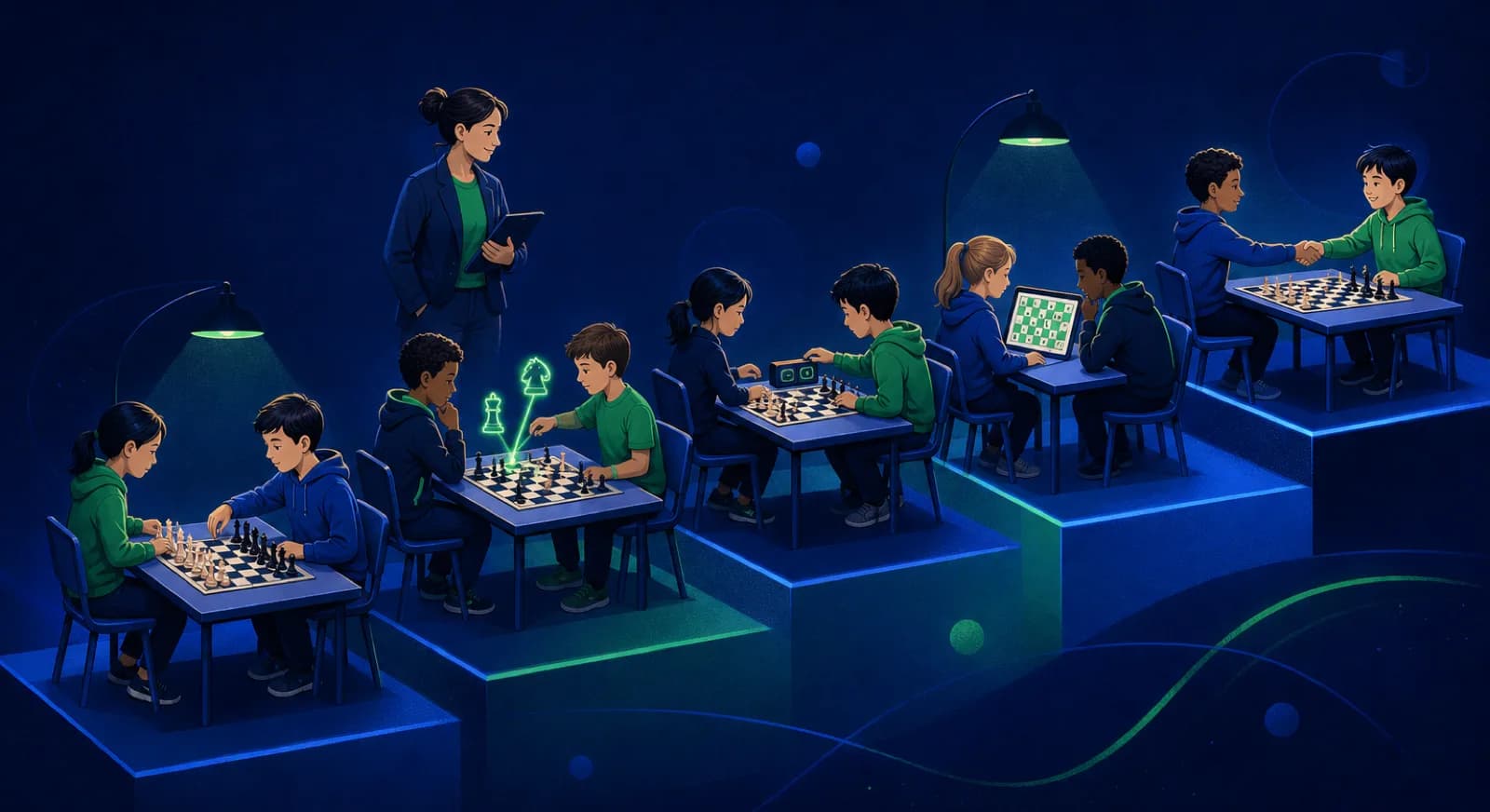
- Beginner objectives: set up the board correctly, move every piece legally, deliver checkmate with a queen and king, and recognise when a piece is under attack.
- Improver objectives: apply opening principles by developing pieces and keeping the king safe, spot two-move tactics, and hold or convert a king-and-pawn endgame with a plan.
- Competitive objectives: manage a clock, calculate a short forcing line, play a rated online game, and review that game to name one improvement.
- Cross-level habits: record games where possible, do a small amount of tactics practice each week, and explain one mistake per game in plain language.
- Attitude objectives: shake hands, accept a loss without drama, and help a newer player, because a school program is judged on conduct as much as results.
Objectives also solve the mixed-ability problem that defeats most school clubs. When the beginner and competitive bands each have their own written objectives, one teacher can run a room where different tables work toward different goals without anyone being bored or lost. The strong Year 7 improver drills two-move tactics while the Year 4 newcomer practises safe captures, and both are on the same curriculum, just at different rungs. For the youngest players who cannot yet read a worksheet, the section on teaching chess to a six year old in our guide to teaching a child chess at home turns the same early ideas into play-first mini-games.
How do you fit the curriculum into the school's teaching calendar?
Start from the sessions your school can actually offer, reserve slots for review and absence catch-up, and only then map the bands. A curriculum written around an imagined perfect year breaks at the first exam week. Every number below is an editable planning example. The school should enter its own sessions and exam breaks, because teaching calendars differ by board, state and school.
| Step | Example figure | Why it is there |
|---|---|---|
| Weekly club or lesson sessions the school can offer this year, after holidays and exam breaks | 30 sessions (the school enters its own number) | The starting budget, not a standard school year |
| Minus assessment and internal event sessions | 3 | Observed tasks and a low-stakes internal event need a session each |
| Minus review weeks | 3 | Time to reteach what the observed tasks showed was not yet learned |
| Minus absence catch-up slots | 2 | Some students always miss a session, and a gap in the sequence compounds |
| Teaching sessions left to map | 22 | 30 minus 3 minus 3 minus 2 |
Now map the six terms from the scope-and-sequence table onto the 22 teaching sessions: 4 each for terms 1 to 4, and 3 each for terms 5 and 6, which is 22. A strong group can compress terms, and a mixed club can spend the whole year in the beginner band. Move a band up when its objective is shown, not when the sessions run out. The within-session shape, a starter puzzle, one taught idea, guided practice, play and a short recap, belongs to the club rather than the curriculum, and our guide to running a school chess club sets it out in full. At the curriculum level, only one rule matters: the taught idea changes each week according to the scope and sequence, and you resist covering two new ideas at once.
Pin the plan to a visible timetable: which band meets when, which room, which teacher and which term topic is live this week. A curriculum that lives in one teacher's head disappears when that teacher is absent, while a shared plan lets a covering teacher pick up the thread and lets a head of department see that the program exists.

Week of 12 October · all batches
0 conflictsMake-up credit · Mia G. · Sat 4:30 PM
Absent Thursday with notice · booked by Noor
Class reminders sent to 148 families
Timing changes update everyone at once
How do you assess progress in a school chess program?
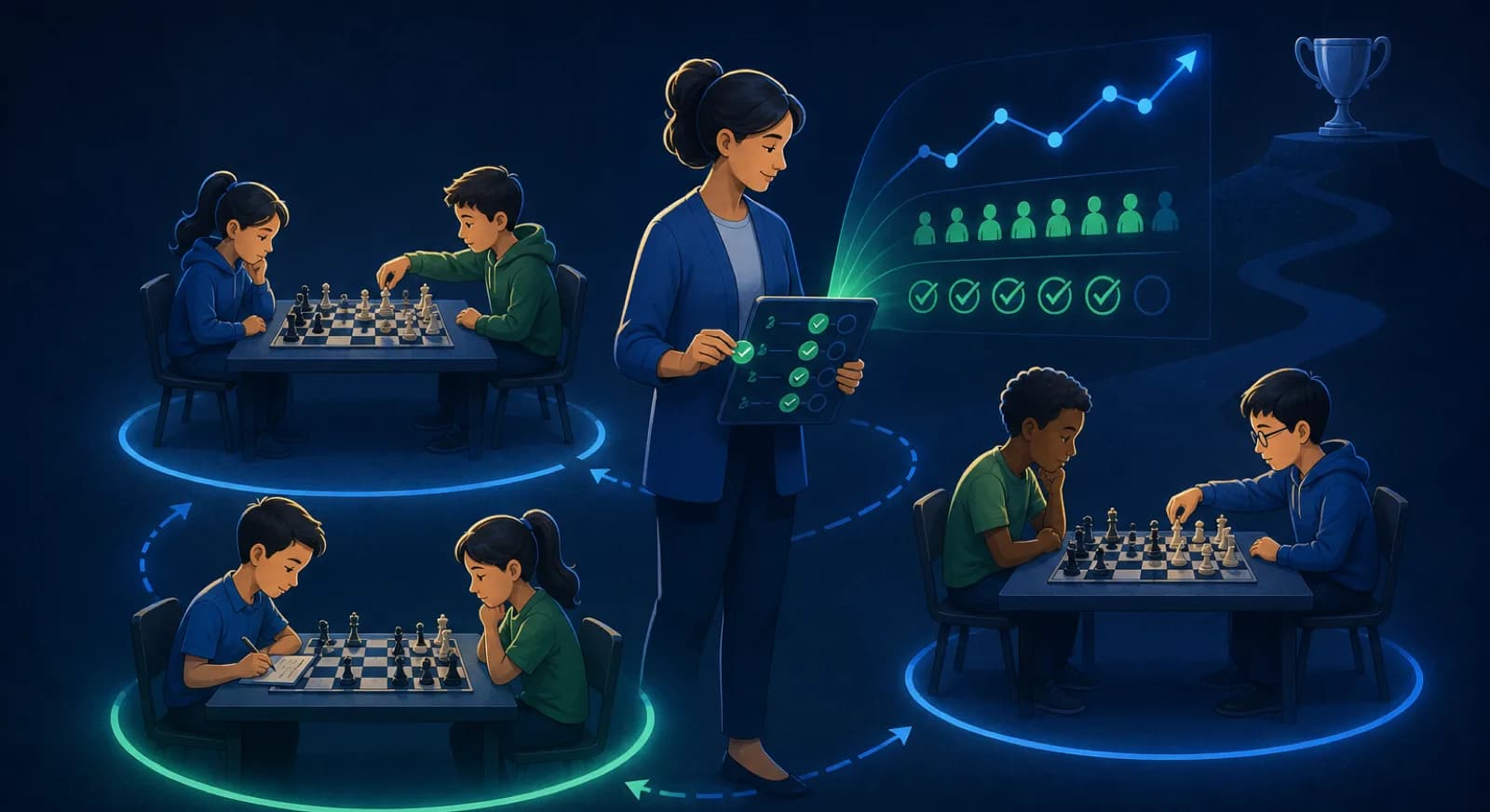
Assess a school chess program against its own objectives, using short observed tasks rather than written tests, and treat online ratings as a longer-term trend. A student meets a term objective when they can do the thing it names. The three tasks below are illustrative examples with an answer key and a reteach step. They are not a validated level test, and the schools that use them should set their own pass standard.
| Band | Task | Answer key | If the skill is not shown, reteach |
|---|---|---|---|
| Beginner: legal move versus checkmate | Show this position, White to move: White king on g6, White queen on c2, Black king on h8. Ask which of Qc8, Qc3 and Qc4 is checkmate, which is check but not checkmate, and which leaves Black with no legal move and no check | Qc8 is checkmate. Qc3 is check, but Black escapes with Kg8. Qc4 is stalemate, a draw, because Black is not in check and has no legal move (FIDE Laws, Article 5.2.1) [9] | Replay Qc3 and let the student find Kg8. For Qc4, ask: is the black king attacked, and can it move anywhere? Repeat with the queen on a different square |
| Improver: a named tactic | Show White king g1, knight d5, pawns f2 g2 h2, against Black king g8, queen c8, pawns f7 g7 h7, White to move. Ask for the best move and the name of the tactic | Ne7+ is a fork of the king and queen. Black must move the king, to h8 or f8, and then White captures the queen with Nxc8 | Show the knight squares from e7 on a board. Ask what the knight attacks from there. Set two more fork positions before moving on |
| Competitive: game review | The student takes one of their own recent games and uses Lichess computer analysis, which runs the Stockfish engine [4], to find the move where the game turned. They then explain in two sentences what they missed | Accept any explanation that names the move and the idea or threat that was missed in plain words; there is no single correct sentence | Replay the position before the move and ask what the opponent threatens. Ask the student to find one better move and say why |
Record the result of each task as a short observation, can or not yet, with the date. A student who is not yet at the standard is not failing; the group simply spends another session on that objective. Where the table gives a position, set it up on a real board and check the answer key before using it in class.
Ratings add a second, lighter layer once students play online. Platforms rate players with Elo-derived systems, so every child who plays regularly acquires a number that records results against opponents. It can rise, flatten or dip for reasons unrelated to what was taught, so keep it in perspective: it is a trend, not a term grade, and it is optional at the beginner band, where conduct and enjoyment matter more. The competitive band is where a rating earns its place, and where a school's strongest players begin looking toward the FIDE ladder [3].
Whatever you assess, record it in one place per student, because scattered evidence is the same as no evidence. A simple record holds attendance, the objectives shown and a rating history if the student plays online. It tells the teacher who is ready to move up and gives the school something concrete to show families. Our guide to a chess study plan for students turns these assessments into the practice a keen player does between sessions.
Lucas M.
Batch B2 · Thursdays · joined Aug 2025
1342
Academy rating · Lichess games synced
Won vs. 1410 · French Defense
Best gameMissed fork on move 23
Homework setWhat resources does a school chess curriculum need?
A school chess curriculum needs surprisingly little: a few physical sets and a demonstration board for the room, and a free online stack for lesson boards, homework, and practice. The physical kit teaches the youngest players and works when the internet does not. The online stack does the heavy lifting for everything else, and the core of it costs nothing, which matters when a program is being justified to a budget holder.
Build the online stack around two free tools from Lichess, an open-source, ad-free chess platform [4]. A Lichess study is a shared analysis board where you can save every lesson position, annotate it, and set homework the class opens with one link, so a term of teaching material lives in one place at no cost [1]. Lichess training serves tactics puzzles matched to each player's rating, which solves the mixed-ability problem for practice: the same homework link gives your Year 4 beginner and your Year 7 improver puzzles pitched at their own level, automatically [2]. For younger primary classes, ChessKid publishes a free school chess curriculum that is for school use and not for commercial redistribution [8]. Pin each term's topics in the scope and sequence to specific studies and puzzle themes, and a new teacher inherits not just a plan but the resources to deliver it. Our guide to teaching chess to beginners covers how to present these ideas in the room.
| Resource | Use in the curriculum | Cost |
|---|---|---|
| Physical sets and demo board | In-room teaching, youngest players, offline backup | One-off |
| Lichess study [1] | Lesson boards, annotated positions, homework links | Free |
| Lichess training [2] | Rating-matched tactics practice for mixed classes | Free |
| ChessKid curriculum [8] | Downloadable school curriculum with pacing guides, free for school use, not for commercial redistribution | Free download (current on 16 October 2026) |
How is a curriculum different from a lesson plan or a syllabus?
A curriculum is the whole multi-term plan, a syllabus is the list of topics it covers, and a lesson plan is a single session inside it. People use the words loosely, but the distinction is practical: the curriculum owns the sequence and objectives across terms, and the lesson plan owns forty minutes. If you are planning a chess curriculum, a school chess syllabus, or a term-by-term lesson sequence, this guide is the right level; the detail of a single session sits in a separate lesson plan.
This matters because the two documents fail in different ways and need different fixes. A program with strong lesson plans but no curriculum teaches brilliant one-off sessions that do not add up, so students plateau and repeat topics. A program with a curriculum but weak lesson plans has the right sequence but delivers it thinly. You want both, held by the right owner: a coordinator keeps the curriculum honest across terms, and each teacher builds the lessons that fill it. Our chess lesson plan template is the companion to this page: use this scope and sequence to decide that Term 2 teaches basic tactics, then use that template to build the individual Tuesday session on the fork. Read this to plan the year, read that to plan the week.
One more boundary is worth naming. A school chess curriculum is not the same as an academy's operating plan. A school runs chess as an enrichment program inside a wider timetable, usually with non-specialist teachers and a duty of care as the first priority. An academy runs chess as its core business. The teaching sequence overlaps, but the surrounding decisions do not, which is why the main guide to starting a school chess program is the right starting point for the school context, and links out to the academy material only where it genuinely helps.
Frequently asked questions
What is a chess curriculum for schools?
A chess curriculum for schools is a multi-term plan that sets out what students learn at each level, in what order, with a clear objective per term and a way to assess it. It has four parts: scope and sequence, objectives, assessment, and resources. It differs from a lesson plan, which covers a single session, because the curriculum owns the whole sequence across terms and teachers, keeping a program consistent even as staff and year groups change.
How do you sequence a scholastic chess curriculum?
Sequence it in three bands, beginner, improver, and competitive, and teach in the order the game is actually learned rather than the order a rulebook lists. Movement and checkmate come first, then piece safety and basic tactics like the fork and pin, then opening principles and simple endgames, and finally planning, clock use, and competitive play. Move a group up only when its stated objective is met, and use bands rather than year groups because a class of mixed ages is often at the same level.
What should a school chess syllabus include for each level?
Each level should list three or four objectives written as things a student can do, plus the topics that build toward them and a named resource for practice. A beginner level covers legal movement, checkmate, and piece safety; an improver level covers opening principles, two-move tactics, and basic endgames; a competitive level covers planning, clock management, and reviewing rated games. Writing objectives in a doing form, such as finds a one-move fork, makes them assessable by any teacher, including a non-specialist.
How do you assess progress in a school chess program?
Assess against the curriculum's own objectives using short observed tasks, such as asking a student to separate checkmate from stalemate in a set position, name a fork, or explain the move where their game turned. A student meets a term objective when they can visibly do the thing it names. Record can or not yet, and reteach the objective if it is not shown. Use online ratings as a longer-term trend, not a term grade, especially for beginners.
What free resources can run a school chess curriculum?
A free stack can carry a school program: Lichess studies hold your lesson boards, annotated positions and homework links in one place, and Lichess training serves tactics puzzles matched to each player's rating so a mixed class gets right-sized practice from a single link. For under-tens, ChessKid offers a children's platform and a free school curriculum, with reuse limits stated on its page. Add a few physical sets and a demonstration board for in-room teaching and offline backup.
How many lessons or terms does a ready-made school curriculum cover?
The published sequences vary: ECU's CiE Teacher's Guide covers 40 lessons [6], Saint Louis Chess Club describes 3-4 semesters of instruction [7], and ChessKid offers a free school curriculum with multiple pacing guides [8]. The sequence in this guide spans six terms across three bands. Treat durations as planning guides: map the sequence onto the sessions your school really has, repeat a topic when students need practice, and advance when they can demonstrate the skill.
Sources
- [1]Lichess Study: free shared analysis boards · accessed 2026-06-28
- [2]Lichess Training: tactics puzzles · accessed 2026-06-28
- [3]FIDE (International Chess Federation) · accessed 2026-06-28
- [4]Lichess · accessed 2026-06-28
- [5]ChessKid · accessed 2026-06-28
- [6]CiE Package, ECU Education Commission (40-lesson Teacher's Guide) · accessed 2026-10-16
- [7]STLCC Chess Instructional Curriculum (first 3-4 semesters) · accessed 2026-10-16
- [8]ChessKid.com's Curriculum (free for schools, English and Spanish) · accessed 2026-10-16
- [9]FIDE Laws of Chess, in force from 1 January 2023 (Article 5.2.1 stalemate) · accessed 2026-10-16
Written by Abhishek Tiwari
ChessCore
Drafted with AI, fact-checked and approved by a human before publishing, the same guardrail our product applies to every report it sends. Read our editorial standards.
Run your school chess program from one plan
See how ChessCore keeps the timetable, term topics, attendance, and student progress in one place, so a covering teacher can run a session from the plan and a head of department can see it working.
- Roster import from the spreadsheets you already keep
- Lichess and Chess.com connections, batches, and fee plans
- First reports in week one, after your approval
- Free plan, no credit card required