On this page10 sections, 19 min read
- What are chess tournament time controls?
- What is the difference between classical, rapid, and blitz?
- Which time control fits which event?
- Which time controls qualify for standard, rapid, or blitz ratings?
- What is increment and how does it change a tournament?
- When is move recording required?
- Rapid vs blitz: which should your tournament use?
- How many rounds can you run in a day at each time control?
- How do time controls affect arbiters and the venue?
- How do you write the time control on the entry form?
- Frequently asked questions
Bottom line
Start from these defaults: a scholastic event uses rapid 15+10 or 25+5, a one-day open uses rapid 15+10 or 25+10, a weekend classical event uses 90+30, and a blitz side event uses 3+2. FIDE rates a game as rapid at more than 10 but less than 60 minutes, and as blitz at more than 3 and no more than 10, counting base time plus 60 increments. Confirm eligibility with the arbiter.
TL;DR
- Check the advertised rating list as well as the time control: FIDE has separate standard and rapid/blitz rating regulations [9][10].
- Increment adds a fixed number of seconds after every completed move. A player can still lose on time if the main time runs out before that move is completed [8].
- Sudden death gives each player a fixed amount of time for the whole game or for all remaining moves. A whole-game control such as G/60 d5 or G/90;inc30 still carries delay or increment per move [6][8].
- Decide the round count from your available venue hours, with time reserved for pairings, breaks, and games that run longer than expected.
- Match the control to the field too: young or new players need enough time to think, while experienced fields can enjoy a fast format that would overwhelm beginners.
Key facts
- FIDE Laws define rapid as more than 10 but less than 60 minutes per player, and blitz as 10 minutes or less, counting 60 increments when applicable.[7]
- FIDE blitz rating eligibility requires more than 3 and no more than 10 minutes per player, counting 60 increments when applicable.[9]
- Increment adds a set number of seconds after each move, unless the player's main time ran out before they completed that move, so a player can still lose on time with increment.[8]
- Online platforms bucket games into bullet, blitz, and rapid by total time, which is the same logic organizers use to plan a live schedule.[3]
- FIDE Laws Article 6.7.1 sets the default time to zero unless the event regulations specify otherwise, so a player who arrives after it loses the game unless the arbiter decides otherwise.[7]
- FIDE standard rating minimums are 60, 90, or 120 minutes per player depending on the players' ratings, which is why slower controls are not automatically rated as standard.[10]
What are chess tournament time controls?
A chess tournament time control specifies each player's thinking time and how it changes during play. In 15+10, each player starts with 15 minutes and receives 10 seconds per move [6]. Read both numbers when choosing a format: ten seconds on every move can substantially change the time available for an endgame.
A control can provide a fixed allowance, add an increment, or use a delay before the main clock counts down [6]. For tournament planning, write the complete setting on the entry form and give the same setting to the arbiter and pairing operator. If the event has more than one section, label each section's control clearly. A parent booking transport needs the schedule; a player needs to know what will be set on the clock.
This post covers how to choose among those formats for an event you are organizing. It sits under our main guide to organizing a chess tournament, which walks through the whole event from venue to prize table, and it pairs with our guide to the rules an organizer needs, which covers the clock-handling and flag-fall regulations that turn a time control into an enforceable rule. Here we stay on one question: given your field, your rating goals, and your available hours, which time control should you run?
What is the difference between classical, rapid, and blitz?
Rapid gives each player more than 10 but less than 60 minutes; blitz gives 10 minutes or less. FIDE's Laws count the allotted time plus 60 increments for these definitions [7]. Slower controls fall outside those bands; standard rating eligibility has additional conditions.
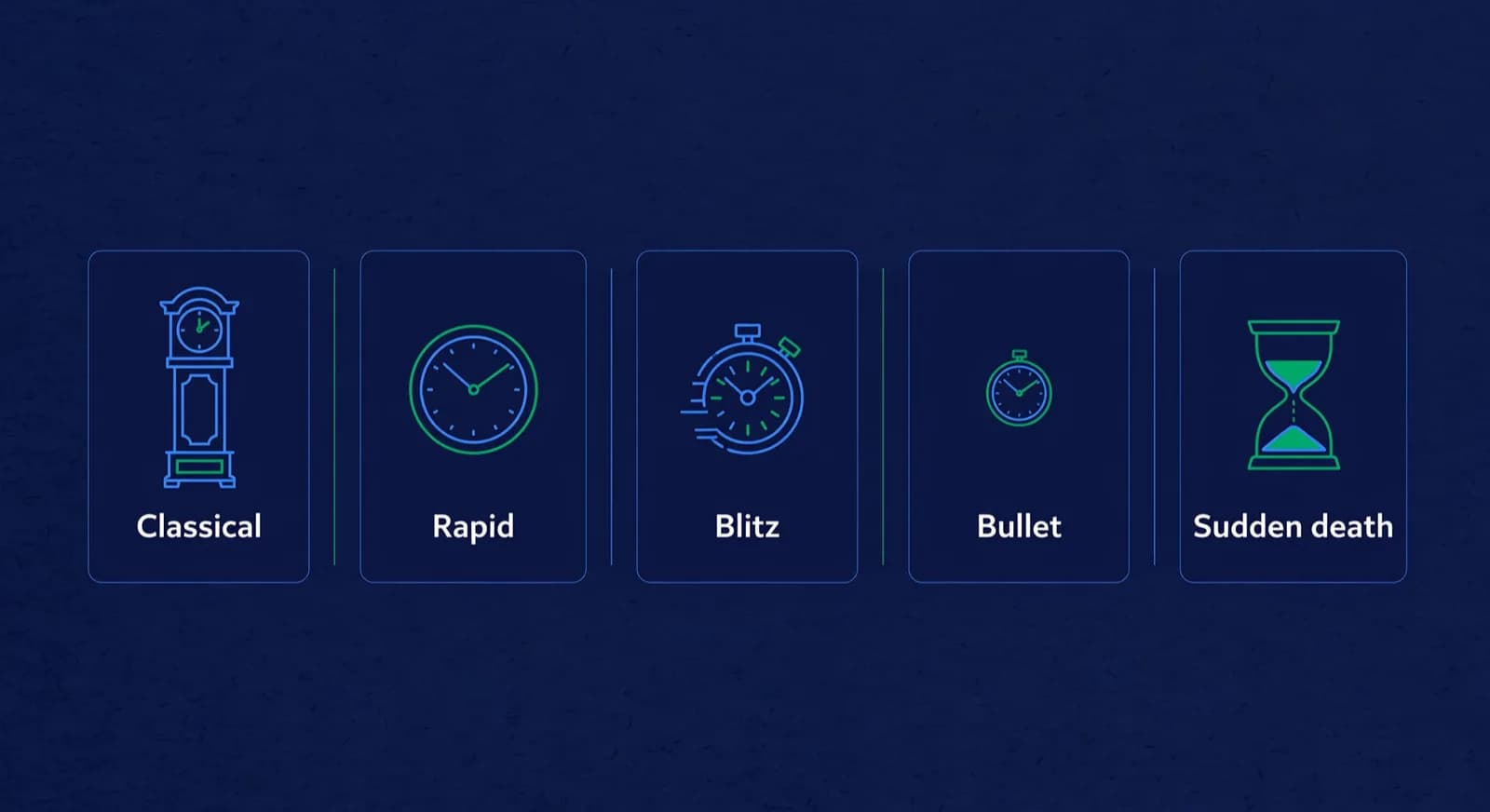
For a school event, choose the pace according to the experience you want students to have. Longer games leave more room to calculate and practise notation. Rapid can suit a day of several rounds, provided the timetable allows breaks. Blitz can be a short additional event for students already comfortable handling a clock. Explain the choice to parents before entry: a beginner's first tournament should have a clear purpose beyond squeezing the largest possible number of games into the day. The table offers suggested uses, not federation requirements.
| Format | Time band per player [7] | Illustrative control | Suggested use |
|---|---|---|---|
| Blitz | 10 minutes or less, including 60 increments | 3+2: 3 minutes plus 2 seconds per move | Short side event for clock-confident players |
| Rapid | More than 10 and less than 60 minutes, including 60 increments | 15+10: 15 minutes plus 10 seconds per move | Main event with several rounds and breaks |
| Slower control | Outside the rapid and blitz bands | 90+30: 90 minutes plus 30 seconds per move | Longer games with room for sustained calculation |
| Sudden death period | A period for all remaining moves [6] | 40/2 then SD/1 | Describe the period separately from the rating category |
Choose the intended rating list before publishing the entry form. FIDE has separate regulations for standard ratings and rapid/blitz ratings [9][10]. A slower game is not automatically eligible for standard rating, and a blitz game is not automatically eligible for blitz rating. Ask the arbiter to confirm the control, registration, and reporting requirements for your actual event. Then publish the list and the exact clock setting together so players know what they are entering.
Which time control fits which event?
Match the control to the event's purpose and field. These are editorial defaults, not federation requirements: rated adult flagship events and norm tournaments use classical, one-day opens and scholastic championships use rapid, and club nights, side events and tie-breaks use blitz. Beginner and young fields lean toward rapid with a comfortable increment so games are decided by chess rather than by a scramble on the clock. The rating list an event feeds is a separate decision from its pace: a slower game is not automatically standard rated, and not every rated event has to be classical.
A few event types deserve their own note. Scholastic events for young children often use rapid with a moderate increment, because very fast controls produce chaotic, tearful finishes and teach the wrong lesson; there is more on age-appropriate design in our overview of scholastic chess. Weekend opens frequently run a rapid main event with a blitz side event on the Saturday evening, which spreads the prize budget and keeps the hall busy. A single evening at a club is the natural home of blitz or a short sudden-death control, because the whole competition has to finish before people go home. Corporate or charity events, where the point is participation rather than a rated result, can use whatever fits the room and the clock, and blitz keeps energy high with players cycling through quickly.

Week of 12 October · all batches
0 conflictsMake-up credit · Mia G. · Sat 4:30 PM
Absent Thursday with notice · booked by Noor
Class reminders sent to 148 families
Timing changes update everyone at once
Which time controls qualify for standard, rapid, or blitz ratings?
Rapid rating requires more than 10 but less than 60 minutes per player; blitz rating requires more than 3 and no more than 10, including 60 increments. Ordinary standard minimums are 60, 90, or 120 minutes according to the players' ratings [9][10].
Under FIDE's standard rating regulations, the minimum is 120 minutes if either player is rated at least 2400, 90 minutes if either is at least 1800 and neither reaches 2400, and 60 minutes when both are below 1800, assuming 60 moves [10]. Registration and reporting requirements still apply, so confirm them with the arbiter before describing the tournament as rated. Treat the clock setting and the rating promise as two parts of the same specification: a slower game is not automatically standard-rated, and a fast game is not automatically rapid-rated.
For an organiser, the useful sequence is to choose the field, ask the arbiter which rating rules apply, and only then finalise the timetable. A mixed-strength event may need more time than a beginner section under the ordinary standard minimums. If you change the control after accepting entries, explain the change to entrants and reconfirm approval before proceeding. Treat the clock setting and the rating promise as two parts of the same event specification.
What is increment and how does it change a tournament?
Increment is a fixed number of seconds added to a player's clock after they complete a move, so later moves arrive with a small top-up. A control of 15+10 means each player starts with 15 minutes and gains 10 seconds per completed move [6]. Increment does not mean the clock can never run dry. If remaining time reaches zero before the move is completed, the increment has not yet been added, and the player can still lose on time [8].
Increment banks extra seconds on the clock; a player who moves quickly can retain them for later. Delay instead gives a short interval before the main clock starts counting down [6]. With Bronstein delay, the time remaining cannot increase [8]. Check which setting your clocks support and practise setting it before the event. Demonstrate the display to children and explain that they still need to complete moves before their time expires.
Increment also affects the timetable. A game with many moves can continue well beyond the starting allowance, so leave room for long endgames before announcing the next round. Scoresheet rules need their own explanation: the control and the supervision arrangements both matter. Put the applicable rule on the entry form and ask the arbiter to demonstrate the clock and notation procedure at the players' briefing. Our tournament-rules guide covers the wider organiser checklist.
When is move recording required?
Standard play requires move recording. Article 8.4 exempts players with under five minutes left who receive less than 30 seconds added per move. Rapid players need not record; blitz recording depends on the supervision rules selected for the event [7].
For blitz under B.2, the Competitive Rules apply when an arbiter supervises one game and an arbiter or assistant records it. Otherwise B.3 applies the rapid exemption. Publish the applicable rules and have the arbiter explain them before play [7]. For school players, practise notation in lessons even when the event does not require it, so game review remains part of their learning. The clock-handling and move-recording rules an organiser enforces are set out in full in our guide to the clock and move-recording rules.
Rapid vs blitz: which should your tournament use?
Use rapid when you want real chess content in a single day and a result players take seriously; use blitz when you want a fast, high-energy event, a side attraction, or a tie-break decider. Rapid preserves enough time for planning and clean endgames, while blitz trades accuracy for excitement and volume, letting you run many more rounds in the same window [3].
The decision usually comes down to three questions. First, what is the level and age of your field? Rapid suits mixed and younger fields because there is time to think and fewer games are decided by a scramble; blitz can overwhelm beginners and reward the few who already move fast. Second, what is the event's purpose? A flagship weekend open wants rapid or classical as its main event, with blitz as an evening side event that keeps players in the venue and adds prize opportunities. Third, how many rounds do you need to separate a clear winner? A blitz format lets a small club run a full round-robin in an evening, while rapid over the same hours might manage five or six rounds.
- Choose rapid for one-day opens, scholastic championships, and any event where the result should feel earned rather than lucky.
- Choose blitz for evening events, warm-up or side tournaments, and playoffs where speed and spectacle are the point.
- Choose classical for rated flagship events, norm tournaments, and serious adult competition where depth matters most.
- Run a blitz side event alongside a slower main event to fill the schedule, add prizes, and keep players in the venue between rounds.
- When two players finish level, most opens rank them by a computed tiebreak such as Buchholz under the FIDE tie-break regulations; a blitz playoff is an option reserved mainly for deciding a title or a single top place.
For online events the same logic holds, just with faster defaults. Platforms bucket games into bullet, blitz, and rapid by total time, so an online arena you host will present the same choice in the same vocabulary [3][4]. If your academy runs internal online tournaments between rated over-the-board events, rapid and blitz are the natural fit because they finish inside a single session and give students frequent, low-stakes competitive practice. Our guide to running a scholastic chess tournament goes deeper on age-appropriate formats for young fields.
How many rounds can you run in a day at each time control?
Decide the round count from venue hours, game-time estimates, pairing work, and breaks. Increment games do not have a fixed maximum duration because each additional move adds time. Plan around a stated move count and leave a buffer rather than promising an exact finish.
Use one formula for every control. Per player, the time for an assumed game is the base minutes plus the assumed moves times the increment seconds divided by 60; double it for both clocks. On a 60-move basis, 15+10 gives 15 plus 60 times 10 over 60, which is 15 plus 10, or 25 minutes a player and 50 minutes across both clocks. A 10+5 game gives 10 plus 5, or 15 minutes a player and 30 across both clocks. A 25+10 game gives 25 plus 10, or 35 minutes a player and 70 across both clocks. A 90+30 game gives 90 plus 30, or 120 minutes a player and 240 across both clocks [6]. These are planning assumptions, not guaranteed game lengths: a game can finish early or run past 60 moves. The free tournament time planner applies the same base-plus-increment arithmetic, and the time control converter checks which category a setting falls in, so you do not have to recompute either by hand.
An illustrative timetable makes this concrete. Take a 60-move planning basis, a 09:00 start, no lunch, and only 15 minutes between rounds for pairings and board resets. Six rounds of 15+10 need 6 times 50 minutes of play plus five 15-minute gaps, which is 375 minutes and a 15:15 finish. Seven rounds of 10+5 need 7 times 30 plus six gaps, which is 300 minutes and a 14:00 finish. Five rounds of 25+10 need 5 times 70 plus four gaps, which is 410 minutes and a 15:50 finish. These are planning assumptions on the clock budget alone, not observed durations or maximums: registration, a lunch break and prize-giving all add time on top, so build them into the day separately.
| Control | Minutes per player (60 moves) | Both clocks | Rounds | Playing time plus 15-minute gaps | Finish from a 09:00 start |
|---|---|---|---|---|---|
| Rapid 15+10 | 25 | 50 min | 6 | 6 x 50 + 5 x 15 = 375 min | 15:15 |
| Rapid 10+5 | 15 | 30 min | 7 | 7 x 30 + 6 x 15 = 300 min | 14:00 |
| Rapid 25+10 | 35 | 70 min | 5 | 5 x 70 + 4 x 15 = 410 min | 15:50 |
Plan for the case where the assumption breaks. If several games in a round run well past 60 moves, the extra moves keep earning increment, the last board finishes late, and it eats straight into the 15-minute pairing gap before the next round. An increment control has no fixed maximum from its base time alone, because every completed move adds seconds, so a round can in principle run far longer than the planning figure. Treat every published finish time as an estimate, keep a contingency margin in the day, and decide in advance what you cut (a round, a side event) if the schedule slips rather than letting the whole hall wait on one long endgame.
Two organizer habits make the schedule hold together. The first is the pairing buffer: the gap between one round finishing and the next starting, during which you enter results, run the next Swiss pairing, and post the boards [5]. Underestimating this is the classic first-time mistake, because the last game of a round always runs longer than you expect and the whole field waits on it. A realistic buffer is 10 to 20 minutes for a manual or software-assisted rapid event, more if you are entering results by hand. The second habit is a default-time and late-arrival policy stated in advance, so a slow finish or a missing player does not stall the entire hall. Both of these are where good tournament software earns its keep, a topic we compare in our guide to chess tournament software.
The reason this section matters more than any single format preference is that the schedule is a promise. Players travel, parents arrange their day, and a venue is booked for fixed hours. If you advertise seven rounds of rapid and the maths only supports five once buffers are honest, you will either cut rounds on the day, which annoys everyone, or overrun the venue, which can cost you the booking. Decide the round count from the time control and the clock, not from optimism, and publish a schedule you can actually keep. When a field sees rounds start on time all day, they come back next year, and that reliability is worth more to a young event than any prize fund.
Lucas M. · first session to today
Every game, report, and payment on one timeline
Aug
Joined at 1240Nov
First tournamentJan
Back-rank drills setOct
1342 · October report drafted
How do time controls affect arbiters and the venue?
Faster time controls raise the workload and difficulty for arbiters and put more strain on the venue's schedule. Blitz and sudden-death games produce frequent flag-fall claims, illegal-move disputes, and scoresheet gaps that an arbiter must rule on in real time, while classical and increment games are slower to adjudicate but far cleaner. The clock rules you choose decide how much refereeing your event needs.
Plan supervision with the arbiter before finalising the event size. Give them the proposed control, round count, player experience, and available assistants, then ask how clock claims and results will be handled. For a school event, practise the procedure with students: pause the clock when instructed, call the arbiter, and explain the concern calmly. Do not expect one official to answer simultaneous questions across a large room without support. Arrange help for collecting results and guiding families so the arbiter can concentrate on play.
The venue side is simpler but just as decisive. A time control that overruns eats into the hours you have booked, and running late has a cost in staff, lighting, and goodwill. This is why the honest round-count maths from earlier is not a nicety but a constraint: you are fitting a chosen time control into a fixed number of venue hours with a fixed number of arbiters, and the format has to respect both. Decide the control, the round count, and the staffing together, not one after another, and your event will feel calm instead of rushed.
How do you write the time control on the entry form?
Write the time control in the standard base-plus-increment shorthand and state the format family alongside it, so players know exactly what they are entering. "Rapid, 15+10" or "Classical, 90+30" leaves no ambiguity: everyone reads the same base time, the same increment, and the same rating category. Ambiguous entries are the source of avoidable arguments on the morning of the event.
A complete announcement gives four things: the format family (classical, rapid, or blitz), the base time, the increment or delay, and the rating category the results feed. "Blitz rated, 3+2, eleven rounds" is complete; "fast chess" is not. Multi-stage controls name each period. Chess.com's time-controls page quotes a FIDE world-championship example: 120 minutes for the first 40 moves, then 60 minutes for the next 20, then 15 minutes for the rest of the game with a 30-second increment starting on move 61 [6]. US Chess style 40/2, SD/1 means 40 moves in two hours, then a sudden-death period of one hour for all remaining moves [6]. Sudden death means a fixed amount of time for the whole game or for that remaining-moves period [6][8]. A whole-game control can still add per-move time: Chess.com's example G/60 d5 is 60 minutes with a five-second delay [6], and Wikipedia's G/90;inc30 is 90 minutes with a 30-second increment [8]. If the event has a side event, list each control separately.
Finally, publish the supporting policies next to the time control, because they are part of it in practice. State the default time (how long a player may be absent before losing on the clock), the increment or delay method, whether players must keep score throughout, and the tie-break method, which for most opens is a computed tiebreak such as Buchholz. Players who see all of this before they enter arrive knowing the rules, and an event that reads as organized on paper tends to run as organized in the hall.
Frequently asked questions
What time control should a beginner or scholastic tournament use?
We suggest rapid with an increment, such as 15+10 or 25+5, for a beginner or scholastic event. Allow time for children to think, practise using the clock before round one, and leave breaks between rounds. Increment provides extra seconds per move, but it does not prevent a loss on time. Choose a faster event only when the students are comfortable with its pace and the arbiter has enough support.
What does 90+30 mean in chess?
It means each player has 90 minutes for the whole game, plus a 30-second increment added after every completed move [6]. On the 60-move planning basis, that is 90 plus 30, or 120 minutes per player, and 240 minutes for both clocks before buffers. A player who makes 40 moves has received 90 minutes plus 20 extra minutes of increment so far. The plus sign separates base minutes from increment seconds, so 15+10 is 15 minutes plus 10 seconds a move.
Is rapid or blitz better for a one-day tournament?
We suggest rapid as the main event when the goal is several thoughtful games in one day, and blitz as a shorter event for experienced players. Work backwards from venue hours and include breaks and pairing time before choosing the round count. If you offer both formats, publish separate controls and schedules so families can decide which event suits their child.
What is increment in chess and why is it used?
Increment adds a fixed number of seconds per move [6]. It gives players extra time as the game continues, while making the final duration less predictable. A player can still lose on time. When planning an event, check the exact clock setting and leave a buffer for long games; explain move-recording requirements separately at the briefing.
What is sudden death in chess time controls?
Sudden death means each player has a fixed amount of time for the whole game, or for all remaining moves after an earlier period, and a player whose time expires generally loses the game [6][8]. Chess.com's time-controls page gives 40/2, SD/1 (40 moves in two hours, then one hour for the rest of the game) and G/60 d5 (the whole game in 60 minutes with a five-second delay) [6]. A whole-game control such as G/90;inc30 still adds a 30-second increment per move [8].
Can a player still lose on time with an increment?
Yes. Increment is added after each move unless the player's main time ran out before they completed it [8]. If the flag falls before that move is finished, the extra seconds have not been credited, and the player can still lose on time. Chess.com defines increment as seconds added for each move that is played [6]. Plan your schedule on a 60-move estimate, and still expect some boards to flag in time trouble.
Sources
- [1]FIDE: International Chess Federation · accessed 2026-07-01
- [2]FIDE (Wikipedia) · accessed 2026-07-01
- [3]Lichess API and time classes · accessed 2026-07-01
- [4]Chess.com · accessed 2026-07-01
- [5]Swiss-system tournament (Wikipedia) · accessed 2026-07-01
- [6]Time Controls in chess (Chess.com terms) · accessed 2026-10-02
- [7]FIDE Laws of Chess effective 1 January 2023 · accessed 2026-10-16
- [8]Time control (Wikipedia): increment, delay and sudden death · accessed 2026-10-02
- [9]FIDE Rapid and Blitz Rating Regulations effective 1 March 2024 · accessed 2026-10-16
- [10]FIDE Rating Regulations effective 1 March 2024 · accessed 2026-10-02
Written by Abhishek Tiwari
ChessCore
Drafted with AI, fact-checked and approved by a human before publishing, the same guardrail our product applies to every report it sends. Read our editorial standards.
Plan your academy's teaching week in one place
See how ChessCore keeps batches, attendance, and student records on one timeline, so an in-house event slots into the free evenings without clashing with classes. Book a walkthrough with your own calendar in hand.
- Roster import from the spreadsheets you already keep
- Lichess and Chess.com connections, batches, and fee plans
- First reports in week one, after your approval
- Free plan, no credit card required