Chess Coach Certification: Do You Need One?

A plain guide to chess coach certification: whether you need a certificate to teach, the FIDE Trainer titles, the AICF route in India, and honest alternatives.
By the ChessCore team · Published July 8, 2026 · Updated August 13, 2026 · 12 min read
Bottom line
You do not need a certification to teach chess to beginners or club players; there is no license to coach, and most coaches start without a title. A formal credential, such as a FIDE Trainer title or the AICF route in India, matters mainly when you coach rated or competitive players. Start teaching, then certify when the students you want require it.
TL;DR
- No certificate is legally required to teach chess, so the honest first question is not how to get certified but whether your target students need you to be.
- The FIDE Trainer titles are a graded ladder of coaching credentials awarded by the FIDE Trainers Commission, with exact criteria and fees published on FIDE's own site.
- In India the path runs through the All India Chess Federation and its state associations, which is also how players reach official FIDE ratings.
- If you are untitled, documented student progress is the credential that actually converts parents: a clean record of ratings, attendance, and reviewed reports.
- Certification can support higher fees and competitive positioning, but it does not replace teaching ability or proof that your students improve.
Key facts
- FIDE, the international chess federation, administers a system of trainer titles through its FIDE Trainers Commission rather than a single pass-or-fail certificate. (fide)
- The FIDE Trainer titles form a ladder from instructor-level categories up to Senior Trainer, awarded on a mix of playing strength, coaching experience, and completed trainer seminars. (fide-wiki)
- In India, the All India Chess Federation is the national body recognized by FIDE, so the domestic certification and rated-event path runs through AICF and its state associations. (aicf)
- Official ratings that competitive students chase are Elo-derived numbers administered under FIDE, which is why competitive coaching positioning tends to reference titles and ratings together. (elo)
- In the demo academy, student Aarav R. reached a 1395 rating after a +155 season, the kind of documented progress that reassures parents more than any wall certificate. (demo academy)
Do you need a certification to be a chess coach?
No, you do not need a certification to be a chess coach. There is no license required to teach chess, and the large majority of working coaches, including many who fill batches and produce rated players, began with no title at all. What students and parents actually buy is teaching ability and evidence that children improve, and neither of those is granted by a certificate. So the honest first question is not how to get certified, it is whether the students you want to teach need you to be.
The answer depends entirely on who you serve. A coach teaching beginners, school clubs, and hobby adults needs clarity, patience, and structure far more than a credential; parents at that level are choosing between you and a screen, not auditing your qualifications. A coach targeting competitive, tournament-bound players is in a different market, where a recognized title signals that you know the training methods and the rated ecosystem those families are entering. Both are legitimate; they are just different businesses, and the wider decision of how to become a chess coach covers the parts of the path this post does not.
This post is deliberately narrow: it is about credentials and certification, not the full path to becoming a coach and not what to charge once you are working. Where those overlap, we point you sideways rather than repeat them, because certification only makes sense in the context of who you teach and how you price. Read this to decide whether a title is worth pursuing for your audience; read the sibling guides for the rest of the plan.
The test that cuts through it
Ask what your next ten students actually require. If they are beginners and parents choosing an after-school activity, a certificate changes almost nothing about whether they enroll. If they are ambitious juniors whose parents already know what a FIDE rating is, a recognized title starts to matter. Certify for the students you want next, not for a shelf.
What is a FIDE Trainer title (the categories)?
A FIDE Trainer title is a coaching credential awarded by FIDE, the international chess federation, through its FIDE Trainers Commission [1][2]. It is not a single pass-or-fail exam but a graded ladder of categories, so that a coach working with beginners and a coach preparing grandmasters can each hold a title appropriate to their level. The titles sit alongside FIDE's separate system of player titles and are administered on their own criteria.
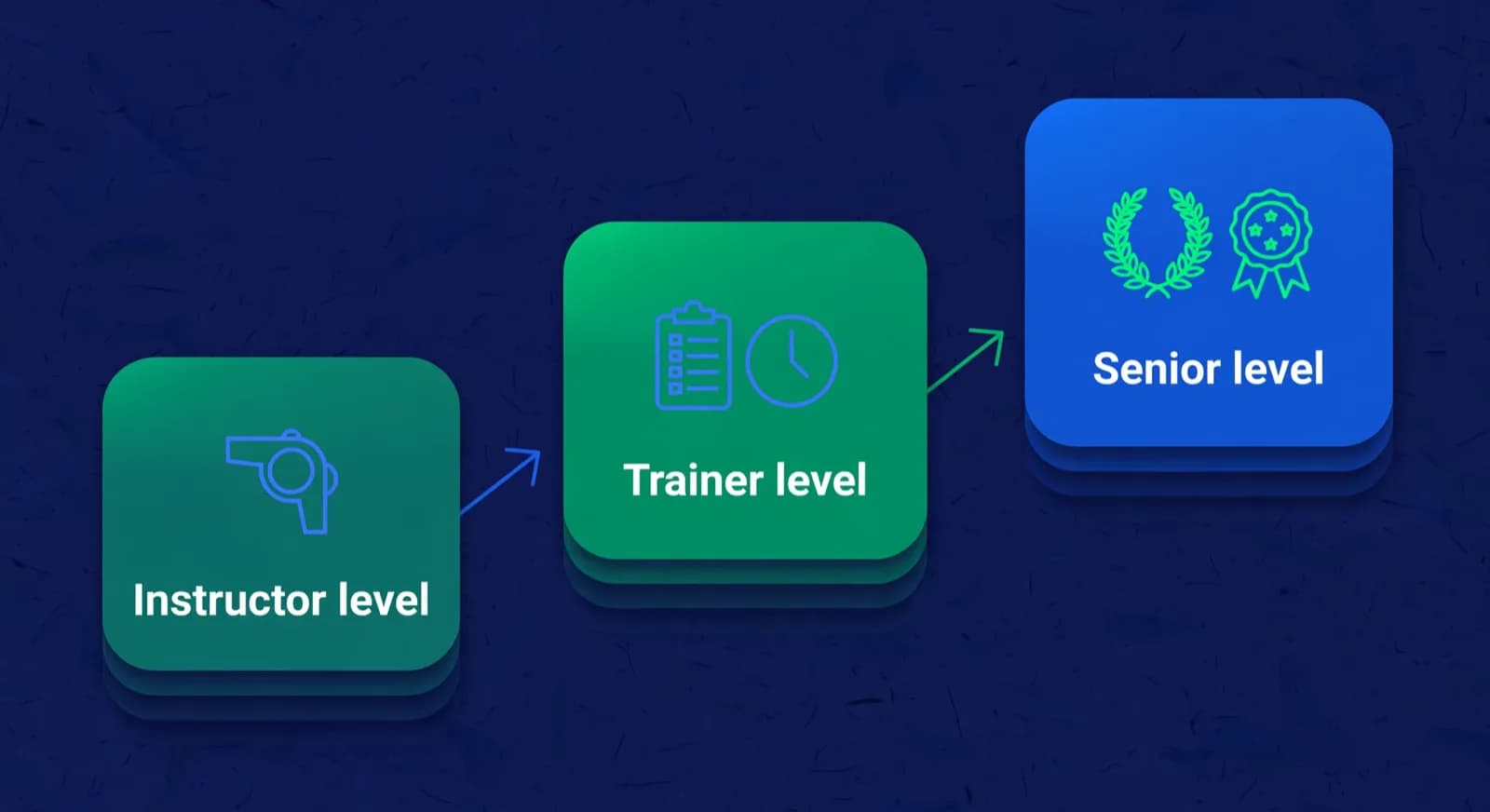
At a general level, the ladder runs from instructor-level categories aimed at coaches of developing and club players up through trainer categories to the senior level intended for those working with titled and elite players. Progression is based on a combination of playing strength, documented coaching experience and results, and completion of official FIDE trainer seminars. The exact category names, point requirements, seminar rules, and fees change over time and are published and maintained by FIDE, so treat any specific number you see quoted elsewhere with caution and check the current regulations on FIDE's own site [1].
| Tier of the ladder | Roughly who it is for | What FIDE weighs (general) |
|---|---|---|
| Instructor level | Coaches of beginners, juniors, and club players | Coaching experience plus a trainer seminar |
| Trainer level | Coaches developing competitive and rated players | Higher playing strength and a track record |
| Senior level | Coaches working with titled and elite players | Strong results and substantial experience |
Two things are worth holding onto here. First, because the system is a ladder, an untitled coach is not shut out; there is an entry rung intended for exactly the coach who teaches beginners well and wants recognition for it. Second, the title certifies coaching credentials, not that your specific students are improving, which is a separate thing you still have to demonstrate. The rest of this post treats the title as one input into credibility, not the whole of it. It is also worth separating the FIDE Trainer titles from FIDE's player titles, such as Candidate Master or Grandmaster, which many parents recognize by name: a strong player is not automatically a certified trainer, and a certified trainer is not necessarily a strong player, because the two systems measure different things and are earned on different criteria.
How do you get certified through FIDE?
You get certified through FIDE by meeting the criteria for a trainer category and applying through the FIDE Trainers Commission, usually via your national federation. In practice the route is: attend an official FIDE trainer seminar delivered by an authorized lecturer, satisfy the experience and playing-strength conditions for the category you are applying for, and submit the application with the required documentation and fee. FIDE publishes the current regulations, seminar calendar, and fees, so the reliable source for exact steps is always FIDE itself rather than a third-party summary [1][2].

- 1Confirm which category you realistically qualify for today, because applying for the right rung is faster than reaching for one above your evidence.
- 2Find an official FIDE trainer seminar, which is the common entry requirement across the categories, and complete it with the authorized lecturer.
- 3Gather your documentation: proof of coaching experience and results, playing record where relevant, and identity and federation details.
- 4Apply through your national federation to the FIDE Trainers Commission, since most applications are routed and endorsed nationally rather than filed directly.
- 5Budget for the seminar cost and the title fee separately, and check the current amounts on FIDE's site rather than trusting a figure quoted in a blog.
The honest expectation to set is time and evidence, not difficulty of a test. The seminar teaches and assesses method; the title recognizes a body of work. A coach two years into filling batches, with a documented trail of student results, is in a far stronger position to apply than someone with a stronger playing rating but no coaching record, because the commission weighs coaching experience deliberately. This is one more reason to start teaching first and certify second: the teaching is what builds the case.
How does certification work in India (AICF)?
In India, coach certification and the rated ecosystem run through the All India Chess Federation, the national body recognized by FIDE, together with its affiliated state associations [3][4]. For a coach in India this matters in two connected ways: FIDE trainer-title applications are typically routed and endorsed through the national federation, and the tournaments where your students earn official ratings are organized within the AICF and state-association structure. So even a coach who never pursues a personal title ends up interacting with this system through their competitive students.

The practical sequence for an India-based coach with competitive ambitions is to get oriented in the domestic structure first. Understand which state association covers your area, how players register and enter rated events, and how ratings flow upward into the FIDE system. Because rules, fees, and schemes are set by these bodies and change over time, the current details belong on the official AICF and state-association channels rather than in a summary like this one; our guide to how FIDE ratings work in India walks through the rating side in more depth, and the broader guide to starting a chess academy in India covers the registration and business context around it.
A useful distinction
Coaching certification and player rating are two different things that people often blur. A FIDE Trainer title certifies you as a coach. A FIDE rating measures a player's strength. Your students need the second; you may or may not need the first. Selling the two clearly to parents, rather than implying one is the other, is part of running an honest academy.
What if you are not titled or certified (alternatives)?
If you are not titled or certified, your credential is proof that your students improve, and that proof is stronger than any wall certificate for the beginner and club market most coaches actually serve. Parents choosing an after-school coach are not comparing FIDE categories; they are asking whether their child will get better and whether they will be told the truth about it. A clean, visible record of rating movement, attendance, and honest progress notes answers exactly that question, and it is something you can start building on day one without any application. It also compounds: every month of documented results makes the next parent conversation easier, and it doubles as the evidence you will need later if you do decide to apply for a trainer category, since the FIDE Trainers Commission weighs exactly this kind of coaching track record.

Think of the untitled coach's credibility stack as three layers, each of which you control. The first is a documented student record: what each child has attended, how their rating has moved, and what they are working on. Elo-derived platform ratings make this concrete quickly, since even a beginner acquires a visible strength number within weeks of playing rated games [5]. The second is honest, regular communication that shows a competent adult is paying attention. The third, optional and later, is a formal title once your student market demands it. Most coaches never need the third layer to fill a beginner academy; they need the first two done well.
Aarav R.
Batch B2 · Tue/Thu · joined Aug 2025
1395
Rapid · synced from Lichess
Won vs. 1410 · French Defense
Best gameMissed fork on move 23
Homework setThis is where tooling quietly earns its keep. In the demo academy, a coach can pull up Aarav R.'s record and show a 1395 rating after a +155 season, with the attendance and reviewed reports behind it, in the time it takes to open a laptop. That is a more persuasive credential to a hesitant parent than a framed certificate, because it is about their child's likely outcome, not your paperwork. Software that keeps this record clean, from ratings synced off Lichess to reports a human approved, means the untitled coach walks into every parent conversation with evidence, which is what coaching software built for chess is for.
March progress report · Aarav R.
1 of 14 drafts for Batch B2
Aarav attended 11 of 12 classes this month and played 18 rated games, moving from 1348 to 1395.
His endgame conversion improved clearly. Next month the focus is back-rank defense, based on the mistakes tagged in his last three games.
Highlighted numbers come from your attendance and rating records. The AI cannot change them.
Goes to the Sharma family after approval
Does certification help you get students or charge more?
Certification helps at the competitive end of the market and helps far less at the beginner end. A FIDE Trainer title is a genuine differentiator when you are pitching to parents of ambitious, rated juniors who already understand the ecosystem; it signals you belong in it and can justify a premium for that segment. For beginners and hobby students, the same title is close to invisible to the buyer, and pricing there is set by outcomes, communication, and convenience rather than credentials. So the honest answer is: it can raise your ceiling in a specific niche, not your floor everywhere.
| Your target student | Does a title help enroll them? | What actually drives the fee |
|---|---|---|
| Beginner or school-club child | Rarely; parents look for outcomes and trust | Progress evidence, communication, convenience |
| Improving club player | Somewhat; it adds credibility | Documented results plus some credential signal |
| Competitive, rated junior | Often; it signals you know the ecosystem | Title, results, and a coaching track record |
None of this decides your price on its own, which is a separate exercise with its own logic. What you can charge is a function of your market, your format, your results, and your local competition, and pursuing a title is one lever among several rather than a shortcut to a higher number. Treat the cost of a seminar and title fee as an investment you underwrite with a specific plan to reach the students who value it, not as a general upgrade that lifts every rate you quote. The full method for setting fees lives in our guide to what to charge for chess lessons, and the realistic picture of earnings across the field is in our look at what chess coaches actually earn; both are worth reading before you assume a certificate pays for itself.
The pragmatic path for most coaches is a sequence, not a leap. Start teaching and build a documented track record of student progress. If and when you move toward the competitive market, pursue the FIDE trainer category you qualify for, using that same record as evidence for the application. Let the credential follow the work rather than gate it. If you are still weighing the wider move into coaching as a business, our guides to starting a chess coaching business and to how to become a chess coach cover the parts around this decision, and the topic hub gathers the whole cluster in one place.
Frequently asked questions
Do you need a certificate to teach chess?
No. There is no license or mandatory certificate required to teach chess, and most working coaches start without one. Beginner and club students are choosing you for teaching ability and proof that children improve, not for a credential. A formal certification becomes useful mainly when you coach competitive, rated players or want the credibility signal a recognized title provides to that specific audience.
How do you get a chess coaching certification?
The main international route is a FIDE Trainer title, awarded by the FIDE Trainers Commission. In general you attend an official FIDE trainer seminar, meet the coaching-experience and playing-strength criteria for the category you apply for, and submit the application through your national federation with the required documentation and fee. Exact requirements and fees are published by FIDE and change over time, so confirm them on FIDE's own site rather than a third-party summary.
What is the FIDE Trainer title?
The FIDE Trainer title is a coaching credential system run by FIDE's Trainers Commission. It is a graded ladder rather than one exam, running from instructor-level categories for coaches of beginners and club players up to senior levels for those working with titled and elite players. Titles are awarded on a mix of playing strength, coaching experience and results, and completed FIDE trainer seminars.
How does chess coach certification work in India?
In India the path runs through the All India Chess Federation, the FIDE-recognized national body, and its affiliated state associations. FIDE trainer-title applications are typically endorsed through the national federation, and the rated tournaments where your students earn official ratings are organized within the AICF structure. Because schemes and fees are set by these bodies and change, check the current details on the official AICF and state-association channels.
Can you be a chess coach without a title?
Yes, and most coaches are. For the beginner and club market, a documented record of student progress, ratings, attendance, and honest communication is a stronger credential than any certificate, because it speaks directly to the outcome parents care about. A FIDE Trainer title becomes worth pursuing when you move toward the competitive market, where it signals you understand the rated ecosystem your students are entering.
Sources
- [1]FIDE: International Chess Federation · accessed 2026-07-08
- [2]FIDE (Wikipedia) · accessed 2026-07-08
- [3]All India Chess Federation · accessed 2026-07-08
- [4]All India Chess Federation (Wikipedia) · accessed 2026-07-08
- [5]Elo rating system · accessed 2026-07-08
Written by the ChessCore team
Drafted with AI, fact-checked and approved by a human before publishing, the same guardrail our product applies to every report it sends. Last updated August 13, 2026. Read our editorial standards.
Let your students' progress be the credential
See how ChessCore keeps a clean record of ratings, attendance, and coach-approved reports, so every parent conversation opens with evidence instead of paperwork.