On this page7 sections, 13 min read
- Can an AI chess coach replace a human coach for my child?
- AI chess coach vs human coach: the scorecard
- What does an AI coach do better than a human?
- What can a human coach add that AI tools may not?
- What about cost?
- What does this comparison rest on, and what does it not?
- What setup actually works best?
- Frequently asked questions
Bottom line
AI chess coach vs human coach is not an either-or choice for every child, in our judgment: AI tools give unlimited practice, instant engine feedback and a low entry price, while a human coach can notice habits, set a plan across months and talk a child through a lost tournament. Which you need depends on the child's goals, how well they practise alone and what feedback they need.
TL;DR
- AI tools win on availability, patience and entry price, and engines give strong positional evaluations; no human can match a 2am puzzle session.
- A human coach can add accountability, a sequenced plan across months, steadiness after tournament losses and the motivation of belonging to a room; how much a child needs depends on the child.
- AI tools mainly train moves; coaches train players. The two jobs overlap but are not the same.
- AI alone can be enough for casual players and self-directed adults; children, competitive goals and long plateaus are cases where many families want a person involved.
- This is a reasoned comparison, not a measured head-to-head trial, and we sell software to academies, so weigh that bias as you read.
Key facts
- Stockfish is a free, open-source engine whose official site describes each release as stronger than the last; an evaluation is still the output of a search at a given setting, not proof of what a student should learn.[1]
- Lichess offers an unlimited browser analysis board with Stockfish 19, deep server analysis for 40 games a day and an adaptive puzzle trainer free of charge, which sets the entry price of AI practice at zero.[6]
- Player-facing AI coach apps such as Noctie and DecodeChess sell explanation and sparring on top of engine analysis; their plans and limits are defined on their official sites.[3]
- ChessCore is academy management software whose AI drafts wait for a person; it equips human coaches and is not a player-facing AI coach.
Can an AI chess coach replace a human coach for my child?
It depends on the child. For a recreational child, AI tools plus an engaged parent can be enough: puzzles stay fun and games get analysed. For a child with competitive goals, many families find a person useful, because a human coach can set direction, notice a drop in practice and talk through a lost tournament. That is editorial judgment, not a measured result: some children practise independently and recover from losses quickly, and others need more help.
A practical test for parents: if your child practises consistently without being asked, recovers from losses on their own, and is improving, the free AI stack may be all you need for now. If practice is sporadic, losses linger, or the rating has been flat for months, the missing ingredient may be human support rather than another tool. Adult improvers are a different case: a self-directed adult who keeps their own habits can run a long way on AI alone, paying for occasional human lessons only at plateaus.
Before paying for either, a parent can check a few things in an afternoon. The list below works for an app, a human coach or an academy, and each item is something you can see rather than take on trust.
- Who looks at the games: ask whether a person reviews your child's real games each week, or whether only the app does.
- What happens after a bad loss: ask what the coach or the app actually does the next day, and listen for a plan rather than encouragement.
- What the plan is for the next three months: a coach should name the next skills in order; an app usually cannot.
- How progress is shown to you: ask to see a rating history from the platform itself, with the time control named, rather than a summary.
- What the AI is allowed to say: if any AI writes to your child or to you, ask whether a person reads it first.
If a recreational child enjoys the app and the answers above do not matter to the family yet, free AI tools are a fine start. Once the child wants to compete, the first two answers tend to matter more.

Parent updates · this week
14 of 14 sentWeekly recap · Lucas M.
Lucas attended Thursday's class and won 2 arena games. His September report is in your portal.
Receipt · October fee
$180 received via card AutoPay. Receipt saved.
9:42 AMRecap approved by Coach Elena
Open the guardian portal
Own login · nothing to install
AI chess coach vs human coach: the scorecard
Most articles on this question are written by someone selling one of the two sides, so the comparison arrives pre-decided. We sell to academies, which means we sell to human coaches, and you should weigh that bias as you read. On several criteria AI tools lead, and a coach who denies that loses credibility with every parent who has watched their child happily drill puzzles at 6am. The table gives each criterion a check you can observe yourself rather than a verdict to take on trust.
| Criterion | Who tends to lead | Check you can observe |
|---|---|---|
| Availability and patience | AI tools | Can the child practise at 2am without booking anyone? |
| Entry price | AI tools | Compare actual monthly costs in one currency; Lichess tools are free [2] |
| Positional evaluation | Engines | Does the tool show a line you can replay? Treat the number as a search result, not a lesson plan [1] |
| Explanation quality | Mixed | Ask for an explanation of a position your child got wrong; can the child restate it correctly? |
| Accountability and habit formation | Depends on the setup | Apps can send reminders and plans; who notices when practice stops, and what happens next? |
| Emotional coaching after losses | A person is better placed | Who talks to the child the day after a bad result? |
| Curriculum across months | Depends on the setup | Can someone name the next three skills in order, and say why? |
| Motivation and belonging | A group or club | Does the child have peers to play and compare with? |
The rest of this comparison walks through each side of that table, then answers the question parents are actually googling: can AI replace a chess coach for a child. If you want the inventory of what the AI column actually contains before the verdicts, our guide to free AI chess coaching covers the full free stack, and the pillar on AI tools for chess academies maps the paid landscape.
What does an AI coach do better than a human?
Four things, clearly: availability, patience, entry price, and positional truth. An AI coach is awake when your motivation strikes. A teenager who wants to drill knight endgames at 2am, or repeat the same losing line forty times until it clicks, gets exactly that, with no scheduling, no judgment, and no awkwardness about asking the same question a fifth time. Infinite patience is not a small feature; for shy students and perfectionists it is sometimes the difference between practising and not.
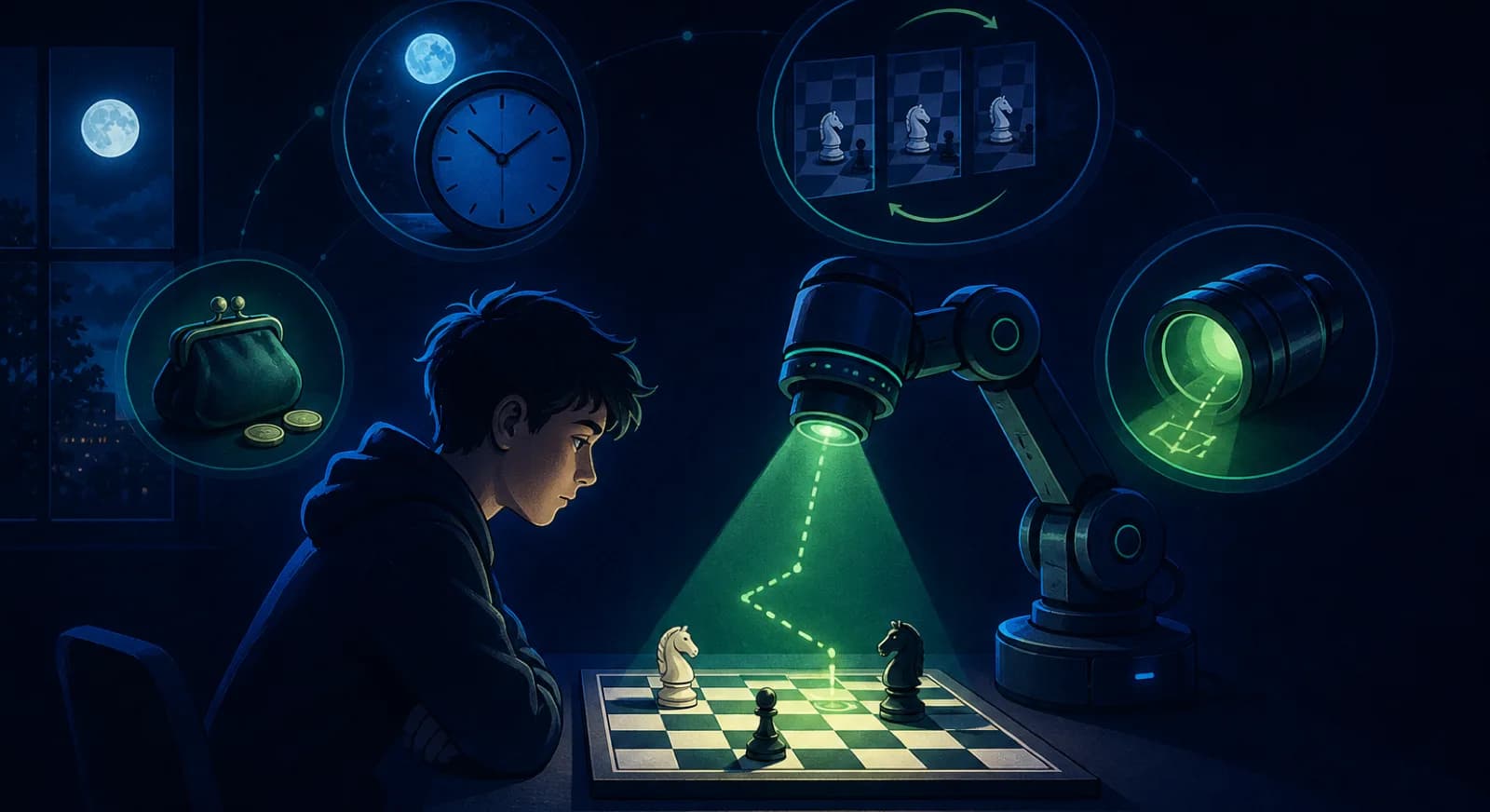
On price, the comparison is hard on paid options at the entry level. Lichess provides an unlimited analysis board with Stockfish, deep server analysis for 40 games a day, and an adaptive puzzle trainer at no cost [2][6], and the paid AI coach apps list monthly subscriptions on their official sites, for example Noctie at €14 a month or €96 a year [3]. A family testing whether chess will stick can run a real training routine for nothing before paying anyone.
On positional evaluation engines are strong, and honest human coaches use them. Stockfish is a free, open-source engine whose official site describes each release as stronger than the last [1]. An engine evaluation is still the output of a search at a particular depth, hardware and setting, so it is a strong reference rather than a verdict on what a particular student should study, and a coach may reasonably prefer a simpler idea the student can learn. A coach's value was never in out-calculating the machine; it is in everything around the calculation. Apps like Noctie add a human-like sparring layer [3], and DecodeChess translates engine reasoning into natural language [4], so the AI column keeps improving at explanation too. Our comparison of engine analysis and AI explanation digs into what that translation layer adds.
Lucas M. vs. Hana K.
Rapid · synced from Lichess · Tue 7:42 PM
14...Qe6? drops the knight
Eval swings +2.1 · the move to review first
Missed fork on move 23
Same pattern as last Tuesday · drill it
Endgame conversion was clean
Won vs. 1410 · French Defense
We score explanation quality as mixed. Good AI explanations are tirelessly available, but they are written without knowing your student. A human coach who has watched a child for six months may know that this player ignores the clock when excited, that this one collapses after losing a piece, that this one needs the why before the what. AI explanation answers the position; a coach can answer the person.
What can a human coach add that AI tools may not?
Four things, and they happen to be the four that most affect long-term improvement: accountability, curriculum across months, emotional coaching after losses, and motivation through belonging. The pattern is that tools lead on the chess content and people lead on knowing the player. That is the comparison in one line, and it is why the question is less either-or than the headline suggests.

Accountability is where the gap is clearest. Many tools wait for the player to show up, although some send reminders or weekly plans, and improvement is largely a showing-up problem. A coach can notice that a student has stopped bringing games, ask why and adjust. The mechanism is simple: a student who knows their coach will open their games on Thursday may play differently on Tuesday. A reminder can prompt; it cannot ask why. This is also where academies earn their fees: attendance, expected games and follow-up are the accountability layer. Our piece on why students quit academies looks at the same effect from the other direction.
Curriculum across months is the second area. Most tools answer the question asked: analyse this game, serve a puzzle at my level. Some build study plans from your games, but a plan generated from games does not know that this student should spend six unglamorous weeks on rook endgames before touching openings, or that last month's tactical theme needs revisiting. Sequencing is judgment built from watching many students succeed and stall. A player with many free resources and no sequence may improve more slowly than one with modest resources and a plan; our rating plateau guide shows how to test whether practice is pointed at the right problem.
Then there is the Sunday evening after a tournament disaster, a moment many chess parents know. A child has lost four games, the engine says round two was winning until move 31, and the precise truth of that evaluation may be exactly what the moment cannot use. The moment needs an adult who separates result from effort, finds the good decision in round three, decides whether this week calls for hard analysis or relaxed blitz, and says the sentence that keeps a nine-year-old in chess. No app we reviewed offers that role. The same applies to motivation through belonging: the rivalries, the team, the coach who remembers your best game. Many players stay in chess because of people, and an app on its own is not a room.
What about cost?
AI tools win on entry price. Lichess analysis and puzzles cost nothing [2], and Stockfish itself is open source [1]. Paid AI apps charge monthly subscriptions listed on their official sites, such as Noctie at €14 a month or €96 a year [3] and Aimchess Premium at $7.99 a month [5]. Human coaching and academy fees vary by city, format and coach, and we have no quote that would stand as a typical figure, so use the worksheet below with real quotes. For Indian class fees, our guide to chess class fees in India sets out what to ask.
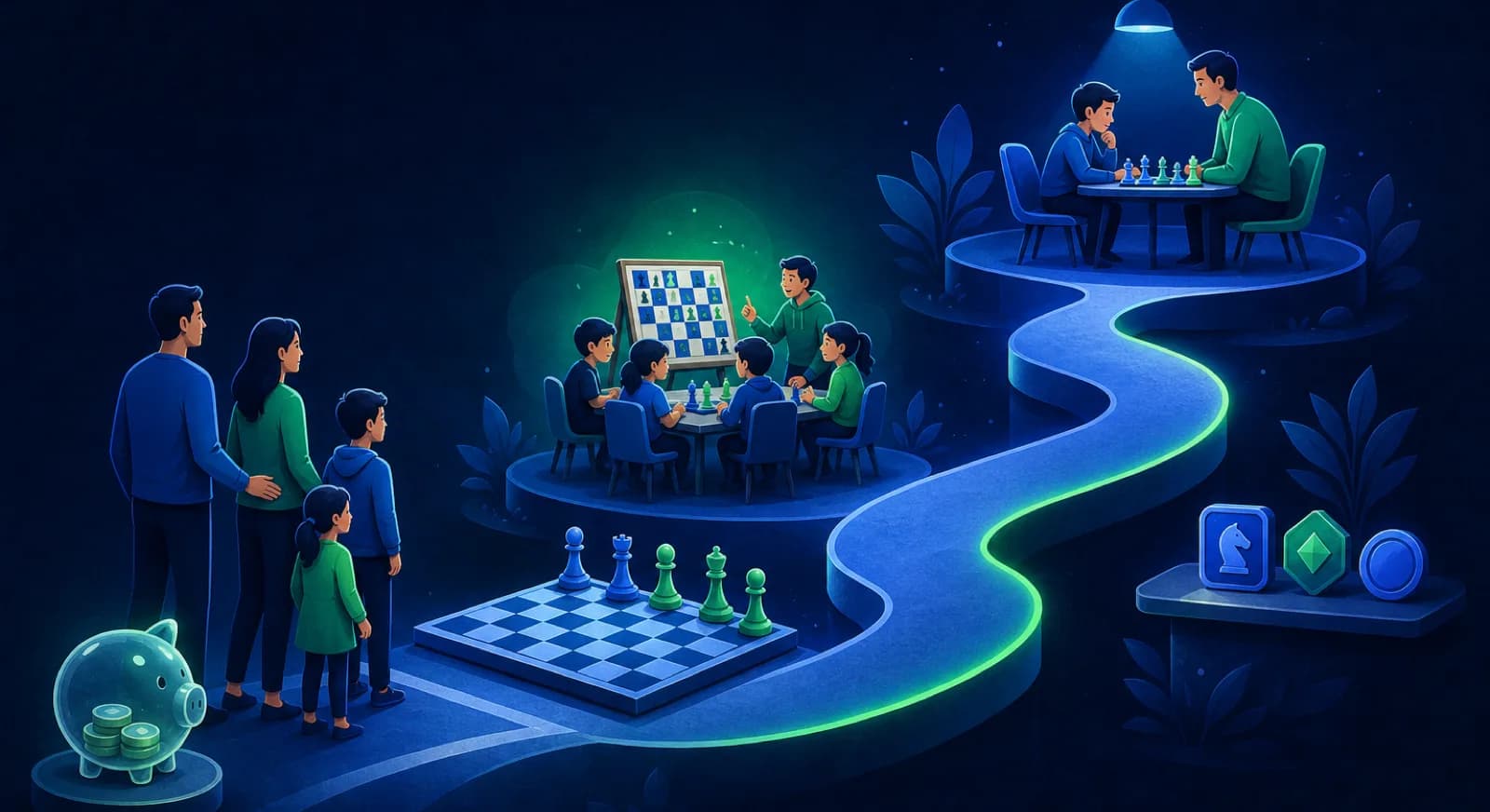
A reasonable sequence for a family is to spend nothing first and watch how much the child sticks with chess. Next, a group class or academy adds the room and regular check-ins. One-on-one coaching suits stated goals or a long plateau. Treat paid AI app subscriptions as an optional supplement throughout, judged by whether the free tools already earned a place in the routine. Our roundup of AI chess training apps ranks the paid options by what each is best at.
Fill this family budget worksheet with written quotes in one currency from the same month. Copy no figure from another city or another year, and treat the cost per session as a comparison aid, not a judgment of value.
| Option | Format | Quoted price (your quote) | Currency and period | Sessions or hours a month | Cost per session |
|---|---|---|---|---|---|
| Free tools | Lichess analysis and puzzles | Free | Not applicable | Your own time | Not applicable |
| Paid AI app | Subscription from the app's own page | (blank) | (blank) | (blank) | (blank) |
| Group class or academy | Written fee schedule | (blank) | (blank) | (blank) | (blank) |
| One-on-one lessons | Written quote from the coach | (blank) | (blank) | (blank) | (blank) |
What does this comparison rest on, and what does it not?
This is a reasoned comparison, not a measured head-to-head trial. We did not run a study or survey families, and we cite no improvement statistics, so nothing here shows that either approach produces faster rating gains. The scorecard is editorial judgment based on what the tools document on their official sites and on how coaching workflows are built.
We build software for chess academies, so we know where an engine's output ends and where an academy workflow begins, and we also have an interest in academies doing well. Where a claim depends on a tool's features it comes from the tool's official site and carries a date [3]; where it is a judgment, it says so. Weigh our academy-side bias accordingly, and treat this as a well-informed argument rather than a finding.
What setup actually works best?
AI tools for volume inside a human relationship for direction is the synthesis this cluster builds to. It is less a compromise between the two columns than a division of labour: the machine supplies tireless feedback and strong evaluations, and the human supplies sequence, accountability and care.
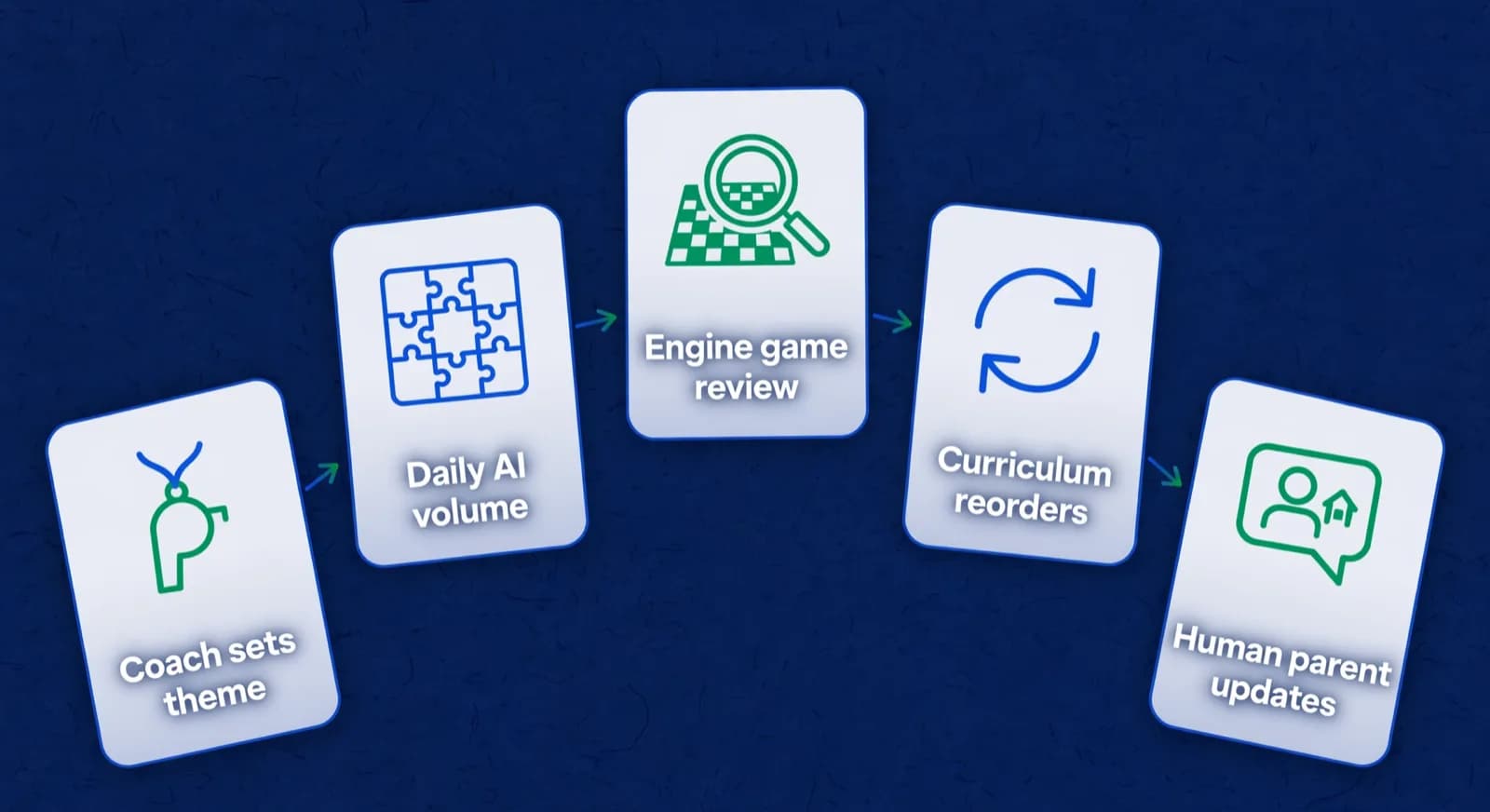


- The coach sets the theme and the homework in the weekly lesson.
- The player does daily volume on AI tools between lessons: puzzles, analysed games, sparring [2].
- Every serious game gets engine analysis before the next lesson, so the coach reviews evidence, not memory [1].
- The coach reorders the curriculum based on what the evidence shows.
- Parents see honest updates from the human, grounded in the real data.
ChessCore, which we build, is academy management software for the human side of this setup, not an AI coach for players. Stockfish produces every engine evaluation [1]; AI-written report text and parent-message drafts wait for a person to approve them, while class reminders, fee reminders and monthly reports send automatically on fixed templates. If you run an academy, the AI page explains the guardrails and a demo shows it on your own batches. If you are a player or parent choosing tools, start free, read our Noctie review if you want AI sparring, and add a person when behaviour, not knowledge, is the bottleneck.
Frequently asked questions
Can AI replace a chess coach?
For engine feedback, AI tools are strong and free. For coaching as a whole, it depends on what you need a coach for. Tools can supply practice, analysis, reminders and plans; a human coach can add accountability, sequencing and encouragement. Casual and self-directed adult players can run on AI alone; children and competitive players often want a person in the loop. This is editorial judgment, not a measured result.
Is an AI chess coach cheaper than a human coach?
At entry, yes: Lichess analysis and puzzles are free, and paid AI apps list monthly subscriptions on their official sites, such as Noctie at €14 a month [3]. Human coaching and academy fees vary widely, so compare real quotes in one currency using the worksheet on this page. A human coach sells time from someone who knows your child, which no subscription includes.
What is better for a child, AI chess training or a human coach?
It depends on the child. A recreational child with an engaged parent can do well on free tools. A child with tournament goals often benefits from a coach or academy that sets direction and checks in, with AI tools as the practice layer between lessons. Children vary, and some self-direct well, so judge by what your child does without being asked.
Do human chess coaches use AI themselves?
Many do. Engines are strong evaluators, so a coach can check their own judgment against Stockfish, assign puzzle and analysis homework on free platforms, and spend lesson time on what a tool does not know: the student in front of them. A coach who refuses any engine input and an app that claims to replace coaches both ask you to take something on trust.
Is there research comparing AI vs human chess training?
This page does not rest on a study. It is a reasoned comparison, not a measured head-to-head trial, and it cites no improvement statistics. Treat any precise percentage in an article on this question with care unless you can read the source and see the method. Our verdicts are editorial judgment from building academy software.
Sources
- [1]Stockfish: strong open source chess engine · accessed 2026-10-16
- [2]Lichess puzzle trainer · accessed 2026-10-16
- [3]Noctie pricing and free trial · accessed 2026-10-16
- [4]DecodeChess: AI chess move explanations · accessed 2026-10-16
- [5]Aimchess: training from your online games · accessed 2026-10-16
- [6]Lichess features: free account and Patron compared · accessed 2026-10-16
Written by Abhishek Tiwari
ChessCore
Drafted with AI, fact-checked and approved by a human before publishing, the same guardrail our product applies to every report it sends. Read our editorial standards.
Equip the side of this comparison that trains players
ChessCore gives coaches engine reviews, student records and AI report drafts that wait for a person, so the AI-plus-human setup can run. See it on your own academy's data.
- Roster import from the spreadsheets you already keep
- Lichess and Chess.com connections, batches, and fee plans
- First reports in week one, after your approval
- Free plan, no credit card required