On this page8 sections, 17 min read
- What is Noctie AI?
- How many difficulty levels does Noctie have?
- Why does humanlike AI opposition matter for training?
- Who is Noctie for?
- How should a coach assess Noctie during the trial?
- How much does Noctie AI cost, and what does the free tier include?
- What are the best Noctie alternatives by job?
- Where does Noctie stop and coaching begin?
- Frequently asked questions
Bottom line
Noctie AI is a chess training bot whose official site describes humanlike opening choices, mistakes and move timings. This desk review reads Noctie's own pages on 16 October 2026, not hands-on games: 25 levels from about 400 to 2800, €14 monthly or €96 annually, a free 7-day trial and a free rating test. It suits individual practice; a coach still judges the fit.
TL;DR
- Noctie AI is a humanlike chess bot for training: it plays like a person at your level instead of a perfect engine, per its official site.
- It suits students who need sparring volume, opening practice, and low-pressure games more than they need new instruction.
- Published pricing on 16 October 2026 is €14 per month or €96 billed annually (€8 per month), with a free 7-day full trial and a free rating test before you pay.
- Use the trial to assess Noctie's move feedback, difficulty levels and ease of use against the student's own practice goals, and record what you saw on a blank sheet rather than relying on memory.
Key facts
- Noctie AI describes itself as a chess bot built for training that mimics human play from beginner to grandmaster level, with humanlike opening choice, mistakes and move timings.[1]
- On 16 October 2026 Noctie listed €14 a month or €96 billed annually; the yearly plan works out to €8 a month, against €168 for twelve monthly payments.[7]
- Every plan starts with a free 7-day full trial, and a free rating test is available without starting a trial. The site says Noctie runs on web, iOS and Android.[7]
- Noctie states it was trained on billions of games between humans and fine-tuned over several years.[1]
- Noctie's FAQ maps its 25 levels from Pawn 1 at 400 to Queen 5 at 2800 and calls the table a rough guide relative to Chess.com online blitz ratings.[8]
What is Noctie AI?
Noctie AI is a chess training bot from Noctie AB that plays like a human at your level rather than like an engine. Its official site calls it "a chess bot that's built for your training" and "a personal AI chess coach with a human touch," and says it mimics human play from beginner to grandmaster level, including humanlike opening choice, mistakes and move timings [1]. The model was trained on billions of games between humans, per the site, and the company claims over 100,000 learners use it on web, iOS and Android [1].
Beyond plain games, the published feature set includes opening practice against the most common human responses, custom position and endgame setup, real-time color-coded move feedback from Excellent down to Blunder, puzzle decks generated from your own mistakes with spaced repetition, more than 100 interactive lessons, and daily puzzles and weekly scenarios [1]. The web app at app.noctie.ai is where the free demo and rating test run [2].
Noctie is best considered as a practice opponent between lessons. Its published features include adjustable opposition, a rating test, and feedback on play [1][2][7]. For a parent or coach, the useful test is whether the student can explain a mistake after a game and apply the lesson in the next one. During the trial, choose one training goal, such as checking for threats before moving, and discuss a few positions together. A subscription is easier to judge when it supports a specific habit.
| Rubric criterion | What we look for | Evidence available |
|---|---|---|
| What it does | Is the core claim clear, specific, and documented on the official site | Verified on Noctie's official homepage [1] |
| Who it fits | Does the tool name its audience honestly, and does the design match it | Inferred from documented use cases, not user testing |
| What it costs | Is pricing published plainly, with a real way to try before paying | Verified on Noctie's official pricing page [7] |
| Where it stops | Does the tool stay honest about what a human coach still has to do | Limited to what the reviewed pages do and do not document |
How many difficulty levels does Noctie have?
Noctie's homepage, checked on 16 October 2026, says the bot mimics human play at 25 levels, from beginner (about 400 Elo) to super-GM (about 2800) [1]. The official FAQ publishes a 25-row rating table from Pawn 1 at 400 to Queen 5 at 2800, labelled as a rough guide relative to Chess.com online blitz rating, not as a FIDE list [8].
Noctie's FAQ says a short rating test sets the starting rank, then ranked-game wins and losses move the badge up or down [8]. Use that rank to choose practice opposition inside Noctie. For a student who also plays rated tournaments or online human games, keep those results alongside the bot rank rather than treating the numbers as interchangeable. During the trial, look for opponents that challenge the student without making every game discouraging.
Why does humanlike AI opposition matter for training?
Noctie positions humanlike opposition as an alternative to conventional bots that mix very strong moves with unrealistic one-move errors. Its official site says the model learned from billions of human games and aims to reproduce human opening choices, mistakes, and move timing at levels from beginner to grandmaster [1]. That is Noctie's product claim, and the trial is where you test it.
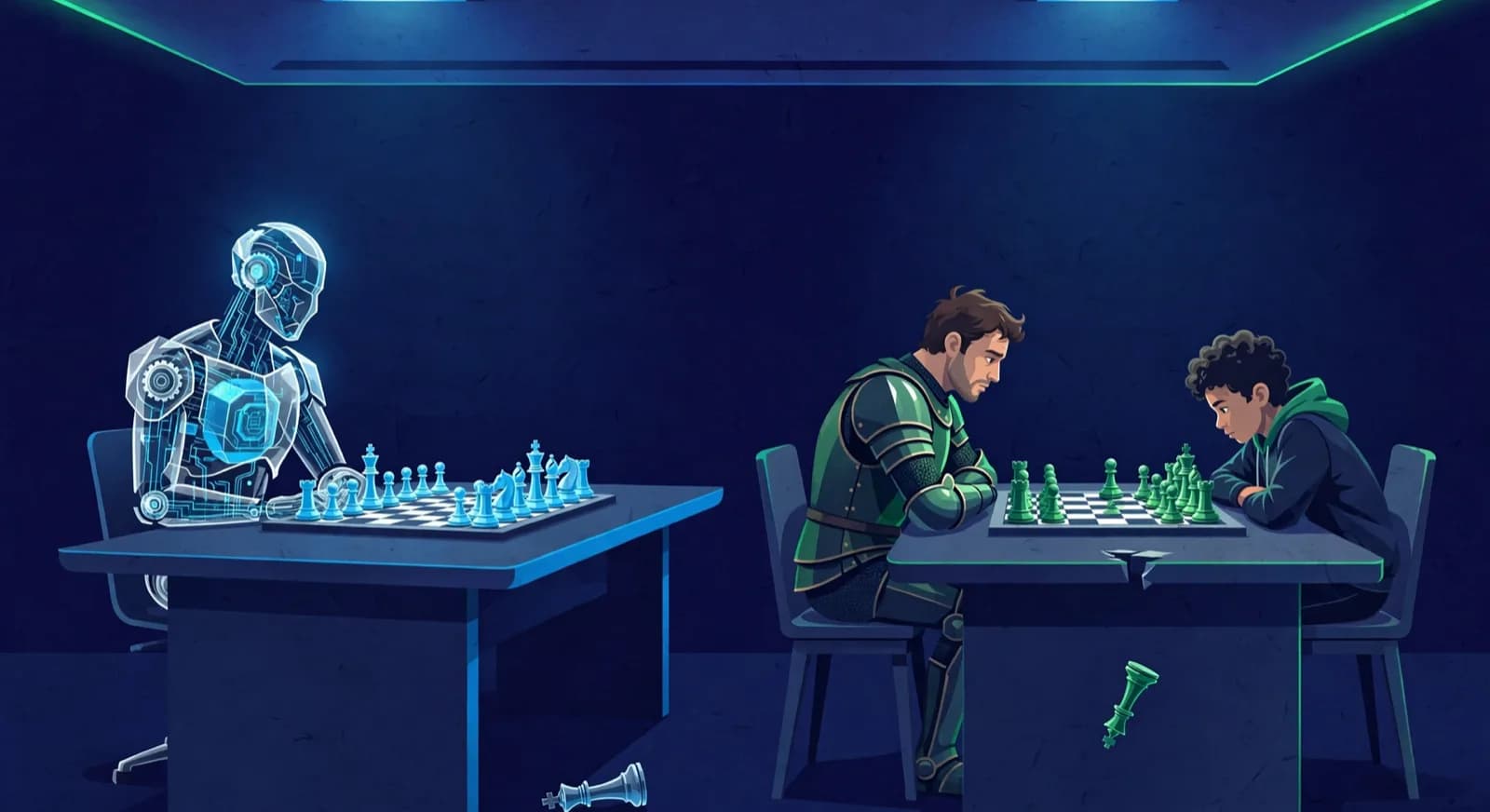
The useful question is whether the bot produces practice positions that resemble the student's real games. A parent or coach can check that during the trial: save several bot games, compare the mistakes with recent tournament games, and note whether the student can explain what changed. That test is more informative than accepting a humanlike label on its own. A handful of games gives a first read, not a verdict: for each one, note the opening, the move where the game turned, and whether a club opponent at that level would plausibly have played it.
The documented feature set also supports repeatable practice. Students can choose common openings, import repertoires, set up endgames and other positions, receive instant move feedback, and revisit mistakes as spaced-repetition puzzle decks [1]. Those tools could support sparring and conversion practice. Their value still depends on whether the student uses them consistently and whether the feedback matches the student's needs.
The feedback follows the same idea. Noctie's FAQ says each move is graded from blunder to excellent on how good it looks from a human point of view, not on centipawn loss or engine accuracy, so a reasonable move that fails to an obscure engine line is not punished and a clever practical move can be rewarded [8]. It also says the feedback picks out the most instructive mistakes rather than the biggest swings in engine evaluation [8]. That is a deliberate difference from an engine review. For a coach it means the two views will not always agree, so check a few of Noctie's grades against a Stockfish line during the trial and decide which one the student should trust for which kind of mistake.
Noctie's site also documents lessons, daily puzzles, weekly scenarios, opening repertoires, and feedback, so it is broader than a bare sparring bot [1]. The pages we reviewed do not document coach oversight, parent reporting, or academy operations. Treat those as separate requirements when choosing a training setup.
Who is Noctie for?
Noctie is designed for players who want level-matched games, opening practice, custom positions, and immediate feedback. Its official site describes a low-pressure environment where the player controls the pace [1]. Based on those documented features, the clearest fit is a student who will use repeated practice between lessons.
The official pages we reviewed describe lessons and training features, but they do not document an individual curriculum chosen by a human coach, attendance accountability, or parent communication [1]. Families that need those services should evaluate them separately. Our comparison of an AI chess coach versus a human coach covers that boundary, and our guide to the best AI chess training apps places Noctie beside other player-facing tools.

Lucas M.
Batch B2 · Thursdays · joined Aug 2025
1342
Academy rating · Lichess games synced
Won vs. 1410 · French Defense
Best gameMissed fork on move 23
Homework setHow should a coach assess Noctie during the trial?
Assess Noctie by giving the student a specific practice goal and reviewing a few games together. Its official pages describe features, devices, subscriptions, and trial terms [1][2][7]; the decision for your family is whether those features fit the student's routine. Check whether the child can navigate the app, understand the feedback, and describe what they will try differently next game. For a coach, the app earns its place when practice produces positions you can discuss in the next lesson.
A useful trial should answer three questions with evidence from the student's own games: does the level match feel credible, do the mistakes resemble human opposition, and does the feedback lead to a better explanation or move on the next attempt? Keep the subscription only if the student uses it enough for those benefits to recur. Prices and features can change, so confirm the checkout terms before paying.
Use this blank observation sheet during a real trial and fill it in only after you have played and saved the games. The sheet is empty on purpose: this review has not run a hands-on test, so no result is reported here.
| Field | What to record | Result (fill after a dated trial) |
|---|---|---|
| Date and device | The day the games were played and whether it was web, iOS or Android | (blank) |
| Student level | Current rating on a named platform and time control, and the starting Noctie rank after the rating test | (blank) |
| Practice goal | One habit, such as checking for threats before each move | (blank) |
| Saved games | How many games were played, and how each was saved for the lesson | (blank) |
| Feedback checked | Three move grades compared with a Stockfish line, and which the student found easier to act on | (blank) |
| Decision | Keep, cancel before day 7, or choose another tool, with the reason in one sentence | (blank) |
How much does Noctie AI cost, and what does the free tier include?
On 16 October 2026, Noctie's pricing card listed €14 per month or yearly at €8 per month with €96 billed annually, and the pricing FAQ explains yearly as €96 instead of €168 [7]. There is no ongoing free tier. The official pricing FAQ says the former free version was replaced by a free 7-day trial of the full product, while the rating test remains free without starting a trial [2][7]. Confirm the amount shown at checkout before paying, because published prices can change.
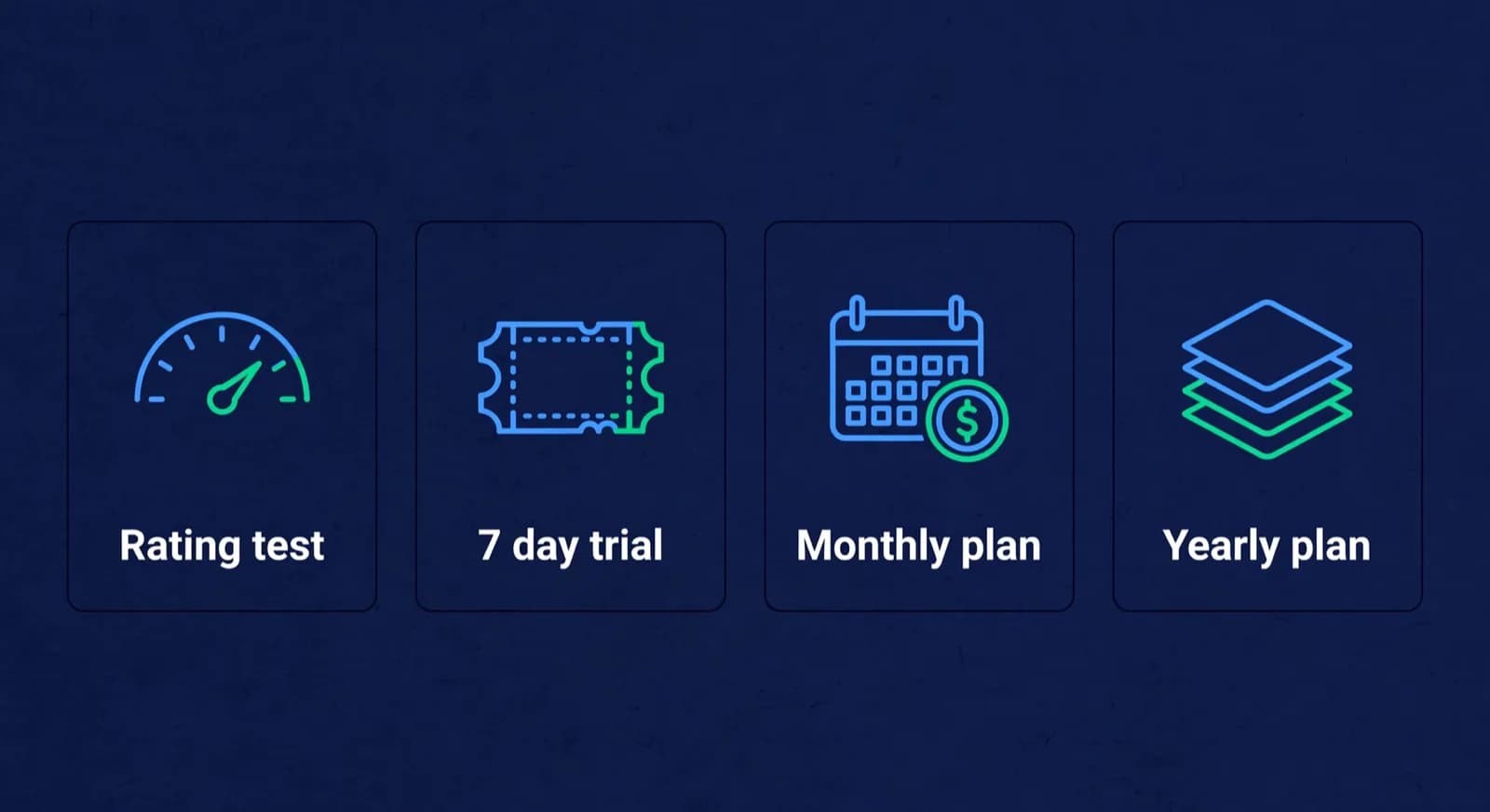
Monthly and yearly include the same feature set; yearly is cheaper because you pay for the year up front. Prices are in EUR. Regional pricing may appear in the iOS or Android app stores for some regions, per the official pricing FAQ [7]. Web billing is managed in-account, and app-store subscriptions cancel through Apple or Google [7]. Confirm figures before subscribing because published prices can change.
| Path | What you pay | What you get (per official site) |
|---|---|---|
| Rating test | Free, no trial required | Placement test to match the bot to your level [2] |
| 7-day trial | Free for the first 7 days | Full product access, cancel before it ends to avoid a charge [7] |
| Monthly | €14 per month | Same unlocked feature set as yearly [7] |
| Yearly | €96 billed annually (€8 per month) | Same feature set as monthly, marketed as a 40 percent saving [7] |
Start with the free rating test, then use the 7-day trial to evaluate several games and feedback sessions. If the student only needs free practice and puzzles, Lichess remains a no-cost option [4]. Paying for Noctie makes sense only when its specific practice loop is useful enough to repeat.
What are the best Noctie alternatives by job?
The best Noctie alternatives split by the job you need: Lichess Maia bots for free humanlike sparring, Chessiverse for a large paid bot roster, Chess.com bots and Coach inside an existing membership, Chessvia for a web coach that explains why a move failed, and Aimchess or DecodeChess for analysis [9][5][6]. Noctie remains the paid package when you want humanlike play plus instant feedback under one plan across web, iOS and Android [1].
Two Noctie traits drive almost every alternatives search. First, humanlike opposition: the bot is meant to fail the way a person fails, not the way a weakened engine fails. Second, instant feedback while the game is still warm. If you only need one of those traits, a cheaper or free tool may win; if you need both in one product with openings, flashcards and lessons attached, Noctie is still a strong paid default [1]. Name the single job first, then pick the tool that owns it, because shopping by brand name is how families end up with three half-used subscriptions.
For free humanlike sparring, Lichess Maia bots are the closest zero-cost option. The Lichess bot directory lists three official Maia bots, each a human-like neural network trained on more than 10 million Lichess games: maia1 at the 1100 level, maia5 at 1500 and maia9 at 1900, free to challenge with a Lichess account [9]. The level labels describe the games each model learned from, not live ratings, and community-run bots can go offline, so keep a fallback at a nearby level before assigning bot homework. What you give up versus Noctie is the packaged product around the game: the feedback, flashcards from mistakes, opening repertoires and lessons Noctie bundles under one account [1].
Chess.com bots are a real alternative when the student already lives on Chess.com or a parent already pays for membership. Free accounts can play bots, with support materials listing 20+ distinct personalities on the free tier, while Gold and higher include all bots; Gold also adds unlimited games against the Coach feature, which free accounts limit to one Coach game per month [10]. Membership prices and trial offers appear on the membership page and vary by billing period and region, so confirm the live page before buying [11]. Chess.com sells personality-led bots, a different product from Noctie's one humanlike model across its levels, so if your student already reviews games there, paying once for membership may beat stacking Noctie on top.
Pick Aimchess or DecodeChess when the real job is not sparring volume. Aimchess pulls games from Chess.com and Lichess, scores play across six areas and turns mistakes into personalized training; its free Standard plan includes one 40-game report a month, with Premium published at $7.99 monthly or $57.99 a year [6]. DecodeChess explains engine recommendations in plain language on Stockfish NNUE, with a free plan of one Decode Game a day and paid plans from $8.25 a month [5][3]. Both answer what to train or why a move was wrong, not who to play right now, so they complement a sparring bot rather than replace it.
Chessvia and Chessiverse are the two vendor-comparison options worth knowing. Chessvia's own comparison page describes a web-only coach with plain-language explanations of why a move failed and a free review of a finished game, and it recommends Noctie for lifelike play on a phone since it has no native apps [12]. Chessiverse's own comparison page lists more than 1,000 bots on a responsive web platform, with pricing from $7.50 a month billed yearly or $12.99 monthly [13]. So the Chessiverse trade is variety against packaging: a thousand browser opponents, or one humanlike model with feedback, flashcards and native apps.
| Option | Role | Published cost (checked 2026-10-16) | What you give up vs Noctie |
|---|---|---|---|
| Lichess Maia bots | Sparring replacement (free) | Free with a Lichess account; maia1, maia5, maia9 at the 1100, 1500 and 1900 levels [9] | Noctie's bundled feedback, flashcards, openings and lessons [1] |
| Chessiverse | Sparring replacement | From $7.50 a month billed yearly, or $12.99 monthly [13] | Native iOS and Android apps [13] |
| Chess.com bots and Coach | Sparring inside a membership | Free tier has bots; Gold includes all bots and unlimited Coach games [10][11] | Noctie's one humanlike-training claim; may mean a wider membership [1][11] |
| Stockfish engine levels | Sparring, not humanlike | Free engine [3] | Human-shaped mistakes; risk of training against unnatural errors [1][3] |
| Aimchess | Complement: weakness drills | Free Standard (one 40-game report a month); Premium $7.99 a month or $57.99 a year [6] | Live sparring as the core product [6] |
| DecodeChess | Complement: explanations | Free plan (one Decode Game a day); paid plans from $8.25 a month [5] | A sparring partner with Noctie's game-plus-feedback loop [1] |
| Chessvia | Complement: why a move failed | Free finished-game review; paid plans on its pricing page [12] | Humanlike sparring as the core product [12] |
- Budget is zero and the job is humanlike games: start with Lichess Maia bots and free puzzle training [9][4].
- You already pay for Chess.com Gold or higher: exhaust bots and Coach games before adding Noctie [10][11].
- You play many online games but cannot name your weakness: Aimchess free report first, Premium only after volume justifies it [6].
- You understand engine arrows but not ideas: DecodeChess, not another sparring app [5].
- You want one paid home for humanlike games plus feedback and flashcards: Noctie's trial is the clean test [1][7].
- You need curriculum, accountability or a human relationship: a coach or academy does what no bot in this list claims.
Where does Noctie stop and coaching begin?
Noctie's public pages document games, move feedback, lessons, opening work, custom positions, and puzzles built from mistakes [1]. The pages we reviewed do not document academy attendance, parent reporting, or a human coach choosing the next lesson. A coach can still use practice games as lesson material: ask the student to bring the two games that felt hardest. The Noctie pages we read describe importing games from Chess.com and Lichess, but we did not see a way to export Noctie games, so check how a game can be saved before you rely on a download [1][7].
Lucas M. vs. Hana K.
Rapid · synced from Lichess · Tue 7:42 PM
14...Qe6? drops the knight
Eval swings +2.1 · the move to review first
Missed fork on move 23
Same pattern as last Tuesday · drill it
Endgame conversion was clean
Won vs. 1410 · French Defense


ChessCore, which we build, is academy management software for coaches and academy owners, and its training portal is only for students of academies that use it, so it is never an alternative to Noctie for an individual player; it is where a coach manages the students who use tools like it.
| Student type | Fit with Noctie, inferred from documented features |
|---|---|
| Improver who plays too few games between classes | Likely fit: more sparring volume is what the documented features offer |
| Student drilling a new opening repertoire | Likely fit: full games in the chosen opening against common human replies [1] |
| Nervous beginner avoiding online play | Likely fit: low-pressure practice at a matched level, per the site's stated philosophy [1] |
| Student needing structure and a study plan | Partial fit: pair it with a coach or academy that sets the curriculum |
| Parent wanting accountability and progress reporting | Not this tool: that is a coach's job, supported by academy systems |
Frequently asked questions
Is Noctie AI free?
Not as an ongoing free tier. Noctie offers a free 7-day full trial and a free rating test, then paid plans at €14 per month or €96 billed annually, as published on noctie.ai when we rechecked. The site's pricing FAQ says the free version was replaced by that trial. If zero cost is the permanent requirement, Lichess offers free play and free puzzle training, and our free AI chess coach guide covers the full no-cost landscape.
Is Noctie's rating estimate accurate?
Use Noctie's estimate to choose an initial bot opponent. Its FAQ describes the rating table as a rough guide relative to Chess.com online blitz ratings. A FIDE rating or a rating from another platform belongs to a different playing context. Keep the student's recent human-game results alongside the app rank, and choose a level that gives useful practice rather than chasing agreement between the numbers.
How many difficulty levels does Noctie have?
Noctie lists 25 difficulty levels, from beginner at about 400 Elo to super-GM at about 2800, on its homepage (October 2026). Its FAQ names the steps from Pawn 1 at 400 to Queen 5 at 2800 and describes them as a rough guide relative to Chess.com online blitz ratings. Use the levels to adjust practice difficulty; they are not entries on a FIDE rating list.
What are the best alternatives to Noctie AI?
It depends on the job. For humanlike sparring at no cost, the closest free substitute is Maia on Lichess, with bots at the 1100, 1500 and 1900 levels. For understanding why moves are good, DecodeChess explains engine recommendations in plain language. For weakness analytics across your games, Aimchess reports on areas like tactics and time management. For free practice, Lichess offers unlimited play and puzzle training. And for curriculum, accountability and a human relationship, a coach or academy does what no bot claims to do.
Can Noctie replace a chess coach?
Use Noctie for individual practice and a human coach for a learning plan and conversations about progress. Noctie's official pages describe humanlike opposition, move feedback, lessons, opening practice, and puzzles from mistakes. A coach can choose which of those activities fits the next lesson and review the student's decisions afterwards. For parents, agree what the child should practise between sessions and ask the coach how that practice will be discussed.
Does Noctie work on mobile?
Yes. Noctie's official site says learners use it on web, iOS and Android, so a student can play training games on a phone or tablet as well as in the browser. The free demo and rating test run in the web app at app.noctie.ai, which is the easiest place to evaluate it before paying for a subscription.
Sources
- [1]Noctie.ai official homepage · accessed 2026-10-16
- [2]Noctie web app (free demo and rating test) · accessed 2026-10-02
- [3]Stockfish: strong open-source chess engine · accessed 2026-08-30
- [4]Lichess puzzle training (free) · accessed 2026-08-30
- [5]DecodeChess: AI chess analysis and explanation · accessed 2026-10-16
- [6]Aimchess: chess analytics and personalized training · accessed 2026-10-16
- [7]Noctie pricing and billing FAQ · accessed 2026-10-16
- [8]Noctie FAQ: difficulty levels and rating table · accessed 2026-10-16
- [9]Lichess online bots directory, including the Maia bots · accessed 2026-10-16
- [10]Chess.com support: premium membership levels, bots, and Coach · accessed 2026-10-16
- [11]Chess.com membership plans page · accessed 2026-08-10
- [12]Chessvia page on Noctie alternative: web-only coach and free game review · accessed 2026-10-16
- [13]Chessiverse vs Noctie comparison, Chessiverse official site · accessed 2026-10-16
Written by Abhishek Tiwari
ChessCore
Drafted with AI, fact-checked and approved by a human before publishing, the same guardrail our product applies to every report it sends. Read our editorial standards.
Coaching the students who train with bots?
ChessCore is academy management software: Stockfish game review, AI report drafts that wait for a person, attendance and fees in one place. See it on your own academy's data.
- Roster import from the spreadsheets you already keep
- Lichess and Chess.com connections, batches, and fee plans
- First reports in week one, after your approval
- Free plan, no credit card required