On this page11 sections, 22 min read
- What is DecodeChess?
- What does AI move explanation actually solve?
- Is DecodeChess a Stockfish alternative?
- What did this DecodeChess review test and not test?
- Is DecodeChess still active, and what does it cost now?
- What are the best DecodeChess alternatives?
- How do you choose a DecodeChess alternative with a clear rubric?
- Can you import your own PGN or Chess.com and Lichess games?
- Who should and should not use DecodeChess?
- How do you upload and decode a game?
- Does DecodeChess work on a phone, and can you export analysis?
- Frequently asked questions
Bottom line
DecodeChess is worth trying if you need engine moves explained in words, and optional if raw Stockfish lines already suffice. Its official site calls it an AI chess tutor for players rated up to 2000, and Unlimited costs $8.25 a month or $84 a year above a free tier whose daily limit the vendor's own pages state differently. This review reads the public pages; it does not test learning gains.
TL;DR
- DecodeChess explains the why behind engine moves in plain language, calling itself the first AI chess tutor on its official site.
- It is a layer on top of Stockfish, not a replacement for it: the engine finds the truth of a position and DecodeChess translates it.
- The official site states it is built for players rated up to 2000.
- Decodes run on DecodeChess's servers with Stockfish 12 NNUE, usually at about depth 24, while the lighter Game Map and basic analysis run in your browser.
Key facts
- DecodeChess calls itself the first AI chess tutor and says it explains the why behind chess moves in rich, intuitive language.[1]
- DecodeChess runs on Stockfish NNUE: the engine produces the moves and evaluations, and DecodeChess explains them.[1]
- The official site states DecodeChess is aimed at players with an Elo rating of up to 2000.[1]
- Each decoded position is explained across five areas: threats, good moves, plans, piece functionality, and concepts.[1]
- DecodeChess offers a free account; its homepage invites users to join for free and try the software for free.[1]
- On 16 October 2026, DecodeChess listed Unlimited at 8.25 US dollars monthly or 84 US dollars yearly, and one-time Light and Medium credit packs at 15 and 25 US dollars. Confirm prices on the official pricing page before paying.[6]
What is DecodeChess?
DecodeChess is worth trying if engine recommendations need a plain-language explanation, and it is optional if raw Stockfish lines already suffice. DecodeChess is chess analysis software from Decodea LTD. Its official site leads with "Chess Analysis, Powered by AI" and calls the product "the first AI chess tutor" that "explains the why behind chess moves in rich, intuitive language" [1]. Under the hood it combines its own explainable AI layer with Stockfish NNUE, so the moves being explained are engine-best moves rather than a weaker model's guesses [1][2]. The site states plainly that it is built for players rated up to 2000 [1]. Treat that ceiling as the vendor's stated audience, then decide whether a student still needs a human to set homework and watch the rating trend. This review uses those official pages, not a test of explanation accuracy or learning gains.
Each position you decode is broken into five tabs per the official feature list: threats (what the opponent intends and what survives the best move), good moves (the best options in order), plans (how the move supports what comes next), functionality (what each meaningful piece is doing), and concepts (the positional and tactical motifs in play) [1]. There is also a humanlike practice opponent that adapts to your play, with the option to decode positions mid-game [1]. The homepage carries endorsements from grandmasters Anish Giri, Boris Gelfand and Sam Shankland [1].
The facts below come from DecodeChess's homepage, pricing page and FAQ, checked on 16 October 2026 [1][6][7]: the feature descriptions, stated audience, prices, device guidance, upload formats, and the mobile and export limits. The section on what this review tested sets out the method once.
| Rubric criterion | What we look for | Evidence available |
|---|---|---|
| What it does | Is the core claim clear, specific, and documented on the official site | Stated on DecodeChess's official homepage [1] |
| Who it fits | Does the tool name its audience honestly, and does the design match it | Audience as described on the official site [1] |
| What it costs | Is pricing published plainly, with a real way to try before paying | Listed on the official pricing page [6] |
| Where it stops | Does the tool stay honest about what a human coach still has to do | Limited to what the reviewed pages document |
What does AI move explanation actually solve?
AI move explanation addresses a common limit of raw engine output: an evaluation and principal variation do not automatically explain the plan in language a student can repeat. Stockfish is an analysis engine [2]. DecodeChess adds a separate explanation layer for threats, candidate moves, plans, piece functions, and concepts [1].
Here is a worked example you can run yourself, so the gap is concrete. Take the position from Morphy against the Duke of Brunswick and Count Isouard, Paris 1858, with White to move: FEN 4kb1r/p2n1ppp/4q3/4p1B1/4P3/1Q6/PPP2PPP/2KR4 w k - 0 16. You can paste that FEN into our free FEN viewer to see the board. A local Stockfish 19 run on 16 October 2026 reports mate in two with the forced line 16.Qb8+ Nxb8 17.Rd8#, and Qb8+ leaves Black exactly one legal reply. The engine states the moves and the mate. It does not, on its own, say why they work.
The teacher's sentence is the missing layer, and this one is written by hand, not produced by any tool: the knight on d7 is the only piece guarding the d8 mating square, so White gives up the queen with Qb8+ to force Nxb8, pulls that defender away, and mates with Rd8#. That is a deflection sacrifice. We have not run this position through DecodeChess, so we do not claim what its explanation would say; the point is only that the explaining step is a separate job from the engine's calculation. The checked engine line above came from Stockfish, not from a vendor screenshot.

DecodeChess presents those explanations as sentences tied to the current position [1]. That can cut the work of interpreting a raw engine line. The site's up-to-2000 audience statement describes whom DecodeChess markets to, not an independently verified performance ceiling [1].
The official pages describe game and position explanations, a practice opponent, and the ability to decode during play [1][6]. They do not document a human coach assigning a curriculum, monitoring attendance, or reporting progress to parents. Those are separate requirements. Our comparison of engine analysis versus AI explanation covers the technical boundary, while our chess rating plateau guide covers other reasons improvement may stall.
Is DecodeChess a Stockfish alternative?
No. DecodeChess and Stockfish are not competitors, and DecodeChess could not exist without Stockfish: its own site says it combines its AI layer with Stockfish NNUE [1]. Stockfish is the free, open-source engine that finds the strongest moves [2]; DecodeChess is a commercial explanation layer that turns those moves into language [1]. Asking which one to use is like asking whether you need the textbook or the teacher reading it aloud: they do different jobs on the same material.
| Question | Stockfish | DecodeChess |
|---|---|---|
| What is the best move? | Yes: this is the engine's entire job [2] | Yes, via the Stockfish engine it runs [1] |
| Why is it the best move? | Evaluation numbers and lines only | Plain-language explanation across five areas [1] |
| What does it cost? | Free and open source [2] | Free account; tier details on the official pricing page [1] |
| Who is it for? | Engine users who can interpret its output | Players rated up to 2000, per the site [1] |
The practical takeaway for a student: you will never choose between them. If you use DecodeChess, you are using Stockfish through it. If you use raw Stockfish on Lichess or elsewhere, the question is only whether you can extract the why yourself or want it translated.

Lucas M. vs. Hana K.
Rapid · synced from Lichess · Tue 7:42 PM
14...Qe6? drops the knight
Eval swings +2.1 · the move to review first
Missed fork on move 23
Same pattern as last Tuesday · drill it
Endgame conversion was clean
Won vs. 1410 · French Defense
What did this DecodeChess review test and not test?
As of 16 October 2026, DecodeChess's homepage, pricing page, and FAQ document the explanation categories, target audience, prices, refunds, device guidance, PGN and FEN upload, and the mobile and export limits cited below [1][6][7]. This review did not upload a PGN, decode a game, test the adaptive opponent, compare explanations with a coach, or complete a purchase. The judgments here follow those published pages and a test method you can run, not a measured performance score.
The free account makes a first-party test possible once you confirm today's limit on the live pricing page, because the pricing page and the FAQ disagree on how many free decodes are included each day [6][7]. Use whatever free path is shown at signup on several recent games, then ask the student to explain the idea without the screen and apply it to a similar position. Record where the explanation is clear, vague, or wrong. Lichess studies remain a free route for raw analysis [3].
Is DecodeChess still active, and what does it cost now?
As of 16 October 2026, DecodeChess's homepage linked to free signup, and its official pricing page listed Free, Unlimited, Light, and Medium purchase paths [1][6]. That is public availability on that date. It does not establish development cadence, service reliability, or how quickly support responds.
Paid prices on the official pricing page on 16 October 2026 were explicit [6]. Unlimited is 8.25 US dollars per month or 84 US dollars per year (the page states a 15 dollar save), with unlimited games and positions, deep explanations, 1.5 times computing power, and a 7-day money-back guarantee. One-time Light costs 15 US dollars for 60 credits and Medium costs 25 US dollars for 120 credits, both valid for 12 months without the subscription guarantee [6]. The arithmetic checks out: twelve monthly payments of 8.25 US dollars come to 99 US dollars, so the 84 dollar yearly plan saves the 15 dollars the page claims, and Light works out to 25 cents a credit against about 21 cents on Medium. Free is listed at 0 US dollars. The pricing page says Free includes 1 Decode Game per day with no position decoding, while the FAQ describes a limited-time offer of 3 free decode sessions per day, counted as 3 positions. Those two official DecodeChess pages disagree, so this review does not publish a single free-limit figure. Confirm the live pricing page before you rely on a daily cap [6][7].
| Plan | Published price | What the official page states |
|---|---|---|
| Free | $0 | Pricing page and FAQ disagree on the free daily decode limit; confirm the live page [6][7] |
| Unlimited (monthly) | $8.25 per month | Unlimited Decode Games and Decode Positions, deep explanations, 1.5 times computing power, 7-day money-back [6] |
| Unlimited (yearly) | $84 per year | Same Unlimited features as monthly, billed annually with a stated $15 save [6] |
| Light (one time) | $15 for 60 credits | Games, positions, and deep explanations; valid for 12 months; no money-back guarantee [6] |
| Medium (one time) | $25 for 120 credits | Same credit-based access as Light; valid for 12 months; no money-back guarantee [6] |
Start with the free signup path shown on the live pricing page. If the explanations help but the free path is restrictive, compare the one-time credit packs with Unlimited based on expected use. A student who decodes only a few positions each month may prefer credits, while frequent game and position review may fit Unlimited. Confirm prices and terms on the official page before paying [6].
What are the best DecodeChess alternatives?
The strongest DecodeChess alternatives to shortlist are Chessiro for automatic explanations of your own games, Chess.com Game Review for guided platform review, and Lichess with Stockfish for free engine analysis [8][10][3]. Chessiro publishes a free weekly allowance of 3 move explanations and 2 coach chats on top of free unlimited engine review [8]. Explanation is no longer the one thing that makes DecodeChess unique, so choose by explanation style and where your games already live.
Start with explanation substitutes, then ask whether a different training job is actually missing. The order below puts direct explanation first, platform convenience second and free manual analysis third. These picks come from each vendor’s own descriptions, not a controlled test of teaching results. Sparring and multi-game analytics sit at the end because they complement review rather than replace the explanation itself.
| Option | Primary job | Published cost signal | Game input | Free limit |
|---|---|---|---|---|
| Chessiro [8] | Automatic explanations of your own games | Paid plans; amount not published on the page | PGN; Chess.com or Lichess import | 3 move explanations + 2 chats a week; engine review unlimited |
| Chess.com Game Review [9][10] | Guided post-game review | Paid Premium tiers; see Chess.com for the price | Native Chess.com games; check other imports | Limited; confirm the exact quota in your account |
| Lichess + Stockfish [3][11] | Engine lines and shared notes | Free | PGN upload | Unlimited browser board; server 40 games a day |
| DecodeChess baseline [1][6] | Game prose and position exploration | USD 8.25 a month or USD 84 a year | PGN or FEN | 1 game a day per the pricing page |
| Noctie, complement [5] | Humanlike sparring | EUR 14 a month or EUR 96 a year | Chess.com or Lichess imports | 7-day full trial |
| Aimchess, complement [4] | Weakness analytics | USD 7.99 a month or USD 57.99 a year | Online game accounts | 1 report of 40 games a month |
Prices are as shown on each vendor’s global pricing page on 16 October 2026, in the currency displayed there; the amount billed in your region may differ. Where a cell says to check a quota, the vendor has not put a number on it, which is not the same as a zero allowance. Confirm what your own account includes before paying, particularly where the official page does not spell out a numerical cap.
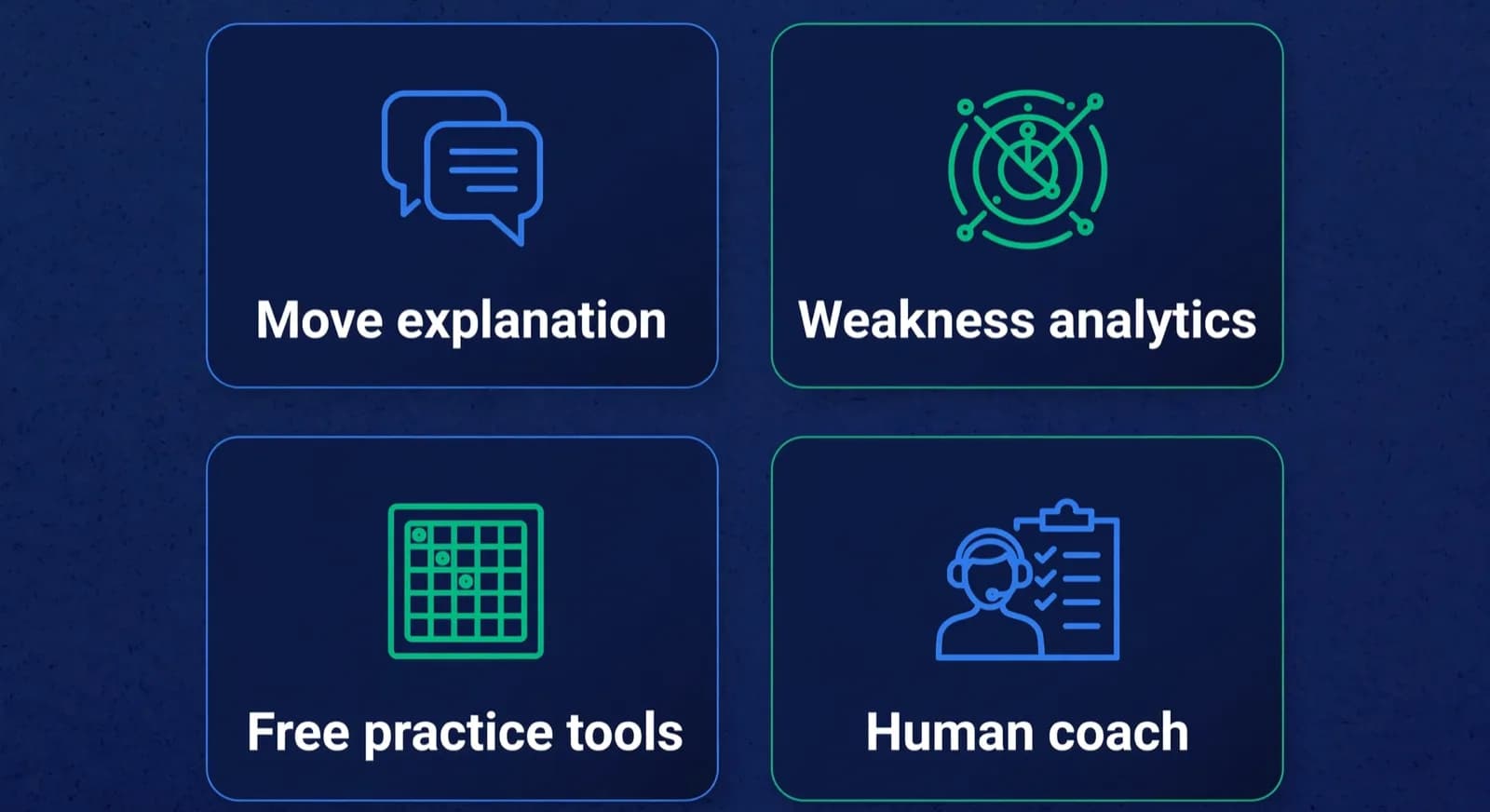
Chessiro is the closest like-for-like substitute: Stockfish finds the deciding moments and the coach says what you missed and what to play instead, on games you import from Chess.com, Lichess or a pasted PGN [8]. Best for a player who can see that a move lost material but cannot describe the missed idea. Chess.com Game Review suits players who want guided review where they already play, with key moments, coach explanations and retry on paid membership tiers [9][10]. Lichess with Stockfish is the free route when you can interpret engine lines yourself: unlimited browser analysis, PGN upload and a server-analysis cap of 40 games a day [3][11].
- Explain a move in words: Chessiro explains your own imported games with a free weekly allowance of 3 move explanations and 2 coach chats on top of free unlimited engine review [8], and Chess.com Game Review explains the key moments of your Chess.com games on paid membership tiers [9][10].
- Read raw engine lines yourself: Lichess study tools give free analysis and shared boards without natural-language explanation [3][11].
- A different job entirely: Aimchess reports weaknesses across many games (our Aimchess review covers it [4]), Noctie AI supplies humanlike sparring (our Noctie AI chess review covers it [5]), and a human coach handles curriculum, accountability and whether the explanation actually landed.
Most of these are complements more than substitutes. A self-driven improver might generate games with Noctie, decode the critical positions with DecodeChess or Chessiro, and track trends with Aimchess monthly. Paying for every adjacent job at once is how subscriptions outrun actual study hours, so fund the bottleneck you can name rather than stacking tabs.
How do you choose a DecodeChess alternative with a clear rubric?
Score the tools yourself on one of your own games, because explanation quality is something you can only judge against a position you already understand. The criteria below are a blank scorecard and the weights are your buying preferences, not measured product results. Run the same game and the same critical position through each tool you are considering, then fill the card in.
Use a short game you can import as PGN, and pick one critical position from it as a FEN. If you want a known position to rehearse the method first, take White to move in Morphy against the Duke of Brunswick and Count Isouard, Paris 1858: FEN 4kb1r/p2n1ppp/4q3/4p1B1/4P3/1Q6/PPP2PPP/2KR4 w k - 0 16. A local Stockfish 19 run on 16 October 2026 confirms the forced line 16.Qb8+ Nxb8 17.Rd8#, mate in two, with Qb8+ leaving exactly one legal reply. The teacher’s one-sentence explanation, written here by hand and taken from no tool, is: the knight on d7 is the only guard of d8, so White sacrifices the queen with Qb8+ to deflect it, then mates on the back rank with Rd8#. You can paste the FEN into our FEN viewer to see the board.
For each tool, answer four questions about that one position and record what the tool actually produced, not what its marketing promises. Leave the output fields blank until you have run the tool; never fill them from a feature description. The four questions are whether the tool names the opponent’s threat, whether it states the proposed move and the idea it serves, whether it explains a reasonable alternative, and whether, with the tool closed, you can restate the plan in your own words.
| Scorecard question (one position) | What a useful answer looks like | Tool A output | Tool B output | Your score 1 to 5 |
|---|---|---|---|---|
| Does it name the opponent’s threat? | A concrete threat on a named square or piece | (fill after running the tool) | (fill after running the tool) | (blank) |
| Does it state the proposed move and why? | The move plus the idea it serves, not just an eval | (fill after running the tool) | (fill after running the tool) | (blank) |
| Does it explain a reasonable alternative? | A second plan with its trade-off | (fill after running the tool) | (fill after running the tool) | (blank) |
| Can you restate the idea with the tool closed? | You reproduce the plan on a blank board | (your own recall) | (your own recall) | (blank) |
Weight the four questions by what you are buying for. A sensible default puts the most weight on the last question, because restating the idea is the only one that measures whether you learned anything, and the least on presentation. Explanation quality is the job DecodeChess, Chessiro and Chess.com Game Review all target [1][8][10]; free Stockfish and Lichess give you the truth of the position but leave the language to you [2][3]; Aimchess and Noctie answer other jobs and are not scored on this single-position card [4][5].
A few edge cases override the general method. A beginner under about 1200 with few reviewed games should build the habit on free tools before buying narration. A player around 1900 who already annotates well may produce the language faster by hand than any decode. A parent of a young child usually needs coaching accountability, not a prose layer. A correspondence-style analyst who lives in long engine lines may prefer raw Stockfish depth to short narrative decodes [2]. And if the DecodeChess free daily allowance already covers your games, paid Unlimited is optional until the cap blocks you repeatedly.
| Edge case | Best first move | Why |
|---|---|---|
| Under 1200, few games reviewed | Lichess with written sentences [3] | Build the habit before buying narration |
| Plays on Chess.com and Lichess, wants words not lines | Chessiro free allowance first [8] | Explains your own imported games at no cost to start |
| Lives on Chess.com only | Chess.com Game Review first [9][10] | Zero workflow friction beats a second site |
| Plays 50+ online games a week | Aimchess map, then selective decode [4] | Pattern detection needs volume |
| Under-trains, over-analyses | Noctie practice block [5] | Creates material worth explaining |
| Hits a why-wall on key moments | DecodeChess free, then Unlimited if capped [1][6] | Specialist explanation job |
Can you import your own PGN or Chess.com and Lichess games?
Yes, by tool-specific routes: Chessiro imports Chess.com or Lichess games or a pasted PGN [8], DecodeChess documents PGN and FEN uploads [7], and Lichess supports PGN upload into the analysis board and studies [3][11]. Native platform review and external game import are different claims, so use the shortlist table rather than assuming automatic account sync.


After importing, compare the starting position, side to move and final move with the original. If the game came from a physical scoresheet, correct any recording error before asking an engine to explain it, because an explanation of the wrong position can be internally coherent and still useless. For repeated use, choose the least awkward route you can verify, keep your own annotated PGN as a portable record, and do not confuse an import feature with a promise that every generated comment can later be exported.
Who should and should not use DecodeChess?
DecodeChess fits self-driven improvers who already review their own games and keep hitting the why wall. The official site describes its audience the same way: players rated up to 2000 who use an engine but cannot figure out its recommendations, who keep asking why a move is good, and who value self-analysis [1]. The further a student sits from that profile (no games to review yet, or no habit of reviewing them) the less an explanation layer can do, because it improves the quality of study that is already happening rather than causing study to happen.
| User type | Verdict on DecodeChess |
|---|---|
| Self-driven improver under 2000 who reviews their own games | Strong fit: this is precisely the audience the site names [1] |
| Student who asks why after every engine suggestion | Strong fit: the product exists to answer that question in language [1] |
| Beginner with few games and no review habit | Weak fit for now: build the playing and reviewing habit first |
| Player rated well above 2000 | Outside the audience the official site states [1] |
| Parent wanting a study plan and accountability for a child | Wrong tool: that is coaching work, not explanation work |
The official pages reviewed do not document a human coach choosing a student's curriculum, tracking attendance, or communicating progress to parents [1][6]. Those jobs sit outside what DecodeChess describes. ChessCore is academy management software for coaches and academy owners, a different category from player training tools, so it is not an alternative to DecodeChess.
October progress report · Lucas M.
1 of 14 drafts for Batch B2
Lucas attended 4 of 5 classes this period and played 18 rated games, moving from 1310 to 1342.
His endgame conversion improved clearly. Next month the focus is back-rank defense, based on the mistakes tagged in his last three games.
Highlighted numbers come from your attendance and rating records. The AI cannot change them.
Goes to the Müller family after approval
How do you upload and decode a game?
You upload a game or position in PGN or FEN through the New Game menu at the top left of the screen, according to the official FAQ [7]. The same FAQ says a Decode can analyse an entire game or one position in depth. This page records that published upload path; it does not report a test of the current uploader.
- Open DecodeChess in a supported browser and use the New Game menu at the top left [7].
- Upload a PGN game or a FEN position; the FAQ lists those as the supported formats [7].
- Start a Decode Game for move-by-move explanations, or a deeper position decode for threats, plans, piece function, and concepts [7].
- The FAQ says each decode session is saved in the online History folder, where you can search, tag, or delete games [7].
The official FAQ says Stockfish runs on DecodeChess servers when you click Decode Game or Decode Deep, while the lighter Game Map and board analysis run in the browser [7]. It names the engine as Stockfish 12 NNUE and puts the usual depth at around 24, reaching 48 in some positions, because the server works harder on a decode than the visual graph does on your machine [7]. That split explains why decoding needs an internet connection even though the board itself feels local.
Does DecodeChess work on a phone, and can you export analysis?
The official FAQ says DecodeChess is mobile responsive, with fewer analysis features on a phone because of screen size, and that analyses are saved online but are not available for download or export [7]. Those are public FAQ statements, not results from a current phone or account test. Note that the two official pages disagree on whether a downloadable app exists at all, so do not count on installing one until you can confirm it live.
- App availability is a direct conflict between two official pages: the FAQ says the DecodeChess app is available on Google Play and not on the Apple store [7], while the pricing page FAQ says the vendor does not have an app you can download yet [6]. Treat installation as unconfirmed until the live page agrees with itself.
- Mobile mode, per the FAQ: play against the computer and decode as you play; set up a board and decode a position; open History and Examples; upload a PGN that is already on the device [7].
- Missing in mobile mode, per the FAQ: the rich tab system for Threats, Good Moves, Plans, Functionality, and Concepts [7].
- The FAQ recommends a large screen for full functionality [7].
- On export: the FAQ says every decode is saved in the online account and is not available for download or export, and that the vendor hopes to release that feature later [7].
The pricing page FAQ repeats that DecodeChess is mobile-responsive, that not all features are available in mobile view, and that a large tablet, laptop, or desktop is recommended [6]. If you need a file you can keep offline, the official FAQ says analyses are saved in the online account and are not available for download or export [7]. Use the History folder it describes, or keep your original PGN outside the tool.
Frequently asked questions
Is DecodeChess free?
DecodeChess publishes a free signup path. On 16 October 2026 the official pricing page listed Free at 0 US dollars, while Unlimited was 8.25 US dollars monthly or 84 US dollars yearly with a 7-day money-back guarantee, and one-time Light and Medium packs cost 15 and 25 US dollars. The pricing page and the FAQ disagree on the free daily decode limit (one Decode Game per day with no position decoding versus a limited-time three decode sessions per day counted as three positions), so this review does not publish a single free-limit figure. Confirm the live pricing page before you rely on a daily cap.
Is DecodeChess better than Stockfish?
The comparison is a category error: DecodeChess runs Stockfish NNUE inside it, per its official site. Stockfish finds the strongest moves and outputs evaluations and lines; DecodeChess translates those moves into plain-language explanations of threats, plans and concepts. If you can read raw engine output comfortably, free Stockfish may be all you need. If the why behind the numbers keeps escaping you, that translation is the entire product.
What are the best DecodeChess alternatives?
By job: Chessiro and Chess.com Game Review also explain moves in words, so explanation alone no longer makes DecodeChess unique; Chessiro's free tier includes 3 move explanations a week. Aimchess covers weakness analytics across many games, Lichess free engine analysis, Noctie AI humanlike sparring, and a human coach everything contextual. Our DecodeChess alternatives guide ranks them.
Who is DecodeChess for?
Per its official site, DecodeChess is for players rated up to 2000 who want to understand the reasoning behind moves: people who use an engine but cannot figure out its recommendations and who value self-analysis. In our judgment the best fit is the self-driven improver who already reviews their own games. It is a weaker fit for beginners with no review habit and for players well above the stated 2000 ceiling.
Does DecodeChess replace a chess coach?
DecodeChess and a human coach cover different requirements. The official pages document game and position explanations, a practice opponent, and the ability to decode while playing. The pages reviewed do not document a human coach assigning an individual curriculum, tracking attendance, or communicating progress to parents.
Can I export my decoded analysis from DecodeChess?
The official FAQ says analyses are saved in your online account and are not available for download or export, and that the vendor hopes to release an export feature later. That is a public FAQ statement from 16 October 2026, not a test of a current account. The two official pages also disagree on apps: the FAQ names a Google Play app while the pricing page says there is no downloadable app yet, so treat installation as unconfirmed. If you need a file you can keep offline, keep the original PGN or FEN outside DecodeChess and treat the History folder as an online copy only.
Sources
- [1]DecodeChess: official site, features and audience · accessed 2026-10-16
- [2]Stockfish: strong open-source chess engine · accessed 2026-08-30
- [3]Lichess studies: free analysis and shared boards · accessed 2026-08-30
- [4]Aimchess: chess analytics and personalized training · accessed 2026-10-16
- [5]Noctie.ai: humanlike chess training bot · accessed 2026-10-16
- [6]DecodeChess pricing plans: Free and Unlimited tiers · accessed 2026-10-16
- [7]DecodeChess FAQ: upload, mobile, and export · accessed 2026-10-16
- [8]AI chess coach, Chessiro · accessed 2026-10-16
- [9]What does each level of membership get me?, Chess.com Help Center · accessed 2026-10-16
- [10]How does Game Review work?, Chess.com Help Center · accessed 2026-10-16
- [11]Lichess: features and analysis limits · accessed 2026-10-16
Written by Abhishek Tiwari
ChessCore
Drafted with AI, fact-checked and approved by a human before publishing, the same guardrail our product applies to every report it sends. Read our editorial standards.
Running the coaching side of the loop?
ChessCore is academy management software: Stockfish game review, AI-drafted reports a coach approves, attendance and fees in one place. See it on your own academy's data.
- Roster import from the spreadsheets you already keep
- Lichess and Chess.com connections, batches, and fee plans
- First reports in week one, after your approval
- Free plan, no credit card required