
On this page10 sections, 17 min read
- How this review scores Aimchess
- What is Aimchess?
- What do game analytics actually tell you?
- Where does automated weakness detection fall short?
- What does Aimchess cost, and is there a free plan?
- How do you go from your first report to a training session?
- What should you use instead of Aimchess for a specific task?
- What are the best free Aimchess alternatives?
- Which free stack fits a student, an adult improver, and a coach?
- Is Aimchess worth it for your kind of player?
- Frequently asked questions
Bottom line
Aimchess is worth paying for only if you play enough online games on Chess.com or Lichess to want its six-skill analytics and the free report already named a task you could check in your own games. Standard is free with one 40-game report a month; Premium is $7.99 monthly or $57.99 yearly, per aimchess.com on 16 October 2026. This is a desk review, not a trial of a live account.
TL;DR
- Aimchess tackles the targeting problem: it tells you what to train from your own games instead of leaving you on generic puzzles.
- Whether it is worth paying for depends on how often you want a report, which sites you play on, whether you share data with a coach, and whether the free report gave you a task you could verify.
- The free Standard plan includes one 40-game analysis report per month; that cap is a plan allowance, not a statistical minimum, so replay the games behind any score.
- Premium is $7.99 monthly or $57.99 billed annually per the official site; twelve monthly payments come to $95.88, so annual billing is $37.89 less, before any tax.
Key facts
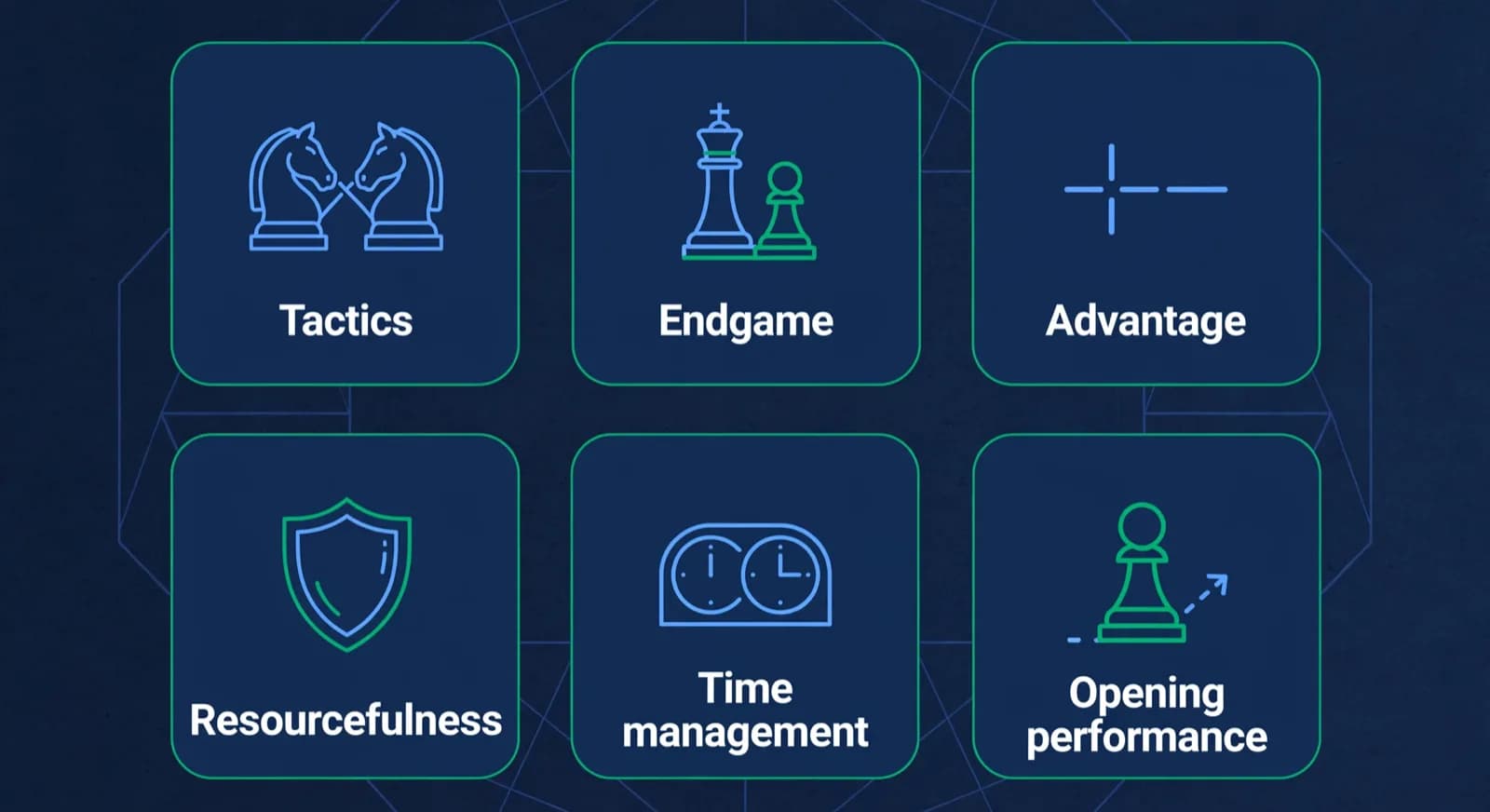
- Aimchess pulls games from Chess.com and Lichess and scores play across six competencies: tactics, endgame, advantage capitalization, resourcefulness, time management, and opening performance.[1]
- The free Standard plan includes one 40 game analysis report per month, a weekly personalized study plan, one daily training session, one daily warm up, and unlimited studies.[1]
- Aimchess Premium is listed at $7.99 billed monthly, or $4.85 per month at $57.99 annual billing, and covers analysis of your last 1000 online games.[1]
- Aimchess offers coach sharing, so a student's data and lessons can be shared with their coach.[1]
- Stockfish, the open source engine, is the standard technology behind game analysis tools across the chess world.[4]
How this review scores Aimchess
Aimchess is worth paying for if you want regular reports on your own online games and the free report has already given you something you could confirm by replaying the games it points to. It connects to Chess.com and Lichess, scores six skill areas from your games, and turns measured mistakes into a weekly training plan. The free Standard tier is the test: use it before paying for Premium.
This review uses the same four part rubric as every tool review on this site: what the tool actually does, who it fits, what it costs as published on its official site, and where it stops and a human coach or academy takes over. Every product claim below comes from aimchess.com [1], as listed on 16 October 2026. One disclosure for honesty: ChessCore, which publishes this blog, is academy management software. That is a different category from player training, so we have no competing product to sell to the players Aimchess serves, and this page will not pretend otherwise.
- What it does: the actual mechanism, not the marketing summary.
- Who it fits: by player type and playing volume, not by enthusiasm.
- What it costs: official published pricing only, nothing inferred.
- Where it stops: the line where a human coach or an academy takes over.
What is Aimchess?
Aimchess is a chess improvement platform that connects to your online accounts, pulls your recent games from Chess.com and Lichess, and measures your play across six competencies: tactics, endgame, advantage capitalization, resourcefulness, time management, and opening performance [1]. From those scores it builds personalized puzzles out of positions you actually misplayed and assembles a weekly study plan aimed at the categories where you lose the most points.
Around that core sit more than a dozen training modules, including an Advantage Capitalization Trainer, an Opening Improver, a Blunder Preventer, and blindfold tactics exercises [1]. The site also lists coach sharing, so a student can share their data and lessons with a coach, and multi account tracking that the Aimchess marketing copy describes across Chess.com, Lichess, and Chess24; Chess24 itself closed its website and apps on January 31, 2024, so that third source is legacy wording rather than a currently active import, and the game sources that matter today are Chess.com and Lichess [1][6]. The tagline is "Learn Chess Your Way", and the pitch underneath it is specific: stop training generically, train against your own measured weaknesses.
Aimchess also advertises a research claim worth recording precisely: that its personalized puzzles raise your rating 31% faster than standard tactics puzzles, based on a 12 week randomized field experiment by researchers at the University of British Columbia [1]. This is the vendor's own advertising, shown on its homepage. We have not reviewed the study and it is not independent validation, so it is not a reason to buy. Even taken at face value, it is a claim about puzzle training, not about the accuracy of the weakness diagnosis itself.
What do game analytics actually tell you?
Game derived analytics solve one genuinely hard problem: knowing what to train. Most improving players default to whatever is in front of them, usually random tactics puzzles, because nothing tells them their real leak is, say, converting winning positions or burning the clock by move 20. A tool that reads hundreds of your own games and says "your endgames are fine, your time management is not" replaces guesswork with direction.
This is the same evidence first principle a good coach applies manually. Before advising a student, you look at the games. Aimchess automates the looking at scale: it can process a volume of games no human would sit through, and it never gets bored on game two hundred. For a self directed adult improver with no coach, that automated first pass is the most valuable thing on the platform, more than any individual training module.

Lucas M.
Batch B2 · Thursdays · joined Aug 2025
1342
Academy rating · Lichess games synced
Won vs. 1410 · French Defense
Best gameMissed fork on move 23
Homework setWhere does automated weakness detection fall short?
How many games a score rests on is the first limit. Six competency scores computed from a small sample are thin slices of data, and a dashboard renders confident-looking numbers whatever the sample, so one tilted evening can move a grade. The free report covers 40 games, but that is the vendor's plan allowance, not a statistical minimum, and this review does not claim one. Before acting on a score, replay a few of the games behind it and check that you recognise the pattern. If you cannot, treat the score as a question to ask a coach, not a training prescription.

The second limit is that categories are generic by construction. "Endgame weakness" is a bucket, and buckets hide causes. A coach who watched the game knows the student did not have an endgame problem in general; they had a rook behind the passed pawn problem, or they had already tilted after blundering a piece on move 18 and rushed every remaining decision. The label and the lesson plan that follows from it are different in each case. Automated categories compress all of that into one word, and the compression is exactly where the coaching value leaks out.
Third, analytics describe the past without watching you think. Engine evaluation, the technology underneath every analysis pipeline, with the open source Stockfish as the field's standard [4], can label a move as an error with great precision. It cannot tell whether you chose it because you miscalculated, because you did not consider it at all, or because you saw the right move and talked yourself out of it. Those are three different weaknesses with three different fixes, and only a human watching you play or talking through the game can tell them apart.
None of this makes the tool useless; it defines the handoff. Analytics can flag the symptom; the context that explains it, school exams, tilt, a rival in the same batch, belongs to a human. For a quick way to check an analytics label against the games behind it, see how to review the games behind an analytics label, and for what to do when the numbers stall despite training, see what to do about a chess rating plateau.
What does Aimchess cost, and is there a free plan?
Aimchess Premium costs $7.99 billed monthly, or $57.99 billed annually, which the site displays as $4.85 a month [1]. There is also a permanent free Standard plan with one 40-game analysis report a month; the free Aimchess alternatives section below covers what it includes and which free tools cover which tasks.

| Plan | Published price | What the official site lists |
|---|---|---|
| Standard (free) | $0 | One 40 game analysis report per month, weekly study plan, one daily training session, one daily warm up, unlimited studies |
| Premium monthly | $7.99 per month | Unlimited analysis reports, last 1000 online games, 2x deeper analysis, unlimited daily training with Premium lessons, statistics page, coach sharing, multi account tracking (the page lists Chess.com, Lichess and Chess24) |
| Premium annual | $4.85 per month, $57.99 billed annually | Same features as monthly, lower effective price |
Those figures are as published on aimchess.com on 16 October 2026 [1]; pricing can change, so confirm on the official site before subscribing. No India checkout amount or tax was verified, so the arithmetic below uses the advertised USD prices only. The sensible path is one month on the free report: if it names a weakness you can confirm by replaying your games, you have a reason to consider Premium.
| Billing option | Calculation (advertised USD prices) | Result |
|---|---|---|
| Twelve monthly payments | $7.99 x 12 | $95.88 |
| Annual billing | Advertised annual total | $57.99 |
| Difference | $95.88 minus $57.99 | $37.89 less on annual billing, about 40 percent |
| Monthly equivalent of annual billing | $57.99 divided by 12 | $4.8325, about $4.83 |
The vendor displays $4.85 a month for the annual plan, while $57.99 divided by 12 rounds to $4.83. This review reports both figures as published and does not reconcile them. The saving of $37.89 assumes prices stay unchanged and excludes any tax or fee at checkout.
How do you go from your first report to a training session?
The path below follows the vendor's homepage: Aimchess analyses your recent games, scores six categories, and builds personalized puzzles and a weekly plan. The homepage does not describe the account-linking step itself, so check how your games get in at sign-up.
- Sign up and give Aimchess your Chess.com or Lichess games; the homepage lists Premium tracking across those sites but not the setup steps [1].
- Wait for the first analysis report, capped at 40 games on the free Standard tier [1].
- Open the six-competency breakdown and identify the lowest-scoring category rather than reacting to all six at once.
- Use the matching named trainer, such as the Blunder Preventer or Opening Improver, for that one category [1].
- Return to the weekly personalized study plan after your next batch of games to see whether the weak category moved [1].
What should you use instead of Aimchess for a specific task?
Pick the substitute by task. To replace the analytics without paying, the free Aimchess alternatives section below stacks free tools by job. To count how often you err on a paid platform, Chess.com lists Advanced Stats for Diamond members from 15 June 2026, with peer-relative ratings for openings, tactics, strategy and endgames in each time control, a paid substitute for Aimchess's competency scores [7]. To understand why a single move was wrong, DecodeChess focuses on explaining engine analysis in human concepts [3], and our DecodeChess review covers where that holds up. For diagnosis with context, a human coach watches how you think, not only what you scored.

One thing that is not an alternative: academy management software, including ChessCore. Aimchess trains a player; academy software runs a coaching business, the batches, attendance, fees and parent updates around the training. A coach could use Aimchess with online active students through its coach sharing feature while running operations elsewhere. Our pillar on AI chess coach apps compared by task maps the player-facing field, and the best AI tools for chess academies covers the operator side.


What are the best free Aimchess alternatives?
No single free tool replaces Aimchess. Stack free tools by job instead: Lichess Insights covers free profile analytics over your own Lichess games, the free Lichess analysis board covers per-game review (including a Chess.com game imported as PGN), and free Lichess puzzle themes cover the drills [8][12][2]. Aimchess itself is partly free, with one 40-game report a month on Standard [1]. Keep per-game review separate from profile analytics.
There are two separate free routes and they do different jobs. Route one is profile analytics: play on Lichess, request computer analysis on the games you care about, then query Insights for patterns such as which openings cost you points, how move times change by game phase, and how results vary by time control [8]. Route two is per-game review: download a Chess.com game as PGN, import it into the Lichess analysis board, and review that one game [12]. Importing a PGN does not by itself add the game to your profile Insights, so treat the two routes as different tools [8][12].
What Lichess Insights does not copy is Aimchess’s packaged product layer: six named competency scores, personalized puzzles generated from your own mistakes in one trainer suite, multi-platform import in one report, last-1000-game coverage and coach sharing as a product feature [1][8]. Chess.com free Basic accounts include unlimited play, three puzzles a day, one full game review a day and basic profile stats, while unlimited Insights and Advanced Stats are Diamond features, not free ones [10][11]. For opening trees from Chess.com, Lichess, grandmaster games or custom PGN in one place, OpeningTree is an adjacent free tool for opening preparation [9].
| Capability | Aimchess free Standard [1] | Lichess Insights + puzzles [8][2] | Chess.com Basic free [10][11] |
|---|---|---|---|
| Cost | Free Standard | Free | Free Basic |
| Analytics depth | One 40-game report a month | Deep free filters on analyzed games | Basic profile stats; full Insights are Diamond |
| Cross-platform import | Premium tracks Chess.com and Lichess together | Lichess games primarily | Chess.com games primarily |
| Tactics volume | Limited daily free training sessions | Unlimited free puzzles and themes | 3 puzzles a day on Basic |
| Coach sharing | Premium feature | Manual share of studies and profiles | Classroom and links; not Aimchess coach share |
Can a free alternative turn your mistakes into puzzles? Partly. Lichess’s free Learn from your mistakes computes a winning-chances swing for every move in an analyzed game, flags the moves that mattered, and lets you retry each one before showing the best move, on any game including imports [13]. That is a real per-game substitute for Aimchess’s Blunder Preventer idea, but it is scoped to one game and does not build a standing cross-game puzzle queue, so it is a manual workaround rather than a replacement [1][13]. Free server-side analysis on Lichess is capped at 40 games a day, while the analysis board with unlimited cloud engine lookups has no such cap [12].
Which free stack fits a student, an adult improver, and a coach?
Pick a free stack by reader job: students need short drills, adult improvers need analytics they will actually open, and coaches need shareable views across many boards. No free stack fully clones Aimchess Premium for every job at once, so combining free tools by job beats forcing one brand to be everything [1][8][2][9][10].
Student (school-age or early club): default to free Lichess puzzles by theme plus a coach study rather than heavy analytics, because a short list of positions a week and a check at the next lesson is easier to sustain than a long report [2]. If the family is already on Chess.com, use the free daily puzzle and the one full game review carefully rather than promising Diamond-only Insights [10][11]. Aimchess free Standard can still show one monthly report if the student plays enough online games [1].
Adult improver with high online volume: Lichess Insights is the free analytics core, OpeningTree covers opening performance across sites, and free puzzle themes close the loop [8][9][2]. Add Aimchess free Standard for a monthly second-opinion scorecard if you want its six-skill framing without paying [1]. Pay Aimchess Premium only after two months where you can show that free charts changed your study plan weekly and you still want automation.
Coach tracking students: free Aimchess coach sharing is not on Standard, it is listed under Premium [1]. Free coaching practice means shared Lichess studies, class homework where relevant, and student profile Insights links when students play on Lichess [8]. OpeningTree helps for opponent or student opening trees from public online games [9]. ChessCore, which we build, is academy management software for rosters, attendance and coach-approved parent communication around game review. It is not an Aimchess alternative for player analytics and does not claim free Aimchess features.
| Reader | Free default stack | Optional free add-on | When to pay Aimchess |
|---|---|---|---|
| Student | Lichess puzzles + coach study [2] | Aimchess Standard monthly report [1] | Rarely; coaching first |
| Adult improver | Lichess Insights + themes [8][2] | OpeningTree for openings [9] | High volume + wants automation [1] |
| Coach | Shared studies + student Insights links [8] | OpeningTree for prep trees [9] | If Premium coach sharing is used weekly [1] |
Is Aimchess worth it for your kind of player?
There is no single answer, because the value depends on how you use the reports. The table below is an editorial buying rule, not a statistical threshold: decide by report frequency, game sources, coach sharing and whether the free report gave you a task you could verify.
| Your situation | Editorial verdict |
|---|---|
| You want a fresh report on your own games every month and the free report named a weakness you confirmed by replaying the games | Reasonable to try Premium for a month. The paid plan lists unlimited reports and analysis of your last 1000 online games [1]. |
| You play on both Chess.com and Lichess, or on more than one account | Check whether you need them in one report. Premium lists tracking multiple accounts [1]; the free report is one 40-game report a month. |
| You work with a coach | Ask the coach whether they would use a shared report before paying. Premium lists sharing data and lessons with your coach [1], and shared reports may shorten session prep, though they cannot replace watching the games. |
| You play few online games, or mostly over the board | Stay on the free report, or spend the money on coaching time. The reports only describe the games you give them. |
| The free report named nothing you could verify in your own games | Do not upgrade. The free report is the test, and a paid plan will not change what the games show. |
| You run an academy | Wrong question. Your bottleneck is operations, not player analytics; see the academy software category instead. |
Lucas M. vs. Hana K.
Rapid · synced from Lichess · Tue 7:42 PM
14...Qe6? drops the knight
Eval swings +2.1 · the move to review first
Missed fork on move 23
Same pattern as last Tuesday · drill it
Endgame conversion was clean
Won vs. 1410 · French Defense
Frequently asked questions
How much is Aimchess Premium?
Aimchess Premium is $7.99 billed monthly or $57.99 billed annually, which the site displays as $4.85 a month, per the official site on 16 October 2026. Twelve monthly payments come to $95.88, so annual billing is $37.89 less before any tax. Both paid options list unlimited reports, analysis of your last 1000 online games, coach sharing and multi account tracking. The free Standard tier and the free alternatives by task are covered in the free Aimchess alternatives section above.
Is Aimchess worth it?
It can be, if you want regular reports on your own online games and the free report named a task you confirmed by replaying the games. It is harder to justify if you play few online games or the free report told you nothing you could check. That is an editorial buying rule, not a vendor claim or a statistical threshold. Try the free Standard report first.
Does Aimchess work with Lichess and Chess.com?
Yes, for tracking. The official homepage lists Premium tracking of multiple accounts across Chess.com and Lichess, and says it analyses your recent games. It does not describe how games get in, so check at sign-up. Your existing online game history is the raw material for its analysis, so the more you play on those sites, the more the reports have to work with.
Is Aimchess still available, and how current is this review?
Yes. On 16 October 2026 Aimchess's homepage still listed its feature set and pricing cards at aimchess.com, with the free Standard plan and Premium at $7.99 a month or $57.99 a year [1]. Vendors change plans, so confirm the price on the official site on the day you subscribe.
Is Aimchess good for kids in a chess academy?
It depends on how many online games the child plays and whether a coach will read the reports. The reports only describe the games they are given, so a child with few online games gives them little to work with, and a coach who reviews the student's actual games, with context about how they were played, will usually diagnose faster. If the child plays often, the free report is a low-risk test.
What is the best free Aimchess alternative?
No single free tool replaces Aimchess. For games on Lichess, Lichess Insights gives free profile analytics and free Lichess puzzle themes give drills. For a Chess.com game, import the PGN into the Lichess analysis board for a per-game review, which does not add the game to Insights. OpeningTree adds opening trees across sources. None of these packages six-skill trainers and multi-account reports in one product, and Chess.com full Insights are a Diamond feature, not free.
Sources
- [1]Aimchess: official site, features and pricing · accessed 2026-10-16
- [2]Lichess training tools · accessed 2026-06-10
- [3]DecodeChess: official site · accessed 2026-06-10
- [4]Stockfish: open-source chess engine · accessed 2026-06-10
- [5]Chess.com: official site · accessed 2026-06-10
- [6]Chess24 to close on January 31 (chess24 website and apps shut down) · accessed 2026-10-16
- [7]Chess.com: Relive All Your Brilliant Moves With Our New Advanced Stats Feature · accessed 2026-10-16
- [8]Lichess Chess Insights example profile analytics (free platform tool) · accessed 2026-10-16
- [9]OpeningTree: opening trees from Chess.com, Lichess, grandmaster games or custom PGN · accessed 2026-10-16
- [10]Chess.com membership levels and free Basic limits · accessed 2026-10-16
- [11]What is Insights on Chess.com? (Diamond feature) · accessed 2026-10-16
- [12]Lichess features comparison: free account versus Patron · accessed 2026-10-16
- [13]Lichess blog: Learn from your mistakes feature · accessed 2026-10-16
Written by Abhishek Tiwari
ChessCore
Drafted with AI, fact-checked and approved by a human before publishing, the same guardrail our product applies to every report it sends. Read our editorial standards.
Running an academy rather than training yourself?
Aimchess trains players. ChessCore runs the academy around them: Stockfish game review on synced student games, AI drafted reports a coach approves, attendance and fees in one place. See it on a demo.
- Roster import from the spreadsheets you already keep
- Lichess and Chess.com connections, batches, and fee plans
- First reports in week one, after your approval
- Free plan, no credit card required