
On this page7 sections, 14 min read
- How should academies evaluate Chessverse?
- What is Chessverse and who is it for?
- How deep is Chessverse's training content?
- What academy operations does Chessverse cover?
- What does Chessverse cost?
- What is free, and should you pay when the trial ends?
- Chessverse vs ChessCore: where should you compare them?
- Frequently asked questions
Bottom line
Chessverse (chessverse.in) offers branded live classes, student batches, training content, and academy administration. Its listed Indian rupee rates run from ₹179 to ₹249 per student per month when billed annually, with a 14-day trial. Chessiverse is a separate bot-practice service. Choose by testing the work your coaches and parents need.
TL;DR
- Chessverse positions itself as an all-in-one, chess-specific platform: white-label student app, training content, live classes, and academy admin in one product.
- Its content depth is a real strength: Chessverse says it has 5M+ puzzles and nine training mini-games, and a ReflexBuilder that turns a student's own games into puzzles.
- Chessverse lists student batches, billing, and WhatsApp; its Indian rupee rates run from ₹179 to ₹249 per student per month when billed annually, with a 14-day trial.
- Compare Chessverse and ChessCore through one live class, a roster change, a fee cycle, and a parent update before choosing.
Key facts
- Chessverse describes a white-label chess coaching platform for academies, individual coaches, and federations.[1]
- Chessverse advertises a white-label offering, so an academy can present the student app and platform under its own brand.[1]
- Chessverse says it has a large training library, including 5M+ puzzles and nine chess training mini-games.[1]
- Chessverse promotes a ReflexBuilder feature that turns a student's own games into puzzles for targeted practice.[1]
- Chessverse lists academy operations features including live virtual classrooms, student and batch management, integrated billing, and WhatsApp.[1]
- On 16 October 2026 Chessverse listed four Indian rupee rates, from ₹179 to ₹249 per student per month when billed annually, a custom Enterprise plan, a 14-day trial and a monthly or yearly toggle that says yearly saves up to 18%.[2]
How should academies evaluate Chessverse?
Evaluate Chessverse against six jobs: live teaching, student practice, roster and attendance, fee collection, parent communication, and progress reporting. Its homepage describes a branded chess coaching platform for academies, individual coaches, and federations [1]. Start with the job that takes your team the most time, then follow one student through the whole workflow. A class that runs well is useful, but you also need to know what happens when that child misses a lesson or changes batches. ChessCore publishes this review and sells competing academy management software. Apply the same trial questions to both products before deciding.
- What it is and how the vendor positions it, in its own words.
- The training and content depth it advertises.
- The academy operations it covers: classes, students, batches, billing, communication.
- Pricing and trial as published on its site.
- Where an academy owner should look closely, and where ChessCore differs.
What is Chessverse and who is it for?
Chessverse describes itself as a white-label chess coaching platform [1]. Its chess-specific tools include live boards, puzzles, student batches, and progress tracking, giving an academy owner a concrete reason to shortlist it. When comparing it with Classplus [3], Teachmint [4], or another teaching platform, start with the lesson itself: can a coach demonstrate a position, ask students to solve it, and assign related practice afterward? Then check administration separately. A platform that supports the chess lesson still needs to fit your attendance, fees, and parent communication routines.
Chessverse may suit an academy that wants lessons, practice, and administration under one brand [1]. Ask a coach and a parent to follow the same student through a lesson, homework, and progress update. Check whether the branding is useful to families and whether the tasks are easy to complete. If you already have teaching tools your coaches value, compare the work involved in keeping them with the work involved in switching. Choose the combination that fits the academy's lessons and records, rather than assuming one platform must handle every task.
How deep is Chessverse's training content?
Chessverse advertises more than five million puzzles and nine training mini-games [1]. For a coach, the useful test is whether that library supports the next lesson and the homework that follows. Try finding suitable material for a new beginner, a child who misses basic tactics, and a tournament player studying a particular ending. Let students try a mini-game and watch what they practise, where they need help, and what the coach can see afterward. Content volume gives you options; the trial should show whether you can choose the right ones.
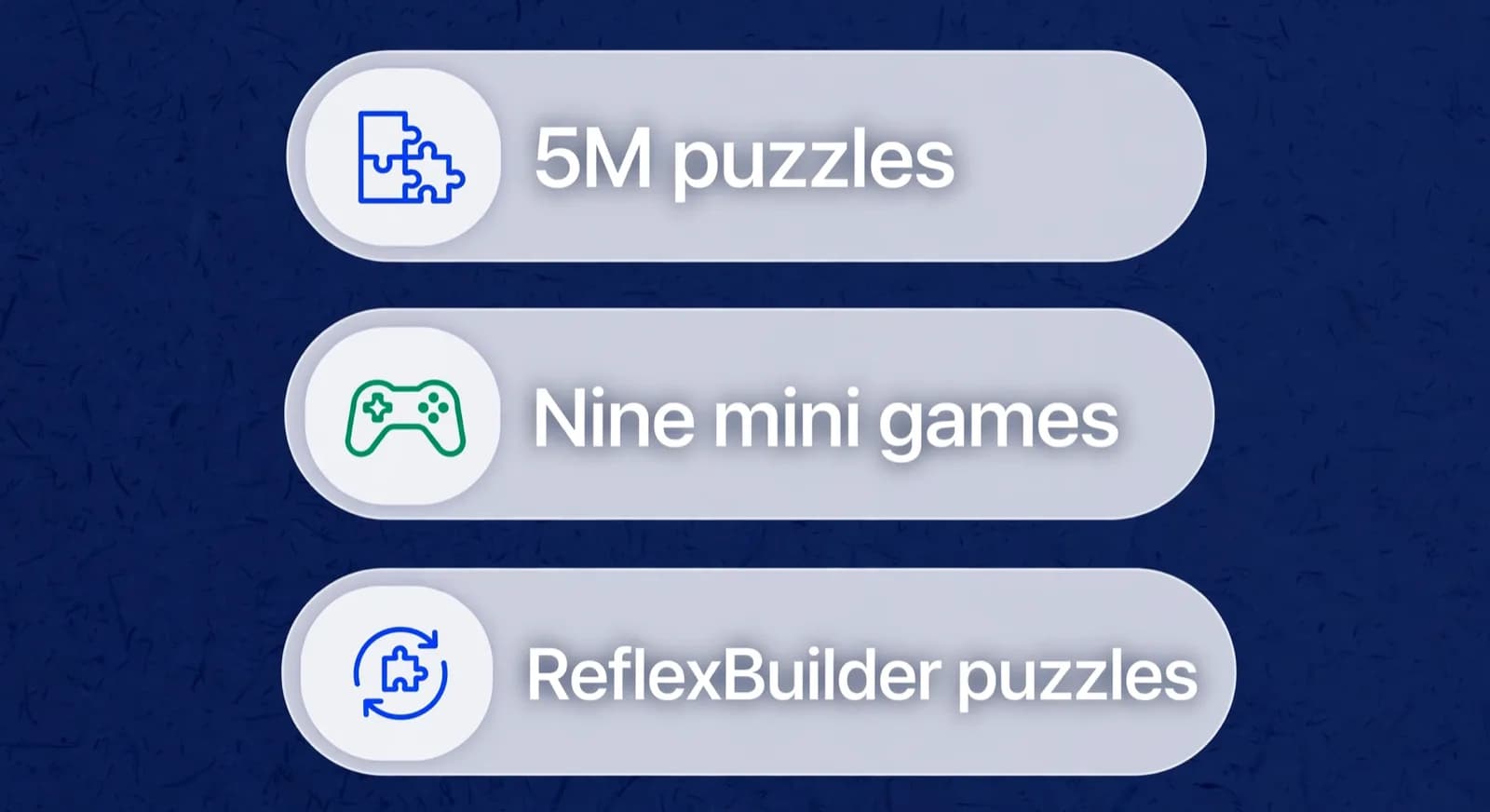
For a large puzzle bank, check both theme and difficulty. Elo is a model of relative playing strength [5], but a rating alone does not describe every skill a student needs to practise. Chessverse advertises puzzles across difficulty levels and themes, along with adaptive ReflexBuilder training [1]. Try assigning work to a beginner and a tournament player, then inspect their results. Ask whether the coach can change an assignment after a student struggles, and whether the next practice set addresses the same learning need.
ReflexBuilder turns weak moves and turning points from a student's games into practice puzzles, according to Chessverse [1]. That gives a coach a way to revisit a mistake the child recognises. Test it with a game you have already reviewed: compare the selected moments with your lesson priorities, check the explanations, and see whether the resulting puzzles are suitable homework. The useful question is whether the student can connect that practice to a better decision in their next game.
What academy operations does Chessverse cover?
Chessverse lists virtual classrooms, student batches, scheduling, attendance, payment processing, and parent communication [1]. Its feature comparison also lists WhatsApp integration [1]. Check these as a connected workflow rather than separate menu items. Schedule a lesson, record an absence, inspect the fee record, and send the guardian a relevant update. For WhatsApp, ask who controls the sender number, how coaches share access, and whether a reply stays attached to the right family. Confirm those details in the trial so the office can continue a conversation when a coach is away.

| Job | Chessverse advertises | Evidence status | What to verify in the trial |
|---|---|---|---|
| Live teaching | Live virtual classrooms [1] | Vendor-described; not independently tested | Whether the in-class board and tools fit how your coaches teach |
| Roster and batches | Student and batch management [1] | Vendor-described; not independently tested | Make-up classes, attendance, and multi-coach batches |
| Fees | Integrated billing [1] | Vendor-described; not independently tested | Recurring collection that fits Indian payment habits |
| Parents | WhatsApp [1] | Vendor-described; not independently tested | Whether updates are automated or still manual |
The evidence status column reads on one scale: vendor-described (listed on chessverse.in but not checked by us), observed in a dated test (watched working on a named date), or not established (no claim either way). Every row here is vendor-described, because we have not run Chessverse hands-on; the trial is how you move a row from vendor-described to observed for your own academy. Use the trial questions to decide whether the platform fits your academy's actual workload. A feature listing gives you a starting point; a lesson and its follow-up show how much work your team still has to do. Record where the coach needs help, where the office needs another spreadsheet, and where a parent cannot find the right information. Apply the same checks to ChessCore or any other shortlisted product. Compare the complete task, including corrections and follow-up, before deciding which tool saves enough time to justify the switch.
Use four practical cases during the trial, and keep notes on each: what worked, what required staff help, and what still needed a separate tool.
- A live class at your normal batch size, with families joining on the devices they would use during the term. Check whether the shared board stays in sync, whether the sound is clear, and whether the coach can annotate while explaining a position. Include a student who joins late and another who loses connection, then see how they catch up.
- A roster change. Mark a child absent, ask for a make-up class, and move another student to a different batch. Check the attendance history and any parent notice after the change, then have a second coach take over the group to see what information is available without a separate briefing.
- A fee cycle. Chessverse lists payment processing [1]; ask which payment methods your academy can use and whether recurring collection is supported. UPI AutoPay is a recurring mandate mechanism [6], so an Indian academy considering it should check authorisation, due dates, receipts and failed-payment handling, using a vendor-approved test arrangement before collecting money from a family.
- A progress update through the agreed parent channel. Read it on a phone as the guardian would, checking the child's name, reporting period, attendance and next practice task. Ask the parent to reply with a question, then check which staff member sees that reply and how another coach can continue the conversation.
Repeat a corrected task if the vendor changes the setup during the trial. Before choosing a plan, discuss unresolved items with the person who will administer the account. A useful decision record says how the academy will teach, collect fees, and respond to parents after the switch, as well as which advertised features are included.
What does Chessverse cost?
On 16 October 2026, Chessverse listed Indian rupee prices of ₹249 per student per month for Solo Coach, ₹229 for Starter Academy, ₹199 for Growth Academy, and ₹179 for Pro Academy, each when billed annually [2]. The respective student limits are 20, 50, 100, and 500; coach-seat limits are 1, 3, 7, and 20. Enterprise has custom pricing. The pricing section has a monthly and yearly toggle that says yearly saves up to 18%, so the monthly rates are higher than the figures above [2]. The plan cards list live classes, training, batches, leaderboards, and white-label branding, and support arrangements and bug-fix commitments vary by tier [2].
| Plan | INR per student/month, billed annually [2] | Student cap | Coach seats | Bug-fix SLA |
|---|---|---|---|---|
| Solo Coach | ₹249/student/month | Up to 20 | 1 | 48 to 72 hours |
| Starter Academy | ₹229/student/month | Up to 50 | Up to 3 | 36 to 48 hours |
| Growth Academy | ₹199/student/month | Up to 100 | Up to 7 | 24 to 36 hours |
| Pro Academy | ₹179/student/month | Up to 500 | Up to 20 | 12 to 24 hours |
| Enterprise | Custom | Scalable | Scalable | Under 12 hours |
Budget against the annual commitment, because per-student pricing grows with the roster. The ₹179 to ₹249 figures are the per-student rate when you pay for a year up front, not the month-to-month price; Chessverse's toggle says yearly saves up to 18%, so a month-to-month plan costs more per student than the table below shows [2]. The table keeps the two products in separate columns on purpose: the Chessverse columns are the budget you are actually sizing, and the ChessCore columns are a reference point, not an exchange-rate conversion. ChessCore, which we build, prices by flat capacity tiers in US dollars (Core covers up to 100 students at $69 a month billed annually, Grow up to 500 at $109). If every student on the roster is licensed, Chessverse's annual rates [2] work out like this:
| Students | Chessverse plan and rate | Chessverse per month | Chessverse per year | ChessCore flat tier, billed annually |
|---|---|---|---|---|
| 20 | Solo Coach, ₹249 each | ₹4,980 | ₹59,760 | Core, $69 a month ($828 a year) |
| 50 | Starter Academy, ₹229 each | ₹11,450 | ₹1,37,400 | Core, $69 a month ($828 a year) |
| 100 | Growth Academy, ₹199 each | ₹19,900 | ₹2,38,800 | Core, $69 a month ($828 a year) |
| 300 | Pro Academy, ₹179 each | ₹53,700 | ₹6,44,400 | Grow, $109 a month ($1,308 a year) |
The shape matters more than the exact exchange rate. Chessverse's bill rises with every student you add, so going from 100 to 300 students nearly triples it, while a capacity tier stays flat until you cross its limit. Ask Chessverse which students count toward the invoice (every enrolled student, or only active ones), whether a plan carries a minimum number of billed licences, how mid-term roster changes are billed, and what happens if you pass the plan limit during a term. The site shows the per-student rate but does not state a minimum licence count or whether taxes such as GST are included, so get both in writing. Confirm taxes, payment timing and renewal terms in the written quote, and run the academy break-even calculator with your own roster, batch sizes and coach costs.

Fees · October · all batches
136 of 148 paidCollected · this term
92%Lucas M. · October · $180
Card AutoPay · receipt sent to Müller family
Mia G. · October · $180
Payment link opened in WhatsApp
Batch B2 · 12 of 14 paid
No bank-transfer screenshots needed
AutoPay mandates · 41 active
Renew monthly without reminders
What is free, and should you pay when the trial ends?
Chessverse offers a 14-day free trial with full feature access and no credit card required, and continued access is sold through its paid academy plans [2]. So the real question is a trial-exit decision: at day fourteen, does the full workflow fit your academy well enough to pay, or do you leave. Decide it from the four cases you ran, not from the puzzle count. For each case, record whether it worked, what still needed staff help, and which tool you kept outside Chessverse. Every outcome below stays unconfirmed until you have actually run it in the trial; this is a decision framework, not a verdict on features we have not tested.
- The live class: did the shared board, video and reminders carry a normal batch, including the late joiner and the dropped connection, or did a coach fall back to a separate call tool. Note what you kept.
- The homework: did ReflexBuilder and the puzzle library produce practice that matched the lesson, and could the coach see and adjust it, or did assignments still go out by message. Note what you kept.
- The fee cycle: did billing collect from an Indian family the way you need, with receipts and failed-payment handling, or did the office keep its existing payment route. Note what you kept.
- The parent report: did a guardian get a correct, readable update through the agreed channel, with replies reaching the right staff member, or did parent updates stay in a WhatsApp group you run yourself. Note what you kept.
Pay when three or four of those cases work with little manual follow-up and the retained-tools list is short. Leave, or extend the evaluation, when the list of unresolved work is long or a case your academy depends on failed. Before either choice, confirm the plan's student capacity, coach seats, whether billing is annual or month-to-month, and the support commitment, and ask the vendor what happens to student records when the trial ends so you can subscribe or leave with a clean handover [2]. If your only need is personal bot practice rather than running an academy, Chessiverse addresses that task instead [7].
Chessverse vs ChessCore: where should you compare them?
ChessCore, which we build, is academy-management software: fee collection, scheduling with make-up classes, and AI-drafted progress reports held for a named person's approval before they go to parents, while class reminders, fee reminders and monthly reports send automatically once the academy turns them on. Chessverse highlights its puzzle library, ReflexBuilder training, and white-label branding [1]. This review deliberately stops at that disclosure rather than running a head-to-head: our detailed Chessverse comparison owns the like-for-like feature fit against the same six jobs, and our Chessverse alternative page owns the effort involved in switching from Chessverse, so compare feature fit on the first and migration work on the second. For the wider method, the pillar on chess academy management software explains the whole workflow; for a separate analysis or training tool, our best AI chess training apps overview, the DecodeChess review, the Aimchess review and the chess software reviews hub cover that category.
October progress report · Lucas M.
1 of 14 drafts for Batch B2
Lucas attended 4 of 5 classes this period and played 18 rated games, moving from 1310 to 1342.
His endgame conversion improved clearly. Next month the focus is back-rank defense, based on the mistakes tagged in his last three games.
Highlighted numbers come from your attendance and rating records. The AI cannot change them.
Goes to the Müller family after approval
Frequently asked questions
Is Chessverse only for chess academies?
Chessverse names academies, individual coaches, and federations as its audience. It offers academy branding, live classes, student batches, homework, and progress tracking. For a school or coach considering it, check whether the plan has enough student capacity and coach seats, then test a lesson and its parent follow-up before subscribing.
What is ReflexBuilder in Chessverse?
ReflexBuilder is Chessverse's personalised practice tool: it uses mistakes and turning points from a student's games to create puzzles. Try it with a game the coach has already reviewed. Check whether the chosen positions match the lesson focus, whether the explanation is useful, and whether the student can apply the idea in a later game.
How much does Chessverse cost?
On 16 October 2026, Chessverse listed Solo Coach at 249, Starter Academy at 229, Growth Academy at 199, and Pro Academy at 179 Indian rupees per student per month, each when billed annually. Their student limits are 20, 50, 100, and 500 respectively. Enterprise is custom-priced. All plans list a 14-day trial. Confirm the billing period and total commitment in your quote before budgeting.
Should I pick Chessverse or ChessCore?
This single-product review does not pick a winner. Both are chess-specific: Chessverse emphasises a very large puzzle library and a white-label student app, while ChessCore emphasises operations and parent communication, with automated fee collection, scheduling with make-up classes, and AI-drafted progress reports a person approves. For the actual choice, read our dedicated Chessverse comparison, which does the like-for-like feature fit, and our Chessverse alternative page, which covers the effort of switching, then trial your own six jobs rather than comparing bullet lists.
Is Chessverse the same as Chessiverse?
They serve different tasks. Chessverse at chessverse.in offers white-label teaching and academy administration for coaches, academies, and federations. Chessiverse at chessiverse.com offers play and practice against more than 1000 human-like bots. Choose the academy platform if you need classes and student management; choose the bot service if you need a practice opponent.
How does it compare with Chess.com or Lichess?
Chessverse emphasises running an academy: its comparison with Chess.com and Lichess lists batches, attendance, parent dashboards, and automated report cards under the academy's brand. It also advertises student-to-student rated and casual games within that platform. Judge it by whether teaching, practice, and administration work together for your academy, rather than treating it simply as a place to play.
Sources
- [1]Chessverse, Chess Academy Software and Coaching Platform · accessed 2026-10-16
- [2]Chessverse pricing section · accessed 2026-10-16
- [3]Classplus, coaching and tutoring management platform · accessed 2026-07-15
- [4]Teachmint, teaching and institute management platform · accessed 2026-07-15
- [5]Elo rating system, Wikipedia · accessed 2026-07-15
- [6]UPI Autopay for Recurring Payments | NPCI · accessed 2026-10-16
- [7]Chessiverse, play against human-like chess bots · accessed 2026-10-16
Written by Abhishek Tiwari
ChessCore
Drafted with AI, fact-checked and approved by a human before publishing, the same guardrail our product applies to every report it sends. Read our editorial standards.
See ChessCore against your own six jobs
Book a walkthrough and run your real workflow, fee collection, scheduling, and parent reports, instead of comparing feature lists on two marketing pages.
- Roster import from the spreadsheets you already keep
- Lichess and Chess.com connections, batches, and fee plans
- First reports in week one, after your approval
- Free plan, no credit card required