
On this page10 sections, 24 min read
- What belongs in a chess progress report for parents?
- What do chess progress report examples look like?
- How do you keep monthly chess reports on schedule?
- Where should the numbers in a report come from?
- What should a report say when a month's records are incomplete?
- How do you talk about ratings without misleading parents?
- How often should reports go out, and who writes them?
- What does an AI-drafted, human-approved reporting workflow look like?
- What must a coach check in an AI-drafted report?
- What does editing an AI draft look like in practice?
- Frequently asked questions
Bottom line
A chess progress report for parents has three parts: evidence from games and the attendance register, a short narrative in the coach's voice, and one specific next step. Assemble the data before the coach writes so reports can follow a monthly schedule. A named coach checks and approves each AI-drafted report before it reaches a parent.
TL;DR
- A report parents read is short: verified numbers, three or four sentences of coach narrative, and exactly one next step.
- Separate record collection from coach writing, so monthly reports have a place in the timetable alongside lessons and preparation.
- Every number in a report should come from a system of record: the attendance register, synced Lichess or Chess.com games, and Stockfish analysis, never from memory.
- Ratings belong in reports only with honest framing: an Elo number is an estimate that swings, and online ratings are not FIDE ratings.
- An AI-drafted, human-approved workflow keeps the cadence alive: software assembles the evidence and drafts the narrative, and a named coach edits and approves each draft before it reaches a parent.
Key facts
- The Elo system rates players relative to each other, and a player's published number is a moving estimate that updates with every rated result, not a fixed measure of ability.[1]
- FIDE publishes official rating lists on a monthly cycle, so an over-the-board rating changes at most once a month regardless of how often a student plays.[5]
- The Lichess API exposes a player's games and rating history programmatically, which is what makes automated evidence gathering for reports possible.[2]
- Stockfish is the open-source engine that produces reproducible move evaluations; any accuracy or blunder figure in a report should trace back to engine output, not to anyone's impression.[4]
- On Lichess, a question mark next to a rating means it is provisional: its Glicko-2 deviation is above 110, so a report should not present that number as settled.[6]
- Lichess calculates ratings with the Glicko-2 method developed by Mark Glickman, so a report should label which rating pool it quotes and never average a Lichess rating with a FIDE rating.[6]
- FIDE prepares its rating list on the first day of each month and lists a rating only for players at 1400 or above, so a report about a young beginner should not expect a FIDE number.[9]
- In ChessCore, contact details are masked and the student name is shortened to first name plus last initial before report inputs reach the language model, and generated numeric citations are checked against the source statistics.
What belongs in a chess progress report for parents?
A chess progress report for parents brings together evidence, the coach's interpretation and a next step. Identify the reporting period, show where attendance and game records came from, explain one learning theme, and finish with a specific practice task the family can understand before the next lesson.
| Report section | What it contains | Where it comes from |
|---|---|---|
| Attendance | Classes attended out of classes scheduled | The attendance register |
| Games and rating | Games played this month and rating movement with context | Synced Lichess or Chess.com history [2] |
| Evidence moment | One position from the student's own game, engine checked | Stockfish analysis of a synced game [4] |
| Coach narrative | Three or four sentences on what improved and what did not | The coach, in their own voice |
| Next step | One concrete focus for the coming month | The coach's plan for the student |
Keep the report focused on this child and this reporting period. A general paragraph about chess benefits does not explain what happened in lessons, and a row of identical skill scores gives the family little to act on. Use a short example from a game or classroom task, then explain why it matters. Avoid promising a future rating. Use a format a parent can read on a phone and respond to without needing a second document. Our progress report template provides a fill-in-the-blanks structure for attendance, learning notes, and the next practice task.
Give the next step enough detail to be useful at home. Fifteen minutes of rook endgame practice twice a week is clearer than improve endgames; two slow games with a review afterward is clearer than play more chess. Match the task to the child's available time and what the coach has seen in lessons. At the next report, return to that task: did the child attempt it, what changed, and does the same focus still make sense? A parent can then follow the coaching plan across several months rather than receiving disconnected comments.
What do chess progress report examples look like?
Three worked chess progress report examples follow: a beginner's first monthly report with no rating, an improver's monthly report with a labelled rating movement, and a term-end report that traces a season. All three use the same five blocks in the same order (header, evidence, themes, narrative, one next step). Every name belongs to Demo Chess Academy, a made-up academy, and the counts are illustrative, not a real child's record. The fill-in version of that structure is the free printable progress report template.
The beginner report carries no rating, because a rating for a child two months into the game is mostly noise, and the evidence leans on attendance and habits instead. The themes could only describe Isla, which is the proof of attention a parent is paying for, and the next step is small enough that a parent who does not play can prompt it at home.
The improver report shows the rating as a labelled start-to-end change rather than one bare number. Lichess calculates ratings with the Glicko-2 method [6], a different pool from the academy rating and from a FIDE classical rating, so a report names the pool it quotes and never merges them. Read the same report in three layers:
- Evidence: the rating change around the Junior Swiss, 4 of 5 classes, one make-up pending, and the game of 14 October. A parent can check every one of these on the child's profile.
- Coach interpretation: the plan was right and the check of forcing replies was missing. That sentence is the coach's judgment, so it sits in the narrative and is not presented as a measurement.
- Next action: one task, with a date to look again, which is the next report.
Examples two and three follow the same student, so you can see how a month rolls into a term. A term-end report keeps the same five blocks but widens every window: it goes out two or three times a year, can run to one or two pages, and joins monthly snapshots into one arc. Rating readings at several dates let a parent see the trajectory instead of a single change, and a dip, had there been one, would be named and explained here rather than hidden.
Engine-generated player reports are a different genre from these coach reports. The 1000ELO sample report is built around blunders per game, average centipawn loss and hanging pieces [7], and the MyChessBot demo shows a skill profile and a training plan for a fictional player of about 1500 [8]. Both are written for a player improving on their own; an academy report to a parent needs the coach's read on the child, with engine output as one source of evidence.
How do you keep monthly chess reports on schedule?
Give monthly reports a fixed deadline, a named owner, and a repeatable way to gather the records. If the founder also teaches, schedules classes, and collects fees, writing can be squeezed between those tasks. Reserve time for it in the working week. Decide when the evidence is ready, when the coach reviews the draft, and who follows up on reports still waiting. A report scheduled for the first Saturday needs preparation before Saturday; leaving the whole batch until that morning makes the deadline depend on an uninterrupted block of spare time.
Start with the work required for one student. You need the attendance record, recent games, the relevant rating history, and notes on the lesson focus before writing a useful summary. For a batch of fifteen, a five-minute review per student is 75 minutes; a ten-minute review is two and a half hours. Those are planning examples, so time your own process before assigning the work. Include correction and approval in that estimate. If the coach repeatedly has to search for a missing register or ask which account belongs to a child, fix that record problem before shortening the narrative.
Keep brief lesson notes during the month so the report can describe something specific. Mateo is making good progress and should practise tactics leaves a parent wondering which tactics and what progress the coach saw. A note about spotting an undefended piece in a particular game gives you a starting point. Record the game or position, the skill involved, and the follow-up task while the lesson is still fresh. At report time, choose the example that best explains the month rather than trying to recreate each lesson from memory. The aim is a useful account of the child's learning, not a longer report.
Separate evidence collection from coaching judgment. Attendance comes from the class register. Games and rating movement can come from a student's linked account; Lichess provides game and rating data through its API [2]. Give the coach that evidence before asking for the narrative. The coach then checks the figures, chooses the learning theme, and sets one next step. Keep a place to flag missing or uncertain records, so a draft cannot quietly turn an incomplete month into a confident claim. Our guide to running a chess academy covers how reporting fits alongside attendance, schedules, and family communication.
Where should the numbers in a report come from?
Every number in a progress report should come from a system of record, never from memory or estimation. There are three systems that matter: the attendance register for classes, the synced game platform for games and ratings, and the engine for move quality. If a number cannot be traced to one of those three, it does not belong in a document a parent will keep.
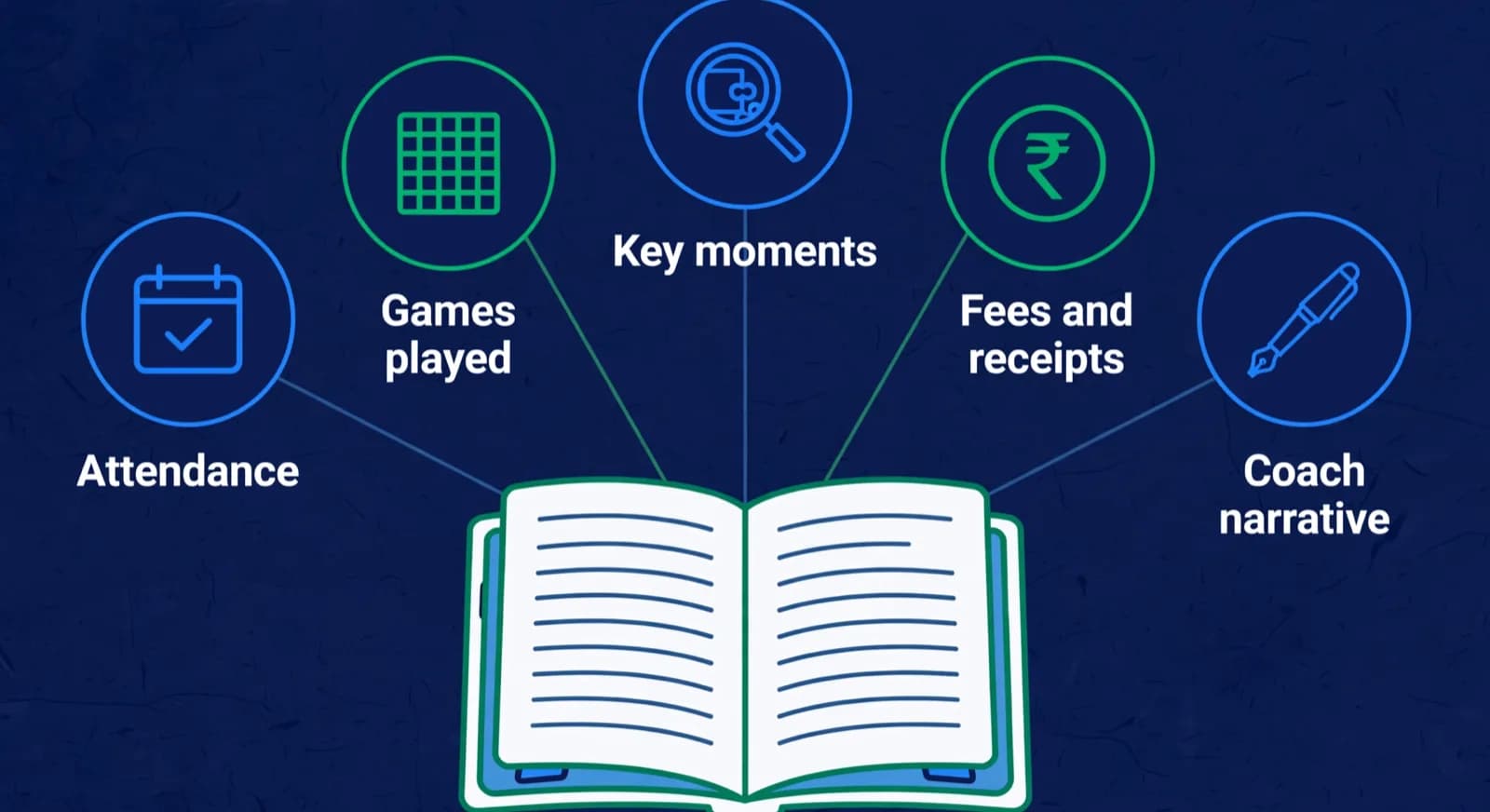
Lichess provides an API for games, rating history, and player information [2], allowing those records to feed a report without retyping screenshots. For Chess.com students, use the imported game history and check that the account belongs to the child. Move-quality notes should be tied to the analysed game and position, using Stockfish engine output [4]. Keep the analysis settings and the move reference with the record so the coach can review an apparent blunder before repeating it to a parent. If the game is missing or the account cannot be matched, leave the figure unreported and explain what the coach can still say from lessons.
Check attendance before approving the report. A parent may query a session because they remember dropping the child off or arranging a make-up class. The register should distinguish a scheduled lesson, an absence, a cancellation, and a recovery session, so the coach can explain the total. Resolve a disputed entry with the person who taught that class. Do not reconstruct the month from chat messages while writing the report. Our guide to attendance tracking covers the register routine; for reporting, use the recorded dates and make the period clear beside the number.
- Attendance: read from the class register, recorded on the day of each class.
- Games played and rating movement: read from the synced Lichess or Chess.com account [2].
- Accuracy, blunders, and key moments: read from Stockfish analysis of those synced games [4].
- Fees and receipts: read from payment records, and kept out of progress reports entirely so money and progress stay separate conversations.
- Coach narrative: the only part written fresh, because judgment is the one thing no system of record can produce.
What should a report say when a month's records are incomplete?
Say what is missing, and make no claim the record cannot support. A class with no attendance mark is not recorded, which is different from absent. A rating with no earlier reading from the same pool supports no claim of change. A month with no reviewed game supports no claim that tactics or endgames improved. Missing is not zero, and a gap in the register is a record problem to fix, not a number to estimate.
| What is missing | Claim you cannot make | Evidence to request first | Placeholder wording for the parent |
|---|---|---|---|
| No attendance mark for a class | That the child was absent, or present | The register entry for that date, or the teaching coach's lesson note | Attendance was not recorded for [date]. [Coach name] is checking and will confirm it in the next report. |
| No comparable rating reading at the start of the period | That the rating rose or fell | A rating from the same pool and time control at the start, such as Lichess rapid on [start date] | The [pool and time control] rating on [date] is [number]. We have no earlier reading from the same pool, so this report makes no claim about change. |
| No reviewed game | That tactics, openings or endgames improved | One game from the period with a saved coach review or engine analysis | No game was reviewed this month, so this report does not comment on tactics. We worked on [classroom task] instead. |
Fix the record, then correct the report. If the missing register turns up before the deadline, replace the placeholder with the real figure. If it does not, send the report with the placeholder and a date for the correction, because a parent who sees the gap named trusts the other numbers more than one who finds it later. Do not fill a gap with last month's figure, an average or a guess, and do not leave a blank that a parent could read as zero.
How do you talk about ratings without misleading parents?
Present ratings as an estimate of playing strength over time, alongside evidence from lessons and games. Elo models relative strength using game results [1]. A child can learn a useful skill during a month in which their rating falls, so describe what the coach observed before interpreting the chart. Name the rating pool and time control, and compare like with like. Explain a movement through the games available rather than assuming a rise proves better teaching or a dip means the child has stopped learning.

Be explicit about which rating you are reporting. A Lichess rapid rating, a Chess.com blitz rating and a FIDE classical rating are three different numbers on three different scales, and they are not interchangeable. FIDE publishes its official rating list on the first day of each month [9], so an over-the-board rating changes at most twelve times a year however much a student plays, while an online rating can move every evening. FIDE also lists a rating only for players at 1400 or above [9], so many young players have no FIDE rating at all. A report that says the rating went up without naming the pool and time control is technically true and practically misleading. Our guide to showing parents rating progress covers the charts and framing that make this legible.
Explain the limits of the rating line before a parent has to ask. Results depend on the opposition and the games played [1], so choose evidence the coach can discuss: a correctly played rook ending, fewer missed undefended pieces in the games reviewed, or a better time-management decision. Say how many games the observation covers, and give the family a practice task that follows from it, with the rating as context rather than the verdict on the month.
How often should reports go out, and who writes them?
Start with a monthly report as the cadence, with brief class notes between reports when useful. Give the system or administrator responsibility for assembling records, the teaching coach responsibility for the narrative, and one named person responsibility for delivery. Adjust the schedule to the programme: a short holiday course may need an end-of-course note, while tournament preparation may need a review after an event. Tell families what to expect and include reporting time in the coach's workload, so the promised date is realistic.
| Cadence | What it suits | Risk to plan for |
|---|---|---|
| Weekly recap | A two-line class note, not a report | Repetitive messages can make the useful note harder to find |
| Monthly report | The full evidence, narrative, next step format | Record collection and review need a reserved place in the month |
| Quarterly review | A longer sit-down before fee renewal | A concern may need a conversation before the quarter ends |
| Tournament report | After each rated event, win or lose | Include the review after difficult results as well as good ones |
Assign the work explicitly. The administrator can check attendance dates and account links; the coach who teaches the student should write or approve the learning notes and next task. Name the person who sends the completed report and follows up on a parent reply. One workable rhythm is to send a batch's reports on the first Saturday of the month, with a list showing which drafts are approved and which are waiting. Use that kind of checklist to notice a missing report before the deadline. If the coach is away, agree who can review the evidence and whether the family needs a revised delivery date.
Choose the delivery channel with families. WhatsApp Business provides messaging tools [3], but the useful choice is the channel parents have agreed to use for their child's updates. Keep individual progress in a private thread or guardian account. Our guide to WhatsApp for chess academies covers the channel rules and when to add a private guardian portal for the records a group chat cannot hold. Check how a parent finds an earlier report and who sees their reply. A familiar channel helps only when the family can identify the child, reporting period, and person to contact.
What does an AI-drafted, human-approved reporting workflow look like?
The workflow has four stages: the system gathers evidence, an AI drafts the narrative around injected numbers, a coach edits and approves in a queue, and only approved drafts go to families. The order is the point. The model never invents a number, because attendance, games and ratings come from the records described above, and a named person stands between every AI draft and every parent.
Take an illustrative month with twelve of twelve classes attended, eighteen synced rapid games and two reviewed mistakes in a rook endgame. The draft can organise those details, but the coach decides whether they describe the important learning theme, and checks the date range, the positions and whether the homework follows from them. Review each child's draft on its own even when the reports share a structure, and remove praise that has no example behind it. The two sections that follow give the review checklist and the stop rules that make this consistent across a batch.

Parent updates · this week
14 of 14 sentWeekly recap · Lucas M.
Lucas attended Thursday's class and won 2 arena games. His September report is in your portal.
Receipt · October fee
$180 received via card AutoPay. Receipt saved.
9:42 AMRecap approved by Coach Elena
Open the guardian portal
Own login · nothing to install
ChessCore, which we build, keeps AI-written report text in an approval queue: the draft waits in a list with the records it was built from, and no AI-drafted report reaches a parent until a person approves it. Automatic monthly reports are a separate path. When an academy switches them on, ChessCore emails guardians a report built from attendance and rating data, with no AI text and no engine analysis, and it counts only the attendance marks that were entered, so an unmarked class is not turned into an absence. Before treating a report as ready, check that the child has a linked guardian email and the guardian's consent for parent communications. Class reminders and fee reminders also go out automatically on a schedule the academy turns on, with no AI text. The approval-queue section of our guide to AI guardrails in coaching software covers what should happen when nobody reviews a draft.
October progress report · Lucas M.
1 of 14 drafts for Batch B2
Lucas attended 4 of 5 classes this period and played 18 rated games, moving from 1310 to 1342.
His endgame conversion improved clearly. Next month the focus is back-rank defense, based on the mistakes tagged in his last three games.
Highlighted numbers come from your attendance and rating records. The AI cannot change them.
Goes to the Müller family after approval
Evaluate any tool that claims this workflow against three questions. Can an AI draft reach a parent without a named person approving it? Are the numbers injected from records, or does the model write them? Is there a trail showing who approved each report and when? The evidence layer, game sync from Lichess and Chess.com plus attendance from the register, is what separates a reporting system from a text generator [2], and the AI layer should be judged on its guardrails before its prose.
What must a coach check in an AI-drafted report?
Check five things in order, because the early checks make later edits pointless if they fail: the period and student, every number against its record, every claim against a number or a note, the tone for this particular month, and the single next step. The draft assembles records; coaching judgment still decides what the report says and whether the evidence supports it.
- Period and student: confirm the date range and the child's name before reading a word, because a draft built on last month's records is wrong in every line.
- Every number against its record: attendance against the register, the rating against the named pool and time control, the game count against the synced list.
- Every claim against a number or a note: if a sentence says the student improved at endgames, point to the game or the coach note that shows it, or cut it.
- Tone for this month: a hard month needs a calm, honest register, not the default cheerful one, and a good month does not need superlatives.
- One next step the coach will check: a specific task with a count and a date, written so next month you can see whether it happened.
If a draft fails the first two checks, fix the records and regenerate it rather than editing around the error. A report whose numbers were corrected by hand in the prose will disagree with the record the next time anyone looks. Before you spend time on wording, run the stop rules below, each of which blocks a different step in a well-built workflow.
- No active data-collection consent for the student: no AI draft should be generated. Record the consent first.
- No guardian email linked: delivery cannot queue, so add the contact before treating the report as ready.
- No parent-communication consent: delivery requires it, so the report is not ready to send until it is recorded.
- Missing attendance marks: count only marks that were entered, and never read an unrecorded class as an absence. Enter the mark, or add a coach note explaining the gap.
- The approval screen: the send control stays disabled until narrative reviewed, numbers verified and ready to send are all confirmed.
Those confirmation steps are ChessCore's design, not an industry standard, and they do not replace reading. An automatic numeric-citation check compares the narrative's numbers with the report statistics, but it cannot tell you whether a sentence means what the record supports, so the review of meaning stays with the coach. Human review of consequential automated output is also a core control in the NIST AI Risk Management Framework, which treats how AI output is used and evaluated as part of managing its risk, and a parent-facing report qualifies [10].
What does editing an AI draft look like in practice?
Editing an AI draft means turning a fluent sentence back into a claim the record supports. The pattern repeats: the draft states an inference the data does not carry, and the coach rewrites it to the evidence plus a next step. The table uses made-up values from Knight's Gate, a made-up demo academy; the draft sentences are authored examples, not captured model output, and nothing in them is a measured result.
| Source record | Draft sentence (illustrative) | Unsupported inference | Coach edit |
|---|---|---|---|
| Academy rating 1342, up 118 since June (1224 on 30 June) | Mateo has made outstanding progress and is ready for the next level. | Outstanding and ready for the next level are judgments; the record shows a rating change, not readiness. | Mateo's academy rating is 1342, up 118 since June. Coach Elena will decide on batch placement and let you know. |
| Attendance: 4 of 5 classes from 16 September to 15 October; 1 make-up pending | Mateo attends reliably and never misses class. | Never misses contradicts the record, which shows one class missed and a make-up still pending. | Mateo attended 4 of 5 classes between 16 September and 15 October. One make-up class is still pending. |
| Coach note on the 14 October game: 17...Rd8 was checkmate, h3 was played instead, lost in 31 moves | Mateo struggles with calculation under pressure. | One missed checkmate does not show a pattern, and under pressure is not in the note. | In his 14 October game Mateo played h3 where 17...Rd8 was checkmate. Next month we will practise looking at every check and capture before quiet moves. |
| No attendance mark entered for one class in the period | Mateo was absent from that class. | A missing mark is not an absence. | The coach enters the mark, or adds a note that attendance for one class was not recorded. |
Naive, ungrounded drafts fail in four predictable ways, and each has a fix. Generic praise such as shows great enthusiasm could describe any student, so replace it with an observation the records support or keep the wording modest. Invented specifics, a tournament result that never happened or a rating the student never held, are caught by checking every number against its record. The wrong emotional register, a cheerful draft after a sixty-point drop and a lost playoff, is fixed by reading the draft with the child's actual month in mind. Omission reads best and checks worst: a draft can be accurate in every sentence and still leave out the two missed classes or the blank homework, because the model only writes what the records hand it, so compare the draft against the register before trusting its tone and add the missing line yourself.
Frequently asked questions
What should a monthly chess report for parents include?
Three things: evidence, narrative, and a next step. Evidence means classes attended from the register, games played and rating movement from the student's synced Lichess or Chess.com account, and one engine-checked moment from their own games. The narrative is three or four sentences in the coach's voice on what improved and what did not. The next step is one concrete focus for the coming month. Keep it to one screen so a busy parent reads it end to end.
How long should a student progress report for chess be?
Aim for roughly 150 to 250 words plus the figures, in a format that reads comfortably on a phone. Include the reporting period, a short learning note, and one next task. Time how long the coach needs to review that format across a batch before promising a monthly deadline, and expand only when the family needs more explanation.
Should a chess progress report include the student's rating?
Yes, with honest framing. Name the exact rating pool and time control, such as Lichess rapid or FIDE classical, show the movement over months rather than weeks, and present the rating as a lagging estimate rather than a score the academy controls. Elo-based ratings swing with opponent strength and variance, so pair every rating mention with evidence of skill the rating cannot show, like cleaner endgames or fewer one-move blunders.
Where can I find a sample chess progress report?
This guide includes three complete samples: a beginner's first monthly report with no rating, an improver's monthly report with a labelled rating movement, and a term-end report that traces a season. Each uses the same five blocks (header, evidence, themes, narrative, one next step). The names belong to Demo Chess Academy, a made-up academy, and the counts are illustrative. Copy the shape, swap in your own student's records, and use the printable template for the blank version.
Can AI write chess progress reports?
AI can draft them well when the numbers are injected from records and a coach reviews the AI draft before sending it. The model writes the narrative around verified attendance, synced game data, and Stockfish evaluations; the coach edits the draft in a queue and sends it. The model should never be the source of a number, because a fluent draft with one wrong figure costs more parent trust than no report at all.
How do I read my child's chess progress report?
Read three things in order: the source, the period and the next step. Check that each figure names where it came from, such as the class register or a labelled rating pool, and that the report states the dates it covers. Check the attendance and game numbers against what you already know. Treat the coach's three or four sentences as a comment on this period and the rating line as a noisy estimate. If a figure says it was not recorded, that is a gap, not a zero. Then act on the single next step, and reply with one line confirming you will support it at home.
Sources
- [1]Elo rating system · accessed 2026-06-10
- [2]Lichess.org API documentation · accessed 2026-06-10
- [3]WhatsApp Business · accessed 2026-06-10
- [4]Stockfish: open-source chess engine · accessed 2026-06-10
- [5]FIDE rating lists · accessed 2026-06-10
- [6]Lichess FAQ: rating system · accessed 2026-10-16
- [7]Sample report, 1000ELO · accessed 2026-10-16
- [8]Sample chess coaching report, MyChessBot · accessed 2026-10-16
- [9]FIDE Rating Regulations effective from 1 March 2024 · accessed 2026-10-16
- [10]NIST AI Risk Management Framework · accessed 2026-10-16
Written by Abhishek Tiwari
ChessCore
Drafted with AI, fact-checked and approved by a human before publishing, the same guardrail our product applies to every report it sends. Read our editorial standards.
Watch a month of reports draft themselves
Bring one batch to a walkthrough and see attendance and synced games turn into drafted reports your coaches review and approve in minutes.
- Roster import from the spreadsheets you already keep
- Lichess and Chess.com connections, batches, and fee plans
- First reports in week one, after your approval
- Free plan, no credit card required