On this page7 sections, 13 min read
- What are the four steps for handling a parent complaint?
- When is a concern a safeguarding matter, not a complaint?
- How do you acknowledge and investigate well?
- What do four common complaint situations look like when worked through?
- What response time should you promise to a parent?
- Where does AI help with complaint replies?
- How do you follow up so the fix actually holds?
- Frequently asked questions
Bottom line
Handle a parent complaint at a chess academy in four steps: acknowledge it privately, check the records before defending anyone, resolve it with a concrete action, then confirm the fix happened. A concern about possible harm to a child is not a complaint. It goes the same day to your safeguarding contact and, where the law requires, to the police.
TL;DR
- Treat a complaint as a request to check the record, because the parent has raised a concern you can still answer.
- Acknowledge in private and name the time of your next update, even before you have the answer.
- Check the dated record before deciding who is right, and say plainly when the record is missing.
- A concern about possible harm to a child is a safeguarding matter, so escalate it the same day and do not wait for a complaint investigation.
- After the fix, check that the remedy you promised actually happened.
Key facts
- Individual complaints belong in a private channel, never in a batch group, because a public dispute about one family puts every other family in the audience.
- Dated attendance, fee and game records can settle a factual dispute, and a missing record should be reported as missing, not filled in.
- Complaints about an attendance charge, batch fit, a rating decline and coach conduct each need different records and a different first reply.
- Section 19 of the POCSO Act 2012 requires a person who has knowledge of, or apprehends, an offence under the Act to give that information to the Special Juvenile Police Unit or the local police, and section 21 penalises failure to report.[2]
- One chess club's published procedure acknowledges a complaint within 48 hours but requires a child-safety concern to reach its safeguarding officer on the same day, so safeguarding runs on a faster clock than routine complaints.[1]
What are the four steps for handling a parent complaint?
Run every routine complaint through the same four steps: acknowledge, investigate, resolve, follow up. A fixed order stops you from defending before you know the facts or apologising before you know what happened. The steps are not complicated. The framework fails when one of them is skipped, and acknowledgement and follow-up are the two most often skipped.
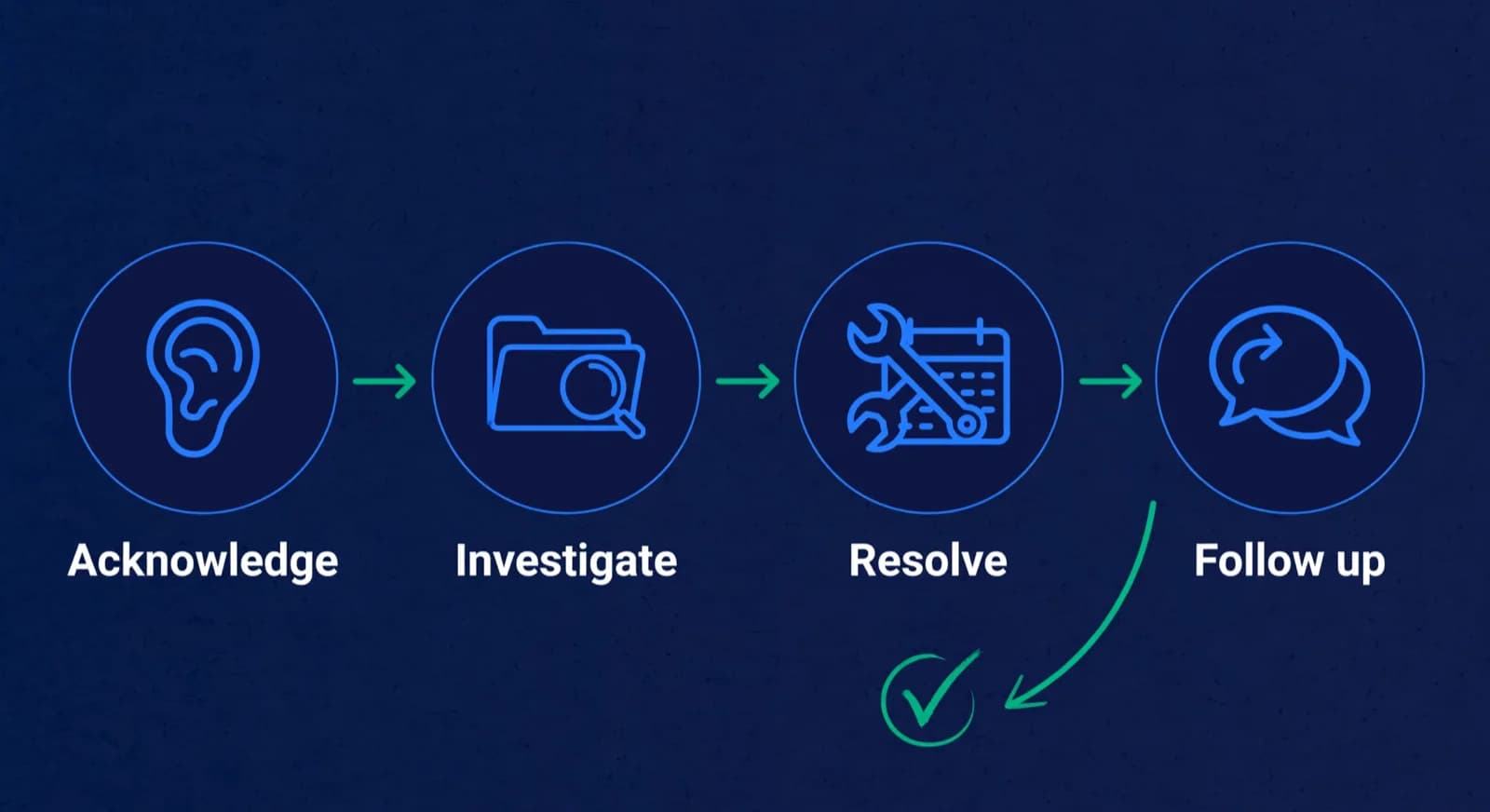
- Acknowledge: reply privately, say which concern you have heard, thank the parent for raising it, and name the time you will send the next update.
- Investigate: pull the dated records, attendance, fees, game history and what the coach observed, before you decide anything.
- Resolve: give a concrete action and an honest explanation. Own a real mistake plainly, and explain the record kindly if there was none.
- Follow up: a few days later, check that the remedy you promised happened and ask whether the parent is satisfied.
You do not need an answer to acknowledge. A reply the same day that says you have seen the message, you are checking the record and you will write again by a named time costs little and keeps a manageable complaint from turning into a second grievance about being ignored. Sometimes the stated complaint is part of a larger worry, such as whether the coaching suits the child. Ask what a good outcome would look like for the family, and write down the answer.
When is a concern a safeguarding matter, not a complaint?
A concern is a safeguarding matter, not a complaint, the moment it involves a disclosure of harm to a child, a suspicion or risk of harm, or any behaviour that could be criminal. Immediate-risk and statutory reporting do not wait for a complaint investigation, a coach's reply or a parent's decision. If you are hearing a child may be at risk, stop using the steps above and escalate the same day.
In India, section 19 of the POCSO Act 2012 requires a person who has knowledge of, or apprehends, an offence under the Act to give that information to the Special Juvenile Police Unit or the local police [2]. Section 21 penalises failure to report: up to six months' imprisonment, a fine or both, and up to one year plus a fine for a person in charge of an institution who fails to report an offence by a subordinate [2]. An internal inquiry is not a substitute for that report. Those figures come from a Government of India school-safety circular that reproduces the Act (retrieved 16 October 2026), and this guide is not legal advice, so confirm your own duties with a lawyer or your state child protection authority.
Decide in advance who at the academy is the named safeguarding contact, who files a report if that person is the subject of the concern, and what counts as same-day escalation. One published example from outside India is King and Queen Chess Club in Queensland, which requires a child-safety concern to reach its Child Safety Officer on the same day, names its Club President as the contact if the concern involves that officer, and reports a child at immediate risk to police immediately [1]. Its deadlines are one club's policy under Queensland law and do not describe Indian law.
How do you acknowledge and investigate well?
Acknowledge privately, quickly and specifically. Private means the family's own one-to-one thread, never a batch group. Quickly means the same working day where you can, even when the answer is not ready. Specific means reflecting the actual concern in your own words, so the parent knows you read it. I understand the make-up class you were promised last week did not happen is a different message from thanks for your message.
Then investigate before you defend. Gather the dated records: the attendance log for a disputed absence, the payment history for a fee query, and the game and rating history for a worry about progress. Talk to the coach involved without assuming fault in either direction, because the parent's account and the coach's account are both partial. If a record is missing or unclear, say so and find out what happened. Do not declare the parent wrong, and do not guess in the parent's favour either.

Lucas M.
Batch B2 · Thursdays · joined Aug 2025
1342
Academy rating · Lichess games synced
Won vs. 1410 · French Defense
Best gameMissed fork on move 23
Homework setWhat do four common complaint situations look like when worked through?
Four situations come up often enough to prepare for: a disputed attendance charge, a batch-fit concern, a rating decline and a complaint about a coach. Each needs a different record and a different first reply. The wording uses placeholders in square brackets, not real families, so adapt it to your own records.
Two cautions apply to the attendance case. A leave request alone does not record attendance or create a make-up credit. The credit follows from the attendance mark under your written policy, so the coach's mark is the record that matters. If the record is missing for the date, say that the mark is missing and investigate with the coach who taught the class. Our make-up class policy guide covers the credit rules in full.
What response time should you promise to a parent?
Promise one simple target and publish it. Our editorial advice is to acknowledge every routine complaint by the end of the next working day, and to name in that reply the time of your next update. That is a proposal for a small academy, not an industry standard, and no study sets it. A published window turns how fast to reply from a judgment under pressure into a standing rule that you and the parent both know.
King and Queen Chess Club's published procedure is one example of a staged process. It acknowledges a complaint within 48 hours, allows 14 days for informal resolution of lower-level concerns, and moves to a written complaint, with a committee meeting within 28 days, only if the informal route fails [1]. Treat that as an illustration of the shape of a process, with a light informal stage first and a written formal stage for what does not resolve, and set your own windows. Safeguarding concerns skip this process entirely.
| Stage | What happens | Timing in the club's published example |
|---|---|---|
| Informal | The parties discuss the issue directly, with the owner or lead coach helping, aiming for an explanation, an apology or a fix | First 14 days [1] |
| Formal | A written complaint with what happened, when, who was involved and any evidence, reviewed by a named person or committee | Committee meets within 28 days [1] |
Where does AI help with complaint replies?
AI can help you get past the blank page, but keep a human in the loop: read, edit, and approve every message before it reaches the parent, because a complaint is the moment when tone and accuracy matter most. ChessCore, which we build, can draft a reply from your records; the AI never sends a reply itself; a person sends the message a parent actually receives. If a draft is created through the copilot, sending it to a guardian needs a second approver, and so does a refund the copilot prepares. Nobody approves their own request. Neither the draft nor the approval decides the remedy: that is your judgment, and no reply should promise a refund before the record and the policy support one.
Lucas M.
Batch B2 · Thursdays · joined Aug 2025
1342
Academy rating · Lichess games synced
Won vs. 1410 · French Defense
Best gameMissed fork on move 23
Homework setHow do you follow up so the fix actually holds?
Follow up a few days after the resolution, in the same private thread, and check that the remedy you promised happened. Did the make-up class run on the named date? Does the fee correction show on the family's account? Is the new feedback style in use? If it did not happen, you have caught the failure before the parent had to raise it a second time. Record what was promised, who owned it and the date it was confirmed.
Many scheduling and communication complaints can be reduced at the source with a written make-up policy and a predictable update rhythm. Our guides to chess academy make-up classes and to WhatsApp for chess academies cover those systems, and the chess progress report template gives families a regular, record-based account of how their child is doing.

Parent updates · this week
14 of 14 sentWeekly recap · Lucas M.
Lucas attended Thursday's class and won 2 arena games. His September report is in your portal.
Receipt · October fee
$180 received via card AutoPay. Receipt saved.
9:42 AMRecap approved by Coach Elena
Open the guardian portal
Own login · nothing to install
Frequently asked questions
How should a chess academy respond to an angry parent?
Reply privately, on the same working day where you can, without matching the emotion. Acknowledge the specific concern, say you are checking the record, and name the time you will write again. Then investigate before defending anyone, resolve with a concrete action and an honest explanation, and follow up to check the remedy happened. If anything suggests a child is at risk, switch to your safeguarding steps instead.
Should I handle a parent complaint in the batch group?
No. An individual complaint aired or answered in a batch group puts every other family in the audience and invites the group to take sides. Answer any harmless part in one line, say you are messaging the family directly, and move fees, a specific child or a behaviour concern to their private thread straight away.
What if the record does not support the parent, or the record is missing?
Explain what the record shows, kindly and with the dated entries in front of you, and offer what your written policy allows. If the record is missing, say that the entry is missing and find out what happened with the coach who taught the class. Do not declare the parent wrong from an empty record, and do not make up an entry to fill it.
How quickly should a chess academy reply to a complaint?
Our editorial advice is to acknowledge by the end of the next working day and to name the time of your next update in that reply. That is a proposal, not an industry standard. One club's published procedure acknowledges within 48 hours [1]. Whatever window you choose, publish it, and treat a safeguarding concern as same-day work.
Can AI help respond to parent complaints?
It can draft a calm reply from your records, but a person must read, edit and send it. In ChessCore a person sends what the family receives, and a guardian message or refund prepared through the copilot needs a second approver. The AI does not decide the remedy or promise a refund. Use it to start a reply, and use your own judgment for the content.
When should a parent complaint be escalated as a safeguarding issue?
Escalate it the same day, outside the normal complaint process, when it involves a disclosure of harm to a child, suspicion or risk of harm, or behaviour that could be criminal. In India, section 19 of the POCSO Act 2012 requires information about an offence under the Act to go to the Special Juvenile Police Unit or the local police, and section 21 penalises failure to report [2]. Name a safeguarding contact in advance, and confirm your duties with a lawyer.
Sources
- [1]Policies, King and Queen Chess Club (Complaints and Reporting Policy and Procedure) · accessed 2026-10-16
- [2]Protection of Children from Sexual Offences Act 2012, sections 19 and 21 (Government of India school-safety guidelines reproducing the Act, Atomic Energy Education Society) · accessed 2026-10-16
- [3]Lichess FAQ: why is there a question mark next to a rating? · accessed 2026-10-16
Written by Abhishek Tiwari
ChessCore
Drafted with AI, fact-checked and approved by a human before publishing, the same guardrail our product applies to every report it sends. Read our editorial standards.
Resolve complaints from facts, not memory
ChessCore keeps attendance, fees and game history in one place and drafts replies that a person reviews and sends, so you can answer a complaint from the record.
- Roster import from the spreadsheets you already keep
- Lichess and Chess.com connections, batches, and fee plans
- First reports in week one, after your approval
- Free plan, no credit card required