How to Teach Chess to a 6 Year Old: A Simple Guide
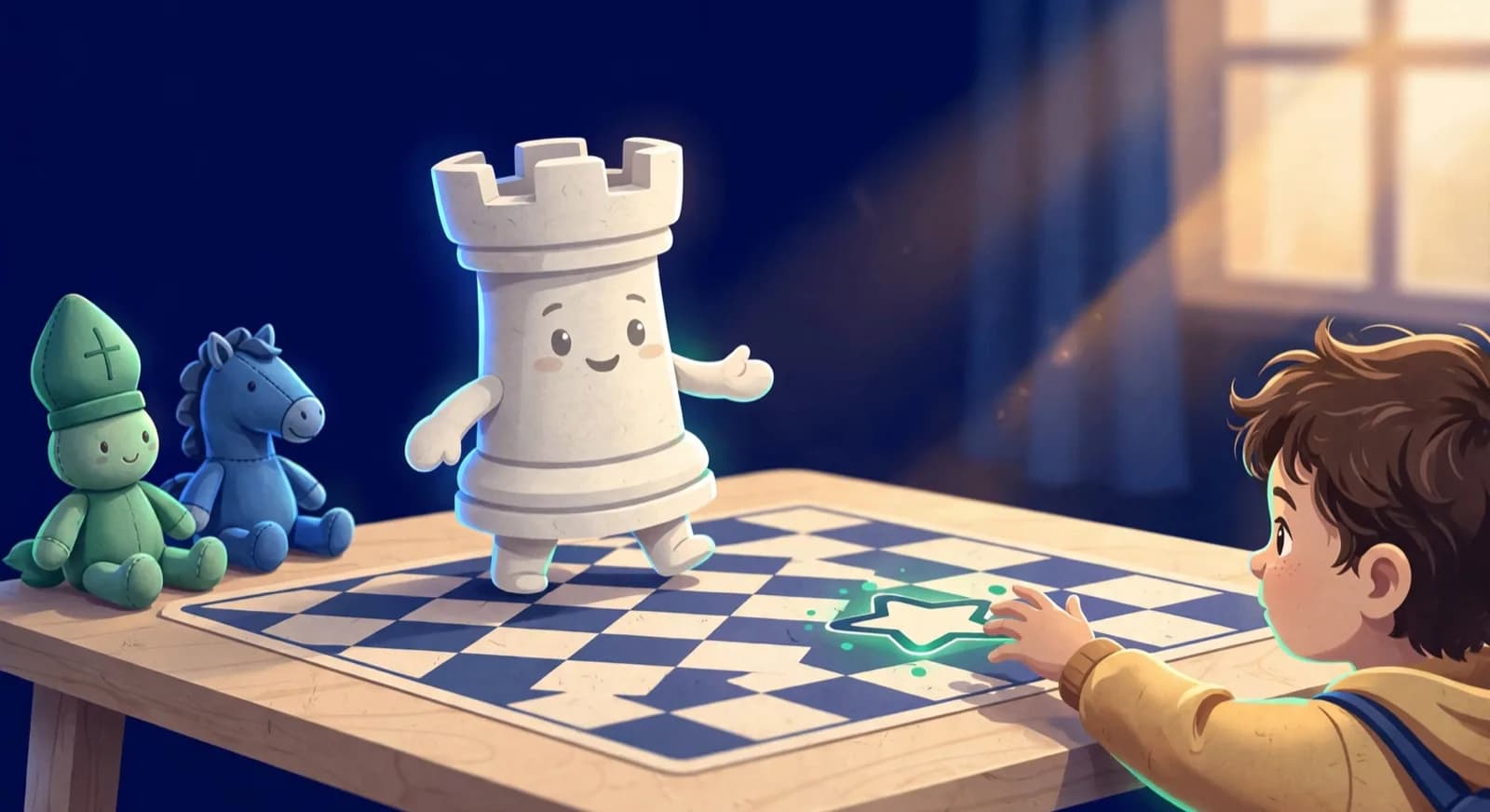
How to teach chess to a 6 year old without frustration: one piece at a time, short sessions, games and stories, and simple ways to see real progress.
By the ChessCore team · Published June 30, 2026 · Updated August 13, 2026 · 18 min read
Bottom line
To teach chess to a 6 year old, introduce one piece at a time, keep each session to about 15 to 20 minutes, and turn the rules into small games and stories so the board feels like play rather than a test. Start with how the pieces move, add simple checkmates once they are confident, and celebrate small wins long before you mention strategy.
TL;DR
- A 6 year old learns chess fastest when you teach one piece at a time and let them play tiny games with just that piece before adding the next.
- Keep sessions short, roughly 15 to 20 minutes, because attention span, not intelligence, is the real limit at this age.
- Stories, nicknames, and mini-games carry the rules far better than explanation, so make the pawn a brave little soldier and the knight a horse that jumps.
- Skip strategy and openings entirely at first, since safe piece movement, basic captures, and simple checkmates are more than enough for months of fun.
- Progress at this age is measured in confidence and curiosity, not rating points, so protect the child's enjoyment above all else.
Key facts
- ChessKid is built specifically for young children, with cartoon guides, guided lessons, and safe play that suit a 6 year old learning the rules. (chesskid)
- Puzzle trainers present one position with one correct idea, which matches how a young child learns best: a single decision at a time rather than a whole game of choices. (lichess-training)
- Lichess studies are free, shareable boards where an adult can set up one piece and a target square, so a lesson can be a game the child simply plays. (lichess-study)
- A 6 year old's attention holds for only a short stretch, so several 15 minute sessions across a week teach more than one long sitting that ends in tears. (product behavior)
- In the demo academy, a coach records what a beginner covered and shares a short update with parents, which is how a family sees steady progress even before any rating exists. (demo academy)
How do you teach chess to a 6 year old?
You teach chess to a 6 year old by breaking it into the smallest possible pieces and turning each one into a game. Introduce a single piece, let the child play with only that piece until it feels easy, then add the next. Keep every session short, keep the mood playful, and leave strategy for years later. At this age the goal is not to build a strong player, it is to build a child who wants to sit at the board again tomorrow.
The most common mistake adults make is teaching chess the way it was taught to them: all the pieces at once, the full setup, and a real game on day one. A 6 year old cannot hold that much in working memory, and a game where everything can move in confusing ways feels like noise, not fun. The fix is patience with the sequence. When the only thing on the board is a rook and a target square, the child has exactly one thing to think about, and success comes in the first minute. That early success is the fuel for everything that follows.
It also helps to accept what this age is not ready for. Openings, tactics with names, notation, and thinking two moves ahead are all a long way off, and pushing them early is the fastest way to make a child decide that chess is hard and not for them. If you teach nothing but safe piece movement, simple captures, and one basic checkmate over the first month, you will be exactly where a 6 year old should be. Our fuller guide on how to teach chess to beginners covers the older learner who can move faster; this page is deliberately about the very young child and the slower, gentler path they need.
The one rule that matters most
Protect the fun. A 6 year old who loses interest cannot be argued back into it, but a child who ends every session wanting one more game will keep learning for years. If a session is going badly, stop early and on a win. You are teaching a relationship with the game as much as the rules of it.
Which chess piece should you teach first?
Teach the rook first, then the bishop, then the queen, then the king, then the knight, and finally the pawn with its special rules. The rook moves in straight lines, which is the easiest movement for a young child to see and copy, so it builds confidence before you introduce the diagonal bishop or the tricky knight. Introduce each piece on its own and let the child play a small game with just that piece before the next one appears.
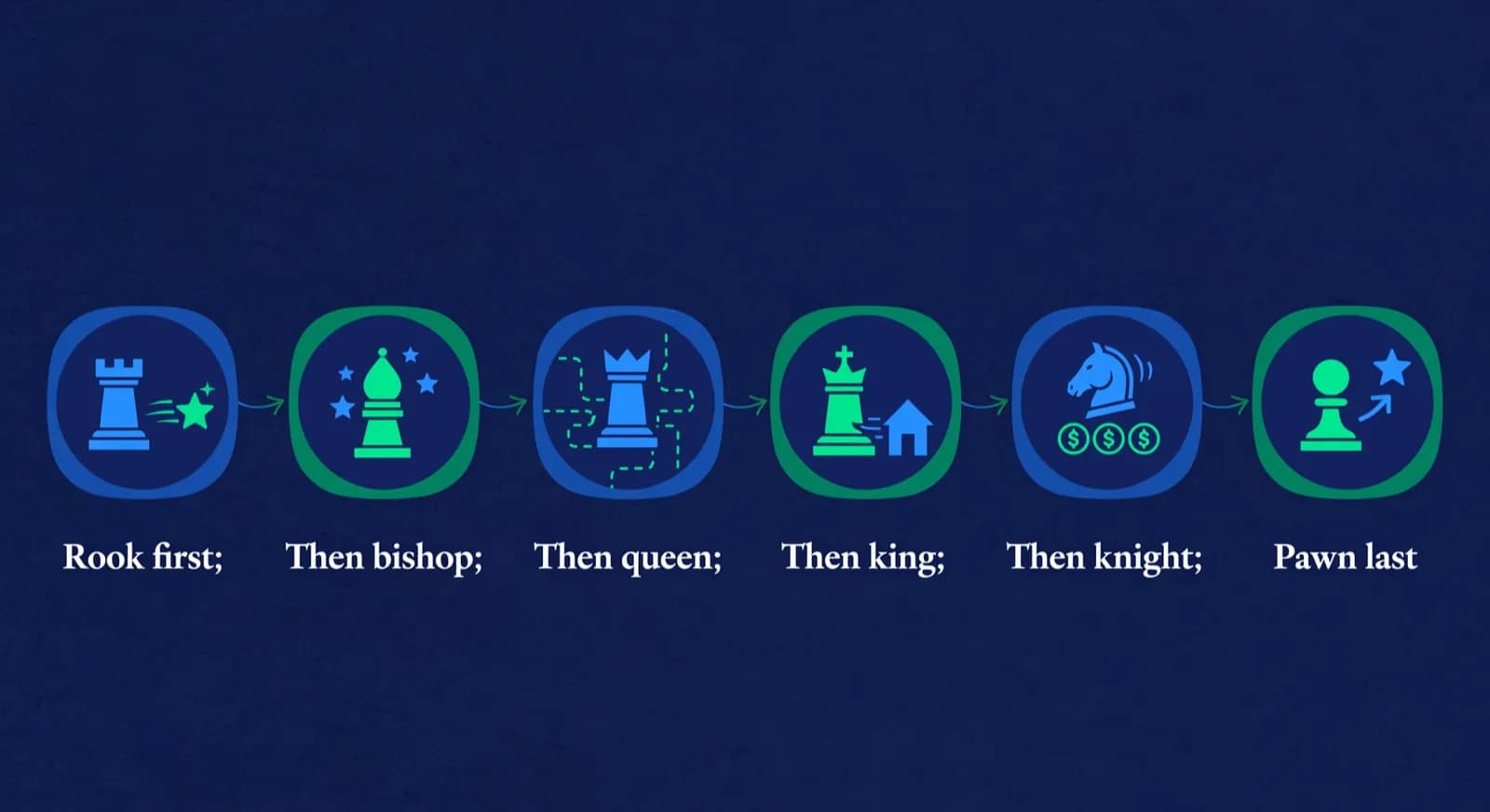
The reason for this order is that each piece adds one new idea rather than several at once. The rook teaches straight lines. The bishop adds diagonals. The queen combines the two, so by the time you reach it the child already knows both movements and simply puts them together, which feels like a reward rather than a new lesson. The king moves like a slow queen, one square at a time, and the knight comes near the end because its jump is genuinely the hardest movement for a 6 year old to picture. The pawn comes last because it carries the most exceptions: it moves one way, captures another, has a first-move option, and promotes at the far end.
| Piece | The one idea it teaches | A game to play with it |
|---|---|---|
| Rook | Straight lines, across and up and down | Race the rook to a target square, avoiding a few blockers |
| Bishop | Diagonals stay one colour | Touch every star of one colour with the bishop |
| Queen | Lines and diagonals together | Reach a square in as few moves as possible |
| King | One slow step in any direction | Walk the king home while a rook chases |
| Knight | The L-shaped jump over pieces | Hop the knight to collect coins on set squares |
| Pawn | Move ahead, capture diagonally, promote | March pawns to the end to become queens |
Give each piece a nickname and a tiny story, because a 6 year old remembers a character far better than a rule. The knight is a horse that jumps the fence. The bishop only ever walks on its own colour of carpet. The pawn is a brave little soldier who can only march forwards but sneaks sideways to capture. These stories are not babyish decoration; they are memory hooks, and a child who giggles at the jumping horse will recall the knight's move long after a dry explanation would have faded.
How long should a chess lesson be for a 6 year old?
Keep chess lessons for a 6 year old to about 15 to 20 minutes, and stop the moment attention fades rather than pushing to a set finish time. Several short sessions across a week teach far more than one long one, because attention span, not ability, is the real limit at this age. A child who plays three cheerful ten minute games learns more than one who endures forty tired minutes and walks away deciding chess is boring.
Watch the child, not the clock. The signs that a session should end are wriggling, guessing moves at random, or asking how long is left, and none of them mean the child is bad at chess. They mean the tank is empty for today. Ending early and on a small victory leaves the child wanting more, which is exactly the feeling you want them to carry to the next session. If you only have one longer window in the week, break it up: a few minutes of moving pieces, a short mini-game, a single puzzle, then a quick pack-away, rather than one continuous stretch of concentration.
Little and often beats long and rare
Three 15 minute sessions in a week will almost always beat one 45 minute session for a 6 year old. The short format matches their attention, keeps every sitting positive, and turns chess into a small regular treat rather than a chore to be survived. Frequency, not duration, is what builds the habit.
How do you use games and stories to teach chess?
Use games and stories by never explaining a rule you can turn into a challenge instead. A 6 year old learns a piece by playing a tiny game that can only be won by moving that piece correctly, and remembers it through a character rather than an instruction. So instead of describing how a rook moves, set up a single rook and a target square and say, get the rook to the star, then cheer when they do. The rule teaches itself through the doing.
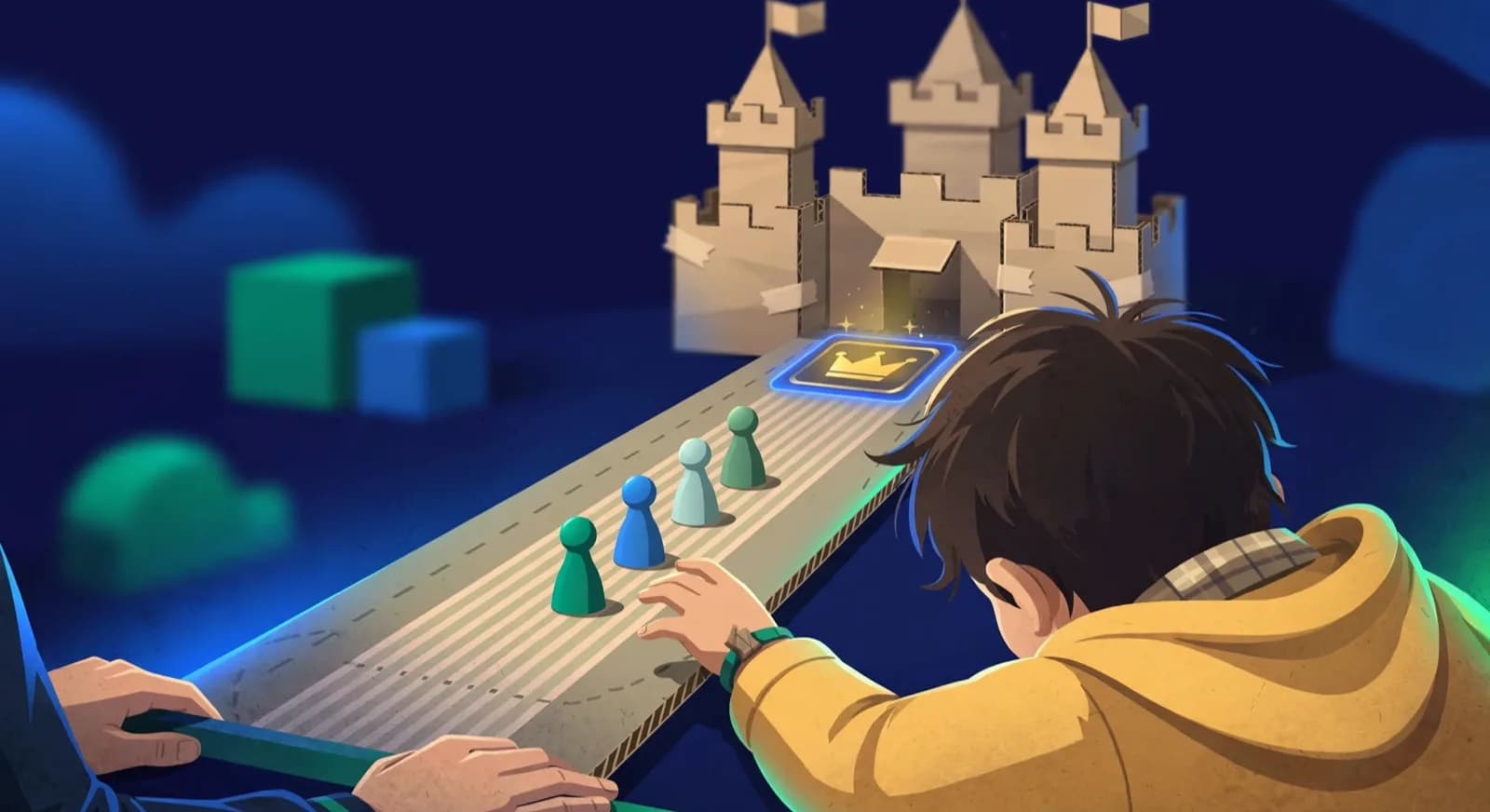
The most useful teaching tool at this age is the mini-game: a stripped-down position with one clear goal. The pawn race lines up a few pawns on each side, and whoever promotes first wins, which drills pawn movement and the idea of racing without a single word of theory. The capture game scatters a few enemy pieces and asks the child to take them all with one piece, teaching how that piece moves and how captures work at the same time. The king walk sends a lone king across the board while a rook tries to cut it off, teaching king safety through a chase the child finds genuinely exciting. Each of these is a real lesson wearing the costume of a game, and children will ask to play them again, which is the whole point.
Stories do the heavy lifting that explanation cannot. Frame the whole board as a kingdom: the king is the one everyone protects, the queen is the powerful helper, the rooks are the castle towers, the bishops run along their coloured paths, the knights are the horses that leap, and the pawns are the little soldiers holding the front line. When a child captures a piece, it is not a technical exchange, it is a soldier being sent off the field, and that narrative makes the stakes feel real and fun. You are not dumbing chess down by doing this; you are meeting a 6 year old where their imagination already lives, and imagination is the strongest memory aid a young learner has. As the child grows, the stories quietly fall away and the real chess underneath is already there, learned without ever feeling like study. Digital tools lean on exactly this instinct: ChessKid, for example, wraps its lessons and puzzles in friendly cartoon characters precisely because young children learn the rules more readily through play than through instruction [1]. You can recreate the same effect for free on a physical board or on a shared Lichess study, where an adult sets up one piece and one target and the lesson becomes a game the child simply plays [2].
- The pawn race: a few pawns each, first to promote wins, drilling pawn movement with no theory.
- The capture game: clear all the scattered targets with one piece to learn how it moves.
- The king walk: run the king across the board while a rook gives chase, teaching king safety.
- The treasure hunt: place coins or stickers on squares and reach them with a chosen piece.
- The colour game: touch every square of one colour with the bishop to lock in the diagonal idea.
What order should you teach chess concepts to a young child?
Teach the concepts in this order: how each piece moves, how captures work, check and getting out of check, checkmate with lots of help, and only then the full game with all the pieces. Each stage rests on the one before, so a child who is rushed past piece movement into whole games simply gets lost. There is no hurry. Spending a month on nothing but moving pieces safely is completely normal and sets up everything that comes later.
Once the child can move every piece and make captures, introduce check as a simple idea: the king is in danger and must be made safe right now. Show the three ways out, move the king, block the attack, or capture the attacker, using positions so simple the answer is obvious, and let the child find it themselves. Only after check feels comfortable do you introduce checkmate, and at first you should help heavily, setting up positions that are one move from mate and letting the child deliver it, so the very first taste of checkmate is a win they feel they earned. A basic king and queen checkmate against a lone king is a good milestone, but it can wait until the child is happily playing short full games.
| Stage | What the child can do | What to leave for later |
|---|---|---|
| Piece movement | Move every piece safely and legally | Captures, check, whole games |
| Captures | Take pieces and understand trades simply | Which trades are good, tactics with names |
| Check and escape | See a king in danger and make it safe | Delivering checkmate unaided |
| Guided checkmate | Finish a position that is one move from mate | Full endgame technique |
| Full games | Play a whole short game start to finish | Openings, strategy, planning ahead |
Notice what sits firmly in the later column throughout: openings and strategy. A 6 year old does not need to know an opening name or a plan, and teaching one early crowds out the basics they actually need. When the child is playing full games happily and asking questions of their own, that is the moment to nudge gently toward simple ideas like developing pieces and protecting the king, and our guide on how to teach chess to beginners picks the thread up from exactly there. For now, mastery of movement, captures, and a helped checkmate is a genuinely full plate, and a child who owns those fundamentals is well ahead.
How do you keep a 6 year old motivated and not frustrated?
Keep a 6 year old motivated by making wins frequent, keeping sessions short, and never letting the game feel like a test they can fail. Praise effort and good moves rather than only results, let them win often in the early days so confidence builds, and stop while they still want more. Frustration is the enemy at this age, and almost all of it comes from a game that is too long, too hard, or too serious, all of which you control.
Losing is the sharpest source of frustration, so manage it deliberately. In the first weeks, engineer positions the child can win, and when you play a full game, play at a level that keeps it close rather than crushing them, because there is nothing to be gained from beating a 6 year old convincingly. As they grow more secure, introduce real losses gently and model how to handle them: a cheerful good game, a quick look at one thing to try next time, and straight on to the next round. A child who learns that losing is just part of playing, and not a verdict on them, will keep playing, and that resilience matters more than any single skill. Puzzles help here too, because a well-pitched puzzle gives a small, clean success: one position, one right answer, one satisfying moment of getting it, which is why trainers built around single positions suit young children so well [3].
Let them win, on purpose, at the start
Deliberately losing to a beginner is not dishonest, it is teaching. A 6 year old who wins their first games builds the confidence to keep playing, and confidence is what carries them to the point where they can handle a real loss. Ramp up the challenge slowly, matching it to the child, so every game is winnable but not trivial.
How do you know a 6 year old is making progress?
You know a 6 year old is making progress when they move pieces correctly without prompting, spot their own mistakes, and ask to play again, not when a rating number moves. At this age there is usually no meaningful rating at all, so progress is measured in confidence, independence, and curiosity. A child who sets up the board themselves, remembers how the knight jumps, and wants one more game is progressing exactly as they should, whatever any scoreboard says.
It still helps to keep a light record of what a young child has covered, because progress at this age is easy to feel but hard to remember. Jotting down which pieces they have learned, whether check and captures have clicked, and what made them light up gives you a simple map of where to go next and protects against re-teaching what they already know or rushing what they do not. For a parent, that record is also reassurance: young children improve in quiet, uneven steps, and a note that last month they could barely move the bishop and now they win the colour game makes the growth visible. In the demo academy, a coach keeps exactly this kind of record for each beginner, a short log of what was covered and what to try next, so nobody has to trust memory alone.
Aarav R.
Batch B2 · Tue/Thu · joined Aug 2025
1395
Rapid · synced from Lichess
Won vs. 1410 · French Defense
Best gameMissed fork on move 23
Homework setSharing that progress with the family matters as much as tracking it, because a 6 year old rarely reports their own chess lesson accurately at the dinner table. A short, honest note after a session, today Aarav learned how the bishop moves and won the colour game twice, tells a parent more than a term of silence, and it keeps the adults at home cheering the child on. Parents who can see what their child is learning stay involved, and involved parents are what keep a young learner coming back. In the demo academy, that update is a quick message a coach sends after class, so the family shares the small wins as they happen.
Parent updates · this week
31 of 31 sentWeekly recap · Aarav R.
Aarav attended all 3 classes and won 2 arena games. His March report is in your portal.
Receipt · March fee
₹4,500 received via UPI AutoPay. Receipt saved.
9:42 AMSent after Coach Priya approved
Open the guardian portal
Magic link · nothing to install
How is teaching a 6 year old different from teaching an older beginner?
Teaching a 6 year old differs from teaching an older beginner mainly in pace, attention, and how much you lean on play. A 9 year old or an adult can absorb several pieces in a sitting, sit for half an hour, and handle a plain explanation, while a 6 year old needs one idea at a time, short sessions, and games rather than instruction. The chess is the same; the delivery is completely different, and matching it to the age is the whole skill.
This is also where it helps to know what this guide covers and what its neighbours do. This page is about the pedagogy for the very young learner: the sequence, the session length, and the games that make the rules stick for a 6 year old. If you are wondering whether your child is even ready to begin, our guide on what age to start chess weighs the signs of readiness and why there is no single right age. If you want to set up regular play at home and support learning between lessons, our guide on chess for kids at home covers the parent's side, from choosing a set to building a gentle routine, and is the natural companion to this one. And if you are comparing kid-friendly apps, our ChessKid review for parents looks at whether that platform is worth it for a young child.
The through-line across all of it is that a young child learns chess best when it never stops feeling like play. Whether you teach at a physical board, on a shared study you set up yourself, or through a children's app, the same principles hold: one idea at a time, short and frequent, heavy on games and stories, and always ending on a high. Platforms differ in how they package this. ChessKid is designed around young children with cartoon guides and safe, guided practice [1], while general sites such as Chess.com and Lichess offer free boards and puzzle trainers an adult can shape into simple lessons [4] [5]. The tool matters far less than the approach, and the approach is the same everywhere: keep it playful, keep it short, and keep the child wanting to come back.
Same game, gentler on-ramp
A 6 year old is not a smaller adult chess student, they are a different kind of learner. Slow the pace, shorten the session, and wrap every rule in a game or a story. Do that and a very young child will learn the same chess an older beginner does, just on the gentle on-ramp their age needs.
Frequently asked questions
How do I teach chess to a 6 year old at home?
Teach chess to a 6 year old at home by introducing one piece at a time and playing tiny games with just that piece before adding the next. Keep sessions to about 15 to 20 minutes, use nicknames and stories so the pieces become characters, and let the child win often in the early days to build confidence. Start with piece movement and captures, add check and a helped checkmate later, and leave openings and strategy for years down the line. Ending each session on a small win is the single most important habit, because a child who wants one more game will keep learning for years.
What is the best age to start teaching a child chess?
Most children can start learning the moves somewhere between five and seven, but readiness matters more than the exact age, and a 6 year old is a very common and comfortable starting point. Look for a child who can sit and focus for a short while, follow simple rules in other games, and shows curiosity about the board rather than a fixed birthday. Some children take to it earlier and some a little later, and neither predicts how good they will become. Our guide on what age to start chess covers the signs of readiness in more detail.
How long should a chess lesson be for a young child?
Keep it to about 15 to 20 minutes for a 6 year old, and stop as soon as attention fades rather than pushing to a set time. Attention span, not ability, is the real limit at this age, so several short sessions across a week teach far more than one long sitting. Watch for wriggling, random moves, or asking how long is left, and treat those as the signal to end on a small win. Little and often beats long and rare almost every time with young children.
Should I let my 6 year old win at chess?
Yes, in the early days you should let a 6 year old win often, because confidence is what keeps a young child playing long enough to actually improve. Deliberately losing to a beginner is teaching, not dishonesty: it builds the belief that they can do this. As the child grows more secure, raise the challenge gradually so games stay winnable but not trivial, and introduce real losses gently while modelling how to handle them. A child who learns that losing is just part of the game, and not a verdict on them, will keep coming back.
Which chess piece should I teach first to a child?
Teach the rook first, because its straight-line movement is the easiest for a young child to see and copy, then move on to the bishop, queen, king, knight, and pawn in that order. Each piece adds just one new idea: the rook teaches straight lines, the bishop adds diagonals, and the queen simply combines the two. Leave the knight until near the end, since its L-shaped jump is the hardest movement to picture, and finish with the pawn because it carries the most special rules. Introduce each piece on its own and play a small game with just that piece before adding the next.
Sources
- [1]ChessKid: chess for kids · accessed 2026-06-30
- [2]Lichess Study: free shared analysis boards · accessed 2026-06-30
- [3]Lichess Training: puzzles · accessed 2026-06-30
- [4]Chess.com · accessed 2026-06-30
- [5]Lichess · accessed 2026-06-30
Written by the ChessCore team
Drafted with AI, fact-checked and approved by a human before publishing, the same guardrail our product applies to every report it sends. Last updated August 13, 2026. Read our editorial standards.
See how coaches keep young beginners on track
Book a walkthrough and see how ChessCore records what each young student has covered and shares simple progress updates with parents, so families stay involved from the very first lesson.