
On this page12 sections, 26 min read
- How does a player in India get a FIDE rating?
- What is AICF registration and how does it work?
- What does AICF registration cost?
- What is AICF affiliation for an academy, and how is it different?
- How does an academy work with its state association?
- What is a FIDE ID and how does a player get one?
- How many rated games does a first rating take?
- Why can online and FIDE ratings differ?
- Are standard, rapid, and blitz ratings separate?
- When should a child start playing rated events?
- How do you check a rating once it is published?
- What is the checklist from registration to a first published rating?
- Frequently asked questions
Bottom line
To get a FIDE rating in India, register the player with AICF (Rs. 300 per year on 2026-27 circulars hosted on aicf.in, checked 12 August 2026), play FIDE-rated over-the-board events, and complete at least five games against rated opponents with a calculated rating of 1400 or more. The number then appears on ratings.fide.com.
TL;DR
- AICF registration comes first: from 1 September 2017 it is online only, and Indian players cannot enter FIDE-rated events in India without a current AICF registration.
- The AICF player registration fee published for 2026-27 is Rs. 300 per year; confirm it on the portal before paying, because an older 2021 notice still on aicf.in quotes Rs. 250 [15].
- A first published FIDE rating needs at least five games against already-rated opponents, pooled across at most 26 months, and the calculated rating must be at least 1400. Those figures are in the FIDE Rating Regulations effective from 1 March 2024 and can be revised.
- A first FIDE rating and a child's online rating sit on different scales, because the rated tournament pool and the time controls differ; the two numbers are not meant to match.
- Standard, rapid, and blitz are separate lists. Chess.com and Lichess numbers do not convert, and FIDE Online Arena ratings do not feed the over-the-board lists.
Key facts
- The All India Chess Federation is the national governing body for chess in India and the FIDE member federation through which Indian players are registered.[13]
- AICF's revised financial regulations dated 26 March 2023 list the player registration fee as Rs. 300 per year; AICF-hosted 2026-27 tournament circulars repeat Rs. 300.[3]
- FIDE publishes standard, rapid, and blitz rating lists on the first day of each month.[7]
- Under the FIDE Rating Regulations effective from 1 March 2024, a new player's rating is published only after at least five games against rated opponents, and the calculated rating must be at least 1400.[7]
- A player registered to FIDE acquires a unique FIDE ID number that stays the same for over-the-board and online chess and is how ratings.fide.com is searched.[9]
- FIDE ratings use the Elo rating system: each result moves the number according to the rating gap between the two players.[11]
How does a player in India get a FIDE rating?
A player in India gets a FIDE rating by registering with AICF, playing FIDE-rated tournaments, and completing enough games against rated opponents for FIDE to publish an initial rating of at least 1400. There is no shortcut, no fee you can pay for a rating directly, and no way to convert a Chess.com or Lichess number into a FIDE one. The pipeline is the same for a six year old and a sixty year old.
- Register the player with AICF. From 1 September 2017, AICF accepts player registration only online. Fresh registration is linked from aicf.in/online-player-registration; renewals go through the players page. Have a passport-size jpeg under 1MB, a birth certificate, and a unique email address ready. AICF's notice and its 2026-27 circulars list these [1][4].
- Enter FIDE-rated tournaments. AICF publishes an events list with FIDE event codes and brochures; the brochure states whether the event is FIDE rated and which time control it feeds [6]. State association calendars list local events the national page may not.
- Play rated games against rated opponents. An unrated player only earns an initial rating from games against opponents who already hold a FIDE rating. The current rule, in the FIDE Rating Regulations effective from 1 March 2024, is at least five such games, pooled across consecutive rating periods of not more than 26 months, and the calculated rating must be at least 1400 [7].
- Wait for the monthly list. FIDE prepares the list on the first day of each month. Tournaments must end at least three days before the list date to make that cycle. Once the player qualifies, the rating appears on ratings.fide.com against their name and FIDE ID [7][10].
Two practical notes for parents. First, the player gets a FIDE ID when AICF registers them with FIDE, often around the first rated event if they do not already have one; keep it safe, because it follows the player for life [9]. Second, the rating does not appear the day after a qualifying tournament. The arbiter submits results, the federation's rating officer uploads them, and FIDE publishes on the next list, so a gap of weeks is a normal part of the list cycle.
Online play is a separate question. FIDE Online Arena ratings do not influence the monthly over-the-board lists [12]. Hybrid events, where players sit in a supervised venue and transmit moves online, can be rated only if the Qualification Commission Chairperson approves that event [7]. In June 2026 FIDE and World Chess said they had agreed in principle on a pilot that would let some online rapid and blitz play convert to a first official over-the-board rating, with a proposed ceiling of 1800, on worldchess.com under FIDE supervision. That announcement is not a finished pathway, and it is not Chess.com or Lichess [14]. For an Indian junior today, the published FIDE number still comes from FIDE-rated over-the-board events on the AICF calendar.
What is AICF registration and how does it work?
AICF registration is the membership step that makes a player eligible for officially rated chess in India. The All India Chess Federation is the national governing body for the game and the FIDE member federation through which Indian players are registered [13]. In practice you register the player with AICF online; your state chess association is one of the affiliated units listed on AICF's own affiliates page, and that is who you ask when a brochure names a separate state fee [5].
The process itself is administrative rather than sporting. AICF's player notice says registrations are online only from 1 September 2017, should be done well before the event starts, and that only passport-size photographs under 1MB in jpeg format may be uploaded [1]. AICF-hosted 2026-27 circulars add that fresh registrations should keep a scanned birth certificate and a unique email address, not used by any other player, ready before starting [4]. Fresh registration is the online-player-registration page, which forwards to AICF's registration portal; existing players renew through the players link on the same notice [1][2]. Most academies handle this paperwork for enrolled students. If yours does not, start with the state unit on AICF's affiliates directory rather than guessing a local website [5].
One thing registration is not: it is not a rating. Registering with AICF gives the player the right to enter rated events. The rating itself only comes from results in those events. Parents sometimes assume the registration fee buys a place on the rating list, and the disappointment a few months later is avoidable if the coach explains the distinction on day one. AICF also does not publish a parallel national Elo list of its own. AICF's own menu routes ratings to ratings.fide.com [10], and what it publishes itself are national championship rankings and an events calendar [6]. The number families mean when they say AICF rating is almost always the FIDE rating earned through AICF-sanctioned play.
Player registration is a separate process from academy affiliation, and the two are easy to confuse. Registering a player is an individual step that makes a child eligible for rated events. A private academy, by contrast, is not an AICF affiliated member at all: that status belongs to the recognised State Chess Association for each State or Union Territory. The section on AICF affiliation for an academy below sets out that distinction and what an academy can actually arrange. This page is mostly the individual player's path to a published rating.
What does AICF registration cost?
AICF's revised financial regulations dated 26 March 2023 list the player registration fee as Rs. 300 per year. AICF-hosted tournament circulars for 2026-27 repeat Rs. 300 as the AICF player registration fee. Confirm the amount on the registration portal before you pay, because an older 2021 notice, published 3 March 2021 and effective from 1 April 2021, still on aicf.in quotes Rs. 250 [3][4][15].
That 2021 notice described a single pan-India AICF registration, with the amount shared with the state association, and said separate state and district registration would stop [15]. The page has not been taken down. It is not what 2026-27 circulars hosted on aicf.in currently print. Those circulars still treat AICF registration as compulsory for Indian players at Rs. 300 for the year, and some of them also name a separate state-association fee for players of that state. AICF does not publish a combined all-India schedule of those extras. Do not treat any one state's figure as the national rate [4].
| Fee | What aicf.in publishes | Where to confirm |
|---|---|---|
| AICF player registration | Rs. 300 per year (FR 26 March 2023; 2026-27 circulars, checked 12 August 2026) | Registration portal linked from aicf.in, and the event brochure |
| State or district extras | No national combined schedule on aicf.in | Your state unit on AICF's affiliates page, and the brochure |
| Tournament entry fee | Not aggregated by AICF; each brochure sets its own amount | The tournament brochure only |
Checked 12 August 2026 against aicf.in. The dedicated online-player-registration page does not print the rupee amount; it only links the portal. The Rs. 300 figure comes from AICF's own financial regulations PDF and from 2026-27 circulars AICF hosts. If the portal charges a different amount on the day you pay, the portal wins. Do not budget from a blog, including this one, once the official page has moved [2][3][4].
What is AICF affiliation for an academy, and how is it different?
Everything above is the individual player's path. Academy owners ask a related but different question, so it is worth settling here: AICF affiliation is membership of a recognised State Chess Association in the All India Chess Federation, not a status a private academy can hold. A FIDE letter dated 7 February 2022, published by AICF as Annexure F, certifies AICF as the affiliated national federation for chess in India [16]. The amended AICF constitution, dated 5 October 2022, defines affiliated members as the recognised State Chess Associations, and grants affiliation to only one State Association per State or Union Territory as a permanent member [17]. A private chess academy therefore cannot apply as another affiliated state association, and paying any fee does not change that.
This matters for fees, because the two charges are often confused. The same financial regulations dated 26 March 2023 that set player registration at Rs. 300 per year also set the affiliated-member annual subscription at Rs. 3000, payable between 1 and 15 April, with a Rs. 100 fine before 30 April [3]. Because the constitution defines affiliated members as the State Chess Associations, that Rs. 3000 line is a state-association subscription, not an academy franchise fee [17]. Government Institutional Members pay Rs. 10,000 and other Institutional Members Rs. 25,000 [3]. An academy pays the Rs. 300 player fee for each student it registers; it does not pay the Rs. 3000 to become an affiliate, because it cannot become one.
| Status | Who holds it | Issuing body | What it does not confer |
|---|---|---|---|
| AICF affiliated membership | One recognised State Chess Association per State or Union Territory | AICF, under its constitution [17] | A route for a private academy; it is not an academy licence |
| Player registration | An individual player | AICF online player registration [3] | A rating, or any academy or club standing |
| Local club or academy recognition | A club or academy, where a state's rules provide for it | The state association, per its own published rules | National membership or a FIDE relationship |
| Rated-event permission | The organiser of a specific tournament | The organiser's state association, which sanctions the event | A standing status; it is granted event by event |
You do not need any of this to start coaching. Affiliation becomes relevant at two specific moments: when your students want to enter FIDE-rated tournaments, which is the player-registration pipeline described above, and when you want to organise your own rated event, which is an organiser relationship with your state association. Keep business registration and local operating requirements, such as GST and Udyam where they apply, on a separate checklist; the absence of federation affiliation does not settle those obligations. A coach's own credential is a third, separate question: trainer titles and licences come from FIDE seminars, not from federation affiliation, and our chess coach certification guide covers that route.
How does an academy work with its state association?
The useful contact for an academy is always the recognised State Chess Association for its area, found through AICF's affiliates directory, not a cold call to the national body [5]. Once more than two or three students are heading toward rated play, affiliation stops being a one-time errand and becomes a recurring correspondence with that association: who is registered, which events are coming, who has entered, and which results have updated. The reliable way to run it is a short written checklist you take into every conversation, so nothing depends on memory or a group chat.
- Name the category you need: player registration, local club or academy recognition where the state provides for it, or event permission. These are different requests with different documents.
- Ask which published rule of this state association governs that category, so you quote the right document rather than another state's. Local club or academy recognition is not a national category; where it exists it comes from a given state's own rules.
- Record the documents, format and deadline the association requires, and the dated charges from its own current schedule, never a secondhand figure.
- If you intend to host rated play, ask which office or person approves an event and by when, before you book a venue or take entries.
- Re-check registration renewals and entry deadlines before each season, so a ready student does not miss an event over paperwork.
If you want to host a rated event, run at least one unrated internal tournament first. The skills you actually need, room setup, pairing sheets, arbiter coordination and keeping rounds on time, are the same either way, and getting them right when nothing counts toward ratings is far cheaper than learning them during a first sanctioned open. Our guide to organising a chess tournament and our explainer on Swiss system pairing cover the practical planning. After that rehearsal, give the association a proposed date, venue and format, and record who is responsible for each approval and when you need a reply.
No academy grants a rating, and no academy membership confers one. The student's path is the sequence set out above: register as a player through the AICF system, enter rated events, and a published FIDE rating follows once the qualifying results are in. Any academy that implies it can grant or fast-track a rating is overselling, and the honest version, that a FIDE rating appears only after qualifying results in rated events and not the moment a student joins, is also the more durable one to give parents. Our guide to showing parents rating progress has language for that conversation. The recurring admin around rated play, registrations, entries and results, is easier to run from one written record than from scattered notes; ChessCore keeps student records, fee collection and parent updates in one place, though it does not register players with a federation or enter them in events.
What is a FIDE ID and how does a player get one?
A FIDE ID is the permanent identifier FIDE assigns a player, issued through their federation, usually around the first rated event. It follows the player for life and is how anyone looks up their rating on ratings.fide.com. FIDE calls it the FIDE ID number, or FIN [9][10].
Registration with FIDE is the procedure of entering the player's personal details into FIDE's players database. A player registered to FIDE acquires a FIN. It is unique: two players cannot share one, and no player is allowed two. The same FIN is used for over-the-board and online chess. In India, AICF is the national chess federation that registers the player. The national rating officer is the official who enters the record. A successful registration returns the FIN, which FIDE also emails [9].
Parents do not apply to FIDE as a separate consumer product. If the child has no FIN when they enter a rated event, the organiser is supposed to ask AICF to register them and provide a FIN before the tournament is submitted for rating. A tournament may not be rated if players lack a valid FIN. That is why academies nag families to finish AICF registration before the first round, not after [9].
Once issued, search ratings.fide.com by that number rather than by name. The public profile shows federation, the three ratings, and month-by-month history. Namesakes are common in Indian junior lists; the FIN is the thing that settles which child is which [10].
How many rated games does a first rating take?
Under the FIDE Rating Regulations effective from 1 March 2024, a rating for a player new to the list is published when it is based on at least five games against rated opponents. Those games need not be in one tournament. Results from other tournaments played within consecutive rating periods of not more than 26 months are pooled. The calculated rating must be at least 1400. The same five-game and 1400 floor apply to the Rapid and Blitz Rating Regulations effective from 1 March 2024. Regulations change; check the handbook before you treat any number as permanent [7][8].
Only games against already-rated opponents count. Unplayed games, including forfeits where no move was made, do not count. If an unrated player scores zero in their first event, that score is disregarded. In a typical open Indian event an unrated child will face a mix of rated and unrated players, so a nine round tournament rarely yields nine countable games. That is why a first rating usually takes more than one tournament, and why coaches plan a small series rather than pinning everything on a single weekender [7].
The 1400 floor is the part families miss. Five countable games are necessary, not sufficient. If the calculated initial rating comes out below 1400, FIDE does not publish it. Players whose published rating later drops below 1400 are shown as unrated on the next list. The initial-rating formula also includes two hypothetical opponents rated 1800, counted as draws, and caps a first published rating at 2200. New players stay on K=40 until they have completed events with at least 30 games [7].
A worked example makes the formula concrete. These numbers are illustrative, not a real player. Suppose a child plays six games against rated opponents averaging 1520 and scores three points. The handbook adds two hypothetical opponents rated 1800, each counted as a draw, so the calculation runs over eight games. The opponent average becomes (1520 times six, plus 1800 times two) divided by eight, which is 1590. The total score is three plus the two half-point draws, which is four out of eight, a percentage score of 0.50. In the handbook's score-to-rating-difference table a 0.50 score gives a difference of zero, so the initial rating is 1590 plus zero, published as 1590. Change the inputs and the result moves: the same six games at 1520 but only two points scored would push the percentage and the published number down. This is the initial-rating method, which is a separate calculation from the rating-change arithmetic our rating change estimator shows for a player who already has a FIDE rating.
FIDE ratings are an application of the Elo rating system: each result moves the number up or down depending on the rating gap between the two players [11]. For an unrated player, the early games estimate where they belong on that scale, which is also why the initial rating is sensitive to the strength of the specific opponents they happened to face. A child who draws two 1600 rated players gets a very different starting estimate than one who beats two unrated friends, even if the second performance felt better from the parents' chairs.
Why can online and FIDE ratings differ?
Online and FIDE ratings can differ because the two numbers measure performance in different pools under different conditions. A 1400 on an online site and a 1400 FIDE are not the same claim, so parents who expect the numbers to match are set up for an unnecessary surprise. The point is not that one number is right and the other wrong; they are separate scales that happen to use similar digits.

The differences stack. Online pools include casual players of every level, while everyone at a FIDE-rated event registered, paid, travelled, and sat down to play serious chess. Online games are often fast time controls where a sharp ten year old's speed covers for thin technique; classical tournament chess gives the opponent an hour or more to find the refutation. Online ratings also typically start new accounts near the middle of the pool and move quickly, while an initial FIDE rating is anchored to results against established rated players [11]. None of this means the online number is fake; it means it is a different scale. Our guide on showing parents rating progress covers how to present the two numbers side by side without confusing families.
There is also a mechanical point about any initial rating: it is calculated from a small sample. The Elo system needs results to estimate strength, and a handful of games against whoever happened to be paired carries real noise [11]. The specific opponents a child faces in those first qualifying games shape where the estimate lands, which is why the early number says little on its own. Coaches should tell parents to read the twelve month trend rather than the month to month wobble, and to judge progress once a few dozen rated games are on the record.

Lucas M.
Batch B2 · Thursdays · joined Aug 2025
1342
Academy rating · Lichess games synced
Won vs. 1410 · French Defense
Best gameMissed fork on move 23
Homework setSet the expectation before the first event, not after. Tell parents in advance that the FIDE number and the online number sit on different scales, because the two rating pools, time controls and player groups differ. A rating that arrives with that explanation already given reads as a new measurement. The same number explained afterwards can sound like an excuse.
Are standard, rapid, and blitz ratings separate?
Yes. FIDE maintains three separate rating lists: standard (classical time controls), rapid, and blitz [7][8]. A player earns each one independently, by playing rated events of that time control, so it is completely normal for a child to hold a rapid rating months before a standard one, or to have a standard rating and no blitz rating at all.
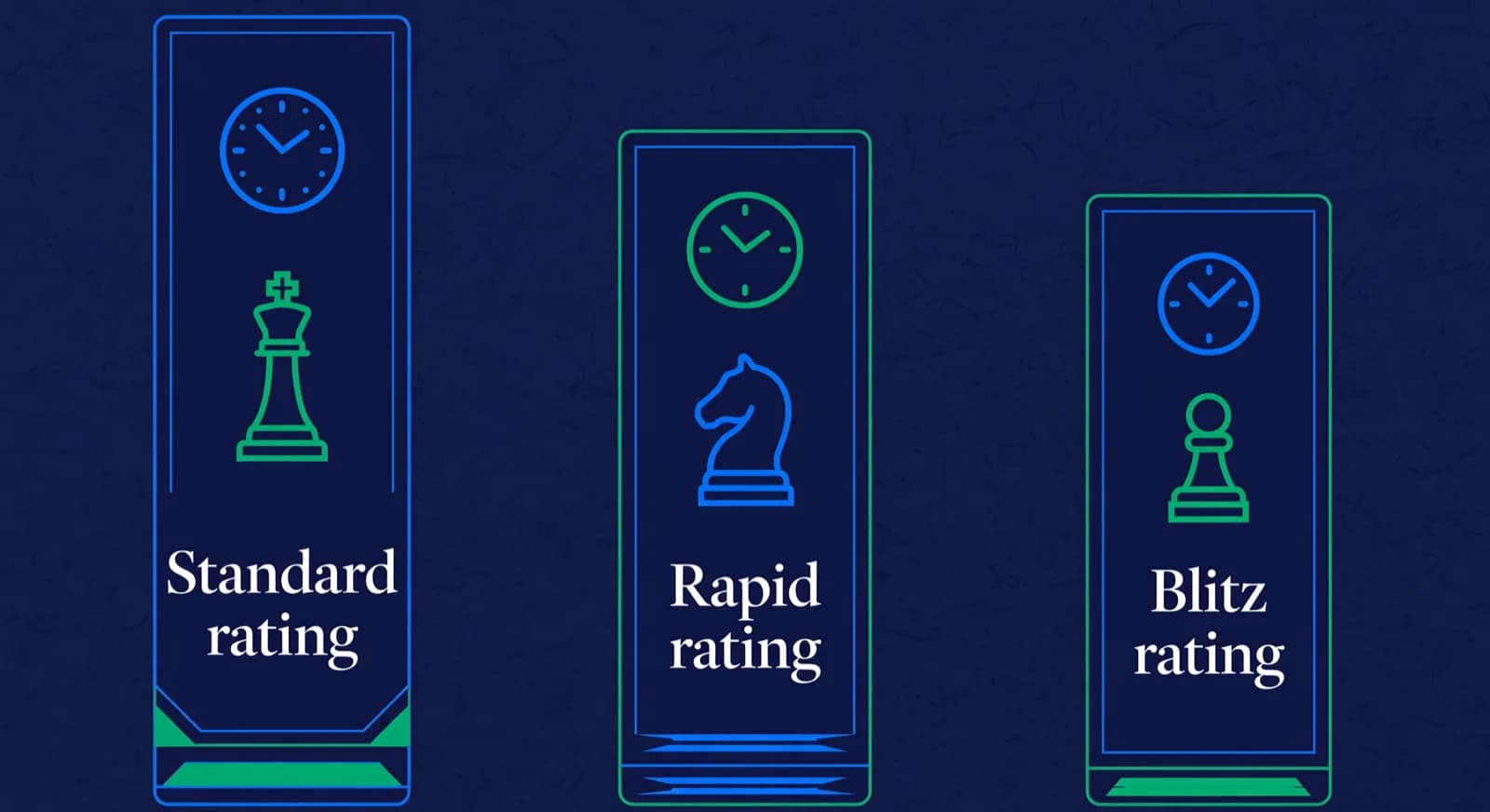
For Indian kids this matters in event selection. Rapid rated events are shorter days, cheaper to run, and more common as a first taste of rated chess; standard rated events are the long, two or three games a day weekenders that classical development eventually requires. A coach choosing a first event is really choosing which list the child starts on. There is no wrong answer, but parents should know which rating a given tournament feeds, because the brochure will state it and the lists never mix.
| Rating list | Typical game length | What it suits first |
|---|---|---|
| Standard | Several hours per game, often 1 or 2 games a day | Players ready for long days and full concentration |
| Rapid | More than 10 minutes and less than 60 minutes per player | A first rated experience without the marathon schedule |
| Blitz | More than 3 minutes and not more than 10 minutes per player | Experienced juniors; rarely the right first rated event |
When should a child start playing rated events?
A child should start when they are ready, not at a set age. The FIDE Rating Regulations effective from 1 March 2024 set no minimum age and publish year of birth on the list, so readiness decides the start date [7]. India has many rated players of primary school age. A rated classical tournament is a long, demanding day, and a bad first experience can sour a child on tournament chess for a year. The calendar should follow the child, not the other way round.
Readiness signals coaches actually look for: the child can sit through a full long game without leaving the board, records moves on a scoresheet without help, handles losing three games in a day without wanting to quit, and asks to play tournaments rather than being entered into them. A child who plays slow chess happily for ninety minutes at the academy is ready for a rapid rated event; a child who is fidgety after twenty is not, whatever their puzzle scores say. How scholastic chess events are organised is a useful bridge for families who have only seen school events so far.
The coach's role in the first events is mostly curation. A gentle field, a category section where the child will face peers rather than veterans, and a stated goal of finishing all rounds and recording every game cleanly. The result sheet is irrelevant the first few times out. Coaches who frame event one as data gathering rather than rating chasing get calmer kids, calmer parents, and better second tournaments. If a student later stalls, that is its own topic; our piece on the chess rating plateau covers what stuck ratings actually mean.
How do you check a rating once it is published?
Search the player's name or FIDE ID on ratings.fide.com, FIDE's official rating site. The profile shows the player's federation, FIDE ID, current standard, rapid, and blitz ratings, and a month by month history [10]. It is free, public, and the same source arbiters and organisers use, so it settles any dispute about what a player's real rating is.
Show parents how to do this lookup themselves once, and you remove a whole category of WhatsApp questions. The one caution: the site lists every player ever registered, including inactive ones and namesakes, so search by FIDE ID where possible. If the number has not appeared, check the two conditions from the first-rating section and whether the tournament ended in time for the next monthly list [7][10].
Lucas M. · first session to today
Every game, report, and payment on one timeline
Aug
Joined at 1240Nov
First tournamentJan
Back-rank drills setOct
1342 · October report drafted
When a rating does not appear, the cause is usually one of four, and each has a specific thing to check before you chase anyone. Work down the table rather than assuming the result was lost.
| Why it has not appeared | What to check | Who to ask |
|---|---|---|
| Not enough eligible games yet | Count games against already-rated opponents across events within 26 months; the rule is at least five [7] | The coach, from the player's game record |
| Calculation below the 1400 floor | A calculated initial rating under 1400 is not published [7] | The coach, who can estimate from the opponents faced |
| Looking at the wrong list | Standard, rapid, and blitz are separate; confirm which list the events fed [7] | The event brochures, which state the time control |
| Report not yet on the relevant list | A tournament must end at least three days before the list date, and the list is prepared on the first of the month [7] | The event arbiter or the state rating officer |
For academies, the pipeline in this post is one strand of a bigger operation: batches, fees, parent communication, and event calendars all have to run alongside it. Our pillar on starting a chess academy in India covers that full picture, the guide to chess academy fees in India covers what families typically budget around tournaments and coaching, and you can track a student's rating over a season on the rating tracker rather than screenshotting ratings.fide.com into a chat. All our chess academy in India guides sit on the same hub.
What is the checklist from registration to a first published rating?
Ten steps, in order, from registering with AICF to seeing the number on ratings.fide.com. Work through it in order, and expect several tournaments across several months between the first payment and the first published rating. This covers the individual player. Academy affiliation and running a rated event are separate processes with their own guides.
- Find your state chess association on AICF's affiliates page so you know who to ask about any extra state component [5].
- Gather a passport-size jpeg under 1MB, a birth certificate, and a unique email address. AICF's notice and its 2026-27 circulars list these for fresh registration [1][4].
- Register the player through the online-player-registration page on aicf.in. Existing players renew; new players use the fresh-registration link [1][2].
- Pay the current AICF player fee. Circulars for 2026-27 hosted on aicf.in state Rs. 300 per year; confirm the portal amount on the day you pay [3][4].
- Read the event brochure for any separate state fee and for the entry fee. AICF does not publish a national average for either. Do not copy a number from another state's circular.
- Pick a FIDE-rated event from AICF's all-events list. Confirm the FIDE event code, the time control, and which list (standard, rapid, or blitz) the brochure says it feeds [6].
- Keep the FIDE ID AICF issues when it registers the player. Search ratings.fide.com by that number, not by name [9][10].
- Play until you have at least five games against already-rated opponents. Unrated pairings and unplayed games do not count. Pool results across events within 26 months if one tournament is not enough [7].
- Wait for the monthly list. FIDE publishes on the first of the month; events must end at least three days earlier to make that cycle. A gap of weeks after the last round is normal [7].
- Look the player up on ratings.fide.com. If there is no number, go back to step 8 before chasing the arbiter. Then plan the next event from the trend, not from one weekend [7][10].
Frequently asked questions
How do I get my child a FIDE rating in India?
Register the child with AICF through aicf.in (online only since 1 September 2017), enter FIDE-rated tournaments from the AICF events list, and let them play at least five games against rated opponents until the calculated rating is 1400 or more. The rating then appears on ratings.fide.com on a monthly list. Expect the process to span several tournaments over several months. AICF does not publish a separate national Elo list; the rating families mean is FIDE's.
What is the minimum age for a FIDE rating in India?
The FIDE Rating Regulations effective from 1 March 2024 do not set a minimum age. They publish year of birth on the list. India has many rated players of primary school age. The practical constraint is readiness: rated classical events are long days, so most coaches start children with rapid rated events once they can sit through full games and record moves independently.
Why is my child's FIDE rating different from their online rating?
Because the pools are different. Online pools include casual players and fast games, while a FIDE rated event is a self-selected field of serious players at slower time controls, and an initial FIDE rating is anchored to results against established rated opponents. The two numbers sit on different scales and are not meant to match, so watch the trend over the first year on each list rather than comparing the starting points across lists.
How much does AICF registration cost?
AICF's financial regulations dated 26 March 2023 list Rs. 300 per year for player registration, and AICF-hosted 2026-27 circulars repeat Rs. 300. Checked 12 August 2026. An older 2021 AICF notice on single player registration on a pan-India basis still on aicf.in quotes Rs. 250 [15]; treat the 2026-27 circulars and the portal charge as current. AICF does not publish a combined schedule of extra state fees. Confirm on the registration portal and the event brochure before you pay.
Can I get a FIDE rating from online games?
Not from Chess.com or Lichess, and not by converting those platform numbers. FIDE Online Arena ratings do not feed the monthly over-the-board lists. Hybrid events can be rated only with Qualification Commission approval. In June 2026 FIDE announced an in-principle pilot with World Chess for some supervised online rapid and blitz play; that remains a proposed pilot. For an Indian player today, a published FIDE rating still comes from FIDE-rated over-the-board events.
Does a chess academy need AICF affiliation, and what does it cost?
No. AICF's amended constitution reserves affiliated membership for one recognised State Chess Association per State or Union Territory, so a private academy cannot become an affiliate, and you do not need affiliation to coach. What an academy actually arranges is player registration for its students, and, where the state provides for it, local club or academy recognition, plus event permission to host rated play. The charges are separate: player registration is Rs. 300 per year, while the Rs. 3000 annual subscription in the 26 March 2023 financial regulations is a State Chess Association subscription, not an academy franchise fee. Start with your recognised state association, found through aicf.in, and keep business and tax compliance on a separate checklist.
Sources
- [1]AICF: player and arbiter registration is online only from 1 September 2017 · accessed 2026-08-12
- [2]AICF online player registration page, linking the current portal · accessed 2026-08-12
- [3]AICF revised financial regulations (26 March 2023): player registration fees Rs. 300 per year · accessed 2026-08-12
- [4]AICF-hosted 2026-27 tournament circular stating AICF player registration fee Rs. 300 · accessed 2026-08-12
- [5]AICF affiliates directory: affiliated state associations and special units · accessed 2026-08-12
- [6]AICF all-events list: FIDE-rated tournaments with event codes and brochures · accessed 2026-08-12
- [7]FIDE Rating Regulations effective from 1 March 2024: five games, 1400 floor, monthly list · accessed 2026-08-12
- [8]FIDE Rapid and Blitz Rating Regulations effective from 1 March 2024 · accessed 2026-08-12
- [9]FIDE Regulations for Registration and Licensing of Players: a registered player acquires a FIN · accessed 2026-08-12
- [10]FIDE Ratings: official public lookup by name or FIDE ID · accessed 2026-08-12
- [11]Elo rating system (Wikipedia) · accessed 2026-08-12
- [12]FIDE Online Arena Rating Regulations: FOA ratings do not influence over-the-board lists · accessed 2026-08-12
- [13]All India Chess Federation (Wikipedia) · accessed 2026-08-12
- [14]FIDE and World Chess agree in principle to test a first over-the-board rating earned online (23 June 2026) · accessed 2026-08-12
- [15]AICF notice: single player registration on pan India basis, Rs. 250 shared with the state association (2021) · accessed 2026-08-12
- [16]FIDE confirmation that AICF is the affiliated national federation for India (7 February 2022, Annexure F) · accessed 2026-10-02
- [17]Amended AICF Constitution, 5 October 2022: affiliated members are the recognised State Chess Associations · accessed 2026-10-02
Written by Abhishek Tiwari
ChessCore
Drafted with AI, fact-checked and approved by a human before publishing, the same guardrail our product applies to every report it sends. Read our editorial standards.
Track every student's path to a first rating
ChessCore keeps registration details, event plans, attendance, and rating history on one student record, so parents see the trend and coaches plan the next event in seconds.
- Roster import from the spreadsheets you already keep
- Lichess and Chess.com connections, batches, and fee plans
- First reports in week one, after your approval
- Free plan, no credit card required