
On this page11 sections, 30 min read
- How do you organize a chess tournament from start to finish?
- Which tournament format should you choose: Swiss or round-robin?
- What venue and equipment do you need?
- How do you handle entries, registration, and seeding?
- How do you make the pairings and how many rounds do you need?
- What time control should you set for a tournament?
- What does the arbiter do, and do you need one?
- What changes if the event must be rated in India?
- How do you set prizes, entry fees, and a budget?
- How do you run the tournament day itself?
- How do you adapt this for a school or scholastic event?
- Frequently asked questions
Bottom line
To organize a chess tournament, decide the format and time control first, then handle venue and equipment, entries, pairings, the arbiter, prizes, and the running of the day in that order. We suggest the Swiss system for club and school events because it lets many players compete in a fixed number of rounds without elimination, and it produces a ranking by the final round.
TL;DR
- Choose the format before anything else: Swiss for large open fields, round-robin for small elite sections, knockout only when you want a fast spectator finish.
- The time control decides how many rounds fit in a day, so pick it early and build the schedule backward from your venue's closing time.
- Entries, seeding by rating, and clean pairings are the administrative spine of the event, and getting them right prevents most tournament-day disputes.
- An arbiter enforces the rules and signs off pairings and results; for rated events this role is required, and for casual events it is still worth appointing someone.
- Set prizes below your entry income so the event breaks even, and plan the day round by round so nothing waits on you between games.
Key facts
- The Swiss system pairs players with similar running scores each round and eliminates nobody, so a large field can be ranked in a fixed number of rounds rather than by knocking players out.[2]
- As a heuristic, many organizers run enough Swiss rounds that the field is at most two to the power of the rounds (about five rounds for 32 players). FIDE Swiss basic rules do not promise a unique first place; publish tiebreaks in advance.[2]
- FIDE, the international chess federation, publishes the Laws of Chess and the rating and title regulations that a rated tournament must follow.[1]
- FIDE Swiss basic rules C.04.1 define the pairing-allocated bye: when the field is odd, one unpaired player gets no opponent and scores as a win unless the regulations say otherwise, and a player may not receive a second one.[7]
- FIDE Laws Article 6.7.1 sets the default time to zero unless the event regulations specify otherwise, so a player who arrives after it loses the game unless the arbiter decides otherwise.[9]
How do you organize a chess tournament from start to finish?
Organizing a chess tournament is a sequence of decisions made in a fixed order: pick the format and time control, confirm the venue and equipment, open entries, seed and pair the field, appoint an arbiter, set prizes within budget, then run the day round by round. Do them in that order because each choice constrains the next. The format decides how many games each player plays, the time control decides how many rounds fit in the venue's hours, and only then can you publish a realistic schedule.
Most first-time organizers get this backwards. They book a hall and a date, print a poster, and only later discover that a classical time control plus seven rounds cannot physically fit into a single Saturday, or that they promised prizes larger than the entry fees will ever cover. The planning sequence below exists to catch those problems on paper, weeks before anyone arrives with a clock. Treat it as a checklist you complete in order, not a set of parallel tasks.
- Define the event: audience (club, school, open), section structure (one open section or age and rating groups), and the date.
- Choose the format (Swiss, round-robin, knockout, or team) and the number of rounds.
- Choose the time control, then build the day's schedule backward from the venue closing time.
- Confirm the venue and equipment: one board and set per two players, a clock per board, numbered tables, scoresheets, and a pairings display.
- Open entries, collect ratings, and set an entry fee that covers costs plus a small surplus.
- Appoint an arbiter and decide which ruleset applies (FIDE Laws of Chess or a local scholastic variant).
- Seed the field by rating, prepare round-one pairings, and set up the results and standings system.
- Publish prizes that stay within entry income, then run each round: pair, play, collect results, repeat.
This pillar walks through every step at the level a club, school, or academy organizer needs to run a smooth one-day or weekend event. The deeper mechanics live in focused companion guides: how the pairing math actually works, how to pick a time control, and the exact rules an arbiter enforces. Where a topic has its own guide, this page gives you the working answer and a link, so you can plan the whole event from here and drill in where you need to. For the full set, see all guides on organizing chess tournaments.
Which tournament format should you choose: Swiss or round-robin?
Choose the Swiss system for any open event with more than about a dozen players, a round-robin for a small section where you want everyone to play everyone, and a knockout only when you want a short spectator-friendly finish. The Swiss system is the default for club, school, and open tournaments because it lets a large field play a fixed number of rounds without anyone being eliminated, pairing players on similar scores together as the event goes on [2].
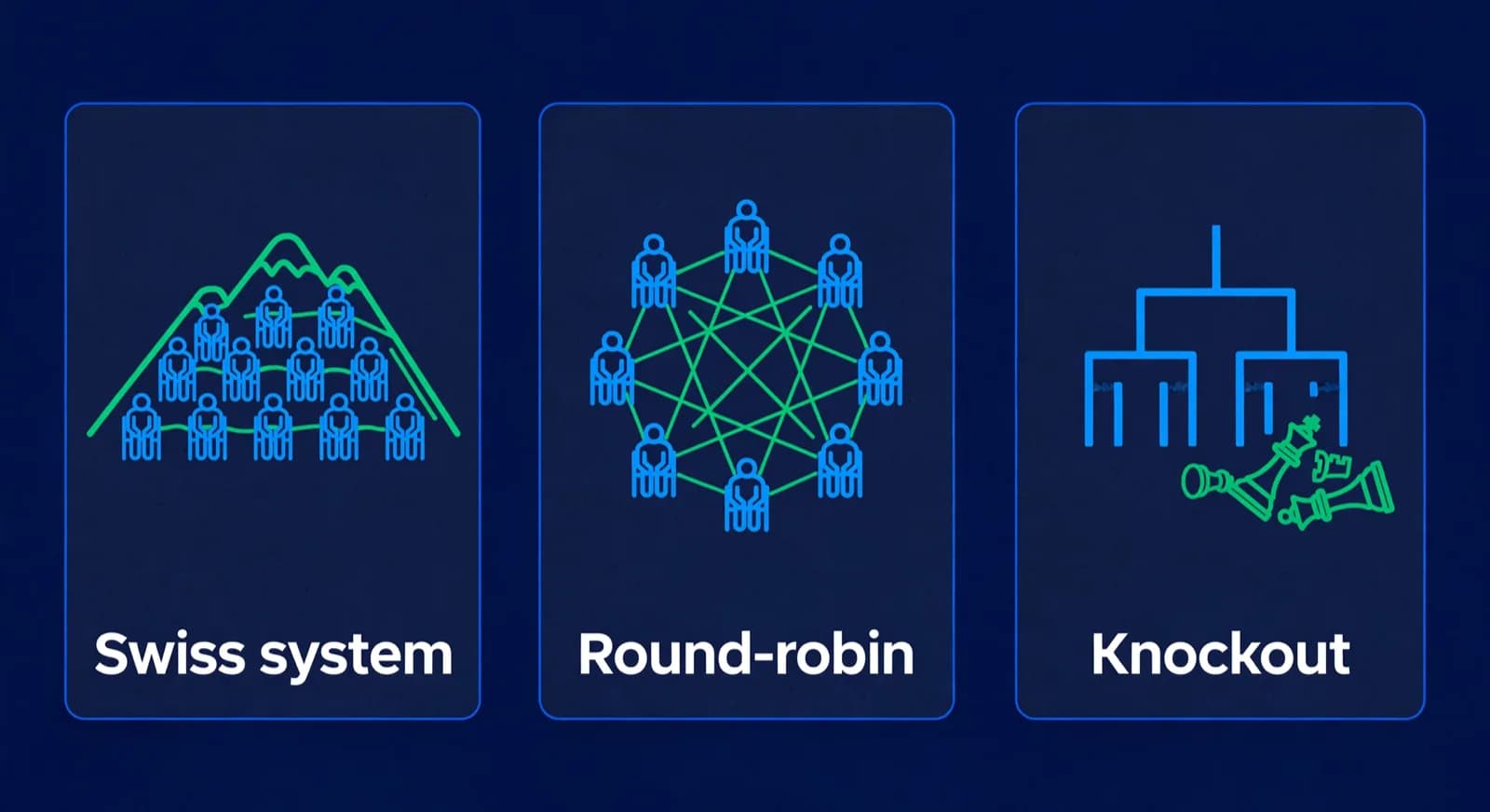
The reason Swiss dominates is simple arithmetic. A round-robin, where everyone plays everyone, is the fairest format but scales badly: ten players already means nine rounds, and thirty players will not fit in a weekend. A round-robin suits any small section, not only a strong one, when the field is small enough that a full set of games fits the schedule. A knockout is fast and dramatic but sends half the field home after a single game, which is fine for a spectacle and poor for a scholastic event where the point is that every child gets a full day of chess. The Swiss keeps everyone playing to the end and still produces a clear ranking, which is why it is worth understanding before you commit to a format.
| Format | How it decides a winner | Best for | Main limitation |
|---|---|---|---|
| Swiss system | Similar-score players paired each round; no elimination; most points wins | Large open events, clubs, schools | Pairings need software or a trained arbiter |
| Round-robin | Everyone plays everyone; most points wins | Small sections up to about ten players | Games grow fast; impractical above a dozen players |
| Knockout | Losers are eliminated each round until one remains | Fast, spectator-friendly finishes | Half the field is out after round one |
| Team | Board results add up for each club or school | Inter-school and league events | Needs equal squads and a fixed board order |
For most organizers reading this, the answer is a Swiss with age or rating sections layered on top: one open section plus, say, an under-1200 and an under-8 group, each running its own Swiss. That gives beginners a realistic shot at a prize without facing the strongest players every round. The mechanics of how the pairings are generated, why you cannot simply pair the top scorers against each other, and how colour balance and the score-group rules work are covered in depth in our guide to the Swiss system pairing explained, which is the companion to this section.
What venue and equipment do you need?
You need one board and set for every two players, a clock on each board if you are using clocks, one table per board with two chairs, numbered boards, scoresheets when notation is required, a few spares of each, and a notice board or screen for pairings and results. Those quantities come from ChessDotes' school-tournament checklist (October 2026) [6]. Confirm the hall hours and the seating plan before you publish the round times, because an equipment shortfall can make round one start late.
| Item | How much | Why it matters |
|---|---|---|
| Boards and sets | 1 per 2 players, plus a few spare [6] | A missing set delays the whole round |
| Clocks | 1 per board if you use clocks [6] | Uneven timing is an instant dispute |
| Tables and chairs | 1 table per board, 2 chairs [6] | Crowded boards produce illegal-move chaos |
| Scoresheets | 1 per player per round if notation is required [6] | Results arguments need a written score |
| Numbered boards and a results display | Every board numbered; pairings posted [6] | Players find games without a queue at one sheet |
| Sound system and certificates | As the hall and prize list require [6] | Announcements and a clean prize-giving |
Set the hall up the day before when you can: number the boards, test clocks, and print the registration list [6]. On the morning, the only equipment job left should be handing a late arrival a spare set. If you are borrowing school tables, walk the room once for sight-lines and noise, because a canteen next door will cost you more games than a missing increment.
How do you handle entries, registration, and seeding?
Handle entries by collecting each player's name, section, and rating in advance, closing registration before round one, and seeding the field from strongest to weakest by rating. The rating is the single most important field to capture, because a Swiss pairing seeds the whole event from it, turning a pile of entries into an ordered start list. Late or missing ratings are the most common cause of a chaotic first round.
Set an entry deadline a day or two before the event and treat it as real. Walk-in entries on the morning are the enemy of a clean start: every late addition forces you to redo the round-one pairings while a hall full of players waits. If you must accept on-the-day entries, cut them off at a hard time (say, thirty minutes before round one) and pair only once that window closes. Collect entries through one channel, whether a form, a spreadsheet, or a registration desk, so you are never reconciling three lists at eight in the morning.
Seeding matters for fairness. In a Swiss, players are listed by descending rating and the pairing system uses that order, so an unrated or wrongly rated player can distort the pairings and the prize outcomes. For unrated newcomers, assign a sensible estimate and note it, and for rated players collect the rating from the relevant federation list. If your event is meant to be officially rated, players must be registered with the national federation first; in India that pipeline runs through the All India Chess Federation before a game counts toward a FIDE rating [5].
How do you make the pairings and how many rounds do you need?
Pair with the Swiss rules and let the number of rounds follow the field size. The pairing mechanics themselves (how the seeded list is split, how equal-score players are matched, and how colours are balanced) are set out in full in our guide to Swiss system pairing. For planning, the working answer is the rounds heuristic: use enough rounds that the field is at most two raised to the power of the rounds, so 16 players often get four rounds and 32 get five [2]. It is a heuristic, not a guarantee of a unique first place, and FIDE's basic Swiss rules require the round count to be declared beforehand and do not promise a single winner on points alone [7].
That rounds heuristic is an easy calculation to get wrong, and a mistake cascades into everything else. Too few rounds and several players finish on the same score with no game having separated them, so you rank by the tiebreaks you already published. Too many rounds and you run out of daylight or exhaust a field of eight-year-olds. Work it out first: decide the field size you expect, pick the rounds from the table below as a starting point, and only then confirm the time control and the schedule. Our Swiss rounds calculator does this arithmetic for you and also suggests tiebreak orders.
| Players in a section | Rounds heuristic | Typical use |
|---|---|---|
| Up to 8 | 3 rounds | Small club or classroom event |
| 9 to 16 | 4 rounds | A one-day scholastic section |
| 17 to 32 | 5 rounds | A busy weekend open |
| 33 to 64 | 6 rounds | A district or city championship |
Byes and withdrawals need a written policy before round one, because an odd field and a last-minute dropout are the two ways pairings break. The full-point pairing-allocated bye, which goes to the unpaired player when the field is odd and cannot go to the same player twice, is defined by the FIDE Swiss rules and explained in full in our guide to Swiss system pairing [7]. What you own here is simpler: publish your requested-bye rule (half-point or zero-point, who may ask, and the deadline), and remove a withdrawn player from later pairings rather than pairing them and recording a forfeit after the fact.
Two practical points follow. First, decide tiebreaks in advance and print them on the entry information, because players will finish level and you do not want to invent a rule under pressure: common tiebreaks reward players who faced tougher opposition. Second, unless you are pairing a tiny event by hand, use pairing software or a trained arbiter, because manual Swiss pairing past a couple of rounds is slow and error-prone, and a single wrong pairing can compromise a rated result. Free platforms make small online events easy: a Lichess Swiss, for instance, handles pairing and standings automatically for a club running its event on the web [4].
What time control should you set for a tournament?
Set the time control from the hours you have and the number of rounds you need, not the other way around: a one-day multi-round event usually needs a rapid control (FIDE rates a game as rapid when each player has more than 10 but less than 60 minutes, counting the base time plus 60 increments), often a setting such as 15+10 or 25+10, while classical controls of an hour or more per player suit one or two games a day. The time control is the lever that decides whether your rounds fit the venue, so fix it early and build the schedule backward from closing time. Once you have the rounds and the control, plan the round times so the day fits the venue hours.
The arithmetic is unforgiving. A game can last up to twice the per-player time plus increments, so a 25-minute control means budgeting close to an hour per round once you add pairing, seating, and stragglers. Multiply that by your round count, add lunch, and compare it with the hours the venue is open. If it does not fit, you drop to a faster control or cut a round, and it is far better to discover that on paper than at four in the afternoon with two rounds still to play. Increments (a few seconds added per move) prevent the scrappy time-scramble finishes that upset children and produce disputes, so most modern events use them.
Rating type follows the time control: fast games are rated on a separate rapid or blitz list rather than the classical list, which matters if you want the event to count officially [3]. The full breakdown of standard controls, when to add an increment, and how to match the control to your audience and rating goal is in our guide to chess tournament time controls, which is the companion to this section.
What does the arbiter do, and do you need one?
The arbiter enforces the rules, approves each round's pairings, resolves disputes at the board, and signs off the final results, so yes, every serious event needs one, and rated events require a qualified arbiter by regulation. The arbiter is a different role from the organizer: the organizer runs the logistics and money, while the arbiter is the neutral authority on the Laws of Chess, which FIDE publishes and maintains [1].
For a casual club or classroom event you can act as both organizer and arbiter, but appoint the role explicitly and know the core rules cold, because disputes will happen: touch-move, illegal moves, clock handling, draw claims, and phone-in-the-room penalties are the everyday cases. For a rated open, a scholastic championship, or any event where prizes are large enough that people care, bring in a certified arbiter. Their neutrality is the point: when a parent disputes a result, the answer carries more weight from someone who is not also handing out the prizes.
- Approves the pairings each round and posts them, then starts the clocks on time.
- Rules on illegal moves, touch-move claims, and clock or notation disputes at the board.
- Applies the fair-play and electronic-device rules consistently across the hall.
- Confirms and records results, updates standings, and signs the final crosstable.
- Decides tiebreaks by the published rule when players finish level.
A well-briefed arbiter and a printed ruleset prevent almost every tournament-day argument. Decide before the event which rules apply and write them down. A rated event uses the FIDE Laws of Chess as the arbiter applies them; local beginner variations, such as gentler illegal-move handling for the youngest children, are a choice you can only make at an unrated event, and you should state the variation in the entry information so nobody is surprised. The exact rules an organizer must know, written for non-arbiters, are laid out in our guide to chess tournament rules for organizers.
What changes if the event must be rated in India?
An unrated school or club event needs only the planning above; a rated event in India adds a federation layer that you must arrange before round one. Rated means the results count toward official ratings, which runs through your state chess association and the All India Chess Federation before a game reaches a FIDE rating [5]. Treat the two paths as a branch: decide early whether you are running an unrated event or a rated one, because a rated event has registration, an approved ruleset, a qualified arbiter, an event code, and a reporting duty that an unrated event does not.
For every regulated step, write down the official source, the person responsible, and the evidence you will keep, then confirm the current requirement in writing with your state association or AICF before you publish any figure. The checklist below is the sequence; it deliberately does not print fee amounts, entry-fee caps, or a reporting deadline as current facts, because the AICF pages that carry those numbers are dated and disagree with each other (see the reconciliation below). Get the live figures from the federation in writing and record who told you and when.
| Step for a rated event | Official source to check | Keep as evidence |
|---|---|---|
| Contact the state chess association and register the event | State association, AICF affiliate list | Written confirmation of recognition |
| Register every player with AICF before round one | AICF Rules for Event [5] | Player registration records and IDs |
| Appoint an AICF or FIDE licensed arbiter | AICF event code letter [10] | Arbiter licence number |
| Obtain the event code and print it on the prospectus | AICF event code letter [10] | The allotment letter with the code |
| Follow the current fee and recognition rules | AICF financial regulations via aicf.in/downloads/ | Written confirmation of the current amounts |
| Submit the arbiter report, standings and backup files | AICF Rules for Event [5] and event code letter [10] | Dated proof of what you sent and when |
Two documents are worth reading in full before you plan a rated event. Our guide to how a player gets a FIDE rating in India explains the registration pipeline from the player's side and, in its section on AICF affiliation for an academy, covers the standing relationship your academy needs with the federation. Neither replaces written confirmation of the current fees and deadlines, which only AICF or your state association can give you for your specific event.
How do you set prizes, entry fees, and a budget?
Set prizes only after you have budgeted, and keep committed prizes plus fixed costs no higher than confirmed sponsorship plus entry income at a realistic turnout, so the event breaks even. The reliable method is to separate fixed costs (venue, arbiter) from per-player costs (refreshments, certificates), add any confirmed sponsorship, then set the entry fee and the prize fund so the sheet balances at the turnout you actually expect, not the one you hope for. A prize fund that is merely smaller than gross entry income does not prove the event breaks even, because fixed costs still have to be covered first.
The sheet below shows the shape of the arithmetic for a small one-day club event, using hypothetical US dollar inputs for illustration, not current market prices or federation fees. Substitute your own venue cost, turnout, fee, and any sponsorship; the method is the point, not the numbers. Columns separate what is fixed from what scales with each player, and the income side lists confirmed sponsorship and entry income separately so you can see which part is guaranteed before anyone turns up.
| Line (hypothetical USD) | Type | Per player | At 40 players |
|---|---|---|---|
| Venue and tables for one day | Fixed cost | 0 | 200 |
| Arbiter honorarium | Fixed cost | 0 | 125 |
| Refreshments and certificates | Per-player cost | 2 | 80 |
| Confirmed sponsorship | Committed income | 0 | 150 |
| Entry fee income, 15 per player | Entry income | 15 | 600 |
| Committed prizes (top three plus age groups) | Committed prize | 0 | 225 |
Always test a lower turnout before you commit. At 25 paid entries the income side is 150 sponsorship plus 375 in entries, which is 525, while costs are 325 fixed plus 50 in per-player spending plus the 225 prize fund, which is 600. That is a 75 shortfall, so a cautious organizer either caps the prize fund at the sponsorship plus a safe share of entries, or makes part of the prize fund conditional on a minimum number of entries and says so in the entry information. The point of the lower-turnout line is to decide the fallback on paper, not on the morning when a third of the expected field has not arrived.
Spread prizes across categories rather than piling everything on first place: a top-three overall plus best in each age or rating group means many more players go home with something, which is what brings them back next time. Trophies and certificates often matter more than cash at scholastic events, and they cost less. Whatever you choose, publish the full prize list before entries open so nobody feels the rules changed after they paid. The commercial software that handles registration, payment collection, and live standings for larger events is compared in our guide to chess tournament software.
How do you run the tournament day itself?
Run the day as a repeating loop: publish the pairings, seat the players, start the clocks together, collect results as boards finish, enter them into the standings, then generate and post the next round only when that round is complete. The whole art of running a smooth event is keeping that loop tight so players are never waiting on unfinished pairings, and so the last round finishes before the venue closes. Everything you planned on paper (format, rounds, time control, schedule, buffers) exists to make this loop run without drama.

Start the first round on time even if a couple of latecomers are still registering, because the whole schedule is downstream of round one and a fifteen-minute slip early becomes an hour by the end. Post pairings in two places (a printed sheet and, if you can, a screen or a shared link) so a crowd does not form around a single list. Number the boards clearly and seat the higher-rated player or the published home color as the rules require, so players find their game in seconds rather than wandering the hall.
Result collection is the step to plan most carefully, so make it deliberate. Have players report the result at a central desk and confirm it against the scoresheet, rather than trusting shouts across the room, because one wrong result poisons the next round's pairings. As each board finishes, enter the score immediately so the standings are always current. Pair the next Swiss round only after every result from the previous round is in, because those pairings depend on the latest standings, as the FIDE general handling rules for Swiss tournaments set out [8]. If a game runs long, the remedy is the buffer you built into the published schedule, not a mid-event cut to a later time control.
Between rounds, the organizer's job is logistics, not chess: keep the room settled, manage the noise for younger sections, handle the queue of parents with questions, and make sure the arbiter has what they need to rule quickly on any dispute. A good event feels calm precisely because the organizer has rehearsed the loop and pre-decided the exceptions (what happens on a no-show, a bye request, an illegal move, a tied final standing). Write those decisions on your one-page brief so you are reading an answer under pressure, not inventing one. When the final round ends, confirm the standings, apply the published tiebreaks, and hold the prize-giving promptly while families are still in the room.
For an academy running its own internal event, the tournament is one item on a busy season, and it has to slot around regular batches, exams, and holidays. Looking at the calendar that already shows the teaching week keeps the event from colliding with normal classes. In Demo Chess Academy, a made-up academy, Coach Elena checks Batch B2's usual Thursday slot before fixing the weekend dates, so nobody is double-booked. The round schedule and pairings themselves come from a Swiss tool or the arbiter.
Pre-decide the two exceptions that break a running day. First, a wrong result reported after the next round is already paired: the arbiter owns the call, the document to consult is your published results-correction deadline and the FIDE handling rules, and under those rules a correction notified after the pairing but before the next round ends affects the next pairing, while one notified later is applied after the tournament for rating only [8]. Do not quietly re-pair a round that is already playing. Second, the venue closing with a game still in progress: the organizer owns the venue problem, but the fix is the buffer and the fallback you set on paper, never cutting a running game's time control, which the arbiter will not allow mid-game. Extend the hall, move the last game to a side room, or apply your published unfinished-game rule. The exact rulings for touch-move, illegal moves, and disputed results are in our guide to chess tournament rules for organizers.
Lucas M. · first session to today
Every game, report, and payment on one timeline
Aug
Joined at 1240Nov
First tournamentJan
Back-rank drills setOct
1342 · October report drafted

Week of 12 October · all batches
0 conflictsMake-up credit · Mia G. · Sat 4:30 PM
Absent Thursday with notice · booked by Noor
Class reminders sent to 148 families
Timing changes update everyone at once
How do you adapt this for a school or scholastic event?
A school tournament uses the same spine as any event (format, time control, pairings, arbiter, results) but changes the priorities: participation and a good day for beginners come first, and competitive integrity, while still real, is calibrated to children rather than rated adults. That single difference drives every adaptation below. Where the earlier sections gave the general method, this one gives the parts that are different because your players are children, so a teacher or coach can run a one-day school event from the same page.
Start with sections. Group children into two or three bands so a six-year-old never faces a confident twelve-year-old: the simplest split is by school class or age, for example an under-8, an under-11, and an under-14 group, each its own small Swiss with its own pairings and prizes run in parallel in one room. Age is the default divider because it is objective and every parent understands it; where you have ratings, you can seed within a band so the first round is not a set of total mismatches, and where you have none, age alone is fine because the Swiss corrects mismatches after round one. Keep the number of sections small, because a section of four children finishes in an hour and then has nothing to do. Publish the sections and their cut-off date (for example age as of 1 September) in the entry information, and decide in advance whether a strong younger child may play up.
Pick the time control from the minutes you actually control, then check it with one formula so the units stay consistent. Per player the planning time is the base minutes plus the assumed moves times the increment seconds divided by 60; double it for both clocks. This is a planning figure, not a ceiling: a game can run past the assumed move count and keep earning increment, so no increment control guarantees the last board finishes by the bell. A whole-day plan might use 15+5 over an assumed 36-move game, which gives each player 18 minutes and budgets 36 minutes of clock a round; with a 4-minute transition a round slot is 40 minutes, so five rounds of play is 200 minutes, and a briefing, a lunch after round three and a short prize-giving fit a morning. A 60-minute after-school slot uses the same formula with smaller numbers and fits about two rounds. When the room must empty at a fixed bell, a labelled no-increment example is clearer because its clock budget has a ceiling: 10 minutes a player, no increment, means both clocks run at most 20 minutes, so two rounds plus a changeover and a contingency fit an hour.
Staff the room with one person clearly in charge as the lead arbiter, plus roughly one adult helper for every twenty to thirty children, drawn mostly from parents. The arbiter owns the rules and settles disputes; helpers run the mechanical work, a results desk collecting and entering scores so a round is never held up, a floor team watching for illegal moves and children who freeze, and a welcome desk that handles registration and becomes the lost-property and first-aid point. Give the floor team one instruction for disputes: do not rule yourself, raise a hand and call the arbiter, so every ruling comes from one consistent source. Keep young children in one supervised space between rounds, make sure at least one adult holds a first-aid qualification, and protect the arbiter from results entry, because an arbiter buried in a scoresheet cannot answer the queue of raised hands.
Agree registration, permissions and supervision with the school before inviting entries, and use the school's own forms rather than inventing your own. A friendly school event needs only a name, a class or section, and a parent contact the school holds; keep the fields short, because data-protection and consent rules differ between school systems. Use the school's own participation-permission slip, check its do-not-photograph list before the prize-giving, and follow its safeguarding policy for the adult-to-child ratio rather than quoting a universal one. Run a sign-out sheet at the welcome desk and release each child only to an adult on the school's collection list, with one named staff member responsible for any child not yet collected. Turning those steps into a one-row-per-task handoff table, naming the owner, the record it leaves and who to escalate to, is what stops a child falling between two adults.
Handle byes and absences with a policy published before round one. When the field is odd one child takes the pairing-allocated bye, which scores as a win and never goes to the same child twice, so rotate it; a child who misses a round simply sits it out and rejoins. A parent-requested bye is a separate, local choice: decide the deadline, the score (a common choice is half a point for a request before pairings and zero for a no-show) and a limit (one per child, none in the final round), and write it on the entry form. Keep the two kinds apart in your own notes so the automatic FIDE bye and your casual absence rule never get confused.
Finally, structure prizes to reward more than the single winner, because the day is judged on whether the nervous beginner who lost early still wants to come back. Give trophies or medals to the top three in each section, add spread-the-joy categories (best in each year group, best newcomer, most improved or best sportsmanship chosen by the arbiter), and give every participant a certificate so the child who scored half a point still goes home having achieved something. Publish the tiebreak rule on the entry sheet and beside the pairings before round one, explain it in language children follow, and at prize-giving show the published rule and the recorded results rather than inventing a standard after play. For the wider school context, see starting a school chess program and running a school chess club, and for how school sections and team events are structured, see scholastic chess explained.
Frequently asked questions
How do you organize a chess tournament for beginners?
Run a short Swiss event in age or rating sections so beginners play others near their level rather than facing the strongest players every round. Keep it to three or four rounds at a rapid time control with an increment, appoint one person as arbiter, and use a gentle scholastic variant of the rules for the youngest children (for example, softer handling of illegal moves). Award trophies or certificates across several categories so most players go home with something, and start round one on time so the whole day finishes before the venue closes.
What is the best format for a small chess tournament?
For a small field of up to about ten strong players, a round-robin where everyone plays everyone is the fairest format. For anything larger or more mixed, use the Swiss system, which lets a bigger field play a fixed number of rounds without eliminating anyone. Knockout is only worth using when you specifically want a fast, spectator-friendly finish and do not mind half the field going home after one game.
How many rounds should a chess tournament have?
Use the two-to-the-rounds figure as a heuristic, not a promise of a unique first place: 8 players often get three rounds, 16 four, 32 five, and 64 six [2]. FIDE Swiss basic rules require the round count to be declared in advance and do not guarantee a single winner on points [7]. Too few rounds leaves several players level, which is why you publish tiebreaks before round one. Too many exhausts the field or overruns the venue. Choose rounds from expected field size first, then pick a time control that fits that many complete rounds into the day, with a buffer so you are not pairing the next Swiss round while boards from the last one are still playing [8].
Do I need an arbiter to run a chess tournament?
For a casual club or classroom event you can act as both organizer and arbiter, but you should appoint the role explicitly and know the core Laws of Chess. For a rated event, a scholastic championship, or any tournament with meaningful prizes, bring in a qualified arbiter, whose neutrality matters when a result or a rule is disputed. The arbiter approves pairings, rules on disputes at the board, applies the fair-play rules, and signs off the final standings.
How do you run an online chess tournament?
Run an online event on a platform that handles pairing and standings automatically, such as a Lichess Swiss or arena, which pairs players, tracks scores, and enforces the clock without a manual arbiter. Set the section, time control, and round count in advance, share the join link with registered players, and enable the platform's fair-play measures. Online events remove venue and equipment costs and let players join from anywhere, though you lose the in-person supervision that young beginners often need.
Do you need a rating or federation affiliation for a school chess tournament?
No, a friendly school chess tournament needs no rating or federation affiliation; you can run it entirely in-house with your own age sections, published tiebreak and prizes. Affiliation matters only when you want games to count toward official ratings: in India that path runs through the All India Chess Federation, and internationally through FIDE-affiliated structures. For a one-day school event focused on participation, adopt FIDE's Laws of Chess as your rulebook for consistency, but you do not need to register the event to run it well.
Sources
- [1]FIDE Laws of Chess (E.I.01), effective from 1 January 2023 · accessed 2026-10-16
- [2]Swiss-system tournament · accessed 2026-07-01
- [3]FIDE (International Chess Federation) · accessed 2026-07-01
- [4]Lichess API and tournaments · accessed 2026-07-01
- [5]AICF Rules for Event (registration, reporting and entry-fee rules) · accessed 2026-10-16
- [6]How to organise a school chess tournament, ChessDotes · accessed 2026-10-02
- [7]FIDE Handbook C.04.1 Basic rules for Swiss Systems (effective 1 February 2026) · accessed 2026-10-16
- [8]FIDE Handbook C.04.2 General handling rules for Swiss Tournaments (effective 1 February 2026) · accessed 2026-10-16
- [9]FIDE Laws of Chess taking effect from 1 January 2023 · accessed 2026-10-16
- [10]AICF event code allotment (organizer instructions letter) · accessed 2026-10-16
- [11]FIDE Rapid and Blitz Rating Regulations, clause 1.1 rate of play (effective from 1 March 2024) · accessed 2026-10-16
Written by Abhishek Tiwari
ChessCore
Drafted with AI, fact-checked and approved by a human before publishing, the same guardrail our product applies to every report it sends. Read our editorial standards.
Plan your events around the teaching week
See how ChessCore keeps an academy's batches, attendance, and student records on one timeline, so you can plan an in-house event around the teaching week. Book a walkthrough.
- Roster import from the spreadsheets you already keep
- Lichess and Chess.com connections, batches, and fee plans
- First reports in week one, after your approval
- Free plan, no credit card required